
光芯屏端网

Search documents
凝聚集体智慧 助力支点建设
Xin Lang Cai Jing· 2026-02-02 21:08
Group 1: Core Insights - The Hubei Provincial Committee of the Chinese People's Political Consultative Conference submitted 25 collective proposals focusing on technology innovation, industrial upgrading, livelihood improvement, and ecological culture to support Hubei's strategic development as a key region in Central China [1] - The government report emphasizes the importance of the 14th Five-Year Plan period for Hubei's economic growth, setting a target of approximately 5.5% growth and promoting the integration of technological, industrial, and financial innovations [2] - Hubei is encouraged to implement a gradient climbing strategy for industries, focusing on consolidating existing trillion-yuan industry clusters while fostering emerging and future industries through specialized roadmaps [2] Group 2: Industry Development - Hubei aims to develop a trillion-yuan low-altitude economy by leveraging its unique advantages, including the establishment of a collaborative manufacturing industry for vehicles and aircraft, and supporting local electric vehicle companies in transitioning to flying car production [3] - The proposals include creating specific scenarios for low-altitude economic demonstration corridors, such as launching drone freight routes and establishing low-altitude tourism zones [3] Group 3: Cultural and Ecological Initiatives - The focus on the creative transformation of Hubei's cultural heritage and ecological advantages is highlighted, with suggestions to utilize digital technology and immersive performances to modernize cultural landmarks [4] - Proposals emphasize the importance of strengthening the research and dissemination of the Yangtze River civilization and converting ecological advantages into developmental benefits [4] Group 4: Social Welfare and Public Services - The Hubei Provincial Committee emphasizes addressing social concerns, particularly regarding the elderly and children, proposing initiatives for child-friendly city development and enhancing mental health services for youth [5] - Recommendations aim to optimize educational resource allocation in response to demographic changes, ensuring that public services are more inclusive and accessible [6] - The government report highlights the need to respond to new consumer demands, including emotional value, and suggests actions to enhance social stability and improve public welfare [6]
多领域组建合作联盟,长江中游城市群冲刺“第五极”
Di Yi Cai Jing· 2025-12-15 05:35
Core Viewpoint - The Yangtze River Middle Reaches Urban Agglomeration is striving to become the "fifth pole" of China's economy through collaborative efforts in various sectors such as transportation, technology innovation, healthcare, and public safety [2][4]. Group 1: Intellectual Property and Innovation - In the past five years, the Yangtze River Middle Reaches Urban Agglomeration has achieved over 337,500 effective invention patents [1][5]. - A cooperation agreement was signed among the intellectual property offices of Wuhan, Changsha, Nanchang, and Hefei to establish a collaborative development framework for intellectual property protection [2]. - The agreement includes the creation of a strategic research base for intellectual property, a cross-regional enforcement mechanism, and a one-stop service for patent pre-examination and rights protection [2]. Group 2: Transportation and Logistics - A multi-modal transport enterprise alliance was established to enhance collaboration among key ports and logistics companies, aiming to improve shipping efficiency and reduce logistics costs [3]. - The alliance will focus on tailored logistics solutions for key industries such as automotive, chemicals, and grain, promoting a modernized port cluster [3]. - Future plans include optimizing intercity container services and creating a "water bus" network to facilitate better connectivity among ports [3]. Group 3: Regional Economic Development - The Yangtze River Middle Reaches Urban Agglomeration spans Hubei, Hunan, and Jiangxi provinces, contributing over 12 trillion yuan to the national economy, with GDP expected to exceed 14 trillion yuan this year [5]. - The region is characterized by a multi-center, multi-level spatial structure that supports collaborative development among cities, enhancing its position in the national economic landscape [5]. - The agglomeration is expected to develop new growth poles in advanced manufacturing, green energy, and modern logistics, further strengthening its innovation capabilities [5].
地方政府与城投企业债务风险研究报告:湖北篇
Lian He Zi Xin· 2025-12-01 11:03
1. Report Industry Investment Rating No relevant content provided. 2. Core Viewpoints of the Report - Hubei Province has an important transportation position, obvious resource endowment advantages, and its economic aggregate and per capita GDP rank among the top in the country. The provincial government's debt burden has increased but remains at a relatively low - medium level nationwide. Debt resolution work is advancing steadily, and the debt risks of urban investment enterprises are generally controllable [4][5]. - The "one - main, two - deputy" regional economic pattern in Hubei is stable, with significant differences in the economic development levels of different cities and prefectures. The general public budget revenue of each city and prefecture has increased year - on - year, but the fiscal self - sufficiency ability is generally weak [4]. - After the introduction of a package of debt resolution plans in 2024, the issuance volume and scale of urban investment bonds in Hubei decreased significantly year - on - year. In 2025, the issuance scale increased year - on - year, but the bond financing of most cities and prefectures showed a net outflow [6]. 3. Summary According to the Directory 3.1 Hubei Province's Economic and Fiscal Strength 3.1.1 Economic Development Status - Hubei has an important transportation position and rich resources. It is a comprehensive transportation and communication hub in central China. The province has abundant water energy, mineral, tourism, and education resources. During the 14th Five - Year Plan period, it will invest 820 billion yuan in comprehensive transportation construction [7]. - The permanent population has slightly decreased, and the urbanization rate is slightly lower than the national average. In 2024, the GDP and per capita GDP ranked 7th and 9th in the country respectively, and the GDP growth rate was 5.8%. In the first half of 2025, the GDP growth rate was 6.18%, higher than the national average [9]. - The industrial structure is continuously optimized, with the service industry remaining dominant. Traditional industries are stable, and strategic emerging industries are developing rapidly. The "Optical - Chip - Display - Terminal - Network" industry cluster centered in Wuhan East Lake High - tech Zone is expected to reach a trillion - level scale [11]. - Policies such as the "14th Five - Year Plan for the Development of the Middle Reaches of the Yangtze River Urban Agglomeration" and the "Wuhan Metropolitan Area Development Plan" are beneficial to Hubei's economic development. Since 2025, Hubei has introduced a series of policies to promote economic development [14][18]. 3.1.2 Fiscal Strength and Debt Situation - General public budget revenue ranks in the middle in the country, with a low fiscal self - sufficiency rate. In 2024, it was 393.788 billion yuan, ranking 11th in the country. From January to June 2025, it was 235.334 billion yuan, a year - on - year increase of 7.6% [21]. - Government - funded revenue was basically the same as the previous year, and the contribution of land use right transfer fees increased. The scale of superior subsidy revenue is large, and the comprehensive financial strength ranks in the middle - upper reaches of the country. In 2024, the superior subsidy revenue was 561.319 billion yuan, ranking 3rd in the country, and the comprehensive financial strength ranked 8th [22][26]. - The overall debt burden is at a relatively low - medium level nationwide. At the end of 2024, the local government debt balance was 1,858.61 billion yuan, a year - on - year increase of 18.95%. The debt ratio and debt - to - GDP ratio increased by 14.12 and 2.97 percentage points respectively [29]. - Hubei strictly implements the debt resolution plan, focusing on "three - asset" reform and actively seeking replacement bond quotas. It has completed the task of exiting financing platforms ahead of schedule, and the debt resolution work is advancing steadily [30]. 3.2 Economic and Fiscal Strength of Each City and Prefecture in Hubei Province 3.2.1 Economic Development of Each City and Prefecture - The "one - main, two - deputy" regional economic pattern is stable, and the economic development levels of different cities and prefectures vary significantly. Wuhan has a strong population siphon effect. Huangshi, Xiaogan, and Jingmen have relatively fast GDP growth rates [33]. - Different regions have different industrial characteristics. The "Han - Xiao - Sui - Xiang - Shi" region has a developed automobile - related industry, and the "Yi - Jing - Jing" region has a well - developed chemical industry. Emerging industries such as the "Optical - Chip - Display - Terminal - Network" in Wuhan are developing rapidly [38]. - In 2024, Huangshi, Xiaogan, and Jingmen had relatively fast GDP growth rates. In the first half of 2025, Shiyan and Jingmen ranked among the top two in terms of GDP growth rate [40][41]. 3.2.2 Fiscal Strength and Debt Situation of Each City and Prefecture - In the first half of 2025, the general public budget revenue of each city and prefecture increased year - on - year. Xiaogan, Shiyan, Huanggang, and Huangshi had relatively fast growth rates, while Wuhan had a slower growth rate [44]. - Affected by the real estate market, the government - funded revenue of some cities and prefectures decreased year - on - year. The government - funded revenue of different cities and prefectures showed a differentiated trend [48]. - The government debt balance of each city and prefecture has increased, and the debt - to - GDP ratio has risen. The debt resolution ideas of each city and prefecture are consistent with the provincial level, and various debt resolution measures have been taken [51]. 3.3 Debt - Repayment Ability of Urban Investment Enterprises in Hubei Province 3.3.1 Overview of Urban Investment Enterprises - Bond - issuing urban investment enterprises in Hubei are mainly at the prefectural and district - county levels. Wuhan has the largest number of bond - issuing urban investment enterprises, accounting for 25.22% of the province. High - credit - rated urban investment enterprises are mainly concentrated in Wuhan [56]. 3.3.2 Bond - Issuing Situation of Urban Investment Enterprises - In 2024, the number and scale of bond issuances by urban investment enterprises in Hubei decreased significantly year - on - year. From January to September 2025, the bond - issuing scale increased year - on - year, but the overall bond financing showed a net outflow [57][59]. 3.3.3 Debt - Repayment Ability Analysis of Urban Investment Enterprises - As of the end of 2024, the debt of bond - issuing urban investment enterprises in Hubei was mainly in the form of bank loans and bonds. The overall debt burden of urban investment enterprises in Ezhou and Wuhan is relatively heavy [63]. - As of the end of June 2025, most cities and prefectures' urban investment enterprises had a slightly improved cash - to - short - term - debt ratio, but there was still significant short - term debt - repayment pressure in Suizhou, Enshi, and Ezhou [68]. 3.3.4 Support and Guarantee Ability of Fiscal Revenue of Each City and Prefecture for the Debt of Bond - Issuing Urban Investment Enterprises - The scale of "total debt of bond - issuing urban investment enterprises + local government debt" in Wuhan is the largest, followed by Xiangyang, Yichang, Jingzhou, and Huangshi. Except for Shennongjia Forestry District and Enshi Prefecture, the ratio of "total debt of bond - issuing urban investment enterprises + local government debt" to comprehensive financial resources in other cities and prefectures exceeds 250% [74].
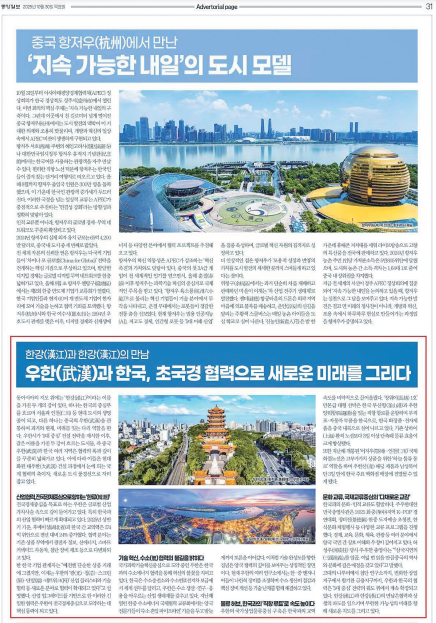
韩国中央日报聚焦武汉汉江与汉江相遇:武汉与韩国跨国合作共绘新图景
Chang Jiang Ri Bao· 2025-10-31 14:59
Core Insights - The article highlights the deepening cooperation between Wuhan, China, and various regions in South Korea, focusing on the development of a modernized Wuhan as a national economic center through international collaboration [3][4]. Economic Cooperation - Wuhan aims to become a national economic center by integrating into global industrial chains, with bilateral trade between Hubei Province and South Korea projected to reach 17.4 billion yuan by mid-2025, marking a 24% year-on-year increase [3][4]. - The collaboration has shifted from traditional trade to new sectors such as optoelectronics, new energy, smart connected vehicles, and high-end equipment manufacturing [4]. Technological Innovation - The partnership in technology innovation is emphasized, with Wuhan and South Korea collaborating on hydrogen energy, where South Korea leads in hydrogen stations and fuel cell vehicles [4]. - Wuhan has established a comprehensive hydrogen energy industry chain, and joint efforts in research and development are evident, as seen in the discussions at the China-South Korea Hydrogen Energy International Cooperation Conference [4]. Logistics and Trade - The logistics capabilities of Wuhan as a national commercial logistics center have significantly improved, exemplified by the direct shipping route between Busan and Wuhan, which saves three days compared to previous routes [5]. - The introduction of the "Ezhou-Incheon" international cargo route has further enhanced the efficiency of transporting high-value goods, allowing for rapid market response [5]. Cultural Exchange - Cultural interactions between Wuhan and South Korea are increasingly vibrant, with various events promoting mutual understanding and friendship, including K-POP competitions and ceramic art exhibitions [6]. - The activities span multiple sectors, including economy, education, culture, sports, and tourism, enriching the relationship between the two regions [6].

湖北99人获全国劳动模范和先进工作者表彰 半数左右来自武汉地区
Chang Jiang Ri Bao· 2025-04-29 00:20
Group 1 - A total of 99 individuals from Hubei were recognized as national labor models and advanced workers, with approximately half from the Wuhan area [1] - The awards ceremony was part of the celebration for the 100th anniversary of the All-China Federation of Trade Unions, marking the 17th national recognition of labor models and advanced workers since the founding of New China [1] - The awardees represent a diverse range of industries, focusing on grassroots and frontline workers, highlighting their contributions to high-quality economic and social development in Hubei [1] Group 2 - Labor models from the Wuhan area are primarily concentrated in infrastructure sectors such as railways, bridges, and electricity, as well as manufacturing industries like automotive, machine tools, and shipbuilding [2] - Many of the recognized individuals hold advanced engineering or technician qualifications, indicating a strong presence of high-skilled talent that supports the development of a nationally influential technology innovation hub [2]