关键矿物

Search documents
刘丹:与中国合作,加拿大少点“护栏”思维
Xin Lang Cai Jing· 2025-12-24 22:54
Group 1 - Canadian Prime Minister Carney emphasizes the need to diversify trade partnerships beyond the U.S. to reduce dependency, particularly highlighting China as a key market for Canadian resources [1][3] - The Canadian government's "guardrails" policy reflects a balance between strategic anxiety and economic interests, aiming to protect national security while seeking new growth opportunities [1][2] - Canada faces significant economic pressure from U.S. tariffs on key industries, prompting a search for alternative markets, with China being a primary target for exports in sectors like oil, gas, and agriculture [1][3] Group 2 - There is a notable divide within Canada regarding its policy towards China, reflecting a struggle between economic rationality and political bias, with some advocating for stronger ties while others push for a more confrontational stance [3][4] - The Canadian government is attempting to reset relations with China through dialogue and cooperation, as evidenced by recent high-level communications and trade discussions [3] - The potential for collaboration in areas such as energy transition, green technology, and climate change exists, indicating mutual benefits that transcend security concerns [2][4] Group 3 - The Canadian approach to defining "critical areas" like artificial intelligence and key minerals is influenced by U.S. perspectives, which may hinder Canada's ability to engage in global technological innovation [2] - Domestic pressures from agricultural and resource-rich provinces are pushing for renewed economic cooperation with China, contrasting with the federal government's more cautious stance [3] - For healthy development of Sino-Canadian relations, Canada is encouraged to adopt a pragmatic attitude and move away from ideological biases, recognizing China's peaceful development as an opportunity rather than a threat [4]
Stardust Power Inc.(SDST) - 2025 Q3 - Earnings Call Transcript
2025-11-13 23:30
Financial Data and Key Metrics Changes - As of Q3 2025, the company had cash and cash equivalents of $1,600,000, an increase from $900,000 as of December 31, 2024 [41] - The net loss for Q3 2025 was $4,500,000, which is a decrease of $5,600,000 year-over-year, primarily due to reduced expenses related to the business combination [42] - The loss per share improved to $0.53 for Q3 2025 compared to $2.23 in the prior year quarter [43] Business Line Data and Key Metrics Changes - The company is currently pre-revenue as it has not yet commenced commercial production of battery-grade lithium carbonate [40] - The Muskogee refinery is designed to have a Phase one capacity of 25,000 metric tons per year of battery-grade lithium carbonate, expandable to 50,000 tons in Phase two [22] Market Data and Key Metrics Changes - The lithium market has begun to stabilize following earlier corrections, with prices improving modestly as inventories normalize [13] - A North American lithium pricing environment is forming, which is beginning to separate from traditional benchmarks in China, Japan, and Korea [14] Company Strategy and Development Direction - The company aims to build a secure American domestic supply chain for battery-grade lithium, aligning with U.S. policy objectives [6] - The focus is on aggregating and unlocking lithium supply that might not otherwise reach the market, emphasizing onshoring critical minerals [7] - The company is actively securing feedstock through agreements with upstream partners, such as Prairie Lithium and Mandrake Resources [18][19] Management's Comments on Operating Environment and Future Outlook - Management highlighted the strong demand for lithium driven by electric vehicles and energy storage, with expectations for continued growth [7] - The geopolitical landscape and U.S. policy actions reinforce the need for a secure domestic critical mineral supply chain [9] - The outlook for lithium remains strong, with steady pricing recovery anticipated through 2026 [14] Other Important Information - The company completed a one-for-ten reverse stock split to maintain its NASDAQ listing [31] - Significant progress has been made in project finance, with independent engineers' validation of the FEL3 nearing completion [32] Q&A Session Summary Question: Additional color on government financing conversations - Management confirmed ongoing discussions with the government regarding equity investments and support for onshoring processing capacity [47] Question: Liquidity options to maintain the balance sheet - Management indicated multiple options for raising capital, including increased volume since summer and limited non-project capital costs moving forward [48][49] - Operational costs are expected to remain similar to current levels, with a focus on running a lean operation [51]
突然大跌!特朗普宣布:新关税来了
Zhong Guo Ji Jin Bao· 2025-08-23 15:54
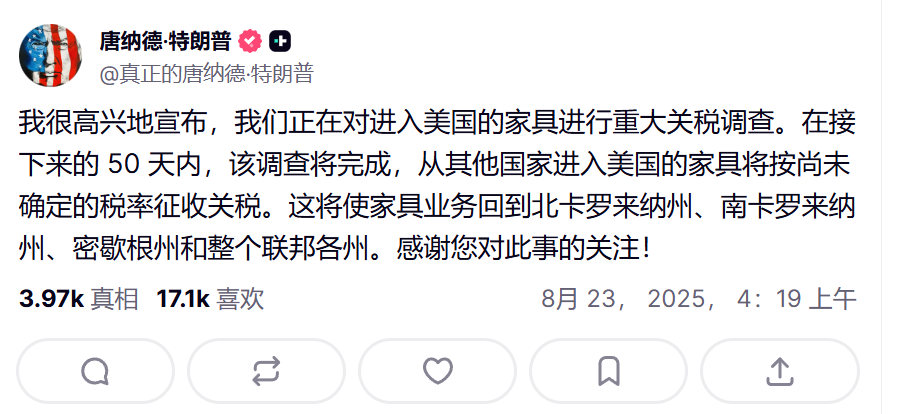
Group 1 - The U.S. is conducting a significant tariff investigation on imported furniture, with potential tariffs to be determined within 50 days [1] - Following the announcement, stock prices of several U.S. furniture retailers dropped significantly, with Wayfair down 10%, RH down 9.9%, and Williams-Sonoma down 6.7%, while La-Z-Boy, which primarily produces furniture in North America, saw a 3% increase [2] - The investigation is part of a broader inquiry under Section 232 of the Trade Expansion Act, which allows tariffs on goods deemed critical to national security, with results expected within 270 days from the start date of March 10 [5] Group 2 - The Trump administration has also initiated a national security investigation into wind energy imports, reflecting ongoing scrutiny of various industries including steel, aluminum, copper, and automobiles [6]

美国的九大关税
Hu Xiu· 2025-07-19 02:31
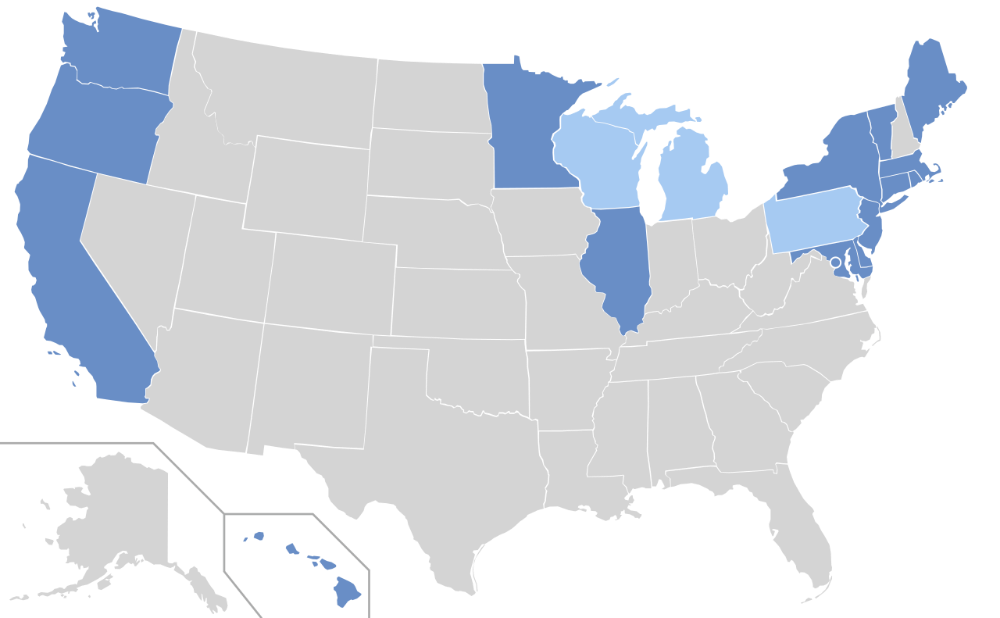
Core Viewpoint - The article discusses the impact of Trump's tariffs, particularly the nine industry-specific tariffs based on national security concerns, which are more stringent than reciprocal tariffs based on trade deficits [1][3]. Group 1: Steel and Aluminum - Trump announced a 25% tariff on steel and a 10% tariff on aluminum in 2018, which were later reinstated and increased to 50% in 2025 [4][6][7]. - The tariffs primarily target Canada, which accounts for over 20% of U.S. steel imports and nearly half of aluminum imports, followed by the EU and Japan [9]. - The tariffs have significant political implications, especially in key swing states like Wisconsin, Michigan, and Pennsylvania, which are crucial for elections [13][14][15]. Group 2: Copper - A 50% tariff on copper was announced, affecting various copper products, with the U.S. relying on imports for about half of its copper needs [16][17]. - Chile is a major copper supplier, contributing to a quarter of global supply, while China and other Asian countries hold significant copper reserves [18][19]. Group 3: Automotive and Parts - A 25% tariff on imported cars and parts was implemented, impacting a market where the U.S. imports over $300 billion worth of vehicles annually [22][23]. - The primary countries affected include Mexico, Japan, South Korea, Germany, Canada, and the UK, with Mexico being the most impacted [24][25]. - The tariffs are expected to influence U.S. automakers significantly, as they rely heavily on imported parts, with nearly 60% of parts being imported [25][32]. Group 4: Commercial Aircraft and Jet Engines - The U.S. imports more commercial aircraft and jet engines than it exports, with a trade deficit of $33 billion in 2024 [40]. - Nearly 50% of these imports come from the EU, with significant contributions from Canada and the UK [41]. Group 5: Wood Products - The U.S. is investigating tariffs on imported wood products, citing national security concerns due to military construction needs [43][45]. Group 6: Pharmaceuticals - The U.S. imports about 80% of its generic drugs and half of its brand-name drugs, with significant imports from Ireland and China [46][48]. - The U.S. has raised concerns about trade imbalances with Ireland, where many pharmaceutical companies have established operations [48]. Group 7: Semiconductors - The semiconductor industry is under scrutiny for potential tariffs, as the U.S. imports $200 billion more in semiconductors than it exports [51]. - Major suppliers include mainland China, Taiwan, and Mexico, with a significant reliance on foreign production [52]. Group 8: Critical Minerals - The U.S. is heavily reliant on imports for critical minerals, with 12 out of 50 minerals fully imported and 28 more than half imported [53][54]. - South Africa and Canada are the largest suppliers, while China dominates the rare earth imports [55]. Group 9: Manufacturing Employment - The article notes a decline in U.S. manufacturing jobs from 17 million to 13 million over the past 30 years, with tariffs aimed at bringing jobs back to the U.S. [58]. - The transition of supply chains is complex and varies by industry, with manufacturing sectors like automotive facing longer timelines for relocation [59][60].