
具身智能产业

Search documents
新春走基层丨北京亦庄的速度和磁场
Ren Min Ri Bao· 2026-02-28 01:56
Group 1 - The "Embodied Tian Gong 3.0" has been released, and the champion of the first robot half-marathon is training intensively, with expectations for significant performance improvements [1] - The Beijing Economic-Technological Development Area (亦庄) is witnessing a vibrant atmosphere of innovation and hard work, with a focus on various strategic emerging industries [1] - The area has gathered 2,386 national high-tech enterprises and 190 national-level specialized and innovative "little giant" companies, accelerating the transition of advanced technologies from laboratories to production lines [1] Group 2 - Beijing Yizhuang has attracted over 700 enterprises in the trusted innovation sector, covering the entire industrial chain from chips to terminal devices, achieving nearly 100% completeness [2] - The "cluster development" model has become the norm, facilitating rapid technology transfer through a full-chain pathway from laboratories to industrialization bases [2] - The Zhuque-3 reusable rocket is preparing for its second-quarter recovery and reuse test, having gathered valuable data from its previous flight, marking a significant step forward in commercial aerospace [2]
动画组图|盘点2025中国经济:举多元之力 绘发展新篇
Zhong Guo Jing Ji Wang· 2025-12-31 01:52
Group 1 - In 2025, China's economy is expected to demonstrate resilience and accelerate growth across various sectors, including event economy, embodied intelligence, and social welfare [1] - The event economy will play a significant role in driving domestic demand and promoting consumption upgrades, connecting various consumption chains from international to grassroots events [1] - The embodied intelligence industry is set for critical growth in the next 3 to 5 years, supported by increasing policy backing and integration into multiple sectors [1] Group 2 - The inbound tourism market in China is heating up, with foreign visitors contributing to new consumption growth and enhancing China's image as an open and vibrant country [2] - The A-share market has surpassed a total market value of 100 trillion yuan, with the Shanghai Composite Index reaching a 10-year high, indicating improved investor confidence and market resilience [2] - The concept of "good housing" has gained traction, reflecting the public's desire for safe, comfortable, and green living spaces, which will drive the construction industry towards sustainable practices [2] - The integration of domestic and foreign trade is accelerating, with significant progress in policies that support the formation of a strong domestic market and higher levels of openness [2]
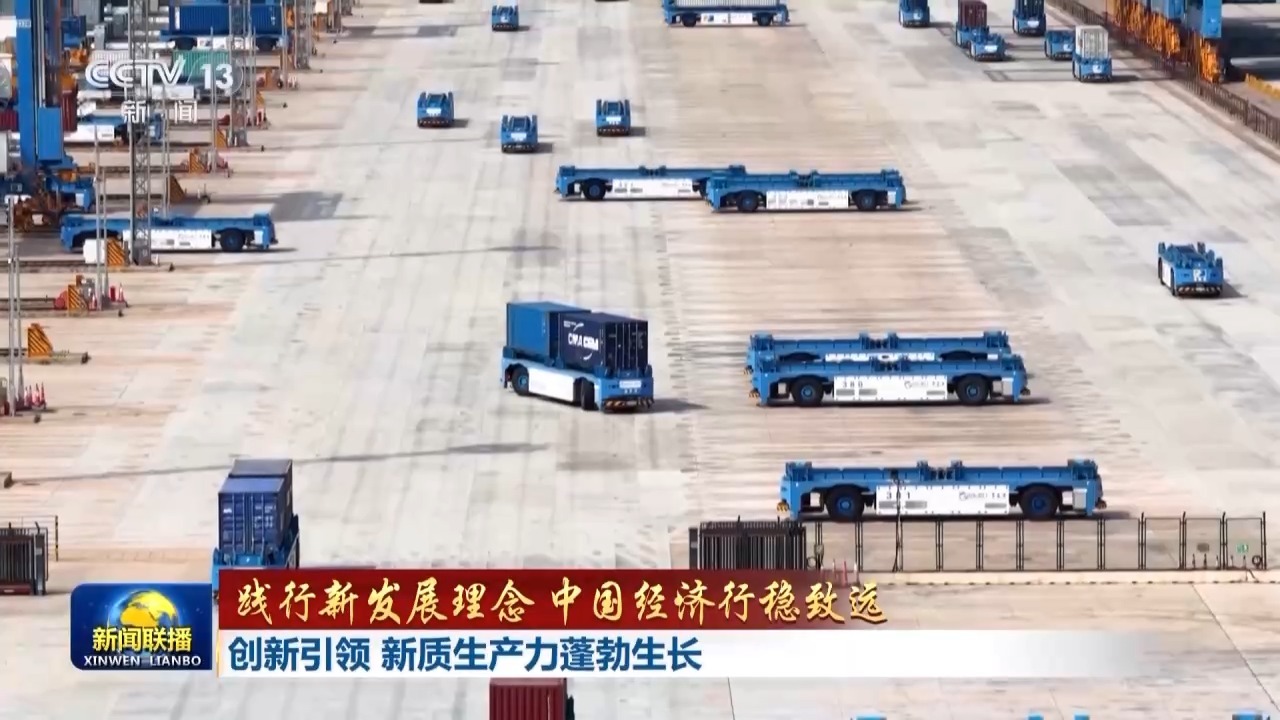
践行新发展理念 中国经济行稳致远|创新引领 新质生产力蓬勃生长
Yang Shi Xin Wen Ke Hu Duan· 2025-12-08 01:09
Core Viewpoint - The year 2025 is pivotal for China's economic development, marking the end of the "14th Five-Year Plan" and the beginning of the "15th Five-Year Plan," with a focus on high-quality growth and technological innovation [2][26]. Group 1: Technological Innovation - The emergence of new productive forces is transforming China through rapid technological advancements, with over a hundred large models integrated into various industries [2][6]. - Significant breakthroughs in technology include the successful testing of the CR450 high-speed train at 400 km/h and advancements in space exploration and energy extraction [6][12]. - The development of artificial intelligence and quantum technology is prioritized, with a national AI framework established to guide future innovations [10][12]. Group 2: Economic Growth and Structure - China's high-tech manufacturing sector saw a 9.3% year-on-year increase in value added, with exports of electric vehicles, photovoltaics, and lithium batteries experiencing double-digit growth [17][20]. - The integration of new industries, such as biomanufacturing and embodied intelligence, is expected to significantly contribute to the economy, with the latter projected to capture nearly 30% of the global market [17][19]. - Traditional industries are undergoing transformation through digitalization and the adoption of new technologies, leading to increased energy efficiency and reduced emissions [20][24]. Group 3: Policy and Strategic Initiatives - The Chinese government is implementing reforms to enhance the economic and technological systems, aiming to create a high-standard market environment [10][15]. - A series of strategic initiatives are being launched to foster innovation and support the development of new productive forces, including talent cultivation in key sectors [10][12]. - The focus on localized development of new productive forces is emphasized, aligning with the broader national strategy for sustainable economic growth [26].

合肥量子产业综合实力全球第二,请看《浪尖周报》第36期
Xin Lang Cai Jing· 2025-08-10 08:15
Core Insights - The "Wave Peak Plan" aims to promote industrial collaboration and technological innovation in the Yangtze River Delta region [1] - The "Wave Peak Weekly: Yangtze River Delta Industrial Dynamics" focuses on the latest industrial developments in nine trillion GDP cities, highlighting 181 key news articles and leadership activities from August 4 to August 10, 2025 [1] Industry Highlights - Hefei's quantum industry ranks second globally in comprehensive strength [2] - Shanghai targets a production value of over 50 billion in the embodied intelligence industry within three years [2] - Nanjing's software industry grew by 5.9% in the first half of the year, approaching a trillion [2] - Hangzhou unveiled the world's first brain-like computer with 2 billion neurons, named "Wukong" [2] - Suzhou's Kunshan signed a 15.1 billion project in the embodied intelligence sector [2] - Ningbo has 104 champion enterprises leading the advanced manufacturing sector [2] - Wuxi's Binhu District aims to complete the intelligent transformation of industrial enterprises by 2027 [2] - Nantong's satellite smart factory has achieved mass production and launch of 100 satellites annually [2] - Changzhou is accelerating the construction of a low-altitude economy system with "three parks, five centers, and one platform" [2]
四大证券报精华摘要:8月7日
Zhong Guo Jin Rong Xin Xi Wang· 2025-08-07 00:07
Economic Outlook - Economic growth faces challenges, and the foundation for improvement needs further consolidation. Fiscal policy is expected to become "more proactive," focusing on key areas such as policy implementation, government bond issuance, expenditure optimization, and social welfare enhancement [1] A-Share Market Performance - The A-share market has shown strong performance, with margin financing and total margin balances rising. As of August 5, the total margin balance reached 2,000.26 billion yuan, and the financing balance was 1,986.31 billion yuan, both hitting over ten-year highs. On August 6, the market continued to rebound, with all three major indices rising, and over 3,300 stocks increasing in value [1] Private Equity Fund Recovery - Established private equity firms are experiencing a resurgence, with some reporting over 40% returns in the first half of the year. These firms are focusing on deep value exploration and growth sectors, showcasing a strategic vision aligned with market trends [2] Monetary Policy and External Factors - Experts believe that external monetary policy adjustments will have limited impact on China's monetary policy autonomy. The People's Bank of China emphasizes maintaining exchange rate flexibility and preventing excessive fluctuations [3] Banking Sector Performance - Six A-share listed banks reported positive half-year performance, attributed to improved net interest margins and non-interest income. Agricultural Bank of China has become the market leader in A-share market capitalization, surpassing Industrial and Commercial Bank of China [4][5] Power Sector Demand - High temperatures have led to record electricity demand, with the State Grid reporting a peak load of 1.233 billion kilowatts, an increase of 53 million kilowatts from the previous year's peak. This has heightened market interest in power sector companies [8][9] Share Buybacks - There has been an increase in share buybacks among listed companies, with 419 companies announcing 431 buyback plans this year. The proportion of buybacks aimed at capital reduction has risen to 18.33%, up from 15.19% last year, driven by policy guidance and valuation recovery needs [9]
