
动力电池回收利用

Search documents
六部门出台新规,为退役动力电池回收利用划定“红线”
Bei Jing Ri Bao Ke Hu Duan· 2026-01-27 00:53
Core Viewpoint - The implementation of the "Interim Measures for the Recycling and Comprehensive Utilization of Waste Power Batteries from New Energy Vehicles" aims to strengthen the supervision and management of the entire chain of waste battery recycling and utilization, which is crucial for ecological protection and the high-quality development of the new energy vehicle and battery industry [1][4]. Group 1: Policy Implementation - The new measures will officially take effect on April 1, establishing clear responsibilities for various stakeholders in the recycling process and promoting a standardized, safe, and efficient recycling system for waste power batteries [1][4]. - The measures include a comprehensive management system for tracking the lifecycle of batteries, ensuring that all stages from production to recycling are monitored [6]. Group 2: Industry Growth and Challenges - The production and sales of new energy vehicles in China are projected to reach 16.626 million and 16.49 million units respectively by 2025, marking year-on-year growth of 29% and 28.2% [2]. - The volume of waste power batteries is expected to exceed 1 million tons by 2030, necessitating the establishment of a robust recycling and utilization framework [2]. Group 3: Technological and Regulatory Developments - The government is actively developing a comprehensive management system for battery recycling, including a digital identity system for tracking battery information throughout its lifecycle [6][8]. - Over 30 national and industry standards related to battery recycling have been established to enhance the regulatory framework [2][3]. Group 4: Environmental Safety and Resource Management - The recycling of waste power batteries is critical for preventing environmental pollution and resource wastage, as these batteries contain valuable metals and hazardous materials [7]. - The Ministry of Ecology and Environment plans to implement measures to ensure that waste batteries are managed responsibly, including strict enforcement against illegal disposal practices [7]. Group 5: Market Dynamics and Utilization - Waste power batteries are increasingly viewed as "urban mines," with significant interest in their comprehensive utilization, including the production of new battery products for various applications [8]. - The concept of "cascade utilization" is being clarified, with regulations prohibiting the use of waste batteries in certain applications to ensure safety and compliance [8].
为退役动力电池回收利用划定“红线”
Zhong Guo Jing Ji Wang· 2026-01-27 00:26
Core Viewpoint - The implementation of the "Interim Measures for the Recycling and Comprehensive Utilization of Waste Power Batteries from New Energy Vehicles" aims to strengthen the supervision and management of the entire chain of recycling and utilization of waste power batteries, which is crucial for ecological protection and the high-quality development of the new energy vehicle and battery industry [1][4]. Group 1: Policy Implementation - The new measures will officially take effect on April 1, focusing on establishing a standardized, safe, and efficient recycling system for waste power batteries [1]. - The measures delineate responsibilities for various stakeholders in the recycling process, aiming to enhance regulatory oversight and ensure compliance across the entire battery lifecycle [4][5]. Group 2: Industry Growth and Challenges - The production and sales of new energy vehicles in China are projected to reach 16.626 million and 16.49 million units respectively by 2025, marking year-on-year growth of 29% and 28.2% [2]. - The volume of waste power batteries is expected to exceed 1 million tons by 2030, necessitating the establishment of a robust recycling and utilization framework [2]. Group 3: Technological and Regulatory Developments - A comprehensive management system for tracking the lifecycle of power batteries is being developed, which includes a digital identity system for better monitoring and traceability [5]. - Over 30 national and industry standards have been established to support the recycling and utilization of waste power batteries, with 148 key enterprises being cultivated to lead industry development [3][2]. Group 4: Environmental Safety Measures - The Ministry of Ecology and Environment plans to implement measures to ensure the safe disposal and recycling of waste batteries, emphasizing the importance of controlling hazardous materials and promoting resource recovery [6]. - The new regulations prohibit the use of waste batteries in certain applications, aiming to clarify the concept of "secondary utilization" and prevent misuse [7].
动力电池新规如何破局“退役潮”?
Zhong Guo Hua Gong Bao· 2026-01-20 02:34
Core Viewpoint - The rapid development of the new energy vehicle industry is leading to an accelerated "retirement wave" of power batteries, prompting the Ministry of Industry and Information Technology (MIIT) and other departments to issue interim management measures for the recycling and comprehensive utilization of used power batteries [1][2]. Group 1: Industry Context - Power batteries are the core component of new energy vehicles, and when their capacity declines to a certain level, they enter the retirement phase and require recycling [2]. - By 2025, China's new energy vehicle production and sales are expected to grow by 29% and 28.2% year-on-year, respectively, with new energy vehicle sales reaching 47.9% of total automobile sales [2]. - Research indicates that China will enter a large-scale retirement phase for power batteries, with an estimated generation of over 1 million tons of used batteries by 2030 [2]. Group 2: Environmental Concerns - Used power batteries contain valuable metals such as nickel, cobalt, manganese, and lithium, as well as toxic substances like fluorinated compounds, which pose environmental risks if not properly recycled [2]. - The current recycling system has shown positive results, with a projected 32.9% year-on-year increase in the comprehensive utilization of used power batteries by 2025, and leading companies achieving international standards in metal recovery rates [2]. Group 3: Regulatory Framework - The newly released management measures significantly enhance legal constraints, providing a basis for strengthening supervision and management of battery recycling [3]. - The measures focus on four core tasks: information traceability management, recycling management, comprehensive utilization management, and supervision and legal responsibilities [4]. Group 4: Implementation Strategies - The management measures aim to clarify the responsibilities and obligations of various stakeholders in the recycling chain, ensuring a seamless connection between different stages of battery recycling [4]. - A digital identification system for power batteries will be established to monitor the entire lifecycle and facilitate information traceability [4]. Group 5: Prohibited Practices - The management measures set a "red line" for comprehensive utilization, explicitly prohibiting the use of retired batteries in electric bicycles and other areas banned by laws and regulations [5]. Group 6: Future Directions - The Ministry of Ecology and Environment plans to enhance efforts in three areas: promoting low-carbon competitiveness in battery production, ensuring controllable waste flows, and enforcing strict regulations on dismantling and processing enterprises [6][7]. - The Market Supervision Administration will accelerate the development of standards for battery recycling and utilization, ensuring alignment with industry policies for high-quality development [7].
新能源车动力电池将有“身份证”了 新规出台解决哪些痛点
2 1 Shi Ji Jing Ji Bao Dao· 2026-01-16 23:09
Core Viewpoint - The new regulations on the recycling and comprehensive utilization of used power batteries for new energy vehicles (NEVs) are aimed at addressing current industry pain points and ensuring a systematic approach to battery recycling as the volume of retired batteries increases significantly in the coming years [1][5][14]. Group 1: Characteristics and Highlights of the New Regulations - The new regulations emphasize "full channel, full chain, and full lifecycle" management of used power batteries, covering all aspects from production to recycling [7][16]. - A nationwide information platform for tracking the lifecycle of power batteries will be established, incorporating a digital identity system for batteries to enhance traceability and accountability [9][18]. - The concept of "cascade utilization" for used batteries is eliminated to prevent confusion regarding battery quality and safety, with strict prohibitions on using recycled batteries in certain applications [11][22]. Group 2: Addressing Current Industry Needs - The introduction of the new regulations is timely, as the previous guidelines lacked strong enforcement mechanisms and did not fully address emerging issues in the battery recycling industry [13][14]. - The regulations clarify the responsibilities and obligations of various stakeholders in the battery production and recycling chain, enhancing the overall regulatory framework [14][27]. - Efficient recycling of batteries is crucial for resource conservation, particularly for critical metals like lithium and nickel, which have high external dependency in China [14]. Group 3: Implementation and Coordination - Provinces are encouraged to establish their own recycling systems while ensuring coordination to avoid resource wastage and promote shared service networks [24][25]. - The regulations stipulate penalties for non-compliance, including fines and potential criminal charges, reinforcing the regulatory framework's strength [27].

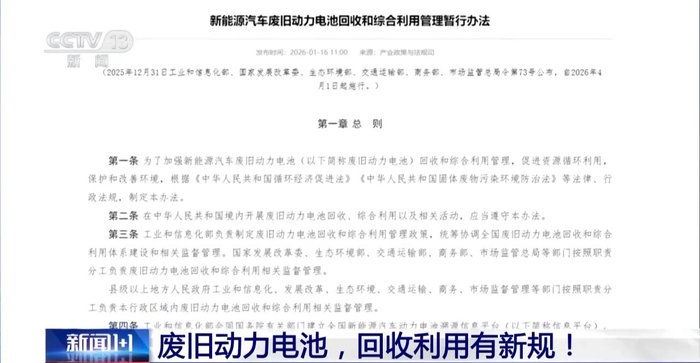
新能源汽车动力电池如何回收利用,七部门发布新规
Di Yi Cai Jing· 2026-01-16 10:50
Core Viewpoint - The rapid development of the new energy vehicle (NEV) industry in China is leading to a significant increase in the volume of retired power batteries, with a projected generation of over 1 million tons of waste batteries by 2030. The newly released "Interim Measures for the Management of Recycling and Comprehensive Utilization of Waste Power Batteries for New Energy Vehicles" aims to establish a standardized, safe, and efficient recycling system for these batteries [1][2][3]. Group 1: Industry Growth and Battery Retirement - By 2025, new energy vehicle sales in China are expected to reach 16.62 million units, accounting for 47.9% of total new car sales, with a year-on-year growth of 29% in production and 28.2% in sales [2]. - The country is entering a phase of large-scale retirement of power batteries, with estimates indicating that over 1 million tons of waste batteries will be generated annually by 2030 [2]. Group 2: Regulatory Framework - The Ministry of Industry and Information Technology (MIIT) has collaborated with several government departments to issue the new management measures, which enhance legal constraints and provide a basis for supervision and management of battery recycling [1][3]. - The management measures emphasize a "full-channel, full-chain, and full-lifecycle" approach to battery recycling, ensuring that all sources of waste batteries, including production, vehicle scrapping, and battery replacement, are properly managed [3]. Group 3: Comprehensive Utilization Management - The management measures introduce new requirements for the comprehensive utilization of waste batteries, including stricter conditions for enterprises and delineation of "red lines" for industry practices [4]. - The concept of "cascade utilization" of batteries has been clarified, prohibiting the use of waste batteries in electric bicycles and other areas where their use is legally restricted [4][18]. Group 4: Standardization and Information Management - A national standardization technical committee for battery recycling is being established to coordinate the development of a comprehensive battery recycling standard system across various industries [5]. - The MIIT is also setting up a national traceability information platform for power batteries, which will monitor the lifecycle of batteries from production to recycling [12][13]. Group 5: Responsibilities and Legal Consequences - The management measures outline the responsibilities of various stakeholders, including battery manufacturers, vehicle producers, and recycling enterprises, to ensure compliance with recycling and utilization standards [14][17]. - Violations of the regulations can lead to penalties, including fines and administrative actions against responsible parties [31][32].

《新能源汽车废旧动力电池回收和综合利用管理暂行办法》发布
Yang Shi Wang· 2026-01-16 08:30
Core Viewpoint - The Ministry of Industry and Information Technology, along with several other government departments, has issued a temporary management measure for the recycling and comprehensive utilization of used power batteries from new energy vehicles, which will take effect on April 1, 2026 [1]. Group 1: General Provisions - The purpose of the measure is to strengthen the management of used power battery recycling and comprehensive utilization, promote resource recycling, and protect the environment [2]. - The Ministry of Industry and Information Technology is responsible for formulating policies related to the management of used power battery recycling and comprehensive utilization [2][3]. - A national information platform for tracking new energy vehicle power batteries will be established to monitor the entire lifecycle of these batteries [2]. Group 2: Production and Coding of Power Batteries - New energy vehicle power batteries produced or imported for sale in China must prioritize standardized and easily disassembled designs, using non-toxic or low-toxicity materials [4]. - Power battery enterprises are required to code their batteries according to national standards and ensure that the coding is unique, accurate, and durable [5][6]. Group 3: Recycling of Used Power Batteries - Power battery enterprises must take responsibility for recycling the batteries they produce or import, including establishing service points for battery collection [7][8]. - New energy vehicle manufacturers are also required to set up recycling service points and inform users about the recycling process when batteries reach the end of their recommended lifespan [7][8]. Group 4: Comprehensive Utilization of Used Power Batteries - The comprehensive utilization of used power batteries must comply with legal and environmental standards, and companies must obtain necessary approvals before engaging in such activities [10]. - Both power battery enterprises and new energy vehicle manufacturers must ensure that collected used batteries are sent to legally established comprehensive utilization enterprises [11]. Group 5: Information Management - Relevant enterprises must report specific information regarding new energy vehicle power batteries to the information platform within designated timeframes [14][15]. - The information platform will facilitate the tracking of battery disassembly and other technical information [16]. Group 6: Supervision and Management - Government departments are tasked with strengthening supervision and inspection of used battery recycling and utilization activities, with the authority to conduct on-site checks [17][18]. - Any violations of the regulations may result in penalties, including fines and orders for correction [19][20]. Group 7: Legal Responsibilities - Violations of the regulations regarding the design and use of toxic materials in power batteries will lead to penalties from market supervision departments [19]. - Companies failing to fulfill their recycling responsibilities may face fines and other legal consequences [21][22]. Group 8: Implementation and Transition - The new measures will come into effect on April 1, 2026, and previous regulations will be repealed [25].
全文 | 《新能源汽车废旧动力电池回收和综合利用管理暂行办法》
Bei Jing Ri Bao Ke Hu Duan· 2026-01-16 03:03
Core Viewpoint - The article discusses the implementation of the "Interim Measures for the Management of Recycling and Comprehensive Utilization of Waste Power Batteries from New Energy Vehicles," aimed at establishing a regulated, safe, and efficient recycling system for waste power batteries in China, in response to the rapid growth of the new energy vehicle industry and the anticipated increase in waste battery generation by 2030 [1][2]. Group 1: Regulatory Framework - The "Management Measures" are a key initiative to implement the "Action Plan" for the recycling and utilization of waste power batteries, emphasizing a "full-channel, full-chain, and full-lifecycle" management approach [2]. - The measures include strict management of battery production, vehicle scrapping, battery swapping operations, and maintenance to prevent waste batteries from being untraceable [2]. - A national information platform for tracking the lifecycle of new energy vehicle batteries will be established, incorporating digital identification systems for better monitoring [2][4]. Group 2: Responsibilities and Obligations - Battery manufacturers are required to establish recycling service points that match their sales volume and must not refuse to accept batteries from battery swapping service providers and vehicle maintenance enterprises [10][11]. - New energy vehicle manufacturers must also set up recycling service points and inform users about the recycling process when batteries reach the end of their recommended lifespan [11][12]. - The measures outline the responsibilities of various stakeholders, including battery manufacturers, vehicle manufacturers, and recycling enterprises, to ensure compliance with recycling obligations [10][19]. Group 3: Compliance and Penalties - The measures specify penalties for non-compliance, including administrative fines and corrective orders for failing to meet recycling responsibilities or for providing false information [21][22]. - Local governments are tasked with supervising compliance and can conduct inspections and investigations to ensure adherence to the regulations [19][20]. - Violations related to the use of prohibited materials in battery production or failure to report required information can lead to significant penalties [21][24]. Group 4: Environmental and Safety Standards - The management measures emphasize the importance of adhering to environmental protection and safety standards in the recycling and utilization of waste batteries [5][13]. - Companies involved in the recycling process must ensure that their operations do not lead to secondary pollution and comply with relevant laws and regulations [5][13]. - The establishment of a comprehensive utilization standard system for waste batteries is encouraged to promote new technologies and practices in the industry [5]. Group 5: Implementation Timeline - The "Management Measures" will come into effect on April 1, 2026, and will replace previous regulations related to the recycling and utilization of new energy vehicle batteries [29].
标准提升激发更大消费活力
Xin Lang Cai Jing· 2025-12-26 23:08
Core Viewpoint - The article discusses the implementation of national standards to support high-quality development in various sectors, particularly focusing on equipment updates and the replacement of consumer goods, aiming to enhance safety, efficiency, and sustainability in the market [1][2][4]. Group 1: National Standards Implementation - The State Administration for Market Regulation, in collaboration with several departments, has issued a plan to revise 294 national standards across 13 key areas, which has been fully approved and published [1]. - The "Two New" initiative focuses on revising 115 national standards in sectors such as automobiles, home appliances, and emerging consumer goods to enhance the quality of durable consumer products and stimulate domestic demand [2]. Group 2: Energy Efficiency and Emission Standards - Over 140 energy consumption and efficiency standards and 170 pollutant emission standards have been published, but further upgrades are needed to meet technological advancements and stricter pollution requirements [2]. - The new mandatory national standard for coal-fired power generation aims to reduce average coal consumption to below 302 grams per kilowatt-hour by 2030, potentially decreasing carbon dioxide emissions by approximately 160 million tons [3]. Group 3: Circular Economy and Resource Utilization - The "Two New" initiative also emphasizes the development of a circular economy, focusing on product design for recyclability and the establishment of standards for the recycling and reuse of waste products [3]. - The introduction of 12 national standards for the recycling of power batteries aims to create a comprehensive standard system covering disassembly, residual energy detection, and recycling, facilitating the efficient recovery of strategic resources like nickel, cobalt, and lithium [3]. Group 4: Industrial and Light Industry Development - The initiative has accelerated large-scale equipment updates in the industrial sector, driving investment growth and promoting industrial development, with the Ministry of Industry and Information Technology completing 44 important national standards [4]. - In the light industry, 52 key recommended national standards have been deployed to address transformation and upgrade needs, with standards like smart furniture grading driving the market for high-end smart furniture products, which has exceeded 10 billion yuan [4]. Group 5: Future Focus Areas - In the coming year, the market regulation authority will focus on optimizing traditional industries and enhancing service quality, planning to revise over 1,800 standards to support industrial transformation [5]. - The authority will also develop a new consumer goods standard system that aligns with high-quality development, addressing consumer demands for safety, quality, and sustainability [5].
富奥股份全资子公司引入战投,绿色动力基金确定为意向方
Zheng Quan Shi Bao Wang· 2025-12-09 12:21
Core Viewpoint - The company, Fawer Co., Ltd., has successfully signed an investment agreement with the Green Power Fund, which will provide 20 million yuan to enhance the capital of its subsidiary, Fawer Smart, amidst a challenging lithium carbonate market [1][3]. Group 1: Investment and Capital Increase - Fawer Smart has signed an investment agreement with the Green Power Fund, which will invest 20 million yuan to subscribe for an increase in registered capital of 18.6794 million yuan [1]. - Following the capital increase, Fawer Smart's registered capital will change to 83.6794 million yuan [1]. - The investment aims to support Fawer Smart's operations and development in the battery recycling industry [3]. Group 2: Strategic Importance and Industry Context - The Green Power Fund is established to support the development of the power battery recycling sector in line with the strategic goals of China FAW Group [3]. - The battery recycling industry is expected to grow alongside the increasing production and sales of new energy vehicles, creating a favorable environment for compliant recycling enterprises [3]. - Fawer Smart is recognized as a key player in battery recycling, being the only enterprise in Northeast China on the white list for tiered utilization and a national high-tech enterprise [2].


国家标准如何规范动力电池回收利用
Jing Ji Ri Bao· 2025-10-17 21:39
Core Insights - The rapid growth of electric vehicle ownership in China is leading to an increase in retired power batteries, making recycling a critical aspect for the healthy development of the industry [1] - The National Standardization Administration has approved five national standards, including the "Evaluation Technical Specification for the Recycling and Utilization of Waste Battery Chemicals," to enhance the recycling standard system for power batteries [1] Industry Development - The domestic power battery recycling volume is expected to exceed 300,000 tons in 2024, corresponding to a market scale of over 48 billion yuan, with projections to surpass 100 billion yuan by 2030 [1] - A total of 22 national standards for power battery recycling have been released, covering various aspects such as general requirements, management specifications, disassembly standards, residual energy detection, and recycling of lithium-ion waste [1] Standardization Efforts - The Ministry of Market Regulation and the Ministry of Industry and Information Technology are working together to establish a National Technical Committee for Power Battery Recycling Standardization to unify standards across the industry [2] - The implementation of the "Disassembly Specifications for Used Power Batteries" has improved disassembly efficiency by over 50%, promoting standardized development in physical processing [2] Environmental Impact - The series of standards for the recycling and utilization of power batteries aim to ensure that harmful substances are managed properly, achieving a reduction in overall energy consumption by over 30% [3] - Strict resource recovery rate indicators have been established, requiring a comprehensive recovery rate of no less than 98% for nickel, cobalt, and manganese, and no less than 85% for lithium [3] International Collaboration - Chinese experts are actively participating in the formulation of international standards related to battery performance evaluation and recycling guidelines, with nearly 40 experts involved in international standard organizations [3] - The proposal for the "General Guidelines for Deep Discharge in Battery Recycling" has been successfully established as an IEC international standard [3] Future Initiatives - The Ministry of Industry and Information Technology plans to strengthen collaboration with the National Market Regulation Administration to accelerate the revision of green design standards for power batteries [4] - The development of mandatory national standards for key aspects of power battery recycling will be prioritized, including safety guarantees and the prohibition of using retired power batteries in electric bicycles [4]