外卖送餐

Search documents
民众担忧“AI泡沫”,多家公司股价大跌,“末日报告”令美国陷入恐慌
Huan Qiu Shi Bao· 2026-02-25 22:55
Core Viewpoint - A hypothetical report by Sitrini Research titled "2028 Global Intelligence Crisis" has gained significant attention, highlighting potential threats posed by artificial intelligence (AI) to the U.S. economy, leading to notable declines in stock prices of several tech and financial companies [1][2][3]. Group 1: Market Reaction - The report has caused a market stir, with the S&P 500 index dropping over 1% on the day following its release, and several software companies, including IBM, experiencing significant stock declines, with IBM's stock falling 13%, marking its worst performance since 2000 [3]. - Other companies mentioned in the report, such as American Express, KKR, and Blackstone, also saw their stock prices decrease, while DoorDash's stock dropped by 6.6% [3]. Group 2: Expert Opinions - Experts have mixed views on the report, with some considering it a typical doomsday narrative that may not reflect reality, while others see it as a warning signal indicating a shift in economic conditions compared to previous years [2][4]. - Nassim Nicholas Taleb, author of "The Black Swan," warned that the software industry might face increased volatility and potential bankruptcies due to underestimating structural risks while overestimating the durability of leading AI companies [4]. Group 3: Investor Sentiment - Investors are showing heightened caution regarding the AI sector, with concerns about a potential bubble, as the report has sparked significant attention and reactions in the market [5]. - The divergence in attitudes among U.S. investors towards AI—ranging from enthusiastic supporters to skeptical critics—could further amplify volatility in the AI sector [5]. Group 4: Regional Insights - The report has led to a belief that Asia may emerge as a winner in the AI transformation, attributed to its strong semiconductor manufacturing capabilities, contrasting with the challenges faced by certain sectors in the U.S. [6][7]. - Analysts suggest that Asian stocks are likely to maintain resilience due to their unique positioning in the AI ecosystem, lower valuations, and robust earnings growth, especially as AI capital expenditure themes continue [7].

氪星晚报|英特尔与SambaNova达成多年战略合作;宗馥莉任浙江娃哈哈管理咨询公司董事;特斯拉指控法国饮料公司恶意抢注Cybercab商标
3 6 Ke· 2026-02-25 10:39
Group 1: Company Updates - Hengdian Film's stock price has deviated by over 20% in the last two trading days, indicating abnormal volatility, but the company confirms no undisclosed significant information exists [1] - Maiwei Co. plans to invest 50 million yuan in Wenzhou Chaoquan Venture Capital Partnership to expand its business scope and enhance competitiveness [2] - SMIC's application to issue shares for acquiring a 49% stake in SMIC North has been accepted by the Shanghai Stock Exchange, pending further approvals [3] - The Arnault family has increased its stake in LVMH to 50.01% of capital and 65.94% of voting rights [4] - Lenovo's infrastructure business reported over 30% year-on-year revenue growth in Q3, with significant increases in various segments, including a 300% rise in liquid cooling solutions [5] Group 2: Market Movements - Tongyuan Petroleum's stock price has increased by over 30% in two consecutive trading days, with no significant changes in its operational environment [6] - DoorDash is exiting four markets, including Qatar and Singapore, as part of a strategic review [8] - WiseTech Global plans to reduce its workforce by nearly 30% while leveraging AI for cost savings [11] Group 3: Investment and Financing - Wuliangye Group has acquired a stake in Sanjiang Huihai Financing Leasing Company, increasing its registered capital by approximately 60% [9] - Warner Bros. is considering a new acquisition offer from Paramount, which may surpass its existing agreement with Netflix [10]




@新就业形态劳动者,这些保障实招请收好
Xin Lang Cai Jing· 2026-01-18 19:30
Core Insights - The new employment model in the province is rapidly developing, with 3.8 million workers requiring urgent social security and labor compensation needs [1] - The provincial human resources department has implemented a series of policies to protect the rights of new employment model workers, focusing on labor compensation, rest, and labor safety [2][3] Group 1: Policy Implementation - The provincial government has clarified the responsibilities of platform companies to address issues such as irregular labor compensation calculations and ambiguous labor relationships [2] - A labor rights protection implementation plan has been established for delivery workers, couriers, and ride-hailing drivers, with a labor rights maintenance working group formed by eight provincial departments [2] - The signing rate of labor contracts and participation in work injury insurance among new employment model workers has significantly increased, with platform commission rates becoming more transparent [2] Group 2: Social Security Innovations - The province has prioritized work injury insurance for new employment model workers, allowing for flexible participation in social insurance regardless of household registration [3] - Local innovations include pilot programs for pension insurance subsidies for delivery riders and a comprehensive risk protection system combining social insurance, occupational injury protection, and medical mutual assistance [3] Group 3: Dispute Resolution - A one-stop dispute resolution platform has been established to efficiently handle labor disputes, exemplified by a case where a network anchor received compensation after intervention [4] - The province has created a diversified dispute resolution system, with 87 one-stop labor dispute resolution organizations established, handling over 1,200 cases [4] - A "green channel" for arbitration has been implemented to assist unemployed workers, providing employment guidance and skills training [4] Group 4: Collaborative Efforts - The provincial government, trade unions, and social organizations are collaborating to protect the rights of new employment model workers, launching a care service action plan [5] - Over 5,056 "union stations" and 93 comprehensive service "driver homes" have been established to address basic needs such as food, water, rest, and sanitation for workers [5] - A special protection plan for new employment model workers is set to be piloted in 2025, focusing on logistics, freight driving, and food delivery sectors [5]
软银投资(上)孙正义的“金蛋”大赚
3 6 Ke· 2026-01-06 04:13
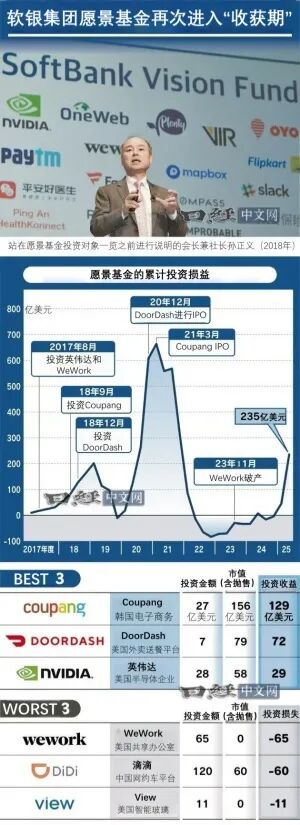
Core Insights - SoftBank Group's Vision Fund has shown strong performance, with total investments reaching $163.2 billion (approximately 25.3 trillion yen) and pre-tax investment returns of about 3.7 trillion yen as of September 30 [2][3] Group 1: Fund Performance - The Vision Fund was launched in 2017 with a scale of 10 trillion yen, and a second fund was established in 2019 [2][3] - The Vision Fund's investment returns recovered to nearly 3 trillion yen in the July-September quarter, marking a significant turnaround after challenges including the bankruptcy of WeWork [3] - The fund's largest successful investment is in Coupang, a South Korean e-commerce giant, which has seen its value increase to $15.6 billion, yielding a net profit of $12.9 billion [4] Group 2: Investment Strategy - SoftBank's investment strategy includes a focus on AI, with plans to invest an additional $22.5 billion in OpenAI, bringing total investments to $34.7 billion [9] - The second fund has faced challenges, with a current investment of $73.7 billion and a loss of $9.1 billion, primarily due to high entry prices for unlisted stocks [5] - The CFO expressed confidence in future IPOs, including potential listings for companies like Chime and Klarna, which could revitalize the second fund's performance [5] Group 3: ARM Investment - SoftBank's direct investment in ARM has generated a significant paper profit of 15 trillion yen, with ARM's value accounting for 18 trillion yen of the total 40 trillion yen in stocks held by SoftBank [6] Group 4: Market Sentiment - Despite the positive outlook for AI investments, SoftBank's stock has experienced volatility, dropping 40% within a month after reaching a historical high in October 2025 [9] - The market remains cautious about SoftBank's heavy investment in AI, indicating potential for continued stock price fluctuations [9]


软银投资(上)孙正义的“金蛋”大赚
日经中文网· 2026-01-06 02:50
Core Viewpoint - SoftBank Group's Vision Fund has shown strong performance, with total investments reaching $163.2 billion (approximately 25.3 trillion yen) and pre-tax investment returns of about 3.7 trillion yen as of September 30 [2][6]. Group 1: Fund Performance - The Vision Fund's investment returns have rebounded to nearly 3 trillion yen in the July-September quarter, marking a recovery after years of challenges, including the bankruptcy of WeWork [3][4]. - The first Vision Fund has generated a profit of $32.8 billion despite significant losses from WeWork, while the second fund, which started investing in 2019, has faced difficulties with a current loss of $9.1 billion on investments totaling $73.7 billion [7][8]. Group 2: Key Investments - Coupang, a South Korean e-commerce giant, has been the most profitable investment for SoftBank, with a return of 5.7 times the initial investment, reaching a value of $15.6 billion [6][7]. - DoorDash, a U.S. food delivery platform, generated $7.2 billion in profit, with an investment return of 11.7 times, and all shares have been sold [7]. - The second fund's most profitable investments include Beike, Symbotic, and Swiggy, with returns of $1.1 billion, $800 million, and $300 million respectively [7]. Group 3: Future Outlook - The second fund's underperformance is attributed to high entry prices for unlisted stocks, but upcoming IPOs, including Chime and Klarna, are expected to improve performance [8]. - SoftBank's CFO expressed confidence in future IPOs and the potential for recovery in the second fund's performance [8]. - The company plans to invest an additional $22.5 billion in OpenAI, bringing the total investment to $34.7 billion, aligning with the "ALL IN AI" strategy [12].