
悦己消费

Search documents
各地打造消费提质新引擎 新业态开拓内需新空间
Xin Lang Cai Jing· 2026-01-16 19:05
Core Viewpoint - The "14th Five-Year Plan" emphasizes the cultivation of new consumption formats, models, and scenarios as a key strategy for boosting domestic demand and promoting high-quality development in various regions [2]. Group 1: Strategic Framework - The central government advocates for expanding domestic demand as a strategic foundation, integrating consumer welfare with investment in goods and people, and fostering a virtuous cycle between supply and demand [2]. - Multiple provinces have released their "14th Five-Year Plan" proposals, focusing on consumption upgrades tailored to local resources, such as Beijing's emphasis on the ice and snow economy and Zhejiang's focus on self-indulgent and digital consumption [2][3]. Group 2: Regional Differentiation - New consumption formats are emerging as growth points for local economies, with differentiated layouts based on regional resources leading to clearer paths for consumption quality upgrades [2]. - Experts highlight that the differentiated development of new consumption formats in regions like Beijing, Zhejiang, and Jiangsu is crucial for creating sustainable growth momentum through supply innovation [4]. Group 3: Consumption Scenarios and Models - Beijing's plan includes fostering new consumption scenarios such as leisure, fashion, and health, while Zhejiang aims to develop self-indulgent and digital consumption [3]. - Jiangsu's strategy focuses on optimizing service consumption supply and promoting new consumption models like instant retail and digital tourism [4]. Group 4: Economic Impact and Long-term Value - New consumption formats are seen as engines for high-quality development, transitioning local economies from investment-driven to consumption-driven growth, and enhancing the interaction between consumption, investment, and production [6]. - Different consumption formats serve various functions in the economy, with experiential consumption significantly contributing to employment and urban vitality, while emotional and cultural consumption enhances industry value and city soft power [6][7]. Group 5: Future Directions - The emphasis on institutional environment construction, market entity cultivation, and the realization of consumption scenarios is crucial for transforming local comparative advantages into stable and sustainable consumption growth [5]. - The collaboration between experiential and digital consumption is essential for regions to shift from investment-driven to demand-driven growth, enhancing internal economic dynamics and risk resilience [8].


悦己经济成中国消费市场提质升级重要引擎
Zheng Quan Ri Bao· 2026-01-12 17:18
Core Insights - The "self-pleasure economy" is gaining momentum in China, with the emotional economy market expected to reach 23,077.67 billion yuan in 2024 and surpass 45,000 billion yuan by 2029, indicating a significant growth trajectory [1] - The trend of self-pleasure consumption is evolving from a niche choice among young people to a consensus across all age groups, with a shift from product consumption to experience and service consumption [1][5] - Consumers are increasingly prioritizing emotional value in their purchasing decisions, leading to a rise in the emotional economy as a new market segment [2][3] Consumer Behavior - A growing number of consumers are willing to pay for emotional value, with 56.3% of the population expected to do so by 2025, reflecting a 16.2 percentage point increase from 2024 [3] - The shift in consumer behavior is characterized by a move from "material possession" to "experiential acquisition," with emotional value becoming a core driver of purchasing decisions [3] - Rational self-pleasure consumption is becoming mainstream, with consumers focusing on precise satisfaction and avoiding impulsive purchases [4] Industry Dynamics - The number of companies engaged in the self-pleasure consumption sector is increasing, with 35 related listed companies in the A-share market having a total market capitalization of 31.544 billion yuan [6] - In the first three quarters of 2025, these companies achieved a total revenue of 66.926 billion yuan and a net profit of 2.833 billion yuan, reflecting year-on-year growth of 3.74% and 50.16% respectively [6] - New business models and professions are emerging, driven by the demand for emotional value, with companies innovating through cultural empowerment and service upgrades [5][6] Emerging Trends - The rise of immersive experience service providers is notable, as they create complex consumption spaces centered around emotional healing and social interaction [5][7] - The industry is witnessing a fundamental transformation in supply chains and brand ecosystems, shifting from scale-based advantages to agile, responsive operations that cater to fragmented and personalized emotional needs [7][8] - Companies are encouraged to adopt a "small batch, quick response" model to reduce inventory risks and focus on building deep trust with consumers through private domain marketing strategies [9] Challenges and Recommendations - The self-pleasure consumption industry faces challenges such as uneven development and lack of standardization, which could hinder its progression towards high-quality growth [8] - Issues include low entry barriers leading to poor service quality and consumer protection difficulties, as well as a concentration of quality resources in first-tier cities [8] - Experts suggest that companies should focus on niche emotional needs and create differentiated value propositions to avoid homogenization and enhance competitive advantages [9]
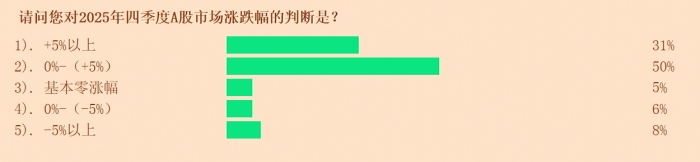
超八成投顾看涨四季度 科技板块仍是主线——上海证券报·2025年第四季度券商营业部投资顾问调查报告
Shang Hai Zheng Quan Bao· 2025-11-05 18:41
Core Viewpoint - The investment advisory community shows a continued optimistic sentiment towards the macroeconomic outlook and A-share market for the fourth quarter of 2025, with over 80% of advisors bullish on the A-share market and a significant upward adjustment in the expected range for the Shanghai Composite Index [4][10][23] Economic Outlook - Approximately 79% of advisors hold a neutral or optimistic view on the macroeconomic situation, an increase of 8 percentage points from the previous quarter [6] - 38% of advisors believe the economy is in a "bottoming out" phase, while 24% think it is operating normally [6] - Nearly 70% of advisors expect economic growth to improve compared to the third quarter [6] - The ongoing implementation of stable growth policies is seen as a primary driver for a stronger stock market [7] Market Sentiment - Over 81% of advisors are bullish on the A-share market for the fourth quarter, marking a new high for the year [10] - The expected range for the Shanghai Composite Index has been raised to between 3900 and 4100 points, up from the previous range of 3300 to 3500 points [10][23] - Advisors predict that the index will fluctuate between 3800 and 3900 points at the lower end [10] Investment Preferences - Advisors recommend that nearly 60% of investors focus on equities as the most valuable asset class for the fourth quarter [14][15] - 34% of advisors suggest investing in equity funds, while 32% recommend direct stock investments [15] - Technology stocks remain the most favored sector, with 46% of advisors optimistic about AI-related technology stocks [11] Client Behavior - 82% of advisors report that high-net-worth clients achieved profits in the third quarter, with a notable increase in their willingness to increase positions [19] - The majority of clients are expected to allocate additional funds to technology stocks, with 41% of advisors indicating this trend [19][21] - Advisors observe a "cash migration" trend among clients, with funds primarily sourced from cash deposits and redemptions of bank wealth management products [18][21] ETF and Fund Preferences - 47% of advisors noted that high-net-worth clients subscribed to ETF products in the third quarter, with a shift towards broad-based ETFs [20] - The popularity of the ChiNext ETF has increased, with 24% of advisors reporting client purchases [20] Conclusion - The overall sentiment among advisors indicates a positive outlook for the macroeconomic environment and A-share market, with recommendations for maintaining high equity positions and adopting flexible thematic investment strategies to capture opportunities in a structural market [23]
港股悦己消费板块强势崛起 情绪价值重构消费新生态
Zhong Guo Zheng Quan Bao· 2025-06-18 20:30
Group 1 - The emergence of the "third consumption society" in China is characterized by personalized and diversified consumption preferences, driven by younger generations such as those born in the 1990s and 1995s [1] - Public funds are increasingly investing in "self-indulgent" consumption companies, with 207 public funds including Pop Mart among their top ten holdings as of Q1 2025 [1] - The trend of "self-indulgent" consumption is attracting significant attention from public funds, with companies like Mixue Group and Laopu Gold also seeing substantial fund allocations [1] Group 2 - Southbound funds are actively betting on the consumption upgrade, with a net inflow of HKD 63.7 billion into the new consumption sector from April 8 to June 9 [2] - The current Chinese consumer market is exhibiting characteristics of "consumption stratification," where consumers are willing to pay for quality at low prices and justified premiums [2] - The Z generation's consumption willingness and ability, along with their focus on "value for money" and "quality for price," are driving the new consumption wave in China [2] Group 3 - There is significant growth potential in self-indulgent consumption, with service consumption in China still relatively low compared to Japan and the U.S. [3] - Historical data shows that service-related expenditures in Japan and the U.S. have consistently increased, indicating a trend that China could follow [3] - Currently, service industry expenditure accounts for only 46.1% of China's total consumption spending, suggesting room for substantial growth [3]