冰雪经济

Search documents
理论专刊|坚持辩证思维构建现代化产业体系
Xin Lang Cai Jing· 2026-02-21 22:20
Group 1 - The modernization of the industrial system is the material and technical foundation of Chinese-style modernization, emphasizing the need to strengthen the real economy [1] - The traditional and emerging industries are complementary pillars of the modern industrial system, with traditional industries providing stability and new industries driving innovation [2][3] - The relationship between traditional and emerging industries should avoid binary thinking, focusing on how new technologies can revitalize traditional sectors [3] Group 2 - The balance between safety and development is crucial, with self-sufficiency being the foundation for security and open cooperation being essential for enhancing competitiveness [4][5] - Emphasis on self-sufficiency in key areas such as high-end equipment and agricultural machinery, while also engaging in international cooperation to enhance supply chain resilience [5] Group 3 - Technological innovation is the core source of advancement in the modern industrial system, and effective transformation of research results into economic value is essential [6] - A complete innovation ecosystem should be established, integrating basic research, applied research, and industrialization to ensure a continuous cycle of innovation and application [6] Group 4 - The integrity of the modern industrial system requires overall advancement, with regional differences necessitating collaborative efforts and complementary advantages [7] - A unified national market approach should be adopted, promoting regional cooperation and resource sharing to enhance the overall effectiveness of the industrial system [7]
人民日报:从总台春晚看中国经济发展向新向优
Xin Lang Cai Jing· 2026-02-21 00:47
Group 1 - The Spring Festival Gala serves as a significant platform to observe China's economic transformation and showcases the progress in new productive forces, particularly in artificial intelligence and integrated circuits, highlighting the country's strategic focus on technological self-reliance [1][3] - The gala featured a fully domestically produced 8K ultra-high-definition television broadcast and demonstrated advancements in the ultra-high-definition video industry, achieving an "end-to-end" autonomous control of the production chain [1] - The appearance of robots at the gala illustrated the advancements in embodied intelligence and high-end manufacturing, showcasing their potential applications in various sectors such as industrial production and daily life [1] Group 2 - The event highlighted the new regional development pattern in China, with four different locations showcasing their unique economic characteristics and cultural elements, reflecting the optimization of regional economic layouts [2] - The Harbin venue emphasized the revitalization of old industrial bases through the "ice and snow economy," while the Yiwu venue represented the city's transformation into a global trade center [2] - The gala also addressed the theme of "technology for the people," exemplified by a skit that explored the relationship between the elderly and artificial intelligence, prompting discussions on ethical considerations and the societal impact of technology [2]
从总台春晚看中国经济发展向新向优
Ren Min Ri Bao· 2026-02-20 22:26
Group 1 - The core viewpoint of the article emphasizes that the Spring Festival Gala serves as a significant reflection of China's economic transformation and a motivational call for progress, showcasing advancements in technology and production capabilities [1][3] - The gala highlights the achievements in key technologies such as artificial intelligence and integrated circuits, demonstrating China's commitment to self-reliance and innovation in these fields [1] - The event features a fully domestically produced 8K ultra-high-definition television broadcast and showcases the complete production chain of 3D sound technology, indicating the maturity of China's ultra-high-definition video industry [1] Group 2 - The four regional venues of the gala illustrate the new pattern of regional development in China, showcasing the optimization of economic layout and the effective complementarity of regional advantages [2] - The Harbin venue reflects the revitalization of old industrial bases through the "ice and snow economy," while the Yiwu venue represents the city's transformation into a global trade center [2] - The Hefei venue highlights rapid advancements in low-altitude economy and quantum technology, and the Yibin venue emphasizes ecological protection and green development efforts in the upper reaches of the Yangtze River [2] Group 3 - The gala also emphasizes the theme of "technology for the people," addressing the ethical implications of artificial intelligence and the importance of intergenerational relationships, thus promoting a collaborative development path between technology, industry, and society [2]
A股收评:三大指数今日涨跌不一,创业板指跌逾1%,玻璃玻纤、小金属板块走高
Ge Long Hui A P P· 2026-02-11 07:08
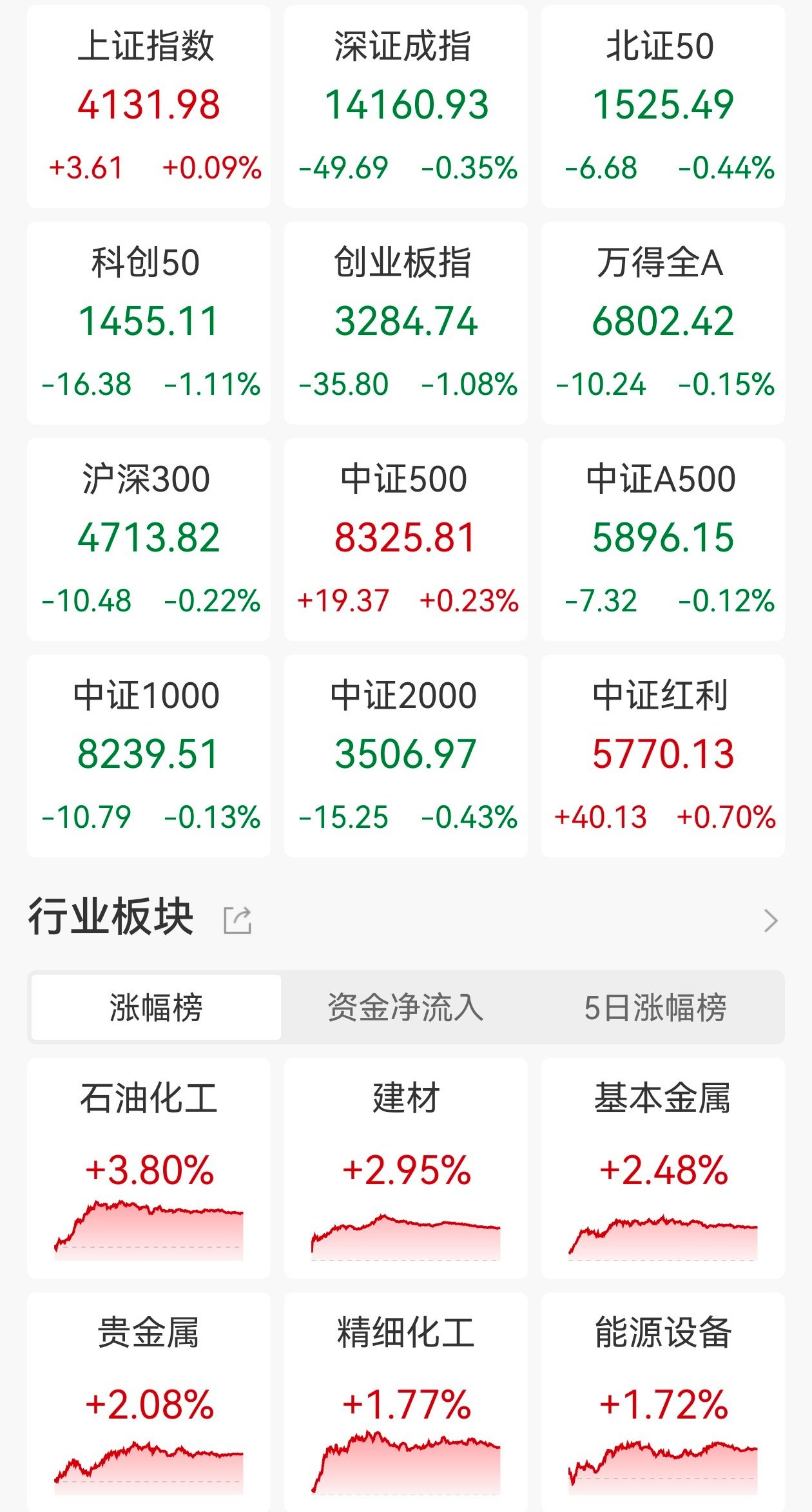
Group 1 - China's January CPI increased by 0.2% year-on-year, which is lower than expected [1] - The A-share market showed mixed results, with the Shanghai Composite Index rising by 0.09% to 4131.99 points, while the Shenzhen Component Index fell by 0.35% and the ChiNext Index dropped by 1.08% [1] - The total market turnover was 2 trillion yuan, a decrease of 123.7 billion yuan compared to the previous trading day, with over 3200 stocks declining [1] Group 2 - The glass fiber sector saw a surge, with leading companies like Guangyuan New Materials and International Composite raising prices for electronic fabrics, leading to stock price limits for several companies [1] - The small metals sector also performed well, with multiple stocks hitting their price limits [1] - The phosphate chemical and fertilizer sectors experienced gains, with Jinzhengda reaching its price limit [1] Group 3 - Conversely, sectors such as cultural media, film concepts, AI corpus, and Sora concepts saw declines, with stocks like Hengdian Film and Zhejiang Culture Industry hitting their price limits [1] - The tourism sector declined, with Haikan Co. dropping over 11% [1] - The cultivated diamond sector faced widespread declines, with Sifangda leading the drop [1]


和音:“五十万亿元”展现的中国大市场——解码数字里的“机遇清单”④
Ren Min Ri Bao· 2026-01-23 03:26
Group 1 - The core focus of the articles is on China's strategy to expand domestic demand, which is seen as essential for economic growth and stability, with a projected retail sales total exceeding 50 trillion yuan by 2025 [1][2] - Domestic demand has become the main driving force for China's economic growth, contributing an average of 93.1% to economic growth from 2013 to 2024, with final consumption expenditure expected to contribute 52% in 2025, an increase of 5 percentage points from the previous year [1][2] - The shift towards service consumption is notable, with service spending projected to account for 46.1% of per capita consumption in 2025, indicating a structural optimization in consumer behavior [1] Group 2 - China's consumer spending is currently at about 40%, with significant room for growth compared to developed countries, which presents a vast investment opportunity in new urbanization, technology industries, and improving livelihoods [2] - The implementation of policies such as the trade-in program for consumer goods is expected to benefit over 360 million people, showcasing the market's potential and the effectiveness of policy measures [2] - China aims to transition from being the "world's factory" to becoming a "world market," enhancing its role as a major consumer market, which will create new opportunities for global cooperation [2][3]
“五十万亿元”展现的中国大市场(和音)
Sou Hu Cai Jing· 2026-01-22 22:48
Core Viewpoint - China aims to transition from being the "world's factory" to becoming the "world's market," accelerating its development as a major consumer economy, which will inject strong new momentum into mutually beneficial cooperation with countries worldwide [1][3]. Group 1: Domestic Demand and Economic Growth - Domestic demand has become the main driving force and stabilizing anchor for China's economic growth, contributing an average of 93.1% to economic growth from 2013 to 2024 [2]. - In 2025, final consumption expenditure is expected to contribute 52% to economic growth, an increase of 5 percentage points from the previous year [2]. - The share of service consumption expenditure in per capita consumption is projected to reach 46.1% in 2025, indicating a structural optimization in consumption [2]. Group 2: Investment Opportunities and Market Potential - China's market is characterized by its large scale, diverse levels, and significant potential, with substantial investment opportunities in new urbanization, technology industries, and improving livelihoods [3]. - The current consumer rate in China is about 40%, with a potential increase of 10-20 percentage points compared to developed countries, indicating room for growth [3]. - The policy of replacing old consumer goods is expected to benefit over 360 million people, showcasing market size and policy effectiveness [3]. Group 3: Global Economic Impact - Over the past five years, China has imported goods and services worth over $15 trillion, establishing itself as the world's second-largest consumer market [3]. - As income levels rise, the demand for a better quality of life will drive new consumption and supply, creating vast investment opportunities [3]. - China's commitment to expanding domestic demand will provide new opportunities for global cooperation, enhancing its role as a major consumer market [4].
各地打造消费提质新引擎 新业态开拓内需新空间
Xin Lang Cai Jing· 2026-01-16 19:05
Core Viewpoint - The "14th Five-Year Plan" emphasizes the cultivation of new consumption formats, models, and scenarios as a key strategy for boosting domestic demand and promoting high-quality development in various regions [2]. Group 1: Strategic Framework - The central government advocates for expanding domestic demand as a strategic foundation, integrating consumer welfare with investment in goods and people, and fostering a virtuous cycle between supply and demand [2]. - Multiple provinces have released their "14th Five-Year Plan" proposals, focusing on consumption upgrades tailored to local resources, such as Beijing's emphasis on the ice and snow economy and Zhejiang's focus on self-indulgent and digital consumption [2][3]. Group 2: Regional Differentiation - New consumption formats are emerging as growth points for local economies, with differentiated layouts based on regional resources leading to clearer paths for consumption quality upgrades [2]. - Experts highlight that the differentiated development of new consumption formats in regions like Beijing, Zhejiang, and Jiangsu is crucial for creating sustainable growth momentum through supply innovation [4]. Group 3: Consumption Scenarios and Models - Beijing's plan includes fostering new consumption scenarios such as leisure, fashion, and health, while Zhejiang aims to develop self-indulgent and digital consumption [3]. - Jiangsu's strategy focuses on optimizing service consumption supply and promoting new consumption models like instant retail and digital tourism [4]. Group 4: Economic Impact and Long-term Value - New consumption formats are seen as engines for high-quality development, transitioning local economies from investment-driven to consumption-driven growth, and enhancing the interaction between consumption, investment, and production [6]. - Different consumption formats serve various functions in the economy, with experiential consumption significantly contributing to employment and urban vitality, while emotional and cultural consumption enhances industry value and city soft power [6][7]. Group 5: Future Directions - The emphasis on institutional environment construction, market entity cultivation, and the realization of consumption scenarios is crucial for transforming local comparative advantages into stable and sustainable consumption growth [5]. - The collaboration between experiential and digital consumption is essential for regions to shift from investment-driven to demand-driven growth, enhancing internal economic dynamics and risk resilience [8].

2026哈尔滨国际冰雪经济博览会向北开放交流活动举行
Zheng Quan Shi Bao Wang· 2026-01-06 14:48
Core Viewpoint - The 2026 Harbin International Ice and Snow Economic Expo has commenced, aiming to enhance cross-border cooperation and support the development of a new highland for opening up to the north [1] Group 1: Event Overview - The expo serves as a platform for building cross-border cooperation bridges using ice and snow as a medium [1] - The event features the signing of several strategic and market-potential projects between China and Russia [1] Group 2: Key Partnerships and Agreements - The Russian Chinese Chamber of Commerce signed an agreement with the China (Heilongjiang) Free Trade Pilot Zone International Cooperation Promotion Association [1] - China Nonferrous Metal Industry Technology Development Co., Ltd. signed a strategic cooperation framework agreement with Harbin Kedewei Metallurgical Co., Ltd. [1] - Vladivostok State University and Heilongjiang Provincial Engineering College signed an inter-school cooperation agreement focusing on cold-region vehicle engineering research and industrial cooperation [1] - Jinlonggang Construction Development Company signed a cooperation project for bilateral cross-border tourism with the management bureau of the China (Heilongjiang) Free Trade Pilot Zone Harbin area [1]
研之有理|双向奔赴 促进城乡融合发展
Xin Lang Cai Jing· 2026-01-01 22:54
Core Viewpoint - The integration of urban and rural development is a necessary requirement for Chinese-style modernization, with significant achievements noted in Heilongjiang Province during the 14th Five-Year Plan period, although challenges such as regional imbalances and inefficient resource allocation remain [1]. Group 1: Key Strategies for Urban-Rural Integration - Establish a dual-direction flow mechanism for population, enhancing the management of migrant populations and improving policies for urbanization of agricultural workers [2]. - Develop a multi-source funding mechanism to encourage financial institutions to innovate agricultural credit products and attract social capital for rural infrastructure [2]. - Optimize land resource allocation by matching land supply with population growth and enhancing land management practices [2]. Group 2: Public Service Equitability - Create a public resource allocation mechanism based on permanent population, ensuring that educational, medical, and cultural resources are distributed equitably across urban and rural areas [3]. - Improve rural infrastructure to enhance living conditions and establish a long-term maintenance mechanism for facilities [3]. - Promote digital transformation of public services by building a comprehensive digital service platform that bridges urban-rural information gaps [3]. Group 3: Industrial Collaboration - Break traditional barriers between urban and rural industries, promoting deep integration of agriculture with secondary and tertiary industries [4]. - Focus on developing new types of urban-rural industries such as deep processing of agricultural products and rural tourism, leveraging local resources [4]. - Establish a modern rural industrial system that utilizes technology to meet market demands and encourages urban capital and talent to flow into rural areas [4][7]. Group 4: County-Level Development Mechanism - Recognize counties as fundamental units for urban-rural integration, tailoring development strategies based on local resources and industrial foundations [5]. - Strengthen the functional roles of counties by fostering leading industries and enhancing mechanisms that connect agriculture with rural development [6]. - Create modern supply chain systems for agricultural products within counties to facilitate market access for small farmers [6].
002347 14分钟上演“地天板”
Shang Hai Zheng Quan Bao· 2025-12-30 04:47
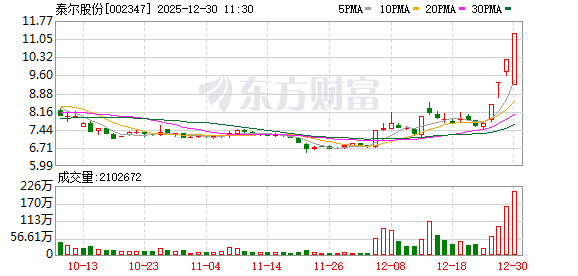
Market Overview - The A-share market opened lower but rebounded, with technology themes such as AI applications and robotics showing active performance. The Shanghai Composite Index reported 3961.21 points, down 0.10%, while the Shenzhen Component Index rose by 0.23% and the ChiNext Index fell by 0.06% [2] Robotics Sector Performance - The robotics concept continued its strong performance from the previous day, with stocks like Tai'er Co., Ltd. (002347) opening at the limit down price but quickly rebounding to hit the limit up within 14 minutes, showcasing a "limit up-limit down" movement. The stock recorded a half-day trading volume of 2.198 billion yuan [4][6] - Other stocks in the robotics sector also experienced significant gains, with Tianming Technology on the Beijing Stock Exchange achieving a 30% limit up, and companies like Wuzhou Xinchun, Tai'er Co., Ltd., and Tianqi Co., Ltd. also hitting the limit up [4] Ice and Snow Economy - The ice and snow economy concept showed active performance, with stocks like Iceberg Cold Chain hitting the limit up, and others like Ousheng Electric and Dalian Shengya rising over 9% and 2% respectively [9][10] - Recent policies from the National Sports Administration and the Ministry of Culture and Tourism aim to promote the ice and snow industry, transitioning it from a "cold resource" to a "hot economy." This includes initiatives for ice and snow activities as a key focus for the year, enhancing the integration of ice and snow sports with culture, equipment, and tourism [11]