
数字服务贸易

Search documents
各方将在WTO再交锋!关于电子传输关税暂停征收令,特朗普政府想要干什么
第一财经· 2026-03-19 13:16
Core Viewpoint - The article discusses the upcoming WTO Ministerial Conference (MC14) in Cameroon, focusing on the debate surrounding the suspension of electronic transmission tariffs, with Brazil proposing an extension of the suspension period until the next conference [3][5]. Group 1: WTO Ministerial Conference and Proposals - The MC14 will take place from March 26 to 29, 2026, where discussions on the "suspension of electronic transmission tariffs" will be a key agenda item [3]. - Brazil has proposed to extend the suspension of the electronic transmission tariff until the next ministerial meeting, emphasizing the need for more time to assess the economic and fiscal impacts of this suspension [3][6]. - The U.S. is advocating for the permanent establishment of this suspension, arguing that stability is essential for promoting digital trade [5][8]. Group 2: Diverging Positions Among Countries - There are significant disagreements among countries regarding the suspension, with the U.S. pushing for permanence while Brazil, India, and South Africa express concerns about retaining domestic policy choices [5][6]. - The EU continues to support the permanent extension of the suspension, while South Africa's position remains unclear [5][6]. Group 3: Digital Economy and Trade Implications - The digital services trade is projected to reach $4.8 trillion by 2024, doubling from 2017, with Europe and North America contributing approximately 70% of this export [8]. - The article highlights the ongoing debates between the U.S. and Europe regarding tax and regulatory issues related to digital services, with the U.S. expressing concerns over perceived unfair treatment of American companies [8][9]. - The potential extension of the suspension is seen as crucial for ensuring emerging economies can benefit from digital innovation and efficiency [8][9]. Group 4: Future Outlook and Negotiations - Experts suggest that while the suspension may be extended, the likelihood of the U.S. proposal for a permanent ban passing is low, with a possible compromise extending the suspension from two to four years [9]. - The outcome of the negotiations may hinge on India's support, as it has recently committed to supporting the extension in a trade agreement with the U.S. [9][10]. - The article notes that India's stance on electronic transmission tariffs remains ambiguous, which adds uncertainty to the negotiations [10].


激发数字贸易新活力
Jing Ji Ri Bao· 2026-02-07 22:09
Core Viewpoint - Digital trade has become a significant driver of global economic growth and trade development, with increasing efficiency in data flow and a rise in cross-border e-commerce and digitally deliverable services [1] Group 1: Cross-Border E-Commerce Development - Cross-border e-commerce in China has shown continuous growth, with a projected import and export scale of 2.75 trillion yuan by 2025, representing a 69.7% increase from 2020 [2] - The establishment of comprehensive pilot zones for cross-border e-commerce has facilitated the growth of this sector across major cities and inland ports in China [2] - Policies such as the "Implementation Opinions on Promoting Innovation in Foreign Trade Development" have been introduced to support the development of new business models in cross-border e-commerce [2] Group 2: Trade Facilitation and Innovation - Cross-border e-commerce has created a commercial ecosystem that enhances trade facilitation and drives product innovation among manufacturing enterprises [3] - Collaborations between e-commerce platforms and public service sectors in various countries have improved global supply chain efficiency and created new trade opportunities [3] - The "small order quick response" model in the apparel sector has significantly shortened product update cycles, fostering innovation [3] Group 3: Digital Services Trade Growth - The digital services trade, particularly in online payment, cross-border financing, and logistics, has seen rapid development, with a projected export scale of $232.71 billion in 2024, a 6.3% increase year-on-year [4] - The integration of digital services with cross-border e-commerce has facilitated the export of software as a service (SaaS) and other digital services to international markets [4] Group 4: Policy and Infrastructure for Data Flow - China has implemented policies to promote efficient and secure cross-border data flow, including the introduction of a negative list for data exit in various free trade zones [8][13] - The establishment of a national integrated computing network and trusted data spaces supports the safe and efficient cross-border flow of data [12] - Local governments are actively creating service systems to assist enterprises in navigating data exit policies and compliance [14] Group 5: Future Trends and Market Adaptation - The future of cross-border e-commerce is expected to focus on refined, branded, and localized operations, with emerging markets in Southeast Asia, Africa, and Latin America becoming key areas for expansion [5] - The integration of artificial intelligence and blockchain technologies is anticipated to further enhance the capabilities of small and medium-sized enterprises in participating in digital services trade [9] - The growth of digital content trade, particularly in online literature and gaming, is becoming a new highlight in China's digital services trade [10]
聚焦高水平开放!广东18条激活数字与服务贸易新动能
Nan Fang Du Shi Bao· 2026-01-05 04:57
Group 1: Core Insights - The Guangdong Provincial Government has officially released the "Implementation Opinions on Promoting High-Quality Development of Digital Trade and Service Trade through High-Level Opening" which includes 18 significant measures to boost the province's trade strength [2] Group 2: Digital Trade Development - Guangdong has identified four key areas for digital trade development: promoting digital product trade, enhancing the quality of digital content production, facilitating the import of high-quality life services in sectors like healthcare and cultural entertainment, and organizing international film exhibitions and cultural exchange activities [3] - The province aims to optimize digital service trade by developing digital manufacturing outsourcing and supporting the establishment of trade digitalization empowerment centers in the Greater Bay Area [3] - There is a focus on accelerating foreign trade in digital technologies such as IoT and AI, with plans to establish international advanced technology application promotion centers [3] - Support for cross-border data flow includes the creation of one-stop service portals for data export declaration and the establishment of data service pilot zones in regions like Nansha [3] Group 3: Service Trade Innovation - The Opinions emphasize institutional openness in service trade, with plans to implement negative lists for cross-border service trade and expand market access in sectors like healthcare, tourism, and telecommunications [4] - There will be efforts to enhance international transport services by improving port facilities and promoting the development of international hub ports in Guangzhou and Shenzhen [4] - The initiative includes fostering international arbitration institutions and law firms, and enhancing the competitiveness of service trade in cultural and intellectual property sectors [4] Group 4: International Market Expansion - The strategy aims to diversify international market layouts by establishing outbound service platforms and supporting the formation of outbound alliances [5] - There will be a focus on collaboration with countries involved in the Belt and Road Initiative and the establishment of international cooperation parks for service trade [5] - The plan includes promoting the "going out" strategy for lawyers and law firms, leveraging Guangdong's overseas offices to enhance service trade [5]

中共广东省委办公厅 广东省人民政府办公厅关于以高水平开放推动数字贸易和服务贸易高质量发展的实施意见(2025年6月16日)
Nan Fang Ri Bao Wang Luo Ban· 2026-01-05 01:39
Core Viewpoint - The article outlines a comprehensive plan to promote the development of digital trade and service trade in China, emphasizing high-level openness and innovation to enhance international competitiveness and facilitate trade growth [1]. Group 1: Development of Digital Trade - Actively develop digital product trade by improving the quality of digital content production and promoting imports in sectors like healthcare and cultural entertainment [2]. - Continuously optimize digital service trade by encouraging the internationalization of third-party service institutions and supporting the digital transformation of traditional service trade [2][3]. - Strengthen digital technology trade by enhancing support for R&D in areas such as IoT, cloud computing, and AI, and facilitating international technology cooperation [3]. Group 2: Innovation in Service Trade - Implement a negative list management system for cross-border service trade to align with international trade rules and encourage pilot reforms in major cooperation platforms [5]. - Relax market access in the service trade sector, particularly in healthcare, tourism, and telecommunications, to attract foreign investment [5]. - Expand international transportation service trade by enhancing port facilities and developing a global air route network [6]. Group 3: International Market Expansion - Build platforms for enterprises to expand globally in digital and service trade, facilitating the establishment of overseas R&D centers and marketing networks [9]. - Deepen international cooperation in service trade by engaging with countries involved in the Belt and Road Initiative and establishing international cooperation parks [10]. Group 4: Support and Infrastructure - Strengthen multi-channel support for service trade innovation through financial tools and tax incentives to enhance international competitiveness [11]. - Facilitate the cross-border flow of professional talent by implementing policies that ease entry for foreign professionals and enhance the public service system [12]. - Optimize cross-border capital flow management to support foreign financial institutions and enhance cross-border RMB settlement [12]. Group 5: Standards and Intellectual Property - Establish a comprehensive standard system for digital trade to improve the standardization level of service trade [13]. - Enhance intellectual property protection and utilization by promoting patent licensing and supporting small and medium enterprises in technology needs [13]. Group 6: Implementation and Coordination - Encourage local governments and relevant departments to prioritize the development of digital and service trade, addressing bottlenecks and improving policy frameworks [14].
活力中国调研行|海南打造高水平对外开放新高地
Ren Min Ri Bao· 2025-11-30 01:06
Group 1 - Hainan Free Trade Port is set to officially launch full island closure on December 18, 2023, aiming to become a significant gateway for China's new era of opening up [1] - The province is actively expanding its institutional openness and improving the level of trade and investment liberalization and facilitation [1][2] - As of mid-October 2023, over 1.06 million foreign visitors have entered and exited Hainan, with nearly 90% of them benefiting from the visa-free entry policy [2] Group 2 - Hainan's digital trade export value reached 16.93 billion yuan in 2024, marking a year-on-year increase of 79.7%, with cross-border e-commerce trade amounting to 8.51 billion yuan [3] - The establishment of the Boao Lecheng International Medical Tourism Pilot Zone has led to the introduction of over 500 innovative medical devices, benefiting more than 180,000 patients [5] - The region has seen significant growth in the biomedical industry, with over 30 medical institutions established and partnerships formed with more than 180 pharmaceutical and medical device companies [4][5]
全球数字服务贸易超4万亿美元 人工智能驱动增长
Di Yi Cai Jing· 2025-09-18 14:15
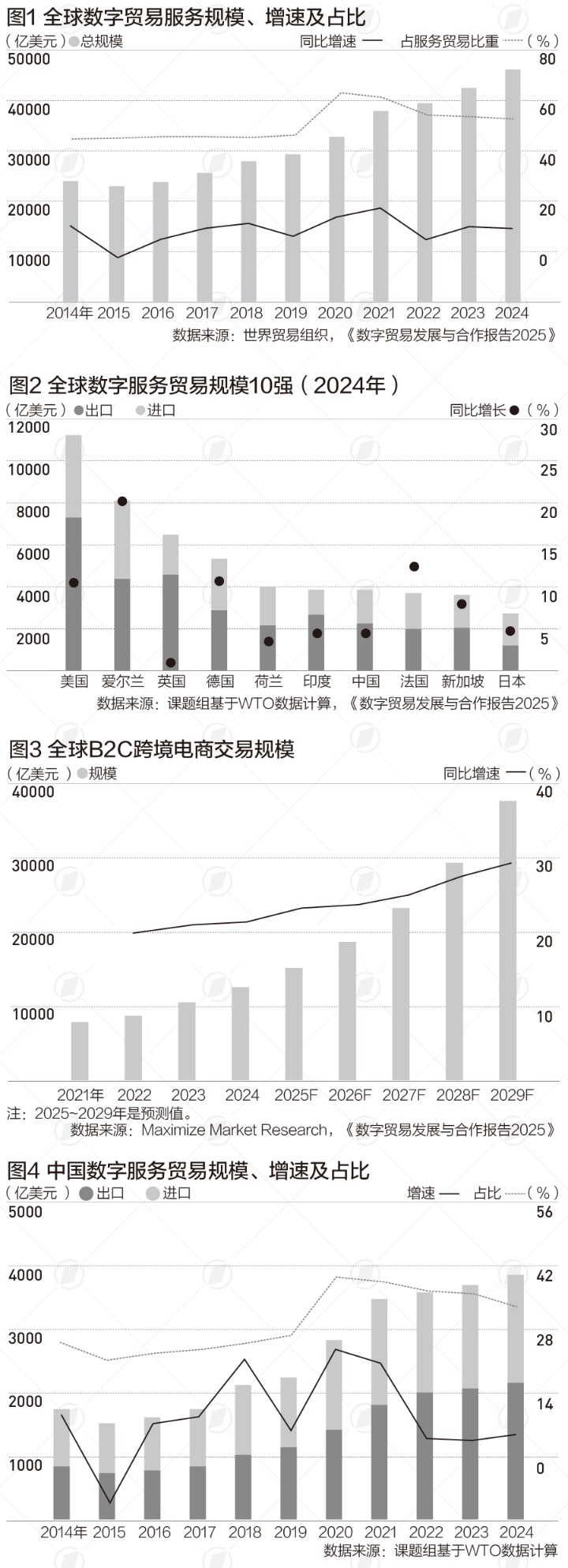
Core Insights - Artificial intelligence is reshaping the entire digital trade value chain and significantly impacting the global digital services trade landscape [1][15] - The global digital services trade is projected to reach $4.64 trillion in 2024, reflecting an 8.3% growth [2] - Digital services trade now accounts for 53.4% of global services trade, although it has slightly decreased from 53.8% in 2023 due to a strong recovery in tourism services [2][3] Digital Services Trade Growth - The global digital services trade has shown resilience and potential for long-term growth, with a 64.7% increase from 2019 to 2024, outpacing goods trade growth of 28.5% [1][2] - The share of digital services in global services trade has increased by 8.8 percentage points since 2019 [1] Country Rankings and Export Dynamics - The top ten countries in digital services trade remained unchanged in 2024, with the United States leading, followed by Ireland, the United Kingdom, and others [6] - The U.S. accounts for 15.3% of global digital services exports, while ASEAN countries collectively represent only 6% [7] E-commerce and Sector Performance - Global B2C cross-border e-commerce is expected to reach $1.167 trillion in 2024, growing by 22.2% [8] - ICT services, financial services, and intellectual property fees are the high-growth segments within digital services, collectively accounting for 52.8% of the sector [8] China's Digital Services Trade - China's digital services trade is projected to reach $385.76 billion in 2024, growing by 5.2% [9][13] - Digital services account for 36.7% of China's service trade, indicating significant room for growth compared to the global average of 53.4% [9][13] Sector Contributions and Trends - In China, ICT services dominate the digital services trade, contributing 59.7% to growth, with computer services showing strong international competitiveness [13] - The personal entertainment sector in China has seen remarkable growth, with exports increasing by 37.5% [14] Impact of Artificial Intelligence - The report highlights the transformative role of artificial intelligence in enhancing global trade across various dimensions [15]
全球数字服务贸易超4万亿美元,人工智能驱动增长
Di Yi Cai Jing· 2025-09-18 12:12
Core Insights - The global digital services trade is experiencing significant growth, with a projected scale of $4.64 trillion in 2024, marking an 8.3% increase from the previous year [2] - Digital services now account for 53.4% of global service trade, although this is a slight decrease from 53.8% in 2023 due to a strong recovery in tourism services [2][7] - The United States leads in digital services exports, holding a 15.3% share of the global market, followed by the UK and Ireland [7] Digital Services Trade Growth - The digital services trade has expanded by 64.7% from 2019 to 2024, significantly outpacing the growth of goods trade (28.5%) and overall service trade (37.5%) during the same period [1] - The resilience and potential of digital services trade are highlighted, as it continues to grow despite fluctuations in traditional goods and services trade due to various global challenges [2] China's Digital Services Trade - China's digital services trade reached $385.76 billion in 2024, growing by 5.2%, with exports increasing by 6.1% and imports by 3.5% [9][13] - Digital services account for 36.7% of China's service trade, indicating room for further growth compared to the global average of 53.4% [9][13] - China ranks 7th globally in digital services trade, maintaining a net export surplus of $55.37 billion [13] Sector Performance - The ICT services sector is the largest contributor to China's digital services trade, accounting for $133.76 billion, with a growth contribution rate of 59.7% [13] - Personal entertainment services have shown remarkable growth, with export growth reaching 37.5% and imports at 27.9% [14] - Cross-border e-commerce is rapidly expanding, with a projected scale of $1.167 trillion in 2024, growing by 22.2% [8][14] Impact of Artificial Intelligence - The integration of artificial intelligence is reshaping digital trade across various dimensions, enhancing both supply and demand sides [14] - The potential for AI to significantly boost service trade growth rates is acknowledged, with optimistic scenarios suggesting increases of up to 18% by 2040 [14]

数贸会筹备工作就绪 参展商超1700家
Zhong Guo Zheng Quan Bao· 2025-09-11 20:17
Core Insights - Digital trade is emerging as a new driving force for high-quality business development and is a crucial pillar for building a strong trading nation. In the first half of this year, China's digitally deliverable service imports and exports reached 1.5 trillion yuan, while cross-border e-commerce imports and exports hit 1.3 trillion yuan, both setting historical records [1][2]. Group 1: Digital Trade Expo - The Fourth Global Digital Trade Expo will be held in Hangzhou, Zhejiang from September 25 to 29, with over 1,700 exhibitors and a total exhibition area of 155,000 square meters [1]. - The expo will feature a strong focus on innovation and digital trade characteristics, emphasizing the integration of development concepts and ecosystems [1][2]. - International exhibitors account for over 20% of participants, including more than 70 Fortune Global 500 companies, and international attendees have increased by 54% compared to last year [1][2]. Group 2: Future Industry Development - The expo will include a "Future Technology Arena" main exhibition area and seven themed exhibition areas, showcasing over 100 first-time releases in China, Asia, and globally, focusing on cutting-edge technologies like generative AI and multimodal sensory interaction [2]. - The event aims to create market opportunities and facilitate cooperation between exhibitors and buyers, with a total expected procurement amount of 30 billion yuan [2]. Group 3: Cross-Border E-Commerce - Cross-border e-commerce is a significant component of digital trade, with Hangzhou continuing to lead in reform and development, optimizing top-level design, and enhancing the cross-border e-commerce comprehensive pilot zone [3].
今日视点:以“人工智能+”赋能服务贸易高质量发展正当其时
Zheng Quan Ri Bao· 2025-08-27 23:27
Core Viewpoint - The development of service trade in China is experiencing significant growth, with a total import and export value of 3.9 trillion yuan in the first half of the year, marking an 8% year-on-year increase, the highest for the same period in history [1] Group 1: Government Initiatives - The government is promoting the integration of "artificial intelligence + service trade" to enhance the international competitiveness of the service industry [2] - Policies such as the "Opinions on Promoting High-Quality Development of Service Trade through High-Level Opening" emphasize the use of digital technology and artificial intelligence to innovate service supply [2] - Local governments, like Chongqing, are implementing action plans to optimize digital service trade and leverage advanced technologies to enhance their international market share [2] Group 2: Industry Adaptation - Service trade entities are encouraged to utilize "artificial intelligence +" to improve product and service competitiveness [3] - The "Opinions on Deepening the Implementation of 'Artificial Intelligence +'" suggest new service models that combine digital empowerment with intelligent-driven services [3] - Companies should focus on enhancing customer service through AI-driven tools for personalized recommendations and efficient client development [3] Group 3: Future Opportunities - The integration of "artificial intelligence +" presents unprecedented opportunities for high-quality development in service trade, driving it towards greater efficiency, intelligence, and quality [4]
浙江省全力打造全球数字贸易中心
Zhong Guo Chan Ye Jing Ji Xin Xi Wang· 2025-08-27 00:49
Group 1 - Zhejiang Province has issued the "Implementation Plan for the Reform and Innovation Development of Digital Trade" to enhance its competitive advantage in digital trade and support high-quality development [1] - The plan outlines a "1+3+N" framework, which includes a global digital trade expo, three key centers (Hangzhou, Ningbo, Yiwu), and encourages other cities to develop distinctive digital trade projects [1] - By 2027, Zhejiang aims to rank among the top provinces in digital trade scale and establish itself as a global digital trade center by 2035 [1] Group 2 - The plan promotes the development of cross-border e-commerce by integrating it with traditional industries and enhancing brand cultivation [2] - It encourages the use of live streaming and visual marketing strategies in cross-border e-commerce, while also improving overseas service capabilities [2] - The initiative aims to optimize global overseas warehouse layouts and enhance their digital and intelligent capabilities [2] Group 3 - The plan focuses on building a competitive digital trade enterprise ecosystem, targeting the cultivation of cross-border e-commerce platforms with annual transaction volumes exceeding 10 billion [3] - It aims to support small and medium-sized enterprises in their digital transformation and technological upgrades [3] - The initiative includes the modernization of digital trade ports, enhancing the digital operation levels of sea, land, and air ports [3]
