
数据中心(IDC)

Search documents
通信行业研究:GTC与OFC共同催化光通信赛道,阿里加速向A1基础设施商转型
SINOLINK SECURITIES· 2026-03-22 14:42
Investment Rating - The report suggests focusing on sectors driven by domestic AI development such as servers and IDC, as well as sectors driven by overseas AI development like servers and optical modules [5] Core Insights - NVIDIA's GTC conference highlighted a projected demand of at least $1 trillion by 2027 for AI computing power, indicating a robust growth cycle for AI demand [1][2][56] - The optical module industry is expected to see a market size increase of 1.5 to 2 times by 2026, with further doubling anticipated in 2027 [1][2] - Alibaba's cloud AI revenue has shown triple-digit growth for ten consecutive quarters, with a target to exceed $100 billion in cloud and AI revenue within five years [1][3][48] - The collaboration between Tower and NVIDIA aims to scale up the production of 1.6T silicon photonics, which is crucial for high-speed AI interconnects [1] Summary by Sections Server Sector - The server index decreased by 4.81% this week and 5.42% this month, but NVIDIA's GTC conference indicated strong AI computing demand [2][7] - Meta signed a $27 billion AI infrastructure agreement with Nebius, and AMD partnered with Celestica to launch the "Helios" AI platform [2][7] Optical Module Sector - The optical module index increased by 1.74% this week and 8.02% this month, with a projected shipment of 8 to 20 million 1.6T modules by 2026 [2][7] - High-end EML supply-demand gaps are widening, with domestic alternatives expected to fill the market [2][7] IDC Sector - The IDC index rose by 1.50% this week but fell by 3.77% this month, with Alibaba's AI-related product revenue growing by 36% [3][12] - The consumption of tokens on Alibaba's MaaS platform increased sixfold over the past three months, indicating a surge in demand for AI services [3][12] Core Data Updates - The telecommunications business revenue reached 1.75 trillion yuan in 2025, with a year-on-year growth of 0.7% [4][16] - The export value of optical modules in December increased by 0.9% year-on-year, although the cumulative annual export value decreased by 16% [4][30]


光模块龙头跌超5%,资金逢跌布局创业板人工智能!11年前最牛赛道卷土重来,网宿科技大涨超12%!
Xin Lang Cai Jing· 2026-02-11 03:21
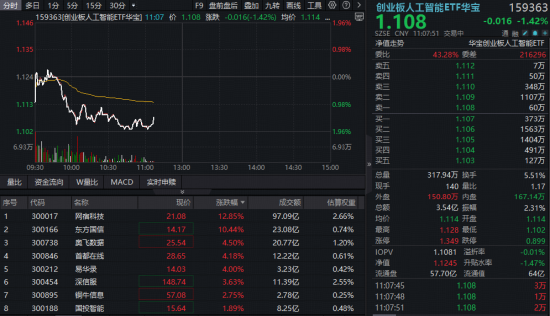
Market Overview - On February 11, the CPO optical module and AI applications experienced a pullback, with the ChiNext AI index dropping nearly 2% during intraday trading. Huace Film & TV led the decline with over a 10% drop, while several stocks like Xinyisheng and Zhongji Xuchuang fell more than 5% [1][6] - Notably, the IDC sector saw a resurgence, with Wangsu Technology surging over 12%, and stocks like Aofei Data and Capital Online rising more than 4% [1][6] ETF Performance - The ChiNext AI ETF (159363), which focuses on "computing power + AI applications," saw its price dip by 2% at one point, with real-time transactions exceeding 350 million yuan and a net subscription of 16 million units during the trading session [1][6] - The ETF's portfolio is approximately 60% allocated to computing power (including leading optical module and IDC companies) and about 40% to AI applications, representing both the core of "computing power" and true "AI applications" [3][8] AI Industry Insights - The recent launch of the AI video generation model Seedance 2.0 by ByteDance has gained significant attention, capable of creating cinematic-quality videos from text or images in just 60 seconds. This model is expected to drive the AI multi-modal industry chain, potentially catalyzing a rebound in AI applications [3][8] - The demand for computing power is anticipated to increase significantly due to the large-scale token consumption driven by large models, benefiting upstream hardware infrastructure [3][8]


证券研究报告行业周报:IDC的边际变化-20260111
GOLDEN SUN SECURITIES· 2026-01-11 12:44
Investment Rating - The report maintains a "Buy" rating for key companies in the IDC sector, including Zhongji Xuchuang, Xinyi Sheng, and Tianfu Communication [5][10][24]. Core Insights - The IDC market is experiencing a shift in supply and demand dynamics, driven by marginal improvements in chip supply and the explosive demand for domestic AI applications [2][20]. - Major domestic companies like ByteDance are significantly increasing their capital expenditure plans, leading to a resurgence in data center bidding activities [1][19]. - The release of NVIDIA's next-generation AI chip platform, "Rubin," is set to redefine hardware standards for high-power, fully liquid-cooled data centers, prompting a global technological upgrade in data centers [4][22][26]. Summary by Sections IDC Market Dynamics - The IDC sector is regaining attention as major companies resume bidding for data centers due to improved chip supply and clear capital expenditure plans [3][21]. - The current valuation of the IDC sector is at a bottom range, providing room for recovery as the national integrated computing network accelerates its systematic construction [3][21]. Supply Chain and AI Applications - The easing of external chip restrictions has allowed internet giants to restart data center bidding, with expectations of improved supply from late 2025 [2][20]. - Continuous iterations of domestic large models are creating real and sustained demand for computing power, which is crucial for data center construction [2][20]. Investment Opportunities - The report suggests focusing on IDC manufacturers such as Dongyangguang, Runze Technology, and Aofei Data, as well as companies in the optical communication and liquid cooling sectors [24][9]. - Key recommended companies include Zhongji Xuchuang, Xinyi Sheng, and Tianfu Communication, among others, with a focus on the optical module industry and domestic computing supply chain [24][9].


浩云长盛彭轶峰:兼容并蓄和系统性思维是应对IDC行业急速迭代的生存法则
Huan Qiu Wang Zi Xun· 2025-12-18 06:31
Core Viewpoint - The data center industry is undergoing a profound transformation, evolving from a mere physical space for data storage and computation to a "computing power center" essential for AI model training and algorithm iteration [1] Group 1: Industry Challenges and Opportunities - The primary challenge facing the IDC industry is not merely technical bottlenecks but a shift in cognitive understanding, moving from "what I can do" to "what I need to do in the future" [3][11] - The demand for computing power in the AI era is characterized by diversification, high elasticity, and rapid iteration, with hardware and algorithm cycles shortening from five to six years to two to three years, and potentially to six months in the future [5] Group 2: Strategic Directions - The future computing power centers must embody compatibility and foresight, as traditional data centers lacking these traits are at risk of obsolescence [4] - The company advocates for a "toolbox" approach, storing a series of compatible technologies that can be flexibly combined to meet varying needs and developmental stages [6] Group 3: Lifecycle and Sustainability - The industry is currently focused on PUE (Power Usage Effectiveness) and WUE (Water Usage Effectiveness), but a more comprehensive view of the full lifecycle resource consumption is necessary, from raw material extraction to end-of-life disposal [7][8] - The company has developed models to analyze the true value of energy-saving measures, emphasizing the importance of optimizing applications and reducing energy conversion losses [8] Group 4: Cooling Technologies - Liquid cooling technology is seen as a potential solution for high-density heat dissipation, but its current market share is only about 15%, with mainstream applications still concentrated in the 10-20 kW range [10] - The company acknowledges that the development of high-density liquid cooling is still in the exploratory phase, requiring extensive application cases and data to validate its effectiveness [11]

当前时点如何看IDC板块?
2025-12-03 02:12
Summary of IDC Industry Conference Call Industry Overview - The IDC industry has experienced a two-quarter stagnation, but optimistic capital expenditure plans from major companies in Q4 indicate that the bidding volume for 2026 is expected to reach a new high, with large-scale orders of 100 MW being realized, signaling a shift from expectations to actual performance [1][2]. Key Insights - The acceptance of domestic cards in the ITC industry continues to rise, as evidenced by Century Internet's 50 MW project utilizing domestic cards, indicating an increase in penetration and a decrease in correlation with overseas cards [1][3]. - The approval authority for IDC projects has been centralized to the National Development and Reform Commission, leading to a slowdown in new supply, which is beneficial for optimizing the current oversupply situation in the market, positively impacting the ITC industry [1][5]. - Valuations of major A-share IDC companies are currently low, with AoFei and Runze at 14x and 17x respectively, below the historical normal demand phase valuation range of 10-20x, suggesting a good opportunity for investment in the ITC sector [1][6]. Market Demand - The demand side for the ITC market is expected to exceed forecasts in 2024, with bidding volumes reaching between 2 to 2.5 GW. However, the IDC bidding stagnated for over two quarters due to the H20 ban in Q2, resulting in smaller project sizes predominantly focused on cloud computing [2]. Supply Dynamics - A new policy implemented at the end of March has centralized the approval process for IDC projects, resulting in a very low approval rate for the first batch of projects, which is less than single digits. This reduction in new supply is expected to positively impact the ITC industry [5]. Investment Attractiveness - Current valuations of A-share companies in the IDC sector are considered attractive, with the potential for significant returns as the market adjusts. The recent REITs issued by Wangguo and Runze have seen their market valuations rise to 20x and 24x respectively, indicating a re-evaluation of IDC asset values [1][6]. Future Prospects - The ITC sector is anticipated to benefit from the catalytic effect of domestic supply chains, particularly with ByteDance's recent AI hardware applications expected to drive demand for underlying computing power. Given the current low valuation and improving fundamentals, the sector is viewed as having substantial growth potential, with expected stock price returns of 30%-40% [3][7].
深圳市宇顺电子股份有限公司第六届董事会第三十次会议决议公告
Shang Hai Zheng Quan Bao· 2025-11-17 19:21
Core Viewpoint - Shenzhen Yushun Electronics Co., Ltd. has approved a proposal to purchase a 6% equity stake in Hebei Aihua Data Technology Co., Ltd. from its controlling shareholder, Shanghai Fengwang Industrial Co., Ltd., for a total consideration of RMB 3 million [4][11][38]. Group 1: Meeting Resolutions - The board meeting on November 17, 2025, was attended by all seven directors, and the proposal was passed with 4 votes in favor, 0 against, and 0 abstentions [2][4]. - The supervisory board meeting also approved the same proposal with 3 votes in favor, 0 against, and 0 abstentions [8][38]. Group 2: Transaction Details - The transaction involves purchasing 6% of the equity of Hebei Aihua Data Technology Co., Ltd. for RMB 3 million, which has already been fully paid by Shanghai Fengwang [4][11]. - The independent directors reviewed and approved the proposal before it was submitted to the board [13][38]. Group 3: Financial and Operational Context - Shanghai Fengwang, the selling party, has a negative net asset value of RMB -229.89 million as of September 30, 2025, with no revenue generated in 2024 and a net loss of RMB -80.54 million for the first nine months of 2025 [15]. - Hebei Aihua Data Technology Co., Ltd. was established on August 29, 2023, with a registered capital of RMB 50 million and is currently in the project preparation phase for a data center project in Zhangjiakou, Hebei [18][20]. Group 4: Strategic Implications - The investment aligns with the company's strategic goals and aims to enhance its competitive position in the IDC industry while controlling investment risks [36][38]. - The company does not plan to increase its stake in Hebei Aihua Data Technology Co., Ltd. in the near future, focusing instead on the current investment [22][38].

世纪互联二季度财报发布:总营收增长22%至24.3亿元
Zheng Quan Shi Bao Wang· 2025-08-22 03:59
Core Insights - Century Internet (VNET.US) reported a strong financial performance for Q2 2025, with total revenue increasing by 22.1% year-on-year to 2.43 billion RMB [1][2] - The company is focusing on the transition to AI-driven data centers (AIDC) through its newly launched Hyperscale 2.0 framework, aiming to enhance competitiveness and sustainability [2][4] Financial Performance - Total revenue for Q2 2025 reached 2.43 billion RMB, reflecting a year-on-year growth of 22.1% [1][2] - Adjusted cash gross profit increased by 34.9% to 1.06 billion RMB, with an adjusted cash gross margin rising from 39.5% to 43.6% [1] - Adjusted EBITDA grew by 27.7% to 732 million RMB, with an adjusted EBITDA margin improving from 28.8% to 30.1% [1][2] Business Operations - The base IDC business saw a significant year-on-year revenue increase of 112.5%, contributing to the overall revenue growth [2] - As of June 30, the operational capacity of the base IDC business increased by 17.5% to 674 MW, with a total of 326 MW under construction and 374 MW in reserve [3] - The company secured approximately 4 MW of orders in urban IDC business and won a 20 MW order for base IDC in Hebei [3] Strategic Initiatives - The Hyperscale 2.0 framework aims to transform the business model from single project resource delivery to providing comprehensive AIDC solutions [4] - The company plans to increase its managed data center asset scale to 10 GW by 2036, with initial developments in Inner Mongolia, Hebei, and Beijing [4] - Century Internet is focusing on high-quality, high-margin business operations while optimizing operational efficiency [3]

云工场(2512.HK):立足IDC “边缘计算+边缘AI”打造新引擎
Ge Long Hui· 2025-07-31 03:30
Core Viewpoint - The company, YunGongChang, is one of the earliest IDC service providers in China, focusing on becoming a leading provider of edge computing and edge AI services, driven by stable upstream and downstream relationships and significant market potential in these areas [1][2]. Group 1: IDC Business Growth - The demand for IDC services is experiencing stable growth due to the digital transformation of Chinese enterprises and advancements in technologies such as cloud computing, blockchain, and IoT. Frost & Sullivan projects a compound annual growth rate (CAGR) of 13.6% for the Chinese IDC market from 2024 to 2028 [1]. - Non-self-built data centers are favored by small enterprises for their low cost and high flexibility, leading to a rapid growth in the IDC solution service market, with an expected CAGR of 17.0% from 2024 to 2028 [1]. Group 2: Market Position and Strategy - The company has established brand recognition through quality service and maintains long-term stable partnerships with upstream and downstream players, which is expected to help expand its market share [1]. - The company is continuously enriching its service product portfolio and expanding its customer base, which may facilitate rapid business expansion through a flexible and scalable business model [1]. Group 3: Edge Computing and AI Growth - Edge computing has extensive applications in IoT, AI, and augmented reality, with significant growth potential. Frost & Sullivan forecasts a CAGR of 32.9% for the edge computing market from 2024 to 2028 [2]. - The company's edge computing brand, "Lingjing Cloud," has established a cross-regional edge computing network across major cities in mainland China and plans to explore lower-tier market opportunities to capitalize on industry growth [2]. - Edge computing has become the company's second growth curve, contributing to its overall revenue growth [2]. Group 4: Financial Projections - The company anticipates revenues of RMB 881 million and RMB 1.042 billion for 2025E and 2026E, respectively, reflecting growth rates of 24% and 18%. Expected net profits are RMB 27 million and RMB 49 million, with net profit margins of 3.1% and 4.7% for the same years [2]. - Based on comparable company valuations, a target price of HKD 5.0 is set for the company, applying a 43x P/E ratio for 2026E [2].
IDC行业报告(二):IDC需求测算逻辑、估值探讨与标的梳理-20250722
Western Securities· 2025-07-22 12:12
Investment Rating - The industry investment rating is "Overweight" [5] Core Insights - The report discusses the IDC industry, focusing on demand measurement and valuation from a quantitative perspective, highlighting the importance of AI servers as core equipment in IDC [1][14] - It provides four methodologies for estimating IDC demand: capital expenditure perspective, application token call volume perspective, IDC vendor revenue perspective, and server shipment volume perspective [14][17] - The report emphasizes that EBITDA is a more accurate reflection of IDC companies' operational performance compared to net profit, advocating for the use of EV/EBITDA valuation method [22][32] Demand Measurement - The IDC industry in China generated revenue of 240.7 billion yuan in 2023, with a year-on-year growth of 26.68% and a compound annual growth rate of 17.07% over the past three years [13] - The number of operational data center racks in China reached 8.1 million in 2023, with an average power of 20.5 kW per rack, reflecting a 24.2% increase from 2022 [13] - The four demand measurement methodologies include: 1. Capital expenditure perspective: Estimating AI server demand based on capital expenditure plans from major companies [17] 2. Application token call volume perspective: Deriving IDC demand from token and FLOPS requirements [17] 3. IDC vendor revenue perspective: Predicting future IDC revenues of major listed companies to estimate market size [17] 4. Server shipment volume perspective: Tracking quarterly AI server shipments to infer IDC demand [15][21] Valuation of IDC Companies - IDC companies primarily use the EV/EBITDA valuation method, as EBITDA better reflects the actual operating conditions and industry characteristics [22][32] - The report highlights the significance of EBITDA rates in indicating the core competitiveness of IDC companies, influenced by client structure and contract terms [30][28] - North American IDC leader Equinix's transition to REITs is noted as a model for Chinese IDC companies, emphasizing the importance of expanding value-added services [42][45] Investment Recommendations - Short-term focus on the IDC industry is advised due to supply disruptions from high-end chip availability, with a recommendation to monitor new chip testing and bidding activities [3] - Long-term outlook remains positive, with a focus on financing costs, power supply optimization, and the expansion of value-added services [3] - Specific companies to watch include: 1. 万国数据 (GDS): Leading IDC company with significant overseas market expansion [46] 2. 润泽科技 (Runze Technology): Rapid capacity expansion and REITs issuance [64] 3. 世纪互联 (CenturyLink): Strong market presence with a dual focus on base and city-type IDC services [58]



城地香江: 容诚会计师事务所(特殊普通合伙)关于上海城地香江数据科技股份有限公司2024年年度报告的信息披露监管问询函的专项说明(容诚专字[2025]200Z0743号)
Zheng Quan Zhi Xing· 2025-07-14 16:25
Core Viewpoint - The company has disclosed accounting errors related to internal transactions, asset capitalization, and revenue recognition, leading to a non-standard audit opinion for the 2024 financial report [2][10]. Group 1: Accounting Errors - The company reported errors in internal transaction income and cost offsets, leading to understated costs and overstated inventory [3][4]. - Errors in the capitalization of rental assets were identified, where renovation costs were incorrectly classified [4][5]. - Issues in revenue recognition for IDC system integration projects were noted, primarily due to delays in collecting and processing original documents [5][6]. Group 2: Financial Impact - The adjustments for the accounting errors resulted in changes to the 2023 consolidated financial statements, including an increase in revenue from 2.37 billion to 2.43 billion and an increase in costs from 1.91 billion to 2.02 billion [6][10]. - The company’s 2024 annual report showed a revenue decline of 33.36%, with IDC business revenue decreasing by 23.51% [10][11]. Group 3: Audit Opinion - The audit firm issued a qualified opinion due to insufficient evidence to confirm the accuracy of the accounting error corrections, particularly regarding the IDC system integration revenue and inventory estimates [9][10]. - The audit procedures included evaluating internal controls, interviewing financial personnel, and reviewing relevant documentation, but sufficient evidence was not obtained [8][9]. Group 4: Client and Supplier Information - The company is required to disclose detailed information about its top ten clients and suppliers, including transaction backgrounds and performance metrics, to explain the revenue decline [10][11].
