
早茶餐饮

Search documents
广州早茶立法表决通过 将区分手工现制、规范茶位费
Yang Guang Wang· 2026-02-02 06:57
Core Viewpoint - Guangzhou is implementing regulations to protect its traditional tea culture, specifically the "Guangfu Tea Drinking Customs," which includes the preparation and serving of dim sum like shrimp dumplings and char siu buns. The regulations aim to define traditional practices and ensure quality standards in the tea dining experience [1]. Group 1: Regulations and Standards - The newly passed "Guangzhou Early Tea Inheritance and Protection Regulations" will define what constitutes "traditional on-site production" for dim sum, allowing pre-preparation but requiring final assembly to occur in-store [1][2]. - The regulations mandate that early tea operators must display the food preparation process transparently, ensuring that traditional items are made within 24 hours of serving to guarantee freshness [2][5]. Group 2: Consumer Rights and Pricing - The regulations require clear pricing for all charges, including tea service fees, and mandate that a variety of teas be offered to consumers, thus protecting their rights to information and choice [6]. - Some businesses are adapting to consumer preferences by offering flexible pricing models, including not charging for tea service if customers do not order tea [6][5]. Group 3: Cultural Preservation and Talent Development - The regulations emphasize the need for a vocational skill evaluation system for tea masters and the establishment of "Guangzhou Tea Master Studios" to preserve traditional skills and facilitate the growth of new talent [9]. - There is a recognition that traditional tea establishments may charge slightly higher prices due to the quality and craftsmanship involved, which consumers are likely to accept in support of traditional practices [9].

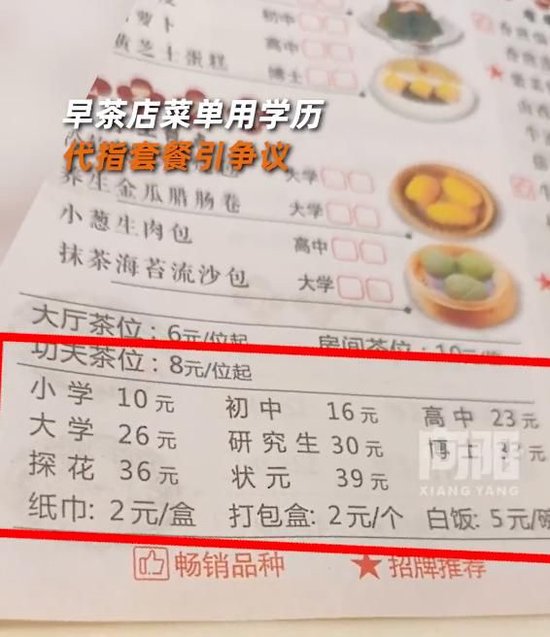
广州一早茶店菜单用学历代指套餐引争议,当地早茶店:“小学”一般是7元,“博士”一般是28元
Xin Lang Cai Jing· 2025-12-31 02:01
Core Viewpoint - A controversy has arisen in Guangzhou, Guangdong, regarding a dim sum restaurant that lists prices based on educational qualifications on its menu, which has sparked public debate about the implications of such pricing practices [1][4]. Group 1 - The menu categorizes dishes by educational levels, with "Elementary" indicating a price of 7 yuan and "Doctorate" indicating a price of 28 yuan [2][5]. - The lower-priced items (7 yuan) are simpler dishes, such as a bowl of congee and a small portion of rice rolls, while the higher-priced items (28 yuan) offer more variety, including options like durian pastry and money belly [2][5].
15000多家店生意火爆!国庆中秋假期江苏泰州早茶火出圈→
Sou Hu Cai Jing· 2025-10-06 15:02
Core Insights - The early tea business in Taizhou, Jiangsu, has seen a significant surge in popularity during the recent holiday, with over 15,000 tea shops experiencing high demand and long queues for seating [1][3]. Group 1: Business Performance - The customer flow in Taizhou's tea shops has increased by over 50% compared to regular weekends, with more than 60% of visitors coming from Changzhou [3]. - Tea shop operators have prepared ample supplies, extended operating hours, and increased staff to accommodate the influx of customers during the holiday [7]. Group 2: Culinary Highlights - The "early tea three treasures" including crab yellow soup dumplings, dry silk, and fish soup noodles have become popular among diners, providing a dual sensory experience of taste and visual appeal [5]. - The Jingjiang crab yellow soup dumpling is renowned nationwide for its unique flavor, with local shops experiencing full capacity every morning during the holiday [9]. Group 3: Cultural Significance - The crab yellow soup dumpling making technique is recognized as a provincial intangible cultural heritage, with the daily preparation of ingredients significantly increasing during the holiday period [11].
城市24小时 | “工业第一城” 继续“拥抱”传统产业
Mei Ri Jing Ji Xin Wen· 2025-09-30 15:59
Core Insights - Shenzhen aims to leverage its rich innovation resources and diverse industrial categories to upgrade traditional industries, targeting a total scale of over 700 billion yuan within three years [1] - The city plans to implement 12 policy measures, including the establishment of various investment funds to support mergers and acquisitions in traditional industries [1][2] - Shenzhen's advanced manufacturing and high-tech manufacturing sectors account for 68.2% and 58.2% of the city's industrial added value, respectively [1] Group 1: Traditional Industry Development - Shenzhen has a strong presence in traditional industries such as high-end women's clothing, jewelry, and eyewear, with the jewelry industry holding a national industrial output value lead [2] - The city will implement an action plan to integrate artificial intelligence into various traditional sectors, aiming to digitize over 100 traditional enterprises within three years [2][3] - The government recognizes both traditional and emerging industries as essential components of a modern industrial system, promoting a blend of technology and traditional manufacturing [3] Group 2: Investment and Policy Measures - The city will create a multi-faceted investment support model involving government-guided funds, listed company capital, and professional investment institutions [1] - Shenzhen aims to cultivate over 100 cross-industry fusion fashion products and popular national trend products by 2027 [3] - The approach of "policy guidance + market leadership + technology empowerment" is expected to serve as a replicable model for traditional industry transformation across the country [3]
广州拟为早茶设立专项规定:预制点心差别定价,茶位费不能只收钱
第一财经· 2025-09-30 08:59
Core Viewpoint - The article discusses the ongoing public consultation regarding the "Guangzhou Early Tea Inheritance and Protection Regulations" draft, highlighting the significance of establishing specific regulations for early tea in Guangzhou to enhance consumer experience and promote local culture [3]. Group 1: Market Growth and Consumer Sentiment - The Chinese catering industry has grown from 3.7 trillion yuan in 2017 to an estimated 5.5 trillion yuan in 2024, indicating a robust market [3]. - Consumers have expressed concerns about the tea seat fee and its perceived value, particularly among younger demographics who are more sensitive to pricing [6][5]. - The article notes that local consumers are generally more accepting of the tea seat fee, while younger consumers may prefer other dining options if the perceived value is not met [6]. Group 2: Regulatory Changes and Consumer Rights - The draft regulations emphasize the need for clear pricing and transparency in the tea seat fee structure, requiring operators to provide a variety of tea options and adequate service [6][8]. - Consumers' rights to know about the preparation methods of tea items are addressed, with a distinction made between traditionally and non-traditionally prepared items [8]. - The regulations propose the establishment of "Guangzhou Early Tea Classic Stores," which will be certified and monitored to ensure they meet traditional standards [8][9]. Group 3: Industry Trends and Brand Revival - There is a noted "Renaissance" in the Guangzhou early tea market, with a resurgence of traditional brands that focus on freshly made tea items [9]. - Historical brands like Huiru Lou and Qiu Da San Yuan are experiencing a revival, indicating a consumer preference for freshly prepared items over pre-made options [9]. - The management of these establishments is adapting to consumer preferences by ensuring that freshly made items are prioritized, even if it results in longer wait times [9].
广州早茶“听劝”:预制点心差别定价,茶位费不能只收钱
Di Yi Cai Jing· 2025-09-30 05:24
Core Viewpoint - The Guangzhou government is seeking public opinions on the draft regulations for the protection and inheritance of early tea culture, highlighting the significance of establishing specific regulations for early tea as a cultural heritage and its potential to boost local tourism and consumption [1][5]. Group 1: Regulatory Developments - The draft regulations require early tea operators to clearly display all charges, including tea seat fees, ensuring consistency across menus and pricing methods [3]. - Operators must provide a variety of tea options, such as black tea, green tea, and pu-erh tea, along with adequate tea service when charging tea seat fees [3]. Group 2: Consumer Rights and Pricing - The draft addresses consumer rights by mandating that early tea operators inform customers about the differences between traditionally and non-traditionally made tea items, with the latter potentially being priced differently [4]. - The regulations also emphasize the need for transparency in food preparation processes, allowing consumers to observe how traditional dim sum is made [4]. Group 3: Market Trends and Consumer Preferences - There is a noted resurgence in the Guangzhou early tea market, with traditional brands gaining popularity as consumers show a preference for freshly made dim sum over pre-prepared items [6]. - The management of traditional tea houses is adapting to consumer preferences by ensuring that freshly made items are prioritized, even if it results in longer wait times for customers [6]. Group 4: Cultural and Economic Impact - The development of standardized, professional, and branded early tea services is seen as a key driver for consumption, internal demand, and tourism, contributing to the preservation of Guangzhou's early tea culture [5]. - The recognition of "classic early tea shops" aims to promote traditional practices and ensure quality, with shops needing to meet specific criteria to maintain this designation [4].
金融活水“烹煮” 早茶“香飘”万家
Jin Rong Shi Bao· 2025-05-13 01:49
Group 1: Industry Overview - The early tea industry in Wuzhong has developed into a comprehensive industrial cluster integrating dining, tourism, culture, and leisure, attracting 3.25 million visitors and generating sales of 826 million yuan during the 2024 Wuzhong Early Tea Food Culture Festival [1] - The early tea industry has become a significant brand and economic engine for local development in Wuzhong, with over 780 registered early tea shops generating an annual output value exceeding 1.5 billion yuan [4] Group 2: Financial Support and Development - The People's Bank of China Wuzhong Branch has prioritized financial support for the early tea industry, launching initiatives to assist small businesses and individual entrepreneurs, resulting in a loan balance of 640 million yuan for the early tea industry, a year-on-year increase of 22.2% [2] - Financial institutions have developed specialized loan products such as "Early Tea Business Loans" and "Ning Shang Quick Loans" to support the entire supply chain of the early tea industry [2] - As of April 2025, Wuzhong banks have provided financial support to 2,175 early tea industry entities, with a total loan balance of 43.73 million yuan, reflecting a year-on-year growth of 5.57% [6] Group 3: Case Studies of Financial Impact - Ningxia Zhonghua Snow Food Technology Co., a key supplier in the early tea industry, received a credit line of 50 million yuan from Ningxia Bank to stabilize its supply chain, ensuring the smooth operation of the early tea industry [3] - The owner of Chenzi Beef Noodle Restaurant successfully expanded his business with the help of a 1 million yuan loan from Wuzhong Rural Commercial Bank, which allowed him to renovate his shop and purchase quality ingredients [5] - Li Haiyan, owner of a well-known early tea shop, quickly obtained a 100,000 yuan loan through the Industrial and Commercial Bank of China’s mobile banking app, demonstrating the efficiency of financial services in supporting local businesses [7]