传统产业转型

Search documents
【西安】规上工业总产值首超万亿元
Shan Xi Ri Bao· 2026-02-06 23:27
Group 1 - The core viewpoint of the articles highlights that Xi'an's industrial output value is projected to exceed 1 trillion yuan for the first time in 2025, reaching 1.06 trillion yuan, with a year-on-year growth of 6.9% [1] - Xi'an is focusing on key industries through tailored strategies, including "one chain, one policy" for major industries and "one enterprise, one special team" for key companies, to support industrial growth [1] - The city is concentrating on ten key industrial chains, including aerospace, semiconductors, new materials, and biomedicine, and has developed a three-year action plan to address weaknesses in these chains [1] Group 2 - The six pillar industries in Xi'an, including automotive and electronic information, are expected to achieve an output value of 826.48 billion yuan, growing by 6.1%, which will account for 77.9% of the total industrial output [1] - The ten key industrial chains are projected to generate a manufacturing output value of 740.63 billion yuan, representing 69.8% of the industrial total, becoming the main engine for industrial growth [1] - The photovoltaic, intelligent connected new energy vehicles, and new materials chains are leading in growth rates, with increases of 56.1%, 14.9%, and 14.2% respectively, indicating significant enhancement in industrial competitiveness [1] Group 3 - Xi'an is promoting enterprise growth through layered cultivation, precise positioning in industrial chains, and integration of small and medium-sized enterprises, achieving over 65% coverage of "smart transformation and digital upgrade" among regulated enterprises [2] - By 2025, Xi'an plans to add 260 regulated industrial enterprises, cultivate 442 specialized and innovative enterprises, and establish 36 manufacturing champions, marking a record high in innovation vitality [2] - The city aims to accelerate the transformation of traditional industries towards high-end, intelligent, and green development, while fostering emerging industries such as biomedicine and new materials [2]
加快完善现代化产业体系
Xin Lang Cai Jing· 2026-01-30 04:13
Core Viewpoint - The construction of a modern industrial system is a crucial support for advancing Chinese-style modernization, with significant progress expected by 2025 in various initiatives such as industrial renewal and "AI+" actions [1] Group 1: Emerging Industries - Emerging industries are accelerating their development, with revenue from central enterprises in these sectors expected to increase by over 10 percentage points compared to 2022 [1] - Five leading enterprises in commercial aerospace and satellite internet have been selected, and over a hundred typical scenarios for future industries are being developed in brain-like computing [1] - World-class industrial clusters are being established in new generation information technology, new energy, new materials, and high-end equipment, with new business models continuously emerging [1] Group 2: Traditional Industries - The transformation of traditional industries is noticeably accelerating, with central enterprises leading large-scale equipment renewal actions [2] - Seventy excellent-level smart factories have been established, including a core component lean manufacturing smart factory for rail transit equipment [2] - Six leading smart factories have been cultivated, and 39 projects have been included in the second batch of national green low-carbon advanced technology demonstration projects [2] Group 3: Supply Chain Resilience - The resilience of industrial and supply chains is continuously strengthening, with central enterprises implementing high-quality development action plans for key manufacturing industry chains [2] - Breakthrough achievements have been made in fields such as integrated circuits, industrial mother machines, and new generation mobile communications [2] - Major projects focusing on food security, energy resources, and high-end equipment are being carried out to maintain the safety of China's industrial and supply chains [2] Group 4: Strategic Directions - The State-owned Assets Supervision and Administration Commission will guide central enterprises to focus on intelligent, green, and integrated directions to enhance their advantages [2] - Key strategic areas include "three concentrations," aiming to adjust existing structures and optimize new investments to enhance the integrity, advancement, and safety of China's industrial system [2] - A number of emerging pillar industries will be developed, with a focus on market-oriented and specialized state capital operation platforms in fields such as new energy, aerospace, and quantum technology [2]
21省抢先发布2025经济成绩单:谁在提速,谁在刹车?
Sou Hu Cai Jing· 2026-01-25 17:21
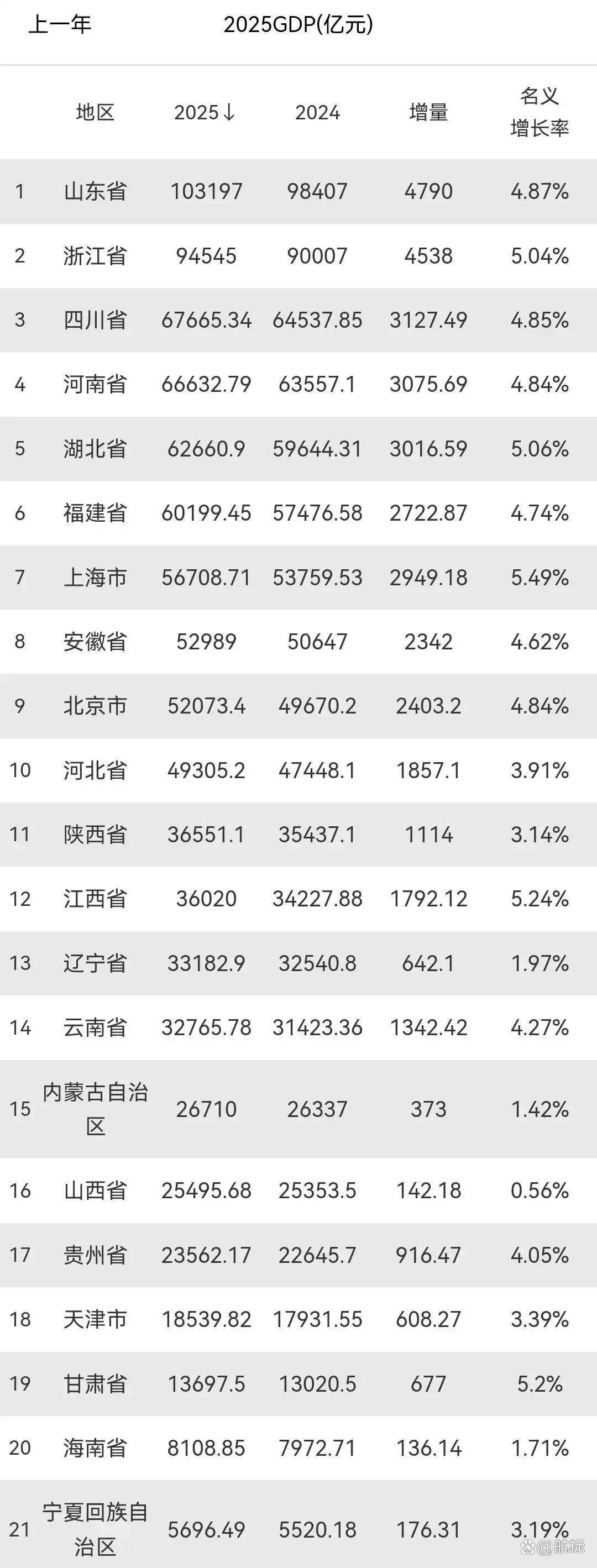
Core Insights - The economic performance of 21 provinces and cities in China for 2025 shows significant variations, with some regions accelerating growth while others are slowing down [1] Group 1: Economic Performance Overview - Shandong Province leads with a GDP of 10.32 trillion yuan and a nominal growth rate of 4.87% [2] - Shanghai has the highest nominal growth rate at 5.49%, driven by its digital economy, with a transaction scale in the data factor market exceeding 500 billion yuan [4] - Jiangxi Province achieved a notable growth rate of 5.24%, largely due to a 42% increase in investment in the new energy sector [4] - Gansu Province, despite a lower total GDP, shows a strong growth momentum with a rate of 5.20% [4] Group 2: Growth Leaders - Zhejiang and Hubei provinces both reported growth rates above 5%, with Zhejiang's resilient private economy and Hubei's optoelectronic information industry being key growth drivers [4] - Anhui Province also demonstrated a stable growth rate of 4.62%, supported by advancements in quantum computing [9] Group 3: Growth Slowdowns - Shanxi Province recorded the lowest growth rate at 0.56%, struggling with a high dependency on traditional energy sectors [7] - Hainan's growth rate of 1.71% fell short of expectations, with tourism recovery lagging [7] - Liaoning Province's growth rate of 1.97% reflects the challenges faced by old industrial bases in transitioning to new industries [7] Group 4: Trends and Observations - New growth drivers are crucial for achieving higher growth rates, with provinces exceeding 5% growth showing over 20% investment growth in strategic emerging industries [12] - Regions with growth rates below 2% typically have a high proportion of traditional industries, indicating a longer transition period to new sectors [12] - Collaborative regional effects are evident, with faster-growing provinces often located in urban clusters that enhance efficiency and reduce costs [12]

民营经济 向新向优
Xin Lang Cai Jing· 2026-01-18 00:57
Group 1 - The private economy is a vital force in the regional economic landscape, with 98% of the total 1.12 million business entities in Handan being private enterprises by November 2025 [1] - In 2025, 13 companies from Handan made it to the list of China's top 500 private enterprises, leading the province with over 40% of the total [1] - Handan's private economy has shown resilience and vitality, driven by supportive policies and services, enabling enterprises to progress towards innovation and quality [1] Group 2 - A favorable development environment is essential for the survival of private enterprises, with Handan focusing on market-oriented and legal reforms to eliminate barriers and support private businesses [2] - From March 1, 2025, Handan implemented remote evaluation for public bidding projects, breaking regional restrictions and promoting a fair competition environment [2] - A special action to rectify bidding processes has been initiated to ensure transparency and fairness in public resource transactions, benefiting the private economy [2] Group 3 - Financing challenges have historically hindered the growth of private and small enterprises, but Handan has helped 124,000 small businesses secure loans totaling 252.183 billion yuan in 2025 [3] - Handan secured 454 million yuan in project funding for "two new" industries, accounting for 64.2% of the city's total, stimulating private investment [3] - The introduction of a QR code regulatory model has clarified enforcement boundaries for 47,000 business entities, reducing arbitrary inspections and fostering a secure business environment [3] Group 4 - In 2025, 13 companies from Handan ranked among China's top 500 private enterprises, highlighting the region's strong leadership and cluster development in the private economy [4] - The steel industry remains a pillar of Handan's private economy, with 92% of the listed companies in this sector, although there is a clear trend towards transformation and diversification [4] - High-quality development is essential for the private economy, with companies like Jinan Steel Group innovating to enhance energy efficiency and reduce environmental impact [5] Group 5 - Handan's private sector is experiencing a surge in investment, with a 9.9% increase in private investment in 2025, accounting for 63.7% of total investments [5] - Investment is expanding from traditional industries into strategic emerging sectors such as renewable energy, high-end equipment manufacturing, and new materials [5] - Companies are adopting innovative practices, such as Hebei Jingtong Construction Technology's modular design approach, which significantly reduces production costs and promotes industry standardization [5]
竞争力重塑 传统产业转型集中发力
Jing Ji Ri Bao· 2026-01-08 01:01
Group 1: Core Insights - Traditional industries are the backbone of China's manufacturing sector, accounting for approximately 80% of key indicators such as value added and employment [1] - The transformation of traditional industries towards high-end, intelligent, and green development is essential for building a modern industrial system [1] Group 2: Cost Reduction and Efficiency Improvement - In Zhengzhou, the use of intelligent manufacturing systems has led to a 10% to 15% increase in production efficiency and a 5% to 10% reduction in delivery cycles, with overall costs decreasing by 3% to 5% [2] - Traditional industries are shifting from relying on scale and experience to a data-driven approach that integrates hardware and software ecosystems [2] Group 3: Smart Factory Development - Over 35,000 basic-level and more than 7,000 advanced-level smart factories have been established since the start of the 14th Five-Year Plan, significantly enhancing production efficiency and reducing costs [3] - Continuous investment in new technology and the application of AI and smart technologies are crucial for traditional industries to enhance their high-end and intelligent capabilities [3] Group 4: Green Development Opportunities - The "dual carbon" goals are driving traditional industries to transition from resource dependency to technology value addition, creating new growth opportunities through smart and green technologies [4] - By 2024, the utilization of recycled resources such as waste steel and waste copper is expected to exceed 400 million tons, highlighting the push for industrial decarbonization and green growth [4] Group 5: Energy Transition and Circular Economy - Traditional energy companies are encouraged to explore clean energy development, while steel companies can utilize recycled materials to reduce costs and emissions [5] - The development of carbon trading markets presents opportunities for traditional industries to profit from energy-saving and emission-reduction efforts [5] Group 6: Consumer Market Dynamics - The expanding consumer market is providing new opportunities for traditional industries, emphasizing the need for precise alignment of production with consumer preferences [7] - The demand for higher quality and diverse products is driving traditional industries to innovate and enhance product offerings [8] Group 7: Value Enhancement Challenges - The ultimate goal for traditional industries is to address the challenge of value enhancement through technological innovation and brand building [9] - Improving product quality and brand premium capabilities are essential for driving value enhancement in traditional enterprises [9]
“掘金”2026年传统产业转型机遇
Zheng Quan Ri Bao· 2026-01-07 17:10
Group 1 - The core viewpoint emphasizes the importance of deep collaboration among policy guidance, clear pathways, and capital empowerment to unlock transformation opportunities in traditional industries [1] - Continuous policy support provides clear guidance for the transformation of traditional industries and establishes a reliable framework for capital market participation [1] - The transformation of traditional industries is driven by dual forces of digitalization and greening, with specific policies expected to be introduced by 2026 to support digital upgrades in key sectors [1] Group 2 - Focusing on the new quality productivity track is crucial for identifying high-potential targets in traditional industry transformation [2] - Traditional industry upgrades involve reconstructing the value chain through digitalization, greening, and high-end development rather than simple equipment replacement [2] - Capital markets are increasingly favoring companies that combine "hard technology + sustainability" as they provide long-term funding support for traditional enterprises [2] Group 3 - The strengthening of policy and regional collaboration is creating a window of opportunity for the development of industrial clusters [2] - By 2026, capital markets are expected to favor traditional industry companies with core technological breakthroughs, clear transformation paths, green financing capabilities, and high-quality information disclosure [2] - Investment and financing will focus on companies listed on the Sci-Tech Innovation Board, Growth Enterprise Market, and Beijing Stock Exchange that are undergoing transformation upgrades [2]
老赛道新思维,顺德新解“中国创造”
2 1 Shi Ji Jing Ji Bao Dao· 2025-12-13 03:12
Core Insights - Traditional industries in China are at a critical juncture, with companies like Midea and Keda Manufacturing showcasing successful transformations from traditional manufacturing to global technology groups, emphasizing the importance of innovation and brand value over mere profit [1][2][3] Group 1: Transformation of Traditional Industries - Midea, with annual revenue exceeding 400 billion, achieved double-digit growth in the first three quarters of the year by transitioning from a "home appliance manufacturer" to a "global technology group," investing over 100 billion in R&D [1] - The shift from "profit-driven" to "value-driven" business models is crucial, focusing on technological innovation to define industry standards and secure future market positions [1][3] Group 2: Government and Enterprise Collaboration - The collaborative model between government and enterprises in Shunde addresses the environmental challenges of traditional industry transformation, with initiatives like "error-tolerant approval" and "annual inspections" to support innovation [2] - New enterprises are emerging in Shunde, such as Haichuang Technology and TianTai Robotics, which focus on long-term value creation rather than short-term profits [2] Group 3: Future Pathways for Traditional Industries - The future of traditional industries lies not in abandoning old practices but in integrating technology innovation, brand value, and social responsibility into their operations [3] - The transformation narrative from "Chinese manufacturing" to "Chinese creation" is achievable through a unified approach between government and enterprises, emphasizing innovation as the core driver of high-quality development [3]
旧中出新何以“沾得很”?
Ren Min Ri Bao· 2025-12-08 02:17
Group 1 - The core viewpoint emphasizes the importance of technological innovation in transforming traditional manufacturing industries to enhance competitiveness and overcome homogenization challenges [1][2] - Yangquan Valve Company has developed a "cladding welding technology + robotics" integration technique that significantly improves the sealing performance and lifespan of large metallurgical valves while reducing production costs by 60% [1] - The company has focused on product innovation, filling 58 product varieties that meet domestic needs, and has been recognized as a national-level specialized and innovative "little giant" enterprise [1] Group 2 - The shift towards new development also aligns with green initiatives, as seen in the increased utilization of coal gangue from less than 30% to over 95% in the production process at Jinkun Mining Products Co., Ltd [2] - Yangquan Valve is actively entering high-dimensional niche markets by developing large-diameter gate valves made from low-temperature resistant cast steel to address issues like brittleness and sealing failure in low temperatures [2] - The company is also focusing on the hydrogen energy sector by developing specialized high-pressure, hydrogen-resistant products to capture opportunities in the hydrogen pipeline construction market [2] Group 3 - The integration of advanced technology and traditional practices is crucial for enhancing industry standards, as demonstrated by the Shanxi Water Tower Vinegar Industry Co., Ltd, which combines traditional fermentation methods with modern automated production lines [3] - The balance between new and old practices is essential for traditional industries, allowing for the activation of development potential through localized and innovative approaches [3] - The commitment to high-quality development across regions is expected to yield positive outcomes, as indicated by the phrase "sunshine nourishes industry, vitality enhances quality" [3]
旧中出新何以“沾得很”(现场评论)
Ren Min Ri Bao· 2025-12-07 22:02
Group 1 - The "14th Five-Year Plan" period in China has been marked by significant achievements and challenges, with a focus on high-quality development for the upcoming "15th Five-Year Plan" [1] - Yangquan Valve Co., Ltd. has successfully integrated "cladding technology + robotics" to enhance the sealing performance and lifespan of large metallurgical valves, reducing production costs by 60% [2] - The company has innovated 58 product varieties that fill domestic gaps and has been recognized as a national-level "specialized, refined, and innovative" small giant enterprise [2] Group 2 - The utilization rate of coal gangue at Jinkun Mining Products Co., Ltd. has increased from less than 30% to over 95%, significantly improving solid waste recycling efficiency [3] - The transformation of corn starch into high-value supercapacitor carbon has increased its price from around 3,000 yuan per ton to nearly 150,000 yuan per ton, showcasing the potential of technology in traditional industries [3] - Yangquan Valve is actively entering niche markets by developing large-diameter gate valves made from low-temperature resistant cast steel to address issues like brittleness and sealing failure in low temperatures [3] Group 3 - Shanxi Water Tower Vinegar Co., Ltd. combines traditional brewing methods with modern technology, utilizing automated production lines and real-time monitoring to enhance efficiency [4] - The integration of new technologies with traditional practices is essential for revitalizing old industries, emphasizing the importance of adapting to new trends while preserving core values [4] - The successful development of traditional industries relies on balancing new and old methodologies, maximizing the potential for growth and innovation [4]
创金合信基金魏凤春:老树新花更有性价比
Xin Lang Ji Jin· 2025-10-30 03:32
Core Viewpoint - The article emphasizes the importance of understanding the "14th Five-Year Plan" before making investment decisions, highlighting that a deep comprehension of this strategic framework is crucial for long-term investment strategies [1] Market Review - The "barbell strategy" remains effective, with technology growth and gold showing inverse performance, indicating a shift in market dynamics [2] - The performance of the A-share market reflects a transition from a defensive to a more aggressive investment approach, with concerns about economic transformation and potential tech bubbles [2] Demand Shortage - The "14th Five-Year Plan" addresses the current economic challenges, particularly the insufficient domestic demand, which is evident in investment, consumption, and real estate sectors [5] - Fixed asset investment decreased by 0.5% year-on-year in the first three quarters of 2025, with manufacturing investment growth slowing to 4.0% [5] - Social retail sales grew by only 4.5% year-on-year, below GDP growth, indicating weak consumer momentum [5] - Real estate investment fell by 13.9% year-on-year, with a significant amount of unsold housing inventory [5][6] Structural Rewards - Emerging industries are experiencing a rebound in profitability, with industrial enterprise profit growth reaching 21.6% in September 2025 [7] - Factors driving this growth include easing price pressures, demand recovery in key sectors like automotive and computing, and favorable policy measures [8] - High-tech manufacturing profits grew by 26.8%, indicating a shift towards more advanced production capabilities [9] Opportunities in Traditional Industries - The "14th Five-Year Plan" redefines traditional industries as foundational to the manufacturing sector, emphasizing quality improvement and reasonable growth [10] - Traditional industries are encouraged to undergo transformation through digitalization, green initiatives, and cluster development [10] Investment Strategy - The distinction between new and old industries is less relevant than the value proposition, with traditional industries offering attractive price points [11] - Recent market adjustments suggest a shift towards balanced allocations between new and traditional sectors, indicating a potential for recovery in traditional industries [11][12]