
智能电车

Search documents
港股25年收官:科指全年累涨23.45%创历史最佳,成份股中芯国际大涨124.69%
Ge Long Hui· 2025-12-31 08:02
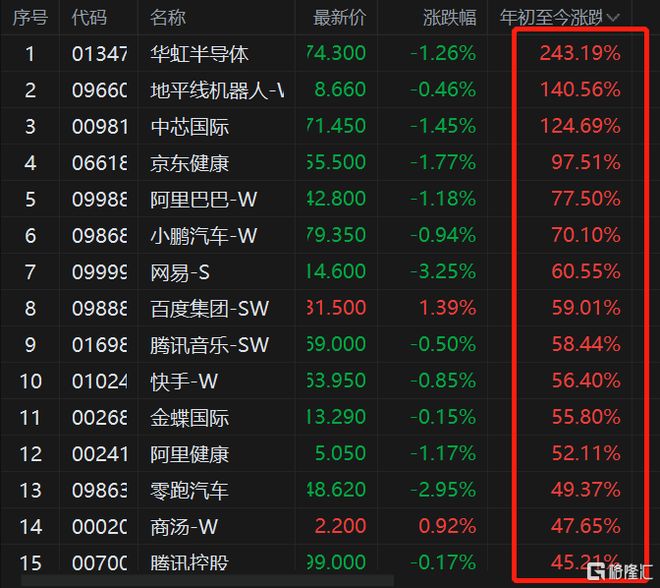
Core Viewpoint - The Hong Kong stock market's Hang Seng Technology Index achieved a remarkable annual increase of 23.45% in 2025, marking its best performance since 2020, with 22 out of 30 constituent stocks rising [1] Group 1: Stock Performance - Among the 30 constituent stocks, notable performers included Hua Hong Semiconductor, which surged by 243.19%, Horizon Robotics with a rise of 140.56%, and SMIC increasing by 124.69% [1] - Other significant gainers were JD Health at 97.51%, Alibaba-W at 77.50%, Xpeng Motors-W at 70.10%, Baidu Group-SW at 59.01%, and Tencent Music-SW at 58.44% [1][2] Group 2: Investment Preferences - The first tier of investment preference is in semiconductor manufacturing (Hua Hong, SMIC) and core AI chips (Horizon Robotics), reflecting a strong focus on hard technology and domestic substitution logic [1] - The second tier includes growth sectors such as smart electric vehicles (Xpeng, Li Auto), AI applications (Baidu, SenseTime), and digital health (JD Health), which benefit from industry trends but still face competitive and profitability uncertainties [1] - The third tier consists of value recovery in platform internet giants (Alibaba, Tencent) and mature applications (NetEase, Kuaishou, Tencent Music), with gains primarily driven by profit realization and value reassessment through dividends and buybacks, categorized as "high-quality mature assets" [1]


纳斯达克上市权威辅导机构—全球上市加速器
Sou Hu Cai Jing· 2025-12-16 23:31
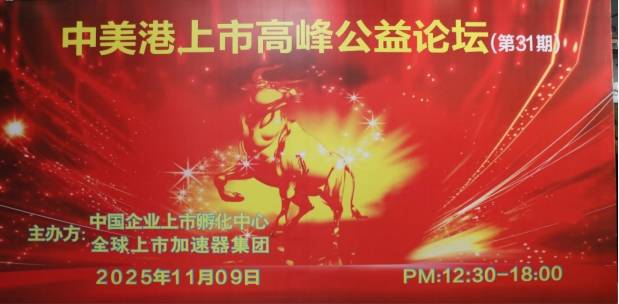
Group 1 - The core viewpoint of the articles emphasizes the evolving IPO environment for companies, particularly focusing on the transition of Chinese enterprises from a product-driven model to a dual model of "product + capital" as a reliable path for future growth [3][10] - The forum on "2025 Enterprise Transformation and Upgrading and US-China-Hong Kong Listing" aims to accelerate the listing process for companies, highlighting the importance of financing in enhancing product competitiveness and market share [1][3] - The New York Stock Exchange (NYSE) is highlighted as a premier platform for Chinese companies to list, with a total market capitalization exceeding $40 trillion, making it an attractive option for medium to large Chinese enterprises [14][19] Group 2 - The forum featured discussions on the Belt and Road Initiative, emphasizing green development, digital cooperation, and international health collaboration as key areas for future investment and partnership [5][6][8] - The global listing accelerator group aims to provide comprehensive services for companies seeking to go public, including IPO guidance, financial consulting, and innovative business model design, with a focus on minimizing risks for clients [16][18][20] - The participation of over 400 companies from various sectors such as internet, renewable energy, biotechnology, and artificial intelligence at the forum indicates a strong interest in capital market opportunities and collaboration [23]
新质生产力投资全景图(附100+页报告)
材料汇· 2025-09-07 13:14
Core Viewpoint - New quality productivity is an inevitable path for switching economic growth momentum, characterized by high technology, high efficiency, and high quality, driven by technological breakthroughs and innovative allocation of production factors [4][10]. Group 1: Overview of New Quality Productivity - New quality productivity is defined as advanced productivity that achieves significant leaps in labor, materials, and objects through technological revolutions and deep industrial transformations [4]. - The development of new quality productivity is supported by various government policies aimed at enhancing emerging industries and future industries [5][24]. Group 2: Key Industry Core Sorting - The overall development of new quality productivity in Chinese provinces shows a trend of improvement and uneven development, with 20 provinces reaching a medium to high level since 2021 [9][10]. - High-level provinces such as Beijing, Shanghai, Zhejiang, Guangdong, and Jiangsu are expected to benefit first due to their advantages in higher education resources, innovation talent distribution, and infrastructure [9][10]. Group 3: Development Potential in Related Fields - The new quality productivity industry chain can be broken down into six core segments: digital economy, high-end equipment, biotechnology, smart electric vehicles, energy transition, and future industries [11][25]. - Each segment is expected to experience long-term favorable conditions driven by policies, with high-end equipment and energy transition showing significant growth potential [12][11]. Group 4: Investment Outlook - The focus on optimizing supply chains and actively cultivating emerging and future industries is crucial for enhancing new quality productivity [11][25]. - The government is expected to implement policies to address overcapacity in certain industries, promoting industrial restructuring and enhancing domestic demand [24][25].

“新质生产力”系列(十一):新质生产力投资全景图
Guoxin Securities· 2025-09-04 07:44
Core Insights - New quality productivity is the core engine driving high-quality economic development in China, characterized by high technology, high efficiency, and high quality, resulting from technological revolutions, innovative resource allocation, and deep industrial transformation [4][8] - The development of new quality productivity signifies a transition from old to new driving forces, marked by a significant increase in total factor productivity (TFP), emphasizing technological innovation and the restructuring of industrial value chains [4][20] - The investment opportunities in new quality productivity are categorized into six core industrial tracks: digital economy, high-end equipment, biotechnology, smart electric vehicles, energy transition, and future industries like quantum information [4][20][38] New Quality Productivity Overview - New quality productivity is defined as advanced productivity that achieves significant leaps in labor, materials, and objects through technological breakthroughs and innovative configurations [8][19] - The overall development of new quality productivity across provinces shows a gradient improvement, with high-level provinces like Beijing, Shanghai, Zhejiang, Guangdong, and Jiangsu expected to benefit first due to their advantages in higher education resources, innovation talent distribution, and infrastructure [19][18] Key Industry Core Analysis - The six core tracks of new quality productivity include: 1. Digital economy, driven by data collection and processing, cloud computing, and AI technologies [39] 2. High-end equipment, which encompasses key materials, core components, and integrated applications [46] 3. Biotechnology, focusing on medical devices and innovative drugs [49] 4. Smart electric vehicles, emphasizing intelligent connectivity [38] 5. Energy transition, which aims for carbon neutrality through the development of non-fossil energy sources [52] 6. Future industries, including quantum technology and low-altitude economy [61][68] Investment Outlook - The investment landscape is shaped by the need to optimize resource allocation efficiency and enhance total factor productivity, with a focus on avoiding overcapacity and low-level repetitive construction [23][31] - The government is expected to implement policies to promote domestic demand and facilitate the transition towards new quality productivity, which includes large-scale equipment updates and consumer goods replacement initiatives [31][32]
国信证券张立超、王开:构筑新质生产力投资框架体系
Zhong Guo Zheng Quan Bao· 2025-08-19 23:29
Group 1: Core Concepts of New Quality Productivity - New quality productivity is a key engine driving high-quality economic development in China, representing a deep integration of technological innovation and industrial upgrading [1][2] - The concept emphasizes the cultivation of strategic emerging industries such as new energy, new materials, advanced manufacturing, and electronic information, aiming to enhance new development momentum [2][3] - The transition to new quality productivity marks a significant improvement in total factor productivity, driven by technological innovation and the restructuring of industrial value chains [3][4] Group 2: Development Pathways for Enterprises - Enterprises are the main practitioners of new quality productivity, focusing on upgrading traditional industries and strategically positioning emerging industries [4][5] - Traditional industries are essential for economic development and serve as a fertile ground for new quality productivity, while emerging industries inject new momentum into economic growth [7][8] - The development of commercial aerospace exemplifies the transition from government-led initiatives to commercial operations, highlighting the rapid growth of the industry in China [7][9] Group 3: Regional Development Strategies - Different regions in China should adopt tailored approaches to develop new quality productivity based on their resource endowments and industrial foundations [8][9] - The Guangdong-Hong Kong-Macao Greater Bay Area is a key region for cultivating new quality productivity, characterized by a complete industrial system and strong economic complementarity [9][10] - Major cities like Beijing, Shanghai, and Guangdong are focusing on specific industries such as integrated circuits, smart connected vehicles, and advanced manufacturing to drive regional economic growth [8][9] Group 4: Investment Opportunities - Investment strategies should focus on sectors that integrate digital and traditional economies, emerging industries with rapid market penetration, and future industries with technological breakthroughs [10] - The importance of selecting the right market segments is emphasized, with attention to opportunities in information technology, finance, and industrial sectors [10]

构筑新质生产力投资框架体系
Zhong Guo Zheng Quan Bao· 2025-08-19 22:15
Group 1: Core Characteristics and Development Logic of New Quality Productivity - New quality productivity represents a new understanding of the relationship between technological revolution, industrial transformation, and economic development, emphasizing the cultivation of strategic emerging industries such as new energy and advanced manufacturing [2][3] - The transition to new quality productivity is marked by a significant increase in total factor productivity, driven by technological innovation and the restructuring of industrial value chains [3][4] - The development of new quality productivity requires deep integration of education, technology, and talent, focusing on information technology empowerment and high-end talent cultivation [3] Group 2: Corporate Development Pathways - Companies can develop new quality productivity through traditional industry transformation and strategic layout of emerging industries, promoting intelligent and green transitions in manufacturing [4][5] - The effectiveness of new quality productivity can be evaluated through indicators such as corporate competitiveness, innovation efficiency, sustainability, and social value, highlighting its advanced nature compared to traditional productivity [4][5] Group 3: Core Industry Tracks of New Quality Productivity - New quality productivity investment can be broken down into six core industry tracks: digital economy, high-end equipment, biotechnology, smart electric vehicles, energy transition, and future industries [5][6] - The digital economy relies on data collection and processing, while high-end equipment encompasses key materials and core components, indicating a broad scope for investment opportunities [5][6] Group 4: Regional Development Layout - Different regions should adopt targeted approaches to develop new quality productivity based on their resource endowments and industrial foundations, with cities like Beijing, Shanghai, and Guangdong leading in various strategic sectors [8][9] - The Guangdong-Hong Kong-Macao Greater Bay Area is highlighted as a key region for cultivating new quality productivity, with a complete industrial system and strong economic complementarity [9] Group 5: Future Outlook and Investment Strategies - Future investment strategies should focus on technology-driven sectors, identifying valuable industry nodes and constructing investment portfolios that integrate traditional and emerging industries [10] - Attention should be given to sectors such as information technology, finance, and industrial opportunities, as well as mergers and acquisitions that may arise from industry logic [10]