海洋食品

Search documents
周大勇:向深远海要食物
Liao Ning Ri Bao· 2026-02-26 01:01
Group 1 - The core focus is on the development and utilization of Antarctic krill resources, which are rich in protein and have high nutritional value, but face challenges such as high transportation costs and lack of advanced processing technology [1] - A collaboration has been established between Dalian University of Technology and Liao Fish Group to form a research and development team for deep processing of Antarctic krill, resulting in a proprietary technology system for processing [1] - The initiative aims to promote the formation of a new industry around Antarctic krill resource development, including the establishment of the "Antarctic Krill Nutrition and Health Research Institute" and the deployment of 152 scientific personnel to work directly in enterprises [1] Group 2 - There is a focus on the elderly health food sector, with a proposal to create personalized nutrition intake standards for elderly individuals based on age, gender, and health status [2] - The development of easy-to-chew and digestible health foods is emphasized to meet the diverse dietary needs of elderly people in various life scenarios [2] - The representative expresses a commitment to advocate for public interests and contribute to the development of the food industry [2]
山东移动日照分公司:以“产业大脑能力中心”筑数智生态新底座
Qi Lu Wan Bao· 2025-12-29 14:13
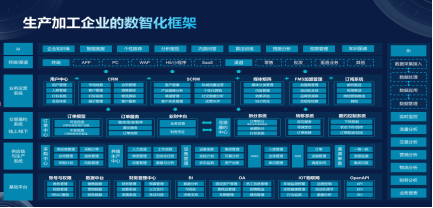
Core Insights - The article highlights the strategic implementation of the "Digital-Real Integration" initiative in Shandong Province, with Shandong Mobile's Rizhao branch at the forefront, utilizing technologies like 5G, AI, and blockchain to create an intelligent empowerment system across various industries [1][8] - The "Enterprise Brain" serves as a digital tool tailored for small and medium-sized enterprises, addressing common challenges such as high transformation barriers and data silos, and enhancing management efficiency by over 60% while reducing implementation costs by more than 60% [2][3] - The integration of core systems through the "Enterprise Brain" not only improves operational efficiency but also fosters a collaborative ecosystem, transforming technology empowerment into a stable business growth engine [3][8] Industry and Company Developments - The "Enterprise Brain" framework expands its influence from individual production workshops to entire industry ecosystems, exemplified by its application in the green tea industry, which integrates climate data for precise planting and marketing strategies [5][6] - The establishment of a credit system based on real business data allows for embedded financial services within the industry chain, attracting various financial institutions and creating new revenue streams for the company [5][6] - The successful replication of the "Industry Brain Capability Center" model across different sectors, including marine food and green construction, demonstrates its scalability and cost-effectiveness, promoting a standardized approach to industry empowerment [6][7] - The strategic value of the "Industry Brain Capability Center" is underscored by its role in advancing local industries towards digitalization and high-end development, contributing to the recognition of Rizhao as a key green tea production area [8]

7院士站台,共话“十五五”海洋经略
2 1 Shi Ji Jing Ji Bao Dao· 2025-11-24 06:40
Core Insights - The event in Zhanjiang, celebrating the 90th anniversary of Guangdong Ocean University, focused on the development path of the marine economy during the 14th Five-Year Plan period, gathering over 4,000 industry elites and academicians [1][2]. Industry Overview - China's marine economy has surpassed 10 trillion yuan, with deep-sea economy accounting for nearly one-quarter of this total. Guangdong's marine economic output exceeds 2 trillion yuan, leading the nation for 30 consecutive years [2]. - The United Nations predicts that by 2030, the share of the deep-sea economy globally will increase from 5% to 30%, indicating a significant market expansion and the emergence of new industrial patterns [3]. Technological Advancements - AI and remote sensing technologies are rapidly reconstructing the value chain of marine industries. These technologies can provide critical data for fishing and aquaculture, enhancing operational efficiency [3][4]. - New markets with high development potential include aquaculture insurance and methane hydrate exploration, supported by AI and remote sensing for risk assessment and resource identification [5][6]. Talent Development - National marine universities are evolving their training models to better align with industry needs, emphasizing practical experience and interdisciplinary education [10][11]. - The establishment of the "Future Marine Research Institute" at Guangdong Ocean University aims to integrate AI with marine studies, focusing on innovative and sustainable development in marine resources [11][15]. Economic Impact - Zhanjiang's marine production value is projected to reach 623.31 billion yuan in the first half of 2025, reflecting a year-on-year growth of 6.05%, which constitutes 34.41% of the regional GDP [14]. - The event highlighted the need for innovation and talent to drive the next phase of marine economic development, emphasizing the importance of collaboration between academia and industry [16][18].
7院士站台,共话“十五五”海洋经略
21世纪经济报道· 2025-11-24 06:31
Core Viewpoint - The article discusses the significant developments and future opportunities in China's marine economy, emphasizing the role of technology, talent cultivation, and the transition towards deep-sea industries as key drivers for growth in the next five years [2][14]. Group 1: Marine Economy Overview - China's marine economy has surpassed 10 trillion yuan, with deep-sea economy accounting for nearly one-quarter of this total [2]. - Guangdong's marine economic output exceeds 2 trillion yuan, maintaining the top position in the country for 30 consecutive years [2]. - The United Nations predicts that by 2030, the global share of the deep-sea economy will increase from 5% to 30% [2]. Group 2: Technological Advancements - The value chain of marine industries is rapidly being restructured, with AI and remote sensing technologies playing a crucial role [2][3]. - AI and remote sensing can provide critical data for fishing and aquaculture, enhancing operational efficiency [3]. - New markets such as aquaculture insurance and combustible ice exploration are emerging, supported by advanced technologies [3]. Group 3: Talent Development - National marine universities are evolving their educational approaches to better align with industry needs [7][9]. - Innovative teaching methods, such as conducting classes on research vessels, are being implemented to enhance practical skills [7]. - The focus is on cultivating a deep understanding and emotional connection to marine environments among students [7][9]. Group 4: Future Directions - The establishment of the "Future Marine Research Institute" at Guangdong Ocean University aims to integrate AI with marine studies, focusing on new quality marine, smart marine, and green marine developments [9]. - The deep-sea sector is expected to see significant advancements, with new research facilities supporting scientific exploration and industrial applications [12]. - The local government is committed to enhancing marine production value, with projections indicating a 6.05% growth in marine GDP for Zhanjiang [12].

7院士站台 共话“十五五”海洋经略
2 1 Shi Ji Jing Ji Bao Dao· 2025-11-23 07:57
Core Insights - The event in Zhanjiang from November 21-23, celebrating the 90th anniversary of Guangdong Ocean University, focused on the development path of the marine economy during the "14th Five-Year Plan" period [1][2]. Marine Economy Overview - China's marine economy has surpassed 10 trillion yuan, with deep-sea economy accounting for nearly one-quarter of this total [2]. - Guangdong's marine economic output exceeds 2 trillion yuan, maintaining the top position in the country for 30 consecutive years [2]. Technological Advancements - AI and remote sensing technologies are highlighted as key enablers for marine industry transformation, providing continuous global marine environmental data [6][10]. - These technologies can assist in assessing fishing conditions and supporting the development of marine ranching and fisheries [7][8]. Emerging Markets - New markets with significant development potential include aquaculture insurance and methane hydrate exploration, supported by AI and remote sensing for risk assessment and resource identification [12]. Talent Development - Educational institutions are adapting their training models to better align with industry needs, emphasizing practical experience and interdisciplinary approaches [22][30]. - The establishment of the "Future Marine Research Institute" at Guangdong Ocean University aims to enhance talent quality and foster innovation in marine technology [30]. Future Directions - The future of the marine industry is expected to shift towards deep-sea exploration and development, supported by major scientific infrastructure projects [34][35]. - Zhanjiang is focusing on integrating land and sea development, enhancing marine ranching, and fostering new productive forces in the marine economy [36].
力诚名校行走进知名百年学府,深化产教融合赋能青年创意
Zhong Guo Shi Pin Wang· 2025-11-10 13:35
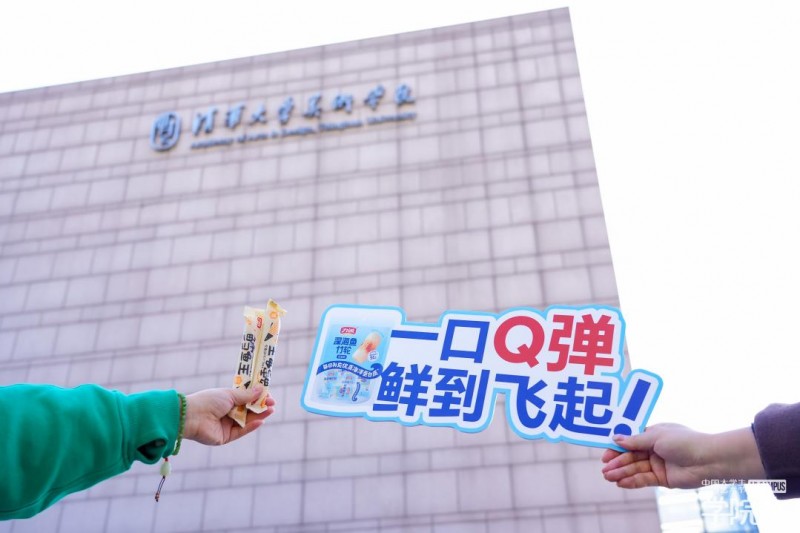
Core Insights - The collaboration between Licheng Foods and Tsinghua University Academy of Arts is a significant step in promoting industry-education integration, enhancing innovation, and talent development in response to national strategies [1][14][17] Group 1: Collaboration and Objectives - Licheng Foods and Tsinghua University Academy of Arts have initiated a co-creation classroom focused on "packaging illustration design practice," building on their successful partnership in 2024 [1][4] - The initiative aligns with the "Implementation Plan for Enhancing Industry-Education Integration" for 2023-2025, aiming to deepen collaboration and explore value creation among youth [1][14] Group 2: Educational Approach - The co-creation classroom integrates real brand projects and market demands into the curriculum, providing students with a practical creative platform to engage with the industry [4][11] - Professor Zhou Yue emphasized the course's goal of helping students understand Licheng Foods' target audience to optimize design and enhance brand recognition [4][6] Group 3: Brand Insights and Student Engagement - Wang Weiwei, Product Director of Licheng Foods, provided in-depth brand insights, focusing on the company's mission to offer healthy food and the development of its cod fish sausage products over 19 years [6][13] - Students demonstrated high professionalism and creativity during the design phase, reflecting their understanding of Licheng's brand characteristics [9][11] Group 4: Evaluation and Feedback - The sharing and evaluation session highlighted students' creative concepts, with Professor Zhou and Wang providing constructive feedback from both design and market perspectives [11][13] - The dual mentorship model allowed students to learn from both theoretical and practical dimensions, enhancing their learning experience [11][14] Group 5: Future Implications - The successful co-creation classroom exemplifies the powerful role of industry-education integration in connecting education, talent, and industry [17] - Licheng Foods aims to continue fostering industry-education collaboration, transforming student creativity into market-leading product innovations and communication strategies [17]
江苏首次亮相2025中国海博会 多维展示海洋强省“深蓝答卷”
Xin Hua Ri Bao· 2025-11-05 07:39
Core Insights - The 2025 China Marine Economy Expo was held in Shenzhen, showcasing Jiangsu's transition from a "marine province" to a "marine strong province" with significant participation from coastal cities like Nantong, Yancheng, and Lianyungang [1] Group 1: Jiangsu's Marine Economy Development - Jiangsu has a coastline of 954 kilometers and considers its marine economy a "blue engine" for high-quality development [1] - The province's participation in the expo reflects a collaborative model with local development and marine authorities, aiming to enhance global resource connectivity through the Guangdong-Hong Kong-Macao Greater Bay Area [1] Group 2: Nantong's Achievements - Nantong's "NGUYAFLNG" floating LNG facility model was highlighted, with an annual production capacity of 2.4 million tons, showcasing the city's strength in high-end marine equipment manufacturing [2] - In 2024, Nantong's marine production value is projected to reach 260.6 billion yuan, accounting for 25% of the province's total and 50% of the coastal cities' total [2] - The city has established a financial fund cluster exceeding 100 billion yuan to support the marine industry [2] Group 3: Yancheng's Innovations - Yancheng's exhibition featured advanced aviation equipment, including a 1.4-ton unmanned helicopter and a tilt-rotor aircraft, symbolizing the integration of ecology and technology [3] - The city accounts for 40% of the national offshore wind power equipment production capacity, with a total installed capacity of 5.73 million kilowatts by the end of September, representing 47.7% of the province's and 12.8% of the nation's total [3] - Yancheng is exploring various zero-carbon park construction paths, aiming to become a hub for international offshore renewable energy [3] Group 4: Lianyungang's Multi-Dimensional Industry - Lianyungang's exhibition showcased its diverse industry system combining fisheries, transportation, and tourism [4] - The port's throughput is expected to reach 346 million tons in 2024, with container traffic projected at 6.69 million TEUs [4] - The city has established 39 provincial-level marine innovation platforms and launched the "Huaguoshan Talent Program" to support marine industry development [4] Group 5: Future Directions - Jiangsu aims to leverage national marine resources through this expo, focusing on "land-sea coordination" and "river-sea linkage" to create a globally influential marine economy innovation hub [4] - The province plans to deepen industrial cooperation with other regions and promote the transformation of achievements in support of building a marine power [4]
深耕平台沃土 推动“研发优势”转为“产业胜势”
Xin Hua Ri Bao· 2025-09-28 06:47
Core Insights - The Jiangsu Marine Biological Resource Innovation Center is focusing on the high-value utilization of marine biological resources, developing products such as Antarctic krill chips and algae-based meal replacement shakes [1][3] - The center is part of Jiangsu Coastal Development Group, a state-owned enterprise, and aims to align with the Jiangsu Provincial Marine Industry Development Action Plan to enhance research and application transformation [1][2] Group 1: Research and Development - The center has established a comprehensive R&D laboratory of 1,700 square meters, equipped with over 300 research instruments, and has invested nearly 40 million yuan in R&D projects [2] - It has undertaken 16 research projects, including 3 provincial-level projects, and has applied for 36 invention patents, with 2 technical achievements recognized as domestically leading [2] Group 2: Talent Development - The center has recruited 11 dedicated R&D personnel, including 6 PhDs and 1 provincial talent, covering various disciplines such as biology, chemistry, materials, and food engineering [2] - A mentorship and project training model is implemented to enhance core capabilities and create a well-rounded technology innovation team [2] Group 3: Industry Collaboration and Innovation - The center has achieved the first artificial mass breeding of silver pomfret in Jiangsu, addressing a significant gap in the local aquaculture industry [3] - Collaborations with major entities like Charoen Pokphand Group and Ningbo University have provided technical support for factory-based aquaculture trials [3] - The center is committed to transforming scientific research outcomes into industrial applications, exemplified by the launch of the "Haiqiqu" brand for marine health foods [3]
中国经济样本观察·县域样本篇丨山东千亿级海滨小城成长记:如何做到“又美又强”?
Xin Hua Wang· 2025-08-12 06:02
Core Insights - Rongcheng, a coastal city in Shandong, has achieved a balance of beauty and economic strength, with a GDP exceeding 100 billion yuan and a focus on marine economy [3][5][20] - The city has been recognized for its ecological environment, ranking first in air quality in Shandong and being awarded the title of "2024 Most Livable City" [3][20] Economic Development - The marine economy contributes approximately 45% to Rongcheng's GDP, with the city being a leader in aquatic product output for over 40 years [5][11] - In 2024, over 310 industrial enterprises are expected to generate an industrial output value of 74 billion yuan, with a projected growth of over 10% in industrial added value [3][5] - Despite external trade pressures, Rongcheng's export value increased by 9.8% year-on-year in the first 11 months of 2024 [3][11] Marine Industry - Rongcheng has established itself as a national base for deep-sea fishing and has developed capabilities in polar fishing [5][11] - The shipbuilding industry in Rongcheng has seen significant growth, with output exceeding 7.8 billion yuan and profits increasing by over 170% year-on-year in 2024 [5][20] Tourism and Cultural Development - The city has leveraged its marine resources to boost tourism, attracting over 5 million visitors in 2024, including around 50,000 from South Korea [8][11] - Rongcheng's unique attractions, such as its fishing ports and natural beauty, have contributed to its recognition as a top tourist destination [8][11] Entrepreneurial Environment - Rongcheng has a vibrant private economy, with many innovative entrepreneurs contributing to its growth, particularly in the RV manufacturing sector [13][15] - The city has been recognized for its supportive policies towards entrepreneurs, fostering a conducive environment for business development [19][20] Government Initiatives - The local government actively promotes a culture that respects and supports entrepreneurs, enhancing their sense of well-being [19][20] - Initiatives like the "Return to Hometown" plan aim to create a better development environment for local and returning entrepreneurs [19][20] Environmental Sustainability - Rongcheng is committed to ecological preservation and aims to become a "zero-carbon city," focusing on energy efficiency and renewable energy sources [20][23] - The city has made significant strides in reducing energy consumption, with a reported 8.4% decrease in energy intensity per unit of GDP in the first half of 2024 [23][24]
与其作为被动选择,不如当成转型机遇……外贸企业开拓国内市场要有长远眼光
Sou Hu Cai Jing· 2025-05-06 14:38
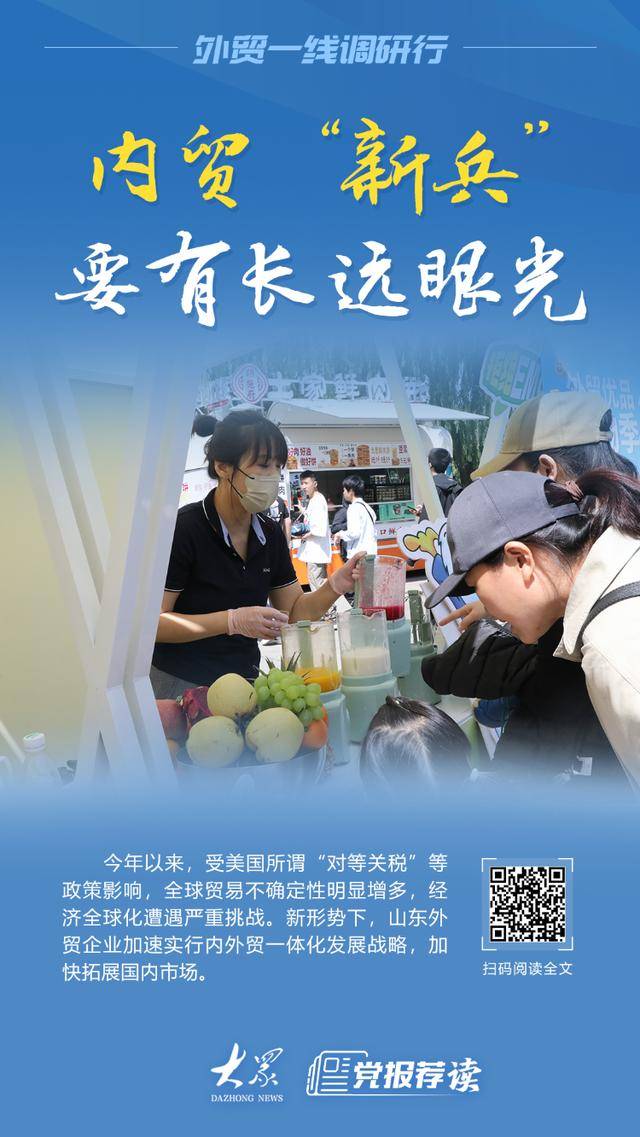
Core Viewpoint - The article discusses the impact of U.S. tariffs on global trade uncertainty and highlights how Shandong foreign trade enterprises are accelerating their integration of domestic and foreign trade strategies to expand into the domestic market [2][3]. Group 1: Market Conditions - In 2024, China's total retail sales of consumer goods are projected to exceed 48.8 trillion yuan, which is more than ten times the export value to the U.S. [4]. - Despite the challenges faced by foreign trade enterprises, the conditions for shifting from export to domestic sales are relatively mature [4]. Group 2: Company Strategies - Companies like Blowing Intelligent Technology have started to explore the domestic market in response to reduced demand from U.S. buyers, with over 600 foreign clients engaged during the Canton Fair [6]. - The shift to domestic markets is seen as a strategic opportunity rather than a passive response to crisis, with companies encouraged to adapt their products to meet local consumer preferences [7][12]. Group 3: Brand and Product Development - Companies are focusing on brand building and product adaptation to meet domestic market demands, such as modifying product designs to cater to local tastes [9]. - Shandong Meijia Group has successfully transitioned to a dual-market strategy, achieving a revenue of 3.25 billion yuan in 2024, with domestic revenue reaching 1.48 billion yuan [9]. Group 4: Government Support and Initiatives - The government is playing a crucial role in supporting foreign trade enterprises to expand into domestic markets through initiatives like the "2025 Shandong Foreign Trade Quality Products Shopping Season" [11]. - Data from the Ministry of Commerce indicates that 87,000 industrial enterprises have achieved integrated domestic and foreign trade operations, marking a 6.3% year-on-year increase [11].