电网储能

Search documents
兴业证券:2026年值得关注的十大产业趋势
智通财经网· 2026-02-18 03:45
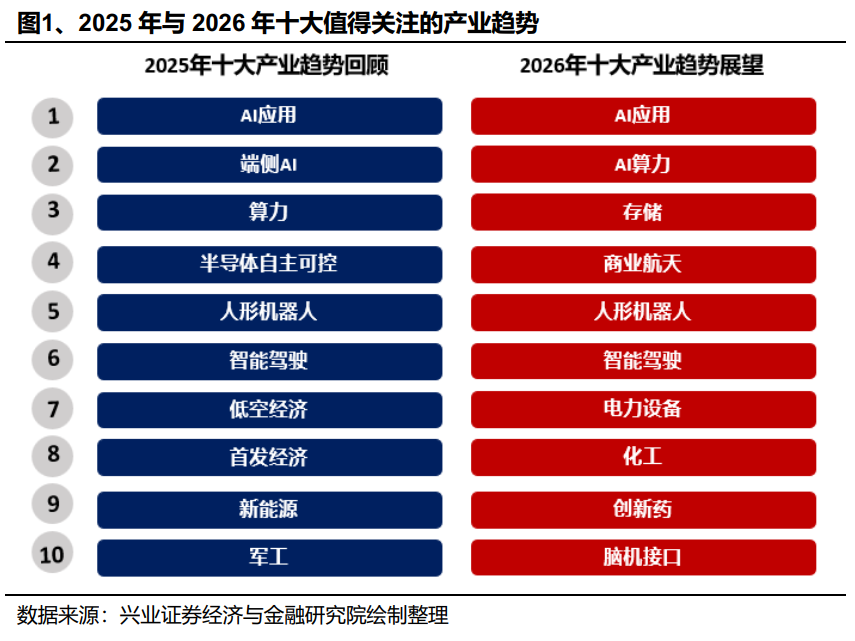
Group 1: AI Applications - The global AI competition is intensifying, with model iterations driving deeper application scenarios, and the focus is on whether significant capital expenditures by tech giants can lead to commercial applications [2][3] - The competitive landscape for AI applications is shifting from dominance by OpenAI to a more multipolar environment, with major players like Google and Meta integrating AI into their ecosystems [3] - In China, AI applications are experiencing a breakthrough, with major tech companies accelerating model iterations and application deployments, leading to a transformation from model landing to scenario monetization [5] Group 2: AI Computing Power - Overseas, major cloud service providers are maintaining high capital expenditures, with a projected increase of 67% in 2026, reflecting a strong demand for AI computing power [7][8] - In China, leading tech companies are increasing capital expenditures and accelerating the iteration of domestic large models, promoting the performance of domestic chips amid tightening supply from foreign sources [9] Group 3: Storage - The demand for storage is entering a new super cycle driven by AI training and inference needs, with AI servers consuming significantly more memory than traditional servers [11][16] - Supply constraints are expected to persist, leading to continued high prices for storage components, as major manufacturers shift production focus to advanced memory types [16] Group 4: Commercial Aerospace - Commercial aerospace is becoming a key battleground in US-China competition, with significant policy support and funding initiatives in both countries to accelerate industry development [19][21] - Domestic companies are achieving breakthroughs in satellite mass production and reusable rocket technologies, transitioning from technical validation to commercialization [22] Group 5: Humanoid Robots - Major overseas companies are ramping up production plans for humanoid robots, benefiting domestic component suppliers, with Tesla aiming for a production capacity of 500,000 units by 2026 [27][30] - Chinese manufacturers are leading in humanoid robot shipments, with significant contracts and production milestones achieved in 2025 [30] Group 6: Intelligent Driving - Domestic policies are expected to facilitate the commercialization of L3 autonomous driving in 2026, with several manufacturers preparing to launch L3 models [32][33] - Tesla's Full Self-Driving (FSD) technology is setting the direction for autonomous driving, with significant advancements in AI capabilities [35] Group 7: Energy Storage - The expansion of AI computing power in North America is driving electricity demand, with domestic power equipment expected to accelerate exports [37][40] - China's "14th Five-Year Plan" includes significant investments in the power grid and energy storage, creating a favorable environment for industry growth [40][43] Group 8: Chemicals - The chemical industry is undergoing a transformation driven by policies aimed at supply-side reform, with a focus on optimizing supply structures and reducing excess capacity [44][47] - New economic sectors are boosting demand for chemical materials, particularly in AI, renewable energy, and robotics, leading to a favorable outlook for new materials [47][48]


【兴证策略】2026年值得关注的十大产业趋势
Xin Lang Cai Jing· 2026-02-18 02:55
Group 1: AI Applications - The global AI competition is intensifying, with significant capital expenditures from tech giants expected to lead to deeper application scenarios in 2026 [1][2] - The competitive landscape for AI applications is shifting from a dominance of OpenAI to a more multipolar environment, with companies like Google and Meta making significant advancements [2] - Domestic AI applications are reaching a tipping point, with major tech companies accelerating their investments and model iterations, leading to a resonance between model development and application penetration [5] Group 2: AI Computing Power - Major cloud service providers in North America are projected to increase their capital expenditures significantly, with a combined guidance of approximately $598.7 billion for 2026, reflecting a 67% year-on-year growth [7][8] - Domestic companies are also ramping up capital expenditures and accelerating the iteration of local models, driven by the need for domestic chip performance improvements [7][8] Group 3: Storage - The demand for storage is entering a new super cycle driven by AI training and inference needs, with AI servers consuming 8-10 times more DRAM and NAND than traditional servers [12][13] - The supply-demand imbalance in the storage sector is expected to persist, with global storage prices rising over 40% in Q4 2025 [13][17] Group 4: Commercial Aerospace - Commercial aerospace is becoming a key battleground in US-China competition, with significant policy support and funding initiatives in place to accelerate the industry [20][21] - Domestic companies are achieving breakthroughs in satellite mass production and reusable rocket technologies, transitioning from technology validation to commercial scale [23] Group 5: Humanoid Robots - Major overseas companies like Tesla and FigureAI are ramping up production plans for humanoid robots, which is expected to benefit domestic component suppliers [25][28] - Chinese manufacturers are leading in humanoid robot shipments, with significant orders and production milestones achieved in 2025 [29] Group 6: Intelligent Driving - The rollout of policies in China is expected to facilitate the commercialization of L3 autonomous driving in 2026, with several manufacturers already launching L3 models [32][33] - Tesla's Full Self-Driving (FSD) technology continues to lead the market, with ongoing enhancements expected to drive the commercialization of Robotaxi services [32] Group 7: Energy Storage - The aging power grid in North America is creating opportunities for domestic power equipment exports, particularly in gas turbines and high-voltage equipment [36][37] - China's "14th Five-Year Plan" includes significant investments in the power grid and energy storage, with a focus on high-value areas [37] Group 8: Chemicals - The chemical industry is undergoing a transformation driven by supply-side reforms, with a focus on optimizing supply structures and reducing excess capacity [41][43] - New economic sectors are driving demand for chemical materials, particularly in AI, renewable energy, and robotics, which are expected to sustain high demand in 2026 [43][46]
午评:创业板指半日跌超2%,电网、储能板块大面积下挫
Xin Lang Cai Jing· 2025-10-17 04:12
板块题材方面,燃气、贵金属、港口航运、煤炭开采加工、钢铁、机场航运、银行板块涨幅居前;电网储能、CPO、可控 核聚变、培育钻石、半导体、光刻机概念股跌幅居前。盘面上,电网设备、光伏、储能板块大面积下挫,良信股份、华明装 备、科陆电子等股盘中跌停。CPO概念股多股走低,仕佳光子大跌超15%,中富电路、生益科技、永鼎股份跟跌。此外、培育 钻石、半导体、电机等板块多数下跌。另一方面,燃气、油气资源股逆市走强,长春燃气、国新能源双双涨停,通源石油、中 曼石油、准油股份跟涨。银行板块延续近日涨势,农业银行股价创出历史新高,走出11连阳。港口航运板块同样延续强势,海 通发展2连板,厦门港务涨停。 三大指数早盘集体下跌,截至午盘,上证指数跌1%,深成指跌1.99%,创业板指跌2.37%,北证50跌1.81%。沪深京三市半 日成交额11890亿元,较上日缩量340亿元。全市场超4100只个股下跌。 ...

2025年中国电网储能行业相关政策汇总、产业链、发展现状、竞争格局及发展趋势研判:政策护航、多元驱动,一季度新增装机2.63GW/6.48GWh [图]
Chan Ye Xin Xi Wang· 2025-06-07 01:58
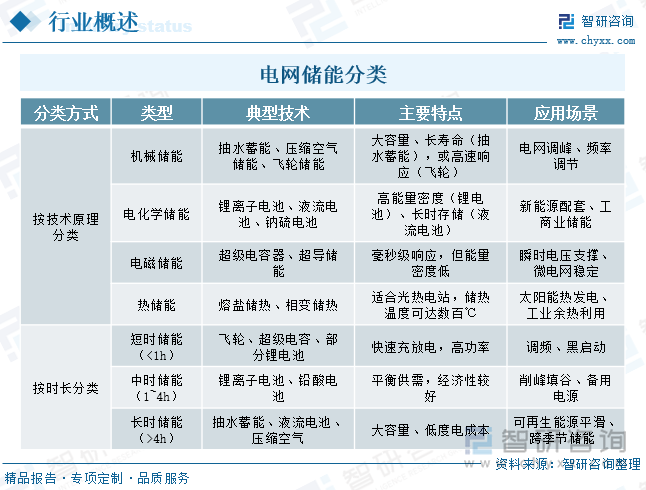
Core Insights - The article emphasizes the importance of grid energy storage as a key infrastructure for building a new power system, focusing on its roles in balancing power supply and demand, stabilizing grid operations, and efficiently integrating renewable energy sources [1][14]. Industry Overview - Grid energy storage refers to systems that store electrical energy through physical or chemical means and release it back to the grid when needed, aiming to balance supply and demand, enhance grid stability, and promote renewable energy consumption [2]. - The technology is categorized by storage principles (mechanical, electrochemical, electromagnetic, thermal) and application duration (short-term, medium-term, long-term) [2][3]. Current Development Status - As of Q1 2025, grid-side energy storage has shown robust growth, with a power scale share of 52.3%, a year-on-year increase of 17 percentage points. New installations reached 2.63 GW/6.48 GWh, reflecting year-on-year growth of 46%/68% [1][14]. - The industry has transitioned from technology exploration to large-scale application over the past three decades, with lithium-ion batteries dominating the market [6][12]. Policy Framework - The Chinese government has integrated carbon peak and carbon neutrality into its ecological civilization strategy, identifying energy storage as a critical technology for supporting high proportions of renewable energy integration [8]. - Policies have been issued to accelerate the development of new energy storage, with targets set for 30 GW of installed capacity by 2025 and a fully market-oriented development by 2030 [8][9]. Competitive Landscape - The grid-side energy storage industry in China has formed a competitive landscape characterized by a tripartite structure of state-owned enterprises, private companies, and technology firms [16]. - Major players include State Grid and Southern Power Grid, which dominate large projects, while battery giants like CATL and BYD control core supply chain segments [16][18]. Future Trends - The industry is expected to see diversification in technology routes, with long-duration storage solutions like flow batteries and compressed air storage gaining traction [22]. - Market-driven models will replace mandatory storage policies, with shared storage and virtual power plants becoming mainstream, enhancing the economic viability of storage projects [23][24].