
绿色新材料

Search documents
“十四五”GDP年均名义增速7.3%!长三角一体化示范区共建全国首个跨省域高新区
证券时报· 2026-01-29 08:55
Core Viewpoint - The article highlights the achievements and future plans of the Yangtze River Delta Ecological Green Integrated Development Demonstration Zone during the 14th Five-Year Plan period and the key work arrangements for the beginning of the 15th Five-Year Plan. Group 1: Economic Performance - The Demonstration Zone achieved an average nominal GDP growth rate of 7.3% during the 14th Five-Year Plan, with a projected GDP of 571.6 billion yuan by 2025 [1] - The industrial output and investment growth rates in the Demonstration Zone exceeded the average levels of the Yangtze River Delta region [3] Group 2: High-tech Development - The number of high-tech enterprises in the Demonstration Zone increased to 3,713, which is 2.4 times the number at its inception [4] - The establishment of the first cross-provincial high-tech zone in China, focusing on new-generation information technology, intelligent equipment, and green new materials, is underway [5][6] Group 3: Institutional Innovations - A total of 26 reform authorization items have been granted to the Demonstration Zone, with 18 from the first two batches already implemented [3] - By 2025, the Demonstration Zone plans to introduce 7 new institutional innovation results, contributing to a total of 161 institutional innovations [3] Group 4: Future Development Plans - The focus for the 15th Five-Year Plan includes enhancing technological innovation and deepening the integration of industrial and innovation chains [9] - The establishment of a cross-regional investment fund with an initial scale of 500 million yuan aims to support green low-carbon development and technological innovation [7] - The construction of data center projects is prioritized to support the development of the new-generation information technology sector [9]


全国首个跨省域的国家级高新区要来了?
3 6 Ke· 2026-01-29 02:50
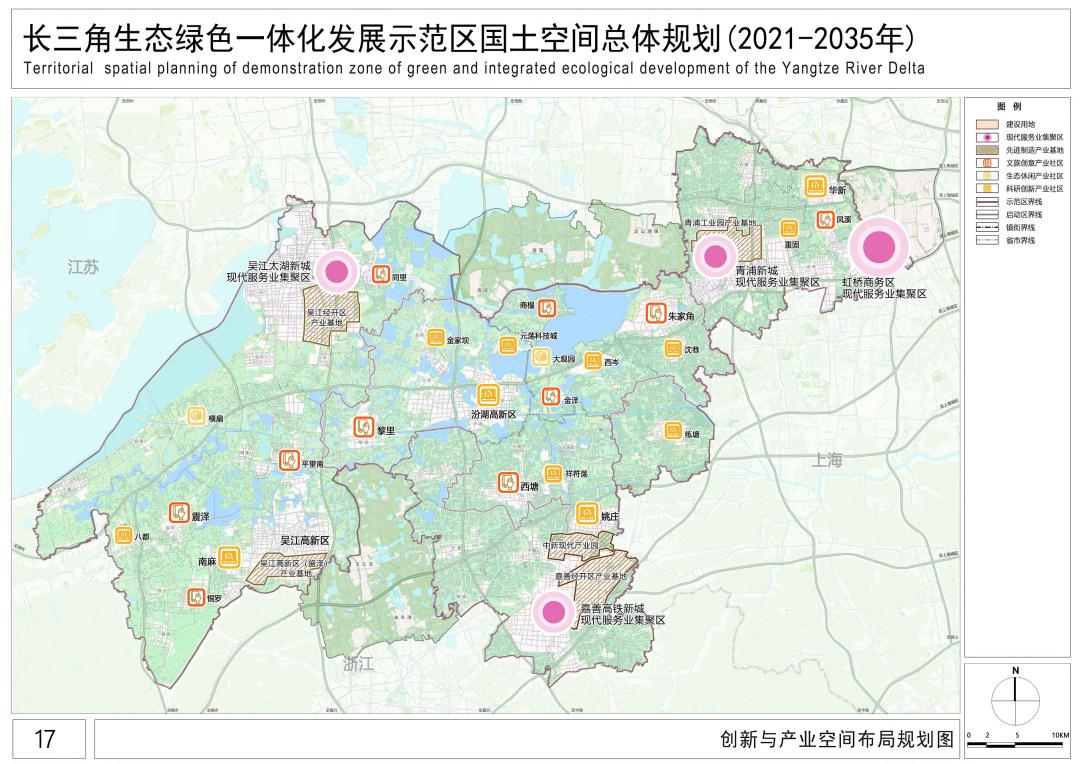
Core Viewpoint - The establishment and official naming of the "Yangtze River Delta Qingwu Jia High-tech Industrial Development Zone" marks a significant step towards the integration of the Yangtze River Delta region, aiming to become the first cross-provincial national high-tech zone in China [1][9]. Group 1: Background and Significance - The cross-provincial high-tech zone was established as part of the Yangtze River Delta Ecological Green Integrated Development Demonstration Zone, representing a move towards institutionalizing and standardizing innovative models [2]. - The strategic positioning of the Qingwu Jia High-tech Zone emphasizes "reduction development," requiring a decrease of 15.7 square kilometers in construction land, which encourages innovation within limited space [2][6]. - The area covers 19.54 square kilometers, spanning Shanghai's Qingpu, Jiangsu's Wujiang, and Zhejiang's Jiashan, facilitating natural conditions for cross-provincial cooperation due to geographical proximity and complementary industries [2][5]. Group 2: Strategic Layout and Management - The high-tech zone aims to create a strategic spatial layout characterized by "one core leading, two corridors driving, three areas collaborating, and multiple points supporting," focusing on innovation and economic density [3]. - A three-tier management structure has been established to ensure unified planning and coordination while respecting the unique circumstances of each area, providing organizational support for cross-provincial collaboration [6]. Group 3: Industry Focus and Investment Mechanisms - The industrial layout focuses on a "3+2" leading industry system, including digital industries, intelligent manufacturing, and green new materials, along with headquarters economy and green innovation services [7]. - An investment fund of 500 million yuan has been established to support the development of the cross-provincial high-tech zone, facilitating capital flow across regions [7]. Group 4: Policy and Future Prospects - The demonstration zone's executive committee has introduced 12 specific measures to promote high-quality development, focusing on reform integration, technological innovation, and resource sharing [7]. - The Qingwu Jia High-tech Zone aims to achieve national high-tech zone status by 2025, with a clear goal of meeting high standards for evaluation indicators [9][10]. - The successful establishment of this zone could serve as a model for regional cooperation and development, potentially influencing broader national strategies for balanced regional growth [11].
长三角青吴嘉高新技术产业开发区来了!系全国首个跨省域高新区
Xin Lang Cai Jing· 2026-01-25 08:39
Core Viewpoint - The establishment of the first cross-provincial high-tech industrial development zone in China, named the Yangtze River Delta Qingwu Jia High-tech Industrial Development Zone, has been approved, aiming to leverage regional technological resources and focus on strategic emerging industries [1]. Group 1 - The high-tech zone spans an area of 19.54 square kilometers, incorporating three regions: Shanghai's Qingpu, Jiangsu's Wujiang, and Zhejiang's Jiashan [1]. - The development will prioritize three strategic emerging industries: digital industry, intelligent manufacturing, and green new materials, along with two characteristic industries: headquarters economy and green scientific innovation services, forming a "3+2" industrial development pattern [1].
上海市、江苏省、浙江省批复同意!
Xin Lang Cai Jing· 2026-01-25 07:58
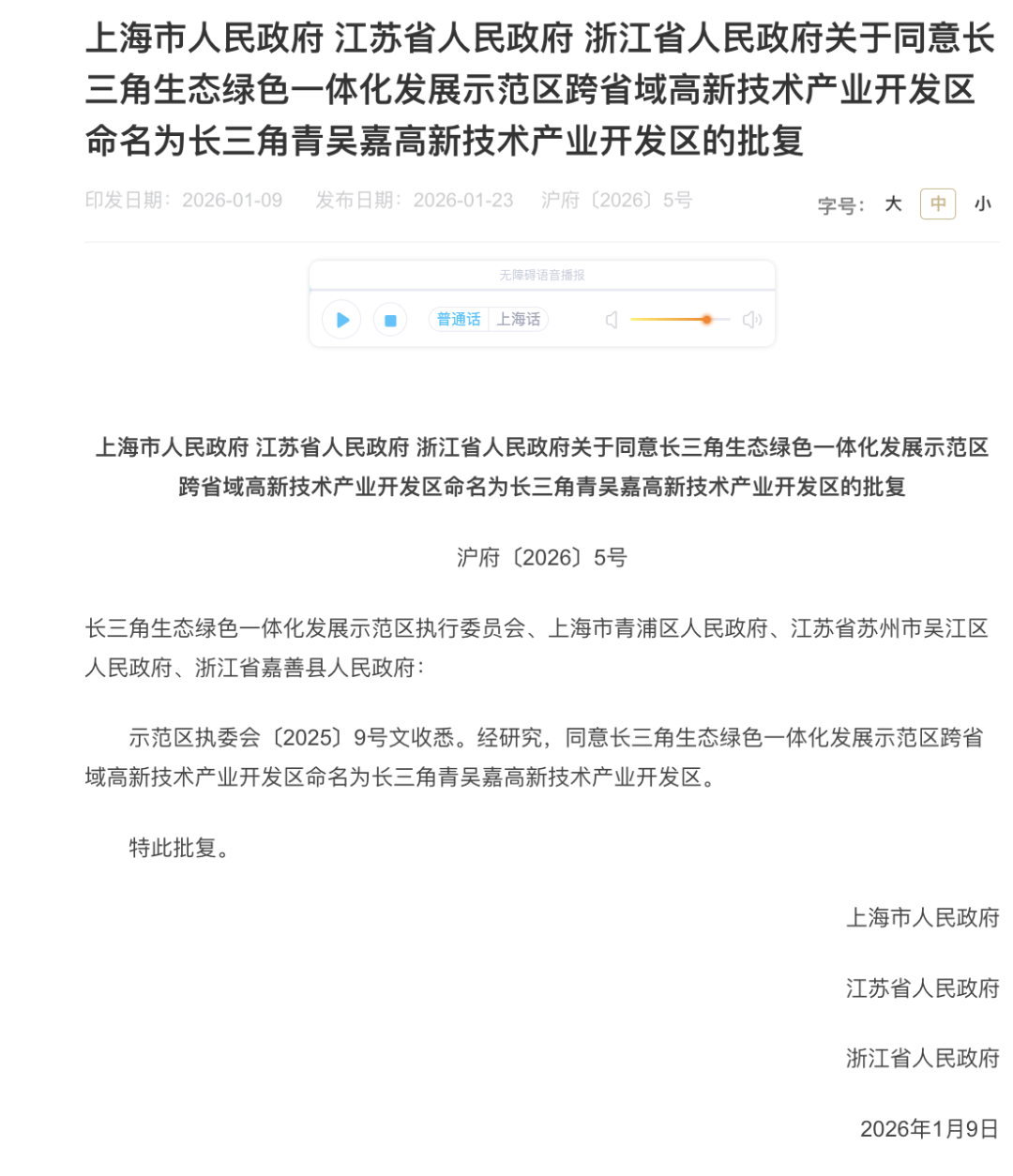
Core Viewpoint - The establishment of the Yangtze River Delta Ecological Green Integrated Development Demonstration Zone's cross-provincial high-tech industrial development zone, named the Yangtze River Delta Qingwu Jia High-tech Industrial Development Zone, has been approved by the governments of Shanghai, Jiangsu, and Zhejiang [1][3]. Group 1 - The cross-provincial high-tech industrial development zone covers an area of 19.54 square kilometers [3]. - It includes three parks located in Shanghai Qingpu, Jiangsu Wujiang, and Zhejiang Jiashan [3]. - The zone focuses on developing three strategic emerging industries: digital industry, intelligent manufacturing, and green new materials, along with two characteristic industries: headquarters economy and green scientific innovation services [3].
上海市政府、江苏省政府、浙江省政府研究,同意全国首个跨省域高新区命名
财联社· 2026-01-25 06:42
Core Viewpoint - The establishment of the Yangtze River Delta Qingwuji High-tech Industrial Development Zone marks a significant step in cross-regional collaboration for high-tech industry development in China, focusing on ecological and green integration [1][3]. Group 1: Development Zone Overview - The Yangtze River Delta Qingwuji High-tech Industrial Development Zone is the first cross-provincial high-tech industrial development zone in China, officially launched in July 2023 [3]. - The development zone covers an area of approximately 19.54 square kilometers, integrating the regions of Qingpu (Shanghai), Wujiang (Jiangsu), and Jiashan (Zhejiang) [3]. Group 2: Strategic Focus - The zone aims to develop three strategic emerging industries: digital industry, intelligent manufacturing, and green new materials, along with two characteristic industries: headquarters economy and green innovation services, forming a "3+2" industrial development pattern [3]. - The management model includes cross-regional and cross-departmental coordination through joint meetings and a collaborative operational office, aligning with national high-tech zone construction requirements [3]. Group 3: Action Plans - Six major actions are outlined for the development zone: gathering strategic scientific and technological resources, promoting industrial technological innovation, enhancing corporate vitality, building a scientific innovation service chain, creating an eco-friendly living environment, and fostering open and integrated innovation [3]. - The goal is to establish a comprehensive innovation corridor that integrates technology supply, technology transfer, enterprise incubation, and emerging industry cultivation, positioning the zone as a new high ground for green technology innovation and ecological economic development in the Yangtze River Delta [3].

上海市政府、江苏省政府、浙江省政府研究,同意全国首个跨省域高新区命名
Xin Jing Bao· 2026-01-25 06:17
Core Viewpoint - The establishment of the Yangtze River Delta Qingwuji High-tech Industrial Development Zone marks a significant step in cross-provincial collaboration for high-tech industry development in China, focusing on ecological and green integration [1][3]. Group 1: Development Zone Overview - The Yangtze River Delta Qingwuji High-tech Industrial Development Zone is the first cross-provincial high-tech industrial development zone in China, officially launched in July 2023 [1]. - The development zone covers an area of approximately 19.54 square kilometers, integrating three regions: Qingpu (Shanghai), Wujiang (Jiangsu), and Jiashan (Zhejiang) [1]. Group 2: Strategic Focus - The zone aims to leverage the rich technological innovation resources and high-tech industry foundation of the Yangtze River Delta, focusing on three strategic emerging industries: digital industry, intelligent manufacturing, and green new materials, along with two characteristic industries: headquarters economy and green scientific innovation services [1]. - The development strategy is structured around a "3+2" model, emphasizing the main industries [1]. Group 3: Management and Operations - The high-tech zone employs a management model that includes cross-regional and cross-departmental joint meetings, a collaborative operation office, and area management institutions [2]. - Six major actions are outlined for implementation, including gathering strategic technological forces, promoting industrial technological innovation, enhancing enterprise vitality, building a scientific innovation service chain, creating an eco-friendly living environment, and fostering open and integrated innovation [2]. Group 4: National Support and Unique Advantages - The national support for the demonstration zone emphasizes "not breaking administrative subordination while breaking administrative boundaries," which is a distinctive advantage for creating cross-provincial high-tech zones [3].
工业引擎动力足 民生画卷幸福长
Xin Lang Cai Jing· 2026-01-14 23:50
Core Viewpoint - Long'an County has achieved significant economic growth and development during the "14th Five-Year Plan" period, focusing on high-quality development, poverty alleviation, rural revitalization, and ecological improvement, resulting in a notable increase in GDP and overall social progress [8]. Economic Development - Long'an County's GDP grew by 5.4% year-on-year in the first three quarters of 2025, with the secondary industry leading at an 8.4% growth rate [8]. - The number of industrial enterprises above designated size reached 103 by November 2025, nearly doubling since 2020, with total industrial output value surpassing 100 billion yuan for the first time in 2022 [9][10]. - The county has seen a significant increase in the number of leading enterprises, with one enterprise exceeding 1 billion yuan in output value and two others in the 500 million to 1 billion yuan range [9]. Industrial Growth - Long'an County's industrial output value in 2023 exceeded 100 billion yuan, becoming a core support for the county's economic growth [10]. - The county invested 3 billion yuan in infrastructure over five years, enhancing the capacity of industrial parks and facilitating the establishment of 216 enterprises, including 88 above designated size [10]. - Major projects such as the BYD testing ground and HeTai green materials production base have been established, contributing to future industrial upgrades [13]. Agricultural Development - Long'an County maintained a stable grain planting area of 510,000 acres, achieving continuous growth in grain production for five consecutive years [14]. - The county invested approximately 112 million yuan in high-standard farmland projects, covering 73,000 acres, which supports stable grain yields above 150,000 tons [14]. - The county has developed a diverse agricultural sector, with 27 leading agricultural enterprises and 288 farmer cooperatives, ensuring a stable supply of key agricultural products [15]. Social Welfare and Infrastructure - Over 80% of the county's general public budget has been allocated to social welfare each year, addressing urgent issues faced by the community [18]. - The healthcare system has been significantly improved, with a county-wide consultation rate exceeding 90% and the establishment of various medical facilities [16]. - Employment services have been enhanced, with the employment service station in the Zhen Dong resettlement area helping over 192,000 workers, generating additional income of over 25 million yuan for relocated residents [18]. Cultural and Tourism Development - Long'an County has seen a flourishing cultural and tourism sector, with various cultural activities and events enhancing community engagement and tourism appeal [17]. - The county's tourism revenue increased by 10.6% year-on-year in the first nine months of 2025, reflecting a growing interest in its cultural heritage and natural attractions [18].

“新”动能“强”突破 解锁成都县域经济崛起密码
Si Chuan Ri Bao· 2025-12-15 02:45
Core Viewpoint - Chengdu is undergoing a significant transformation with a focus on enhancing county-level economies and urban integration, aiming for a comprehensive development strategy that includes strong leadership from urban new areas and breakthroughs in county-level cities [1] Economic Development - In the first three quarters of this year, seven out of eight county-level cities in Chengdu exceeded the city's average GDP growth rate, with three ranking in the top four [2] - The county-level cities are showing strong performance in fixed asset investment, with several cities ranking in the top five for growth [2] Urban Functionality and Quality - The quality of urban functionality is crucial for competitiveness and sustainability, with public services like education and healthcare identified as common weaknesses in county-level cities [3] - Chengdu is addressing these weaknesses by enhancing educational resources and healthcare services in county-level cities [4] Infrastructure Development - All eight county-level cities are now connected to the central urban area via highways, and seven have access to rail transit, creating a multi-channel transportation network [8] - Significant infrastructure projects, such as the completion of the Ningrong Line and the expansion of the Chengya Expressway, are underway to support economic activities [9] Industrial Development - The competition among county-level economies is shifting towards resilience in industrial chains and innovation, with several industrial clusters recognized at the provincial level [6] - Chengdu is actively promoting new industries, including aerospace and green materials, to diversify its economic base [7] Water and Energy Infrastructure - Water infrastructure projects, such as the Li Jia Yan Reservoir and Sanba Reservoir, are progressing, which will support both economic development and ecological sustainability [10] - New power transmission projects are being implemented to enhance energy capacity in key areas, supporting industrial growth [9]
“成色”足、“动能”强!区域协调发展跨域聚力 织密“发展经纬”绘就融合新图景
Yang Shi Wang· 2025-10-19 09:26
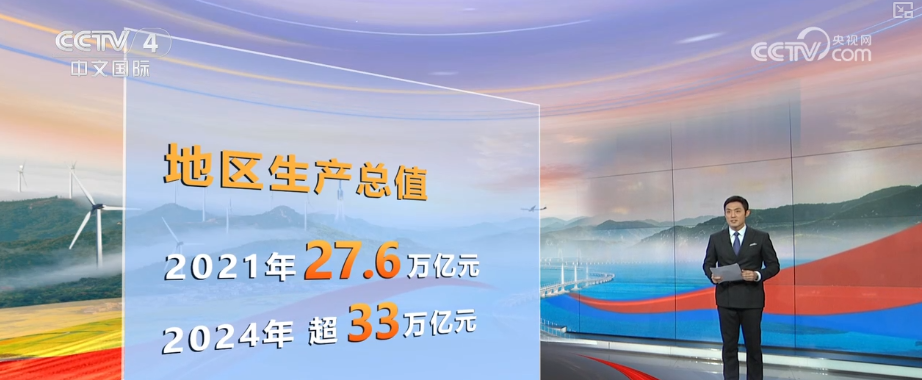
Group 1 - The core viewpoint emphasizes the importance of regional coordination in China's development, highlighting significant strategies like the integration of the Yangtze River Delta and the Greater Bay Area [1] - The Yangtze River Delta's GDP is projected to rise from 27.6 trillion yuan in 2021 to over 33 trillion yuan by 2024, supported by nine cities with GDP exceeding 1 trillion yuan and a strong manufacturing base [3] - The establishment of the Fangting Water Institute symbolizes the integration efforts, allowing for seamless cross-regional interactions and improved administrative efficiency [10][11] Group 2 - The Beijing-Tianjin-Hebei region has seen substantial progress, with over 12,000 collaborative projects and improved public service integration, enhancing the region's cohesiveness [18] - The automotive industry in the Tianjin Wuqing area exemplifies the benefits of regional collaboration, with production capacity expected to double by 2025 [24][28] - The Chengdu-Chongqing economic circle has experienced a significant economic boost, with its total economic output increasing from 6.3 trillion yuan to 8.7 trillion yuan over five years [39] Group 3 - The Greater Bay Area has improved its transportation infrastructure, with new cross-river channels enhancing connectivity and facilitating economic integration [41][44] - The completion of the Shenzhen-Zhongshan Bridge has significantly reduced travel time across the Pearl River Delta, demonstrating the impact of infrastructure on regional development [44] - The cultural and economic integration efforts in the Greater Bay Area have led to increased tourism and local economic growth, with traditional arts like the Yingge dance gaining international recognition [53][56]
长三角示范区6年推出154项制度创新成果
Su Zhou Ri Bao· 2025-09-14 00:30
Core Viewpoint - The Yangtze River Delta Ecological Green Integrated Development Demonstration Zone has made significant progress over the past six years through institutional innovation and project construction, resulting in 154 institutional innovation achievements and 57 experiences promoted nationwide [1] Group 1: Institutional Innovation and Policy Implementation - The demonstration zone has focused on institutional innovation and reform authorization, establishing a comprehensive land spatial planning system and implementing unified ecological environment standards, monitoring, and law enforcement [1] - A series of integrated institutional innovations in key areas have been effectively implemented, providing institutional support for high-quality development [1] - The zone has received 18 reform authorization items from the central government, with 14 already implemented, facilitating the construction of the demonstration area [1] Group 2: Project Construction and Functional Development - The demonstration zone has launched a three-year action plan for major construction projects, with a total investment of 645.6 billion yuan across 180 key projects, including 43 projects supported by central budget investment of 2.133 billion yuan [2] - The functional layout of the water town has been improved, with major technological innovation platforms established to enhance the transition from form-based to function-based development [2] - The zone hosts 1 national manufacturing innovation center, 15 national enterprise technology centers, 3,750 national high-tech enterprises, and 82 listed companies, with R&D expenditure intensity reaching 42%, surpassing the average level in the Yangtze River Delta [2] Group 3: Future Development Goals - By 2030, the water town construction framework is expected to be fully formed, with core demonstrations established and industrial patterns developed [3] - Plans are underway to create a world-class lake area around the Lake District, promoting ecological governance and the establishment of various key projects [3] - The construction of "railway demonstration zones" and "water demonstration zones" is being accelerated, with significant projects like the national key laboratory for water pollution control and resource recycling being implemented [3]