
货币金融业

Search documents
3月PMI数据点评:制造业PMI超季节性回升,价格大幅上行
Western Securities· 2026-04-01 05:51
1. Report Industry Investment Rating No relevant content provided. 2. Core Viewpoints of the Report - In March, the manufacturing PMI exceeded seasonal expectations and returned above the boom - bust line, with the production index seasonally rebounding, both domestic and external demand improving, and enterprises actively replenishing inventories. The service industry PMI returned to the expansion range, while the construction industry was still in the contraction range, and cost - rising pressure emerged. The subsequent focus should be on international situation changes and promoting various economic - stabilizing policies [1][10]. - The improvement in the manufacturing PMI in March led to some adjustments in the bond market. The current core driving factors of the market are the Middle East situation, inflation expectations, and the increasing allocation power in the bond market. Ultra - long - term interest rates have entered a stage of restorative decline, and the bond market is expected to be volatile and bullish. Future attention should be paid to the persistence of the decline in risk appetite, the situation of fundamental recovery, and the special treasury bond issuance plan in Q2 [4][36]. 3. Summary by Relevant Catalogs 3.1 3 - month PMI Data Review - Manufacturing: In March, the manufacturing PMI was 50.4%, a 1.4 - percentage - point increase from the previous month, returning above the boom - bust line after two months. The production index seasonally recovered, both domestic and external demand improved, the price index rebounded significantly, enterprises actively replenished inventories, and procurement volume returned to the expansion range [10]. - Non - manufacturing: The service industry PMI returned to the expansion range, and the construction industry's contraction slowed down. In March, the service industry business activity index rose 0.5 percentage points to 50.2%, and the construction industry business activity index rose 1.1 percentage points to 49.3%. However, the month - on - month performance of both was weaker than the non - epidemic Spring Festival seasonality [12][15]. 3.2 Manufacturing: Simultaneous Improvement in Production and Demand, and a Significant Rebound in the Price Index - Production: The manufacturing PMI production index in March was 51.4%, a 1.8 - percentage - point increase from the previous month, returning to the expansion range. This was due to the return of employees after the Spring Festival, the recovery of market demand, and the further manifestation of policy effects [16]. - Demand: Both domestic and external demand improved. The proportion of manufacturing enterprises reporting insufficient market demand dropped to below 50% for the first time since July 2022. The new order and new export order indexes increased by 3.0 and 4.1 percentage points respectively. SMEs stabilized, and three key industries expanded rapidly [18][20]. - Price: Affected by rising commodity prices and accelerated corporate procurement, the main raw material purchase price index and ex - factory price index rose by 9.1 and 4.8 percentage points respectively. The ex - factory price index reached a new high since April 2022, indicating that the year - on - year growth rate of PPI in March is expected to turn positive [22]. - Inventory: Enterprises actively replenished inventories, and procurement volume returned to the expansion range. The raw material inventory and finished - product inventory indexes increased by 0.2 and 0.9 percentage points respectively, and the procurement volume index rose to 50.9% [23]. 3.3 Non - manufacturing: Service Industry PMI Returns to Expansion, Construction Industry's Contraction Slows Down - Service Industry: In March, the service industry's prosperity increased slightly by 0.5 percentage points, returning above the boom - bust line. Industries such as railway transportation, telecommunications, and finance were in a high - prosperity range, while consumer - related industries declined due to the high base of Spring Festival consumption [29]. - Construction Industry: In March, the construction industry business activity index rose 1.1 percentage points to 49.3%. The civil engineering construction industry showed a significant increase, while the housing construction industry was still below 50%. The overall recovery was slower than in previous post - holiday periods [32]. 3.4 Impact on the Bond Market - In March, the manufacturing PMI exceeded seasonal expectations, the service industry PMI returned to expansion, but the construction industry was still in contraction, and cost - rising pressure emerged. The bond market adjusted due to the improvement in the manufacturing PMI. The current core driving factors are the Middle East situation, inflation expectations, and the increasing allocation power in the bond market. The bond market is expected to be volatile and bullish, and future attention should focus on risk appetite, fundamental recovery, and the special treasury bond issuance plan in Q2 [36].
产需两端均有改善 11月制造业PMI回升
Di Yi Cai Jing· 2025-11-30 13:56
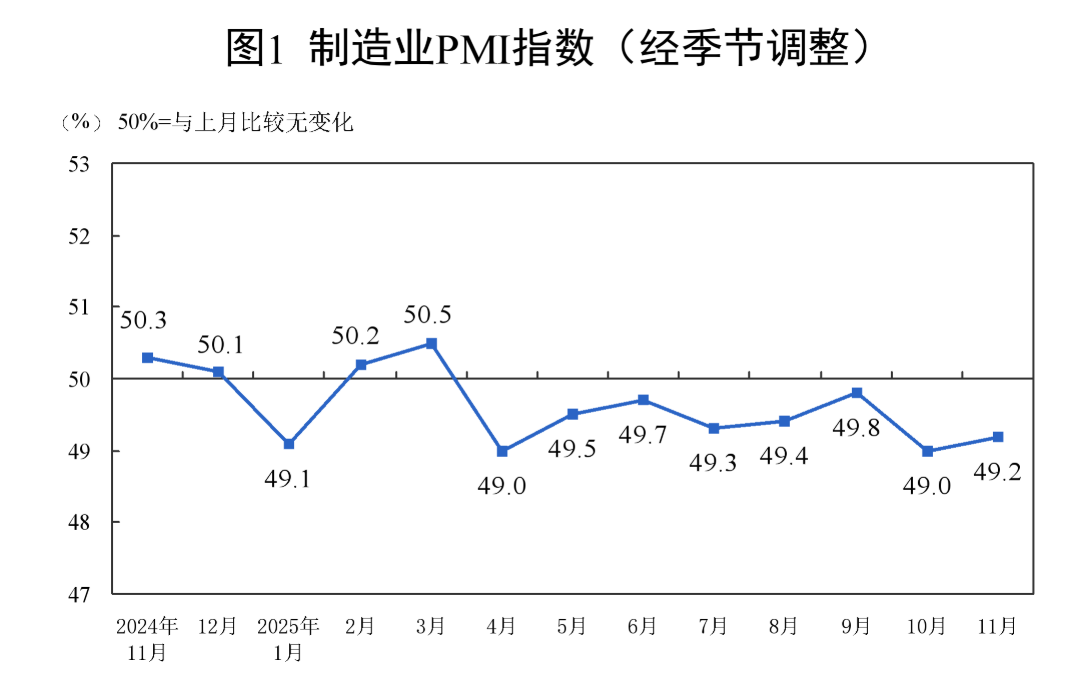
Group 1: Manufacturing Sector Overview - The manufacturing PMI for November is reported at 49.2%, an increase of 0.2 percentage points from October, but it has remained below the critical line for eight consecutive months [1] - The production index and new orders index for November are 50.0% and 49.2%, respectively, indicating improvements in both production and demand [4] - High-tech manufacturing PMI stands at 50.1%, remaining above the critical point for ten months, suggesting continued growth in this sector [4] Group 2: Economic Indicators and Market Sentiment - The production expectations index for November is 53.1%, reflecting increased confidence among manufacturing enterprises regarding market development [5] - The new export orders index has risen to 47.6%, up 1.7 percentage points from October, indicating a stabilization in manufacturing exports [5] - The overall manufacturing market demand is showing signs of recovery, with the new orders index increasing by 0.4 percentage points from October [5] Group 3: Price Trends and Inventory Levels - The purchasing price index for raw materials is at 53.6%, up 1.1 percentage points from October, indicating rising input costs [7] - The finished goods inventory index is at 47.3%, down 0.8 percentage points from October, suggesting smoother sales activities for enterprises [6] Group 4: Service Sector Performance - The non-manufacturing business activity index is reported at 49.5%, a decrease of 0.6 percentage points from October, indicating a slowdown in service sector activities [9] - The financial services sector shows strong performance, with business activity and new orders indices both exceeding 55%, indicating robust growth [13] - The construction industry business activity index has improved to 49.6%, up 0.5 percentage points from October, signaling a recovery in construction activities [14]

产需两端均有改善,11月制造业PMI回升
Di Yi Cai Jing· 2025-11-30 13:40
Manufacturing Sector - The manufacturing PMI for November is reported at 49.2%, showing a slight increase of 0.2 percentage points from October, but remains below the growth threshold for eight consecutive months [1][4] - The production index and new orders index for November are 50.0% and 49.2%, respectively, indicating improvements in both production and demand, with the production index returning to the critical point [4][5] - High-tech manufacturing PMI stands at 50.1%, remaining above the critical point for ten consecutive months, indicating continued growth in this sector [1][4] Economic Outlook - Analysts suggest that the slight recovery in the manufacturing PMI reflects improved market confidence, driven by the "14th Five-Year Plan" and recent positive outcomes from US-China trade talks [4][5] - Despite the improvements, there are still significant downward pressures on the economy, particularly due to external uncertainties and ongoing adjustments in the real estate market [6][8] - The production activity expectation index for November is 53.1%, indicating increased confidence among manufacturing enterprises regarding market development [5] Export and Demand - The new export orders index for November is 47.6%, up 1.7 percentage points from October, suggesting a stabilization in manufacturing exports [5] - All major manufacturing sectors, including high-tech and consumer goods, have seen increases in new export orders, with high-tech manufacturing new export orders rising over 3 percentage points [5][6] Price Trends - The purchasing price index for raw materials is at 53.6%, up 1.1 percentage points from October, indicating rising costs for manufacturers [7][8] - The factory price index is at 48.2%, showing a slight recovery but still in the contraction zone, suggesting that price increases are primarily affecting upstream sectors [7][8] Service Sector - The non-manufacturing business activity index for November is 49.5%, down 0.6 percentage points from October, reflecting a seasonal decline in consumer-related services [9][12] - The financial services sector shows strong performance, with business activity and new orders indices both exceeding 55%, indicating robust growth in this area [12][13] - The construction sector's business activity index has improved to 49.6%, signaling a recovery in construction activities, supported by recent policy measures [13][14]