通信工具

Search documents
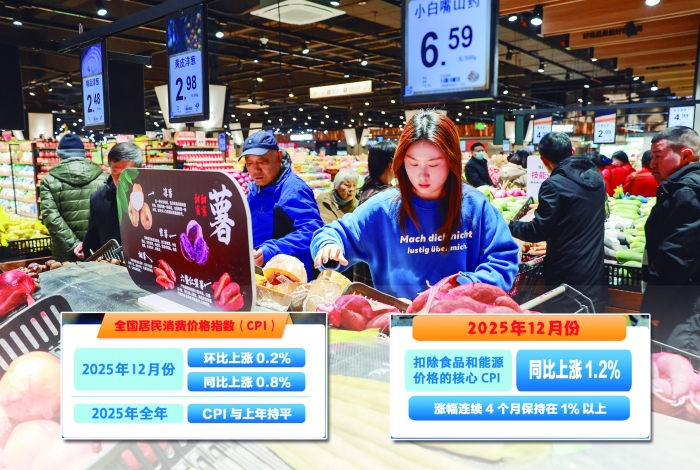
2025年12月居民消费价格指数同比上涨0.8%
Ren Min Ri Bao· 2026-01-10 00:43
Group 1 - The consumer price index (CPI) increased by 0.2% month-on-month and 0.8% year-on-year, reaching the highest level since March 2023, primarily driven by rising food prices [1][2] - Food prices rose by 1.1%, contributing approximately 0.17 percentage points to the year-on-year CPI increase, while energy prices decreased by 3.8% [1][2] - The core CPI, excluding food and energy, maintained a year-on-year increase of 1.2% for four consecutive months [1] Group 2 - The producer price index (PPI) rose by 0.2% month-on-month, marking the third consecutive month of increase, with a year-on-year decline of 1.9% [2] - Key industries such as coal mining and lithium-ion battery manufacturing saw price increases, with coal mining prices rising by 1.3% and lithium-ion battery prices by 1.0% [2] - The decline in PPI year-on-year has narrowed by 0.3 percentage points compared to the previous month, indicating positive changes in some industry prices due to ongoing macroeconomic policies [2]
扩内需促消费政策显效2025年物价呈温和回升态势
Shang Hai Zheng Quan Bao· 2026-01-09 18:38
Core Viewpoint - The expansion of domestic demand and consumption policies is showing effectiveness, leading to a moderate recovery in prices and improved supply-demand relationships in key industries [2][6][7]. Group 1: CPI and PPI Trends - In December 2025, the Consumer Price Index (CPI) increased by 0.8% year-on-year, marking the highest level since March 2023, with food prices significantly contributing to this rise [2][3]. - The Producer Price Index (PPI) decreased by 1.9% year-on-year in December, but the decline was narrower than in November, indicating positive changes in certain industries due to improved market competition [4][6]. - The core CPI, excluding food and energy, rose by 1.2% year-on-year, maintaining a growth rate above 1% for four consecutive months, reflecting stable demand recovery [3][6]. Group 2: Industry-Specific Insights - Prices in the coal mining, lithium-ion battery manufacturing, and photovoltaic equipment sectors showed reduced declines, indicating a positive trend in market competition and production capacity management [4][5]. - The price of lithium-ion batteries and cement manufacturing increased by 1.0% and 0.5% month-on-month, respectively, demonstrating a recovery in these key industries [4][5]. - The prices of external storage devices and bio-liquid fuels rose by 15.3% and 9.0% year-on-year, respectively, driven by the growth of new productive forces [5]. Group 3: Future Outlook - Experts predict that with continued policy support for domestic demand and consumption, the CPI is expected to show a steady upward trend in 2026, with food prices returning to a reasonable fluctuation range [6][7]. - The overall economic operation is expected to improve, with demand gradually recovering and supply-side structural optimization continuing [7].

7月CPI环比转涨0.4%,核心CPI创年内新高,扩内需政策效应显现
Sou Hu Cai Jing· 2025-08-10 13:12
Group 1 - The domestic economy shows positive changes as the Consumer Price Index (CPI) increased by 0.4% month-on-month in July, reversing a previous decline of 0.1%, while year-on-year it remained flat [1] - The Producer Price Index (PPI) saw a narrowing decline of 0.2% month-on-month, with a year-on-year decrease of 3.6%, indicating an improvement in market supply and demand relationships [1] - The expansion of domestic demand policies is having a noticeable effect, leading to marginal improvements in price movements [1] Group 2 - The core CPI rose by 0.8% year-on-year in July, marking the highest level since March 2024, reflecting enhanced market vitality and smoother economic circulation [3] - Service prices significantly contributed to the CPI increase, with airfares, tourism, hotel accommodations, and transportation rental fees rising by 17.9%, 9.1%, 6.9%, and 4.4% respectively, collectively accounting for over 60% of the CPI's month-on-month increase [3] - Industrial consumer goods prices also showed positive trends, with a 0.2% month-on-month increase excluding energy, driven by demand recovery from consumption policies [3] Group 3 - The month-on-month decline in the PPI has narrowed for the first time since March, indicating a stabilization in industrial product prices due to improved market competition [4] - Key industries such as coal, steel, photovoltaic, cement, and lithium battery sectors have seen reduced price declines, contributing to a decrease in the downward pressure on the PPI [4] - Prices of representative "anti-involution" goods like coking coal, rebar, polysilicon, and lithium carbonate have entered a strong upward cycle, positively impacting the PPI [4] Group 4 - International factors are also positively influencing industrial product prices, with oil and gas extraction prices rising by 3.0% and non-ferrous metal smelting and rolling prices increasing by 0.8% [4] - The transformation and upgrading of industries are driving price recoveries in related sectors, with caustic soda prices up by 3.6% and a reduced decline in glass manufacturing prices by 0.9% [4] - The release of domestic demand potential is leading to year-on-year price increases in certain industries, such as a 13.1% rise in the manufacturing of arts and crafts and a 5.3% increase in sports balls manufacturing [4]