LED显示屏

Search documents
蝉联三届国家制造业单项冠军丨洲明重磅荣誉+1
Xin Lang Cai Jing· 2026-02-06 11:21
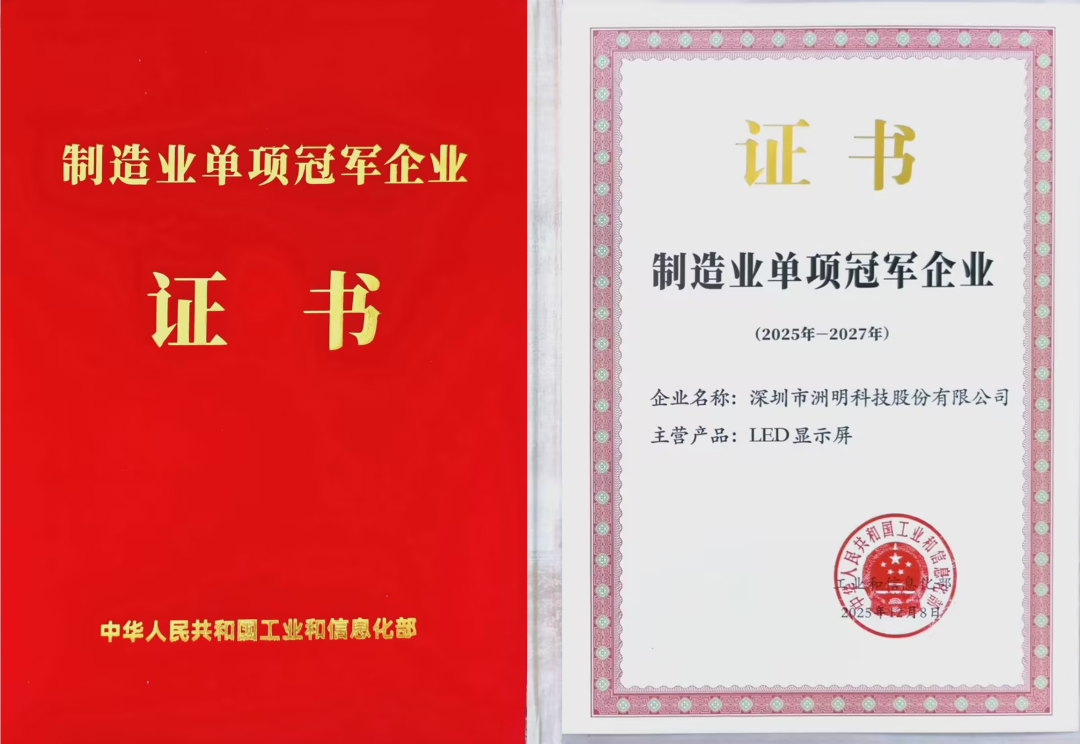
Core Viewpoint - Shenzhen Absen Optoelectronics Co., Ltd. has been awarded the "Manufacturing Single Champion" title by the Ministry of Industry and Information Technology for the third consecutive time, marking it as the first and only company in the LED industry to achieve this honor, reflecting its long-term commitment to innovation and leadership in the display technology sector [2][20]. Group 1: Recognition and Achievements - The "Manufacturing Single Champion" title is a national honor established to recognize companies that have achieved excellence in specific fields and possess global competitiveness [3][21]. - Absen has been recognized as a "Manufacturing Single Champion" in 2019 and 2022, symbolizing the pinnacle of China's manufacturing capabilities in niche markets [5][24]. - The company has maintained its position as a leader in technology innovation, market share, and brand influence in the LED display sector, achieving industry and global leadership [6][25]. Group 2: Product Innovation and Development - Absen has introduced innovative LED display products such as holographic transparent screens and texture screens, addressing industry pain points and customer needs [9][27]. - The company follows a dual technology strategy with COB and MIP, creating a diverse product matrix that includes various series of LED displays for different applications [11][29]. - As of December 2025, Absen has over 3,500 patents and has participated in the formulation of more than 190 international, national, and industry standards, showcasing its comprehensive industry chain layout in the Mini/Micro LED field [13][31]. Group 3: Future Directions - In the AI era, Absen aims to focus on customized industry models and AI applications, transforming displays into intelligent service platforms for various sectors such as government, education, and marketing [16][34]. - The company is committed to providing smarter, more integrated, and innovative display solutions for diverse industries, continuing its legacy of excellence and innovation [18][36].


诺瓦星云:公司在MLED领域超前布局
Zheng Quan Ri Bao Zhi Sheng· 2026-01-16 10:13
Core Viewpoint - The acceleration and upgrade of MLED (MiniLED & MicroLED) technology are expanding the application scenarios of LED displays from professional markets to commercial and consumer markets [1] Group 1: Company Strategy - The company has made advanced layouts in the MLED field and is continuously collaborating with leading enterprises and research institutions to strengthen technological breakthroughs [1] - The company aims to facilitate the entry of MLED displays into the consumer market through these collaborations [1]

抖音第二总部将落地深圳
21世纪经济报道· 2026-01-06 10:47
Core Viewpoint - Douyin Group is establishing its second headquarters in Shenzhen, which will focus on the research and development of core products and new businesses, including AI and SaaS services [1][4][7]. Group 1: Douyin's Expansion in Shenzhen - Douyin Group's second headquarters is set to be located in Nanshan District, with a total investment of 310 billion yuan for 30 projects, making it the highest in the city [1][4]. - The new headquarters will support Douyin and Toutiao's core products and new business developments, including the establishment of the ByteDance AI lab and SaaS platform service center [1][4][7]. - The first regional headquarters, Douyin Group's Houhai Center, was opened in July 2025, covering an area of approximately 77,000 square meters [7]. Group 2: Investment Climate in Shenzhen - During the 14th Five-Year Plan, Shenzhen's fixed asset investment is expected to reach 4.5 trillion yuan, which is 1.5 times that of the previous plan [2]. - The recent heavy investments by industry leaders reflect a strong recognition of Shenzhen's business environment and strategic position, injecting significant momentum into the start of the 15th Five-Year Plan [2]. Group 3: Headquarters Economy in Shenzhen - The 15th Five-Year Plan for Shenzhen emphasizes the development of headquarters economy, aiming to enhance the concentration of headquarters projects and promote high-quality development [4]. - The focus is on creating a comprehensive headquarters project that integrates research and production, thereby strengthening the digital economy and AI sectors in Nanshan District [4][9]. Group 4: Advanced Manufacturing Projects - Among the 222 projects launched in Shenzhen, 76 are industrial projects with a total investment of 384.5 billion yuan, focusing on smart manufacturing and new display technologies [9][11]. - The global high-end measurement equipment and sensor manufacturing park by Hexagon, a Swedish company, is set to be completed by 2027 with an investment of 1.5 billion yuan, aiming for a production value of 13 billion yuan within five years [8][10][11].

抖音在深圳开建“第二总部”
2 1 Shi Ji Jing Ji Bao Dao· 2026-01-06 09:25
Group 1 - Douyin Group is establishing its second headquarters in Shenzhen, focusing on the development of core products and new business areas such as payment systems, alongside the construction of an AI lab and SaaS platform service center [1][3][6] - The project in Nanshan District has a total investment of 310 billion yuan, making it the largest among 222 new projects launched in Shenzhen, which collectively amount to approximately 1573.4 billion yuan [1][2] - The first regional headquarters, Douyin Group's Houhai Center, was inaugurated in July 2025, indicating the company's commitment to expanding its presence in the Greater Bay Area [1][6] Group 2 - Shenzhen's fixed asset investment during the 14th Five-Year Plan period is projected to reach 4.5 trillion yuan, which is 1.5 times that of the previous plan, reflecting strong economic growth and investment confidence [2] - The city is actively promoting headquarters economy, with policies aimed at nurturing and expanding existing headquarters and developing new models that integrate research and production [3][7] - The advanced manufacturing sector in Shenzhen is thriving, with significant contributions to the city's industrial output, and the 15th Five-Year Plan emphasizes building a modern industrial system centered on advanced manufacturing [7][8] Group 3 - Hexagon, a Swedish Fortune 500 company, is investing 1.5 billion yuan to build a global high-end measurement equipment and sensor manufacturing park in Longhua District, expected to generate a cumulative output value of 13 billion yuan within five years of operation [1][8] - The park will serve as a "lighthouse factory" and a model for global industrial internet 4.0, showcasing advanced manufacturing capabilities [8] - Other significant projects include the Yuanheng Optoelectronics global intelligent manufacturing base, which aims for an annual output value of no less than 2 billion yuan in its first year [9]
诺瓦星云(301589) - 2025年12月26日投资者关系活动记录表
2025-12-26 10:24
Group 1: Market Trends - The global LED display market is projected to reach $79.71 billion by 2025 and $102.36 billion by 2028, with a compound annual growth rate (CAGR) of 7% from 2023 to 2028 [2][3] - Mini LED is identified as a new growth point, with the global market expected to reach $3.3 billion by 2028 and a CAGR of approximately 40% from 2024 to 2028 [3] Group 2: Company Products in MLED - The company has launched several products in the MLED field, including MLED core detection equipment and MLED core integrated circuits [4] - Key detection equipment includes the MLED Demura system, MLED lighting test machine, MLED color grading machine, and MLED fully automatic repair machine, enhancing production efficiency and quality [4] - Integrated circuits include MLED ASIC control chips, high-speed interface chips, and PWM+PAM mixed drive chips, improving display quality and meeting industry demands for high-quality and ultra-thin MLED displays [4] Group 3: R&D Investment - R&D investments for the first three quarters of 2024 and 2025 were $5.40 million and $3.88 million, respectively, accounting for 16.47% and 16.05% of revenue [4] - The company plans to maintain high R&D investment levels and focus on cutting-edge technology to enhance its competitive advantage [4] Group 4: AI Technology Integration - The company is actively exploring the application of AI technology in the video display control industry [5][6] - AI technology has been integrated into some products to enhance visual quality, with plans for continued exploration of potential applications [6]
艾比森董事长自投反对票后续:“这是一次自我革命”
Sou Hu Cai Jing· 2025-12-04 15:09
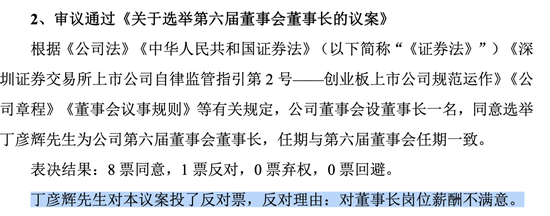
Core Viewpoint - The unusual voting scenario during the board meeting of Absen (300389.SZ) highlighted internal governance issues, with the chairman, Ding Yanhui, voting against his own re-election to signal the need for reform in the company's governance and compensation structure [2][3]. Group 1: Governance and Shareholding Structure - Ding Yanhui's dissenting vote was motivated by a desire to address the company's governance structure, which he believes is hindered by concentrated shareholding and unequal distribution of interests [3][5]. - The three founding shareholders, including Ding Yanhui, hold a significant portion of the company's shares: Ding holds 33.78%, while the other two founders hold 16.61% and 14.23%, respectively, leading to limited market participation from institutional investors [3][4]. - The concentrated ownership structure has resulted in decision-making inefficiencies, with major decisions potentially blocked by dissent from any of the three major shareholders [5]. Group 2: Compensation and Incentive Mechanisms - Ding Yanhui expressed dissatisfaction with the current compensation system, describing it as "unscientific and unreasonable," which has led to internal inequities in pay among employees [12][13]. - The company reported a significant increase in employee compensation, with total payable employee salaries reaching 156 million yuan, a 27.80% increase year-on-year, aligning with a 30.84% increase in net profit [10]. - Despite the increase in compensation, Ding Yanhui noted that the distribution mechanism has not kept pace with the company's growth, indicating a need for a more balanced approach to value creation among shareholders, the company, and employee incentives [10][11]. Group 3: Future Directions and Challenges - Ding Yanhui aims to establish a more modern and transparent board decision-making mechanism, emphasizing the importance of optimizing the shareholding structure as part of the reform process [6][11]. - The company is taking steps to address governance issues by hiring younger, highly educated professionals for key positions and engaging third-party consultants to revamp the compensation system [13]. - The internal conflict and governance challenges at Absen reflect broader issues faced by private enterprises in China as they transition towards modern governance practices [13].

对435万年薪不满?艾比森董事长拒绝连任,竟是想给员工多发钱?
Sou Hu Cai Jing· 2025-12-04 08:19
Core Viewpoint - The dramatic scene at the board meeting of Aibison, where Chairman Ding Yanhui voted against his own reappointment due to dissatisfaction with his salary, highlights deeper internal conflicts regarding governance and reform within the company [1][2] Group 1: Governance and Internal Conflicts - Chairman Ding Yanhui's rejection of his own reappointment was initially perceived as a personal grievance over his salary of 4.35 million, which has increased more than threefold since 2021 [1] - The company clarified that Ding's dissatisfaction was a "surface reason," indicating that he aimed to address significant issues related to governance structure, profit distribution, and compensation mechanisms [1] - Ding expressed that he faced substantial resistance in pushing for internal reforms, as the founding team remains influential, with any dissent from one of the three major shareholders halting major decisions [1] Group 2: Company Performance and Market Position - Despite the internal governance issues, Aibison's operational performance is strong, particularly in the LED display sector, with over 70% of revenue coming from overseas markets, establishing the company as an "export champion" in the industry [2] - Ding suggested that major shareholders consider reducing their stakes to improve the company's equity structure, although he acknowledged the significant obstacles to such changes [2] - The rejection of Ding's reappointment, while seemingly a minor issue regarding salary, reflects a broader challenge to the company's governance and long-term reform efforts [2]
艾比森董事长丁彦辉投票反对自己连任,不满薪酬
Sou Hu Cai Jing· 2025-12-03 03:03
Core Viewpoint - The chairman of Absen, Ding Yanhui, voted against his own re-election due to dissatisfaction with his salary, which has seen significant increases over the years [3][6]. Group 1: Chairman's Salary Discontent - Ding Yanhui cast the only dissenting vote during the board meeting on November 28, opposing his own election as chairman, citing dissatisfaction with the chairman's salary [3][6]. - His pre-tax salary for 2024 is reported at 4.36 million yuan, ranking 135th among A-share company chairmen, with a nearly sixfold increase from 730,000 yuan in 2020 to 4.36 million yuan in 2024 [9]. - The salary increase from 2023 to 2024 was approximately 51%, but excluding the employee stock plan's principal and earnings of 1.7399 million yuan, his actual salary would be 2.6157 million yuan [9]. Group 2: Personal Financial Needs - In October, Ding announced a plan to reduce his holdings by up to 3% of the company's total shares, citing "personal financial needs" as the reason for the sell-off [10]. Group 3: Company Performance Challenges - Absen's main business, LED display screens, is facing challenges, with both sales volume and price declining. The average selling price dropped from 12,300 yuan per square meter in 2022 to 9,920 yuan in 2024, and sales volume decreased from 373,800 square meters to 355,800 square meters [13]. - The company's production capacity utilization rate fell to 68%, with actual production of 217,000 square meters out of a total capacity of 320,000 square meters [13]. - For 2024, Absen reported a revenue of 3.663 billion yuan, an 8.58% year-on-year decline, and a net profit of 117 million yuan, down 62.98% year-on-year, primarily due to a shrinking domestic market [13]. Group 4: Strategic Adjustments - In response to industry challenges, Absen is shifting its strategy to focus on high-value clients and has begun to cut low-margin, long-account period businesses [14]. - The company is also pursuing a "branding + light asset + digitalization" strategy, maintaining fixed assets around 600 million yuan, significantly lower than competitors [14]. - Absen has started to explore the energy storage business since 2023, although it currently contributes minimally to revenue [14]. - In the third quarter, Absen reported a revenue of 1.053 billion yuan, a 14.5% year-on-year increase, and a net profit of approximately 69.05 million yuan, up 138.55% year-on-year [14].
436万年薪的A股公司董事长不想干了?理由:得涨工资
3 6 Ke· 2025-12-03 01:04
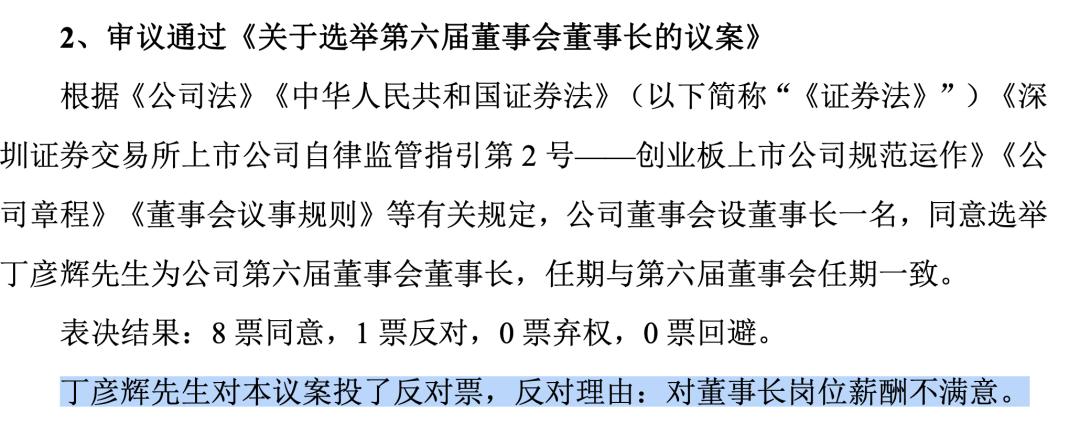
Core Viewpoint - The chairman of Aibisen, Ding Yanhui, expressed dissatisfaction with his salary during the board meeting, casting the only dissenting vote against his own election as chairman, which has raised market concerns about the company's internal dynamics [1][3]. Group 1: Company Leadership and Governance - Ding Yanhui was elected as the chairman of Aibisen during the first meeting of the sixth board of directors on November 28, but he voted against his own election due to dissatisfaction with the chairman's salary [1][3]. - Ding Yanhui holds 33.78% of the company's shares and has been the chairman since the company's founding in 2001 [3][8]. - His salary for 2024 is reported to be 4.36 million yuan, ranking 135th among chairmen of over 5,000 A-share companies, with a significant increase from 730,000 yuan in 2020 to 4.36 million yuan in 2024, marking a nearly sixfold increase [5][6]. Group 2: Financial Performance - Aibisen's revenue for 2024 is projected to be 3.663 billion yuan, a year-on-year decrease of 8.58%, with a net profit of 117 million yuan, down 62.98% compared to the previous year [10][11]. - The company has faced challenges with a decline in both sales volume and price for its LED display products, with sales price dropping from 123,000 yuan per square meter in 2022 to 99,200 yuan in 2024 [10]. - In the third quarter of this year, Aibisen reported a revenue of 1.053 billion yuan, a year-on-year increase of 14.5%, and a net profit of approximately 69 million yuan, up 138.55% year-on-year [12]. Group 3: Strategic Adjustments - Aibisen is undergoing strategic adjustments to address industry challenges, focusing on high-value clients and cutting low-margin, long-account receivable businesses [11]. - The company is also exploring new growth areas, including energy storage solutions, although this segment currently contributes minimally to overall revenue [11].
436万年薪的A股公司董事长不想干了?理由:得涨工资!
Xin Lang Cai Jing· 2025-12-02 14:20
Core Viewpoint - The chairman of Aibisen, Ding Yanhui, voted against his own re-election due to dissatisfaction with his salary, which has seen significant increases over the years [2][5][20]. Group 1: Chairman's Salary and Voting - Ding Yanhui cast the only dissenting vote against his re-election as chairman during the board meeting on November 28, citing dissatisfaction with the chairman's salary [2][5][21]. - His pre-tax salary for 2024 is reported at 4.36 million yuan, ranking 135th among over 5,000 A-share companies [7][23]. - From 2020 to 2024, his salary increased nearly sixfold, from 730,000 yuan to 4.36 million yuan, with a 51% increase from the previous year [7][23]. Group 2: Shareholding and Personal Financial Needs - Ding Yanhui holds a 33.78% stake in Aibisen and has announced plans to reduce his holdings by up to 3% due to personal financial needs [5][10][26]. - His entrepreneurial journey began in 1996, leading to the establishment of Aibisen, which has since expanded into international markets [10][28]. Group 3: Company Performance and Challenges - Aibisen's main business involves the R&D, production, and sales of LED displays, but it is currently facing challenges with declining sales prices and volumes [15][31]. - The average sales price of LED displays dropped from 123,000 yuan per square meter in 2022 to 99,200 yuan in 2024, with sales volume decreasing from 373,800 square meters to 355,800 square meters [15][31]. - The company's revenue for 2024 is projected at 3.663 billion yuan, an 8.58% year-on-year decline, with net profit down 62.98% [15][31]. Group 4: Strategic Adjustments - Aibisen is undergoing strategic adjustments, focusing on high-value clients and cutting low-margin, long-term businesses starting in the second half of 2024 [15][31]. - The company maintains a light asset operation model with fixed assets around 600 million yuan, significantly lower than competitors [16][32]. - In Q3 2023, Aibisen reported a revenue of 1.053 billion yuan, a 14.5% increase year-on-year, and a net profit of approximately 69.05 million yuan, up 138.55% [31][32].