
Nonferrous Metals

Search documents
材料板块 -全球供应收紧背景下,铝价重估将持续- China Materials-Aluminum Re-rating to Continue Amid Tightening Global Supply
2026-03-20 02:41
Summary of Aluminum Industry Conference Call Industry Overview - The aluminum industry is experiencing a tightening global supply due to various geopolitical tensions, particularly in the Middle East, which could further exacerbate supply deficits and support rising aluminum prices [1][4][29]. - The current aluminum price outlook is bullish, with expectations of prices reaching up to US$3,700 per ton in a favorable scenario [4][41]. Key Points on Supply and Production - **China's Supply Constraints**: - China's aluminum production capacity is capped at 45 million tons (mnt), with total operating capacity at 44.6 mnt as of the end of 2025. Production is expected to rise by 2% year-on-year (YoY) to 44.9 mnt in 2026 [2][20]. - The government is unlikely to relax this capacity cap due to ongoing carbon emission reduction efforts [2][52]. - **Overseas Supply Issues**: - Supply growth in overseas markets, particularly Indonesia, is constrained by power shortages and slow construction of necessary infrastructure. Indonesia's aluminum output is projected to increase by 775,000 tons YoY in 2026, but actual growth may fall short due to these constraints [3][19]. - The Middle East has already seen 564,000 tons of aluminum capacity shut down, with risks of further suspensions if geopolitical tensions persist [4][16]. - **Global Supply Deficit**: - A structural supply deficit is anticipated for 2026 and 2027, with potential capacity suspensions in the Middle East affecting global supply dynamics [4][21]. - The total aluminum production in the Middle East was approximately 7 mnt in 2025, accounting for 9% of global supply [12]. Company-Specific Insights - **Chuangxin Industries and Tianshan Aluminum**: - Both companies are rated as Overweight (OW) with price targets of HK$37.50 and RMB 23.20, respectively. Their strong earnings contributions from aluminum segments are expected to benefit from the improving price outlook [6][23]. - Chuangxin trades at a forward P/E of 12.9x, while Tianshan trades at 8.4x, below its historical average [23]. Cost and Margin Outlook - Production costs for aluminum are expected to remain low, supporting solid margins for smelters despite a decline in alumina prices. Total alumina production is forecasted to reach 94.4 mnt in 2026, up 6% from 2025 [5][22]. Demand Dynamics - Demand for aluminum is projected to increase by approximately 2.2% YoY in 2026, driven by sectors such as renewable energy and electric vehicles, despite a slowdown in the solar sector [30][74]. - The aluminum market is also seeing a shift towards using aluminum in HVAC systems, which could further support demand [30]. Risks and Considerations - Key risks include the potential easing of tensions in the Middle East, which could lead to a correction in aluminum prices, and faster-than-expected supply increases in other regions [6][25]. - Changes in global growth expectations and demand concerns could also impact aluminum prices negatively [24][42]. Conclusion - The aluminum industry is poised for a period of tight supply and rising prices, with significant implications for key players like Chuangxin Industries and Tianshan Aluminum. The geopolitical landscape, particularly in the Middle East, remains a critical factor influencing market dynamics.

【前瞻分析】2026年中国锑行业供给市场及进出口贸易分析
Sou Hu Cai Jing· 2026-02-28 03:46
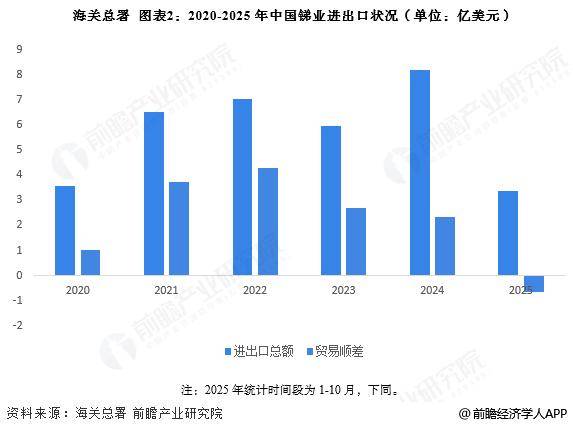
Group 1 - The core viewpoint of the article indicates that the Chinese antimony industry is experiencing a shift from trade surplus to trade deficit due to customs bans impacting exports and overall market dynamics [1][2][3]. Group 2 - From 2020 to 2024, the total import and export value of the antimony industry in China fluctuated, reaching $820 million in 2024, with a trade surplus of $23.2 million [1]. - In 2025, the trade surplus is projected to turn into a deficit of $6.5 million due to the impact of customs bans [1]. - Antimony product export value showed volatility, with a 22% year-on-year increase to $526 million in 2024, but export volume dropped significantly to 34,400 tons, and further declined to 5,600 tons in the first ten months of 2025 [3]. Group 3 - Antimony raw material production has been on the rise, increasing from 42,200 tons in 2020 to 46,200 tons in 2024, reflecting a year-on-year growth of 13.1% [6]. - The production of antimony trioxide saw a decline, with output falling to 91,700 tons in 2024, a decrease of 12.33% compared to 104,600 tons in 2021, influenced by reduced raw material and ingot production [7]. - Future growth in antimony trioxide production is anticipated as processing technologies continue to improve [7].

拧成一股绳 招引好项目
Guang Xi Ri Bao· 2026-02-27 02:32
Core Viewpoint - The development of the non-ferrous metal industry in Guangxi is focused on high-quality growth, with an emphasis on attracting and nurturing industry investments, leading to successful partnerships with major state-owned enterprises and industry leaders [1][2]. Group 1: Investment and Project Development - Guangxi has successfully engaged with major enterprises such as China Minmetals, CITIC Group, and China National Gold Group for collaboration and investment opportunities [1]. - Since the establishment of the "Ten Ones" working group in October 2025, there has been a dual focus on attracting and nurturing industry investments, resulting in 35 projects signed at the Guangxi Non-Ferrous Metal Key Metal Industry High-Quality Development Conference, with 8 projects already under construction and a total investment of 763 million [1]. - The key mining project in Hechi has made significant progress, including the acquisition of mining rights for Baida and Wuxu mines, while the Hechi Zhenghua lead-antimony separation project is advancing rapidly with new equipment procurement and infrastructure development [1]. Group 2: Industry Chain Development - A "chain leader + chain master" dual-drive mechanism has been established to strengthen and extend the industry chain, with monthly tracking of new, ongoing, completed, and planned projects [2]. - The focus is on supporting the industrialization of critical materials and technologies, leading to the successful development of high-end new materials such as 6N61SP semiconductor aluminum alloy and high-purity tin ingots [2]. - By 2025, the number of projects in the non-ferrous metal industry is expected to increase to 109, with significant growth in industry clusters, including the cultivation of five enterprises with over 10 billion in output value and 13 national-level specialized and innovative "little giant" enterprises [2]. Group 3: Strategic Planning and Infrastructure - Guangxi has issued the "Overall Development Plan for Industrial Parks in Guangxi (2025-2035)," focusing on the construction of key metal high-quality development pilot zones and enhancing land use, infrastructure, and standard improvements [3]. - The plan aims to attract leading enterprises and extend the industry chain into deeper processing stages, aligning with the "Nine Chains and Three Clusters" strategy [3].
【ETF洞察】稀土爆发,多只ETF大涨超6%!两大指数差别一文看懂
Sou Hu Cai Jing· 2026-02-25 13:25
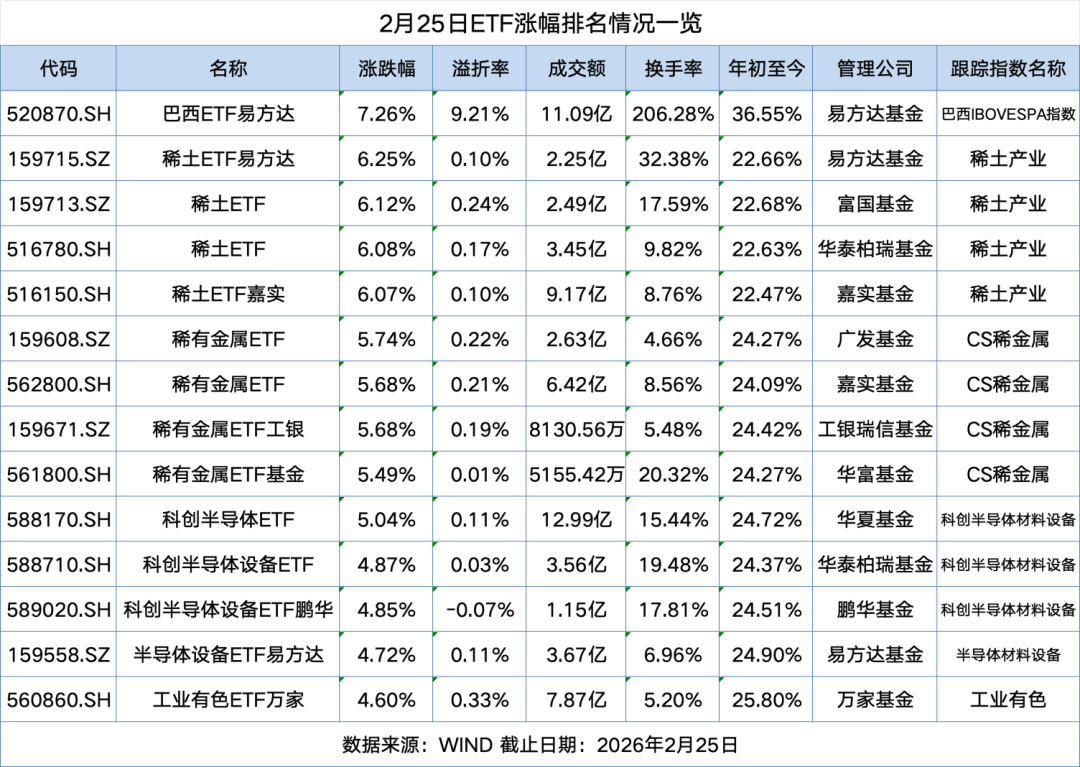
Core Viewpoint - The rare earth sector has shown significant growth, with related ETFs experiencing strong performance, particularly on February 25, when the A-share market surged and the rare earth sector rose by 8% [1][5]. ETF Performance - On February 25, a total of 1,052 ETFs increased in value, with the highest gain reaching 7.26% [1]. - The top-performing ETFs included the Brazil ETF from E Fund, which rose by 7.26%, and several rare earth ETFs, such as the E Fund Rare Earth ETF, which increased by 6.25% [2][8]. - The trading volume for the Brazil ETF was 1.109 billion, indicating high investor interest [2]. Sector Analysis - The rare earth industry accounts for 29.23% of the CSI Rare Earth Industry Index, while the CSI Rare Metals Theme Index has a lower allocation of 18.72% to rare earths [6]. - The demand for rare earth materials is driven by the explosive growth in AI hardware, which has increased the need for rare earth permanent magnet materials [7]. Market Sentiment - The market sentiment is bullish, with significant inflows into stock ETFs, totaling 5.634 billion on February 24, reversing the trend of outflows seen prior to the holiday [9]. - The overall market is experiencing heightened enthusiasm, with various sectors, including semiconductors and steel-related ETFs, also showing considerable gains [8].

白银有色铜业公司因生产安全事故被罚50万元
Qi Lu Wan Bao· 2026-02-25 05:43
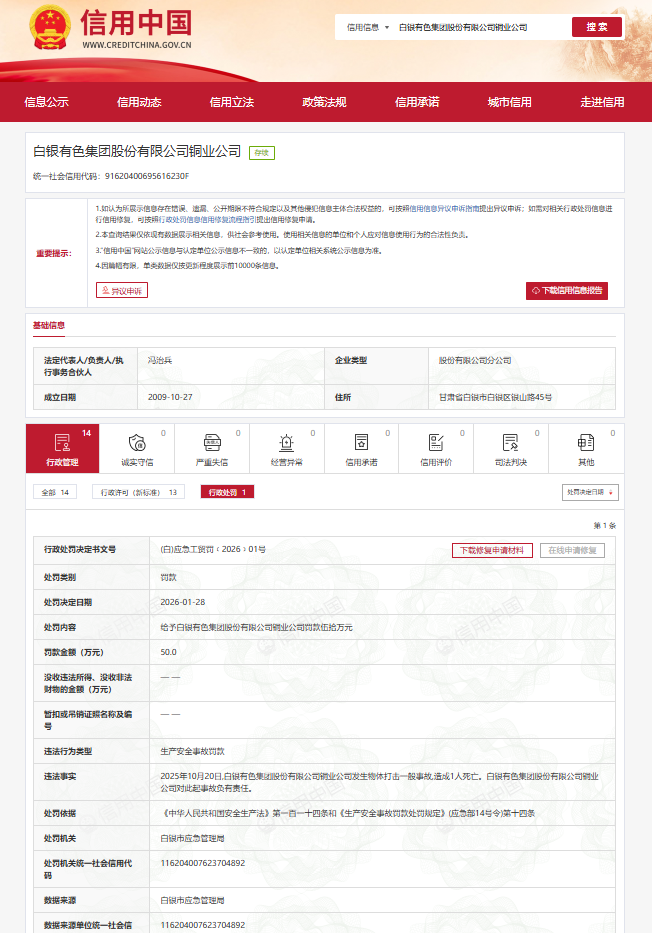
Core Viewpoint - Baiyin Nonferrous Metals Group Co., Ltd. faced a fine of 500,000 yuan due to a production safety accident that resulted in one fatality, indicating potential operational risks within the company [1]. Company Overview - Baiyin Nonferrous Metals Group Co., Ltd. was established in 1954 and is a significant player in China's nonferrous metal industry, contributing to the development of the local economy and the national industry over the past 70 years [2][5]. - The company underwent a strategic investment from CITIC in 2008 and successfully listed on the Shanghai Stock Exchange on February 15, 2017, under the stock code 601212 [2][5]. Operational Details - The company has a registered capital of 7.405 billion yuan and operates 42 subsidiaries, producing over 40 types of products, including copper, lead, zinc, gold, and silver [6]. - Baiyin Nonferrous has a mining and processing capacity exceeding 23.5 million tons, with specific capacities of 800,000 tons for copper, lead, and zinc, 100 tons for gold, and 1,000 tons for silver [6].

一产一策|江西有色金属产业人才政策一图读懂
Xin Lang Cai Jing· 2026-02-24 04:56
Group 1 - The article discusses measures to support the talent development in the non-ferrous metal industry in the province, focusing on attracting high-level talent and innovation teams [2][4] - It outlines financial incentives for companies to hire high-end talent in key technology areas, including a subsidy of up to 200,000 yuan per person per year for three years based on the annual taxable salary [4] - The article mentions the establishment of a high-level talent innovation and entrepreneurship competition, where eligible winners can directly enter the "Ganpo Talent Program" [4] Group 2 - There is encouragement for leading enterprises and major innovation platforms to independently establish research projects aimed at young scientific and technological talents in the non-ferrous metal sector, with a minimum selection ratio of 50% for projects led by individuals under 40 [6] - Financial support is provided for companies hiring doctoral graduates in the non-ferrous metal field, with subsidies of 50,000 yuan and 70,000 yuan per person [6] - The article emphasizes the importance of establishing targeted classes in universities and providing subsidies for companies that retain graduates [6] Group 3 - The article highlights the support for leading enterprises to host industry entrepreneur salons, academic exchanges, and training programs to promote major talent projects [8] - It mentions a reimbursement of up to 100,000 yuan for actual expenses incurred in promoting major talent projects [8] - There are incentives for enterprises founded by provincial-level E-class or above talents in the non-ferrous metal field, including rewards for becoming recognized as national-level specialized and innovative "little giant" enterprises [8] Group 4 - The article discusses the cultivation of skilled talent in the non-ferrous metal industry, with financial support for those achieving senior professional titles [11] - It encourages enterprises to conduct independent recognition of vocational skill levels and aims to establish a career development pathway for high-skilled talents in engineering technology [12] - The establishment of modern industry colleges for copper, tungsten, and rare earths is also mentioned, with financial support for talent training [13] Group 5 - The article outlines support for the establishment of research and development platforms by leading enterprises, with financial incentives based on the annual new output value generated [17] - It provides details on subsidies for enterprises that obtain insurance compensation qualifications for major technological equipment, rewarding key personnel involved in research and development [17] - The article emphasizes the importance of transforming scientific and technological achievements into industrial applications, with financial support for universities and research institutions involved in this process [20][21]

泉果基金月度观点: AI为核心的科技创新仍是市场主线
Xin Lang Cai Jing· 2026-02-05 01:44
Market Overview - In January 2026, the equity market experienced a strong start driven by ample liquidity and policy expectations, with major indices showing a pattern of initial gains followed by a pullback, indicating a significant increase in market risk appetite [1][10] - The Shanghai Composite Index, Shenzhen Component Index, and ChiNext Index rose by 3.76%, 5.03%, and 4.47% respectively, with the average daily trading volume in A-shares reaching a historical high of 3.04 trillion yuan, a substantial increase from December [1][10] - The Shanghai Composite Index hit a new high of 4190.87 points, but the momentum was curtailed mid-month due to regulatory adjustments and large-scale redemptions of broad-based ETFs, shifting the market from a "fast bull" to a "structural slow bull" [1][10] Sector Performance - Growth style outperformed value style, with the Sci-Tech 50 index, representing AI computing power and semiconductor equipment, surging by 12.3%, while the CSI Dividend Index only increased by 3.5% [1][10] - The non-ferrous metals sector led the gains with a 22.6% increase, driven by soaring precious metal prices and rising resource prices. The media sector benefited from the improved sentiment in AI marketing and gaming, rising by 17.9%, while the oil and petrochemical sector increased by 16.3% due to geopolitical risks pushing oil prices up [1][10] - The banking sector was the only one to experience a significant decline, dropping by 6.6% due to the impact of large ETF redemptions [1][10] Investment Outlook - In the AI sector, the increasing stock of chips has accelerated the iteration speed of AI models, with a clear trend of model differentiation. The emergence of Clawdbot highlights the strong capabilities of large models and the demand for suitable product forms [3][12] - The non-ferrous metals sector is expected to experience volatility, influenced by geopolitical events and the potential for a shift in monetary policy under the new Federal Reserve chair nomination. Despite short-term corrections, the long-term upward trend for precious and non-ferrous metals is anticipated to continue due to ongoing central bank gold purchases and supply constraints [4][13] Investment Strategy - The company maintains an optimistic outlook for the 2026 equity market while remaining vigilant about potential risk events. A proactive and diversified investment approach is recommended to retain flexibility for timely responses [5][14] - Key focus areas include AI-driven technological innovation, which is expected to continue evolving rapidly, and the infrastructure supporting AI applications, such as GPUs and power supply [5][14] - The insurance sector is highlighted for its growth potential due to rapid increases in liabilities and sustainable investment returns [6][14] - There is a positive long-term outlook for gold, copper, aluminum, and rare metals, with caution advised regarding short-term price reactions in futures and stock prices [6][14] - Continued attention is recommended for the lithium battery supply chain, internet, gaming, and offshore wind industries [7][15]
Copper Rebounds as China Industry Group Calls for Stockpiling
Yahoo Finance· 2026-02-03 18:56
Group 1 - Copper prices rebounded by as much as 4.9% to $13,526 a ton on the London Metal Exchange after an 11% decline from a record high [1] - The China Nonferrous Metals Industry Association called for an expansion of strategic reserves and collaboration with state-owned producers to increase commercial stockpiles [1] - Signs of dip-buying from investors in China, the largest consumer of copper, contributed to the price rally as fabricators returned to the market to replenish stocks ahead of the Lunar New Year [2] Group 2 - Fabricators are willing to buy copper when prices correct by more than 10%, indicating strong fundamental support for the metal [3] - Investor interest in metals has surged due to doubts about the US dollar and a shift away from currencies and sovereign bonds, leading to significant price rallies in January [3] - However, drivers for further price increases have weakened due to uncertainty over US monetary policy and reduced risks of a supply squeeze on the LME [4] Group 3 - Spot prices are trading at a discount to the three-month benchmark contract on the LME, indicating ample near-term supplies [5] - Large premiums on Comex contracts over LME contracts have diminished, which may discourage metal flows to the US ahead of potential import tariffs [5]
有色ETF鹏华(159880)收涨超7.3%,14只成分股今日涨停
Xin Lang Cai Jing· 2026-01-28 07:38
Group 1 - The core viewpoint of the news highlights a significant surge in the non-ferrous metal sector driven by rising risk aversion and expectations of interest rate cuts, with the Penghua Non-Ferrous ETF (159880) rising over 7.3% and 14 constituent stocks hitting the daily limit up [1] - Southwest Securities indicates that both precious metals and industrial copper sectors are showing positive expansion, with resource-advantaged companies continuously increasing reserves and production, and upcoming production from marine gold mining projects [1] - As of January 28, 2026, the Guozheng Non-Ferrous Metal Industry Index (399395) has surged by 6.31%, with significant gains in constituent stocks such as Silver Non-Ferrous (up 10.04%), China Aluminum (up 10.02%), and Yunnan Copper (up 10.02%) [1] Group 2 - As of December 31, 2025, the top ten weighted stocks in the Guozheng Non-Ferrous Metal Industry Index (399395) include Zijin Mining, Luoyang Molybdenum, Northern Rare Earth, and others, collectively accounting for 51.65% of the index [2] - The Penghua Non-Ferrous ETF (159880) closely tracks the Guozheng Non-Ferrous Metal Industry Index, which selects 50 securities from the non-ferrous metal industry based on size and liquidity, reflecting the overall performance of listed companies in this sector [1][2]





贵金属、有色金属涨势不止!有色金属ETF(512400)大涨近7%,有色板块逻辑转向宏观避险与战略资源安全并重
Sou Hu Cai Jing· 2026-01-28 06:53
Core Viewpoint - The non-ferrous metal ETF (512400) has seen significant gains, driven by geopolitical risks and macroeconomic factors, leading to a bullish outlook for precious metals and industrial metals [1][2][3]. Non-Ferrous Metals Sector Overview - The non-ferrous metal ETF (512400) rose by 6.78%, with a trading volume of 3.385 billion yuan, reflecting strong investor interest [1]. - The ETF has experienced continuous net inflows over the past 17 days, indicating robust demand [2]. Precious Metals - Precious metals are entering a historic bull market due to multiple factors, including the sell-off of dollar assets, escalating geopolitical conflicts, and increased central bank gold purchases [3]. - Central banks, including the People's Bank of China, have been increasing gold reserves for 14 consecutive months, providing strong support for gold prices [3]. - Despite expectations of a Federal Reserve rate cut in the second half of 2026, current demand for safe-haven assets is dominating the market [3]. Industrial Metals - Industrial metals are facing seasonal inventory accumulation but are supported by extreme shortages at the mining level and low global inventories [3]. - Copper prices are resilient due to strong pre-holiday stocking by downstream industries, with a significant supply gap expected in the first half of the year [3]. - Aluminum prices are expected to rebound due to low global inventories and strong demand driven by investments in power grids and solar energy [3]. New Energy and Minor Metals - Strategic resource attributes of metals like lithium and cobalt are becoming more prominent due to geopolitical tensions [4]. - The Democratic Republic of Congo's submission of a list of strategic assets, including copper, cobalt, and lithium, underscores the importance of these resources [4]. - Although cobalt prices have slightly declined, the structural supply tightness remains, supporting a long-term bullish outlook [4]. Overall Sector Logic - The logic of the non-ferrous metals sector is shifting from a simple supply-demand dynamic to a focus on macroeconomic risks and strategic resource security [5]. - The index for non-ferrous metals reflects the performance of 50 listed companies in the sector, with major constituents including Zijin Mining, Luoyang Molybdenum, and China Aluminum [5].