个人电脑(PC)

Search documents
惠誉:确认联想集团"BBB"长期本外币发行人评级,展望"稳定
Ge Long Hui· 2026-03-02 03:12
Core Viewpoint - Fitch Ratings has confirmed Lenovo Group Limited's long-term foreign and local currency issuer default ratings at 'BBB' with a stable outlook, reflecting expectations of maintaining a robust credit profile due to its leadership in the global PC market and progress in service-oriented transformation [1] Group 1: Business Performance - Lenovo maintains a strong market position in the global PC sector, with PC shipments remaining the highest globally and market share expected to increase to 25% by Q4 2025 from 24% in Q4 2024 [2] - The company achieved record profit levels in the first nine months of the fiscal year ending March 2026, driven by stable market share growth and enhanced profitability in the Solutions and Services Group (SSG), with IDG revenue growing by 15% and SSG revenue by 18% year-on-year [2] - The Infrastructure Solutions Group (ISG) experienced an expanded loss, but EBITDA increased by 27% year-on-year to $3.7 billion in the same period [2] Group 2: Dependency on PC Business - Lenovo's profitability and cash generation remain highly dependent on its PC business compared to peers like Dell and HP, with only about 35% of its segment profit coming from non-PC businesses, while Dell and HP contribute approximately 69% and 60% respectively [2] - The company's mixed manufacturing model requires higher working capital and capital expenditures, leading to volatility in free cash flow before dividends, reflecting PC cycle fluctuations and higher capital expenditures related to manufacturing migration [2] Group 3: Growth Projections - SSG revenue is projected to grow at a mid-teens CAGR from FY2026 to FY2029, primarily driven by managed services and project solutions, which together account for about 60% of SSG's total revenue in Q3 FY2026 [3] - The company anticipates further growth in "as-a-service" and digital workplace solutions, with integrated solutions penetrating various verticals, maintaining SSG profit margins between 20% and 22% [3] - ISG is expected to reach breakeven in Q4 FY2026 after restructuring and cost-cutting measures, although higher inventory costs may impact profit margins [3] Group 4: Financial Leverage - Fitch expects Lenovo's total EBITDA leverage ratio to remain at a moderate level of 1.0x to 1.3x over the next three years, with sufficient liquidity and free cash flow to cover dividends, acquisitions, and capital expenditures while gradually reducing total leverage [4] - The company's conservative leverage level is a credit strength that helps mitigate business risks associated with lower diversification and thinner overall profit margins compared to peers [4]

盘后暴涨逾13%!戴尔(DELL.US)AI服务器需求爆棚 财测远超预期点燃市场
Zhi Tong Cai Jing· 2026-02-26 23:25
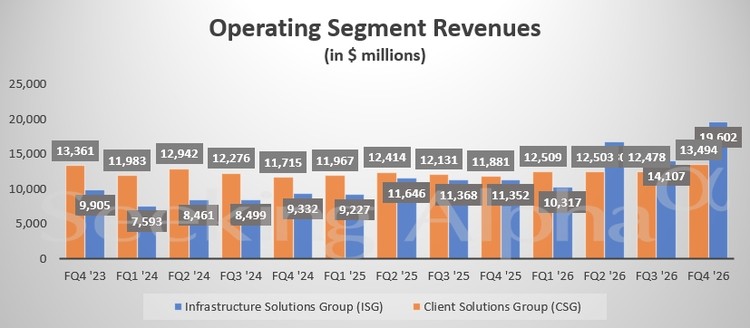
Core Insights - Dell Technologies (DELL.US) has reported a financial outlook that significantly exceeds Wall Street expectations, driven by strong demand for its AI servers, leading to a stock price increase of over 13% in after-hours trading [1] - The company anticipates AI server revenue to reach approximately $50 billion in the fiscal year ending January 2027, representing a year-over-year growth of 103% [1] - Dell's overall revenue forecast for fiscal year 2027 is between $138 billion and $142 billion, well above analyst expectations of $125.54 billion, with adjusted earnings per share projected at $12.90, exceeding the expected $11.59 [1] Financial Performance - Dell's fourth-quarter revenue grew by 39% year-over-year, reaching a record $33.4 billion, surpassing market expectations of $31.73 billion [2] - Adjusted earnings per share for the fourth quarter were $3.89, higher than the anticipated $3.53 [2] - The Infrastructure Solutions Group (ISG) revenue surged by 73% to $19.6 billion, while the Client Solutions Group (CSG) revenue increased by 14% to $13.49 billion [2] Market Dynamics - Dell has over 4,000 AI server customers, including notable companies like Elon Musk's xAI and CoreWeave, with major tech firms such as Google, Microsoft, Amazon, and Meta planning significant investments in AI infrastructure [4] - Despite the rapid growth in AI server business, rising storage chip prices are exerting pressure on profit margins across different segments [4] - The operating margin for the server and networking business was 14.8%, above the expected 12.9%, while the PC business margin was 4.7%, below the anticipated 6.18% [4] Industry Challenges - The current market environment is characterized by high uncertainty, with unprecedented AI demand leading to ongoing supply constraints and frequent price adjustments [7] - The rising costs of storage chips are forcing manufacturers like Dell and HP to increase product prices, which may suppress demand for consumer electronics, including PCs, smartphones, and gaming consoles [7] - Competitors such as HP and Lenovo have indicated potential challenges in their future performance due to pressures on PC shipment volumes [7]


盘后暴涨逾13%!戴尔(DELL.US)AI服务器需求爆棚 业绩指引远超预期点燃市场
智通财经网· 2026-02-26 23:25
Core Insights - Dell Technologies (DELL.US) has significantly exceeded Wall Street expectations in its financial outlook, driven by strong demand for AI servers, leading to a stock price increase of over 13% in after-hours trading [1] - The company anticipates AI server revenue to reach approximately $50 billion in the fiscal year ending January 2027, representing a year-over-year growth of 103% [1] - Dell's overall revenue forecast for fiscal year 2027 is between $138 billion and $142 billion, well above analyst expectations of $125.54 billion, with adjusted earnings per share projected at $12.90, exceeding the anticipated $11.59 [1] Financial Performance - Dell's fourth-quarter revenue grew by 39% year-over-year, reaching a record $33.4 billion, surpassing market expectations of $31.73 billion [2] - Adjusted earnings per share for the fourth quarter were $3.89, higher than the expected $3.53 [2] - The Infrastructure Solutions Group (ISG) revenue surged by 73% to $19.6 billion, while the Client Solutions Group (CSG) revenue increased by 14% to $13.49 billion [2] Market Dynamics - Dell has over 4,000 AI server customers, including notable companies like Elon Musk's xAI and CoreWeave, with major tech firms such as Google, Microsoft, Amazon, and Meta planning substantial investments in AI infrastructure [4] - Despite the rapid growth in AI server business, rising storage chip prices are exerting pressure on profit margins, with the operating margin for server and networking business at 14.8%, above the expected 12.9%, while the PC business margin was 4.7%, below the anticipated 6.18% [4] Industry Challenges - The current market environment is characterized by high uncertainty, with unprecedented AI demand leading to ongoing supply constraints and frequent price adjustments [7] - The rising costs of storage chips are forcing manufacturers like Dell and HP to increase product prices, which may suppress demand for consumer electronics, including PCs, smartphones, and gaming consoles [7] - Competitors such as HP and Lenovo have indicated potential challenges, with HP forecasting its fiscal 2026 performance at the lower end of previous estimates and Lenovo warning of increasing pressure on PC shipment volumes [7]
惠普发布盈利预警,内存芯片波动或持续至明年
Huan Qiu Wang Zi Xun· 2026-02-25 04:43
Core Viewpoint - HP has issued a profit warning, indicating that the volatility in memory chip prices will persist into next year, leading to a projected double-digit decline in PC shipments, which caused its stock to drop approximately 6% in after-hours trading [1][3]. Group 1: Financial Forecast - For the fiscal year ending October 31, 2026, HP expects adjusted earnings per share to be at the lower end of the previously forecasted range of $2.90 to $3.20 [3]. - The company acknowledged that the weakness in the PC market has exceeded prior expectations, with shipment declines aligning with overall industry trends [3]. Group 2: Profitability and Cost Pressures - HP's adjusted operating profit margin for the first fiscal quarter of 2026 was reported at 6.9%, below the market average expectation of 7.4%, indicating ongoing cost pressures affecting profitability [3]. Group 3: Strategic Responses - To mitigate the impact of rising memory chip prices, HP has implemented several self-help measures, including price increases to pass on some costs, expanding its supplier network to reduce dependency, and optimizing product designs to decrease memory chip usage [3]. - The company announced that these strategic initiatives have made progress, including the completion of the certification process for new suppliers [3].

联想集团股价下跌 存储芯片涨价冲击利润
Xin Lang Cai Jing· 2026-02-12 07:10
Group 1 - Lenovo Group reported a revenue increase of $22.2 billion for the last fiscal quarter, despite a 21% year-over-year decline in net profit [1][2] - Following the earnings announcement, Lenovo's stock price dropped by 6.3%, indicating market concerns over profit margin pressures due to rising storage chip prices [1][2] - The holiday promotions and anticipated price increases have stimulated the PC market, with IDC reporting a 9.6% growth in overall PC shipments, and Lenovo, HP, and Dell all achieving double-digit growth [1][2] Group 2 - The AI boom has led to a tight supply of consumer electronic components, including storage chips, with expectations that the impact on profit margins will intensify in the coming months [1][2] - Analysts from Daiwa Capital Markets noted that the demand surge is expected to continue into the first quarter, but as lower-cost inventory is depleted, further price increases may occur, potentially affecting end-user demand [1][2] - Lenovo's infrastructure solutions group, responsible for servers and storage hardware, saw a 31% revenue growth, reaching a record high of $5.2 billion, driven by investments in AI infrastructure [1][2]
英特尔称,存储芯片价格上涨,可能会在2026年伤害到个人电脑(PC)市场
Jin Rong Jie· 2026-01-22 23:18
Core Viewpoint - Intel indicates that rising prices of memory chips may negatively impact the personal computer (PC) market by 2026 [1] Group 1 - Intel has reported an increase in memory chip prices [1] - The potential impact of these price increases could harm the PC market in the coming years [1]

美国硬件科技股遭大幅抛售
第一财经· 2026-01-21 03:24
Group 1 - The core viewpoint of the article highlights a significant downturn in the hardware technology sector, with major companies experiencing substantial stock price declines due to reduced corporate spending amid economic uncertainty and rising component costs [3] - Morgan Stanley downgraded the hardware technology industry rating, warning of a "perfect storm" formed by slowing demand, rising input cost inflation, and overvaluation, leading to a more defensive strategy until 2026 [3][6] - The latest survey by Morgan Stanley indicates that hardware technology budget growth for 2026 is expected to be only 1% year-on-year, marking the weakest growth in nearly 15 years, excluding the pandemic period [3] Group 2 - According to the International Workplace Group's 2026 Corporate Executive Outlook Report, 95% of CEOs are optimistic about 2026, but all surveyed CEOs believe cost control is crucial, with an average budget cut of 10% planned by CFOs [4] - Companies are actively leveraging AI and flexible working solutions to enhance operational efficiency and unlock investment potential [4] - A separate Morgan Stanley survey revealed that if component inflation continues, 30% to 60% of customers may reduce their planned purchases of PCs, servers, and storage devices [5] Group 3 - Morgan Stanley stated that higher costs and elastic demand increase the risk of downward adjustments in profit expectations for 2026 [6] - Citigroup analysts noted that hardware companies and distributors face fluctuations in corporate demand, rising memory costs, and a decline in PC shipments for 2026 [6] - IDC's recent market outlook predicts a potential decline of up to 9% in PC shipments for 2026, with a moderate scenario indicating a shrinkage of 5% [6] - The current industry landscape may lead to further market share concentration among leading manufacturers like Dell, HP, Lenovo, and ASUS, which are better positioned to withstand market pressures compared to smaller regional brands and white-box manufacturers [6]

采购成本急剧上升 存储芯片“涨声”不止正迅速向终端传导
Zhong Guo Chan Ye Jing Ji Xin Xi Wang· 2025-12-17 00:17
Core Viewpoint - The global electronic industry is experiencing a "super cycle" of storage chip price increases driven by a surge in AI server demand, leading to significant cost pressures across the supply chain [1][2]. Group 1: Price Increases and Market Impact - Storage chip prices have skyrocketed, with DRAM prices increasing over fourfold and Flash prices nearly tripling within the year [1]. - The price of DDR4 memory has seen a cumulative increase of over 200% in six months, with recent monthly increases ranging from 30% to 70% [2]. - Major PC manufacturers like Lenovo, Dell, and HP are planning to raise product prices by up to 20% due to rising storage chip costs [4]. Group 2: Demand and Supply Dynamics - The demand for AI servers has surged, with storage configurations reaching 1.7TB compared to 0.5TB for traditional servers, causing a shift in production focus towards high-margin products like HBM and DDR5 [2]. - The ongoing price increases are expected to last longer than previous cycles, with predictions of a decline in global notebook shipments from a growth of 1.7% to a decrease of 2.4% in 2026 [5]. Group 3: Strategic Responses from Companies - Companies are adopting varied strategies to cope with rising costs; some are increasing prices while others are adjusting product configurations or expanding supplier networks [3]. - Domestic storage companies in China, such as Changxin Storage and Yangtze Memory Technologies, are expanding capacity and making technological breakthroughs, potentially disrupting the market dominated by foreign giants [6]. Group 4: Future Market Considerations - The elasticity of terminal demand will be crucial in determining whether price increases can be sustained; excessive retail price hikes may suppress consumer demand, leading to a potential price correction [6]. - The ongoing shortage of storage chips is viewed as both an opportunity and a challenge for storage module manufacturers, necessitating long-term strategic planning [6].
PC和AI推动,联想三季度营收猛增15%,但存储芯片涨价侵蚀利润
美股IPO· 2025-11-20 02:41
Core Viewpoint - Lenovo Group's latest financial report shows a mixed picture, with a 15% year-on-year revenue growth driven by a recovery in the PC market and strong demand for AI servers, but a 5% decline in net profit raises concerns about future profitability due to rising component costs [3][10][11]. Financial Performance - Lenovo's quarterly revenue reached $20.5 billion, exceeding market expectations of $20.1 billion [5]. - The net profit for the quarter was $340.3 million, falling short of the consensus estimate of $434.2 million [4][11]. - For the first half of the year, Lenovo reported a net profit of $845.6 million and revenue of $20.45 billion [6]. Business Segments - The PC business has shown strong performance, with a 17.3% year-on-year increase in shipments from July to September, helping to boost revenue [8][9]. - AI servers have emerged as a key growth driver, with increasing investments in computing infrastructure from global enterprises accelerating demand [10]. Cost Pressures - Rising storage chip prices are significantly impacting Lenovo's profit margins, leading to concerns about the overall profitability of PC manufacturers [11][12]. - Morgan Stanley has downgraded its rating for Lenovo based on the anticipated erosion of profits due to increasing component costs [3][12].
日常生活中的市场设计|《财经》书摘
Sou Hu Cai Jing· 2025-11-11 13:38
Core Insights - The article discusses the pervasive nature of market design in everyday life, illustrating how even simple choices, like breakfast, are influenced by complex market operations [2][3] - It highlights the transformation of markets from traditional matching systems to standardized commodity markets, using wheat and coffee as primary examples [4][6] Market Transformation - The Chicago Mercantile Exchange established a standardized grading system for wheat, allowing for anonymous and efficient trading, which eliminated the need for buyers to know the seller's identity [4][5] - The transition from a matching market to a commodity market increases market "thickness," enabling any buyer to purchase from any seller, thus enhancing efficiency [5] Coffee Market Evolution - The establishment of the Ethiopian Commodity Exchange in 2008 introduced an anonymous coffee grading system, allowing buyers to purchase coffee without knowing the supplier's identity [6][7] - The grading system incentivizes coffee farmers to harvest only ripe cherries, improving the overall quality of coffee available in the market [7] Market Dynamics - There exists a tension between commoditization and product differentiation, where sellers aim to attract buyers in a thick market while also wanting their products to stand out [8][9] - The article illustrates that while consumers may prefer standardized products for convenience, they also appreciate unique offerings that require more effort to find [9][10] Local Market Appeal - Farmers' markets are presented as a blend of matching and commodity markets, where buyers can connect with local sellers, enhancing the shopping experience [10]