中试平台

Search documents
浙江第二城,加速“抱紧”上海
3 6 Ke· 2026-01-09 02:08
Core Insights - The visit of the Ningbo municipal party and government delegation to Shanghai marks a significant step in enhancing collaboration and integration within the Yangtze River Delta region, focusing on high-quality development and technological innovation [1][4]. Group 1: Economic Goals and Challenges - Ningbo aims to achieve a GDP of over 2 trillion yuan by 2025, positioning itself among the top 10 cities in China, which requires an annual growth rate exceeding 10% from its projected 1.81 trillion yuan in 2024 [3]. - The GDP growth rate for Ningbo in the first three quarters of 2025 was only 5.0%, indicating challenges in meeting the ambitious economic targets [3]. Group 2: Strategic Initiatives - The Ningbo delegation's discussions emphasized the importance of deepening cooperation with Shanghai in areas such as major technological breakthroughs, industrial cluster development, and talent exchange [1][4]. - The focus on integrating "new technologies" and fostering a robust innovation ecosystem is a priority, with plans to enhance investment in research platforms, talent cultivation, and technology incubators [3]. Group 3: National Strategic Alignment - Ningbo's inclusion in the national high-energy innovation network opens new opportunities for research collaboration, industrial upgrades, and talent aggregation, aligning with the central government's strategic initiatives [4]. - The central economic work conference highlighted the establishment of three major international technology innovation centers, with Shanghai leading the charge, which will benefit cities like Ningbo through enhanced regional collaboration [3].
锐评|最高1亿元!助力北京科研跨越“死亡之谷”
Xin Lang Cai Jing· 2026-01-05 11:29
Core Viewpoint - Beijing's policy document aims to enhance the city's pilot testing service capabilities to promote the integration of technological and industrial innovation, offering substantial financial support for the construction of pilot testing platforms [1][3]. Group 1: Policy Measures - The new policy includes 14 measures to address existing issues related to pilot testing platforms, such as awareness of available platforms, future construction areas, participation eligibility, and specific government support measures [3]. - New pilot testing platforms can receive up to 100 million yuan in subsidies, which is expected to stimulate industry interest and participation [1][3]. Group 2: Importance of Pilot Testing Platforms - Pilot testing platforms serve as critical intermediaries between laboratory innovations and large-scale industrial production, with a reported success rate of 80% for technologies that undergo pilot testing compared to only 30% for those that do not [3]. - The establishment of these platforms is essential to reduce the barriers to technology commercialization and to invigorate innovation across society [3][4]. Group 3: Challenges in Technology Transfer - The technology transfer process is often fraught with challenges, including funding shortages, lack of facilities, limited application scenarios, and difficulties in aligning with real business needs, leading to a phenomenon known as the "valley of death" for many projects [4]. - The need for macro-level coordination and support is emphasized to ensure successful transitions from laboratory samples to market-ready products, thereby enhancing the overall efficiency of technology transfer [4]. Group 4: Resource Utilization and Sustainability - Beijing possesses rich educational and research resources, with many existing pilot testing facilities in universities and research institutions that could be opened to the public to maximize resource utilization [5]. - The long-term sustainability of pilot testing platforms is highlighted as a critical challenge, necessitating a focus on financial product diversity and independent legal entity reforms for these platforms [5].

北京:对符合条件的新建中试平台最高给予1亿元补助支持
Xin Lang Cai Jing· 2026-01-04 12:29
Core Viewpoint - Beijing aims to establish 10 national-level manufacturing pilot platforms and support the construction of 50 municipal-level pilot platforms by 2030, with financial incentives for qualifying projects [1] Group 1: Financial Support - New pilot platforms for industries such as artificial intelligence, healthcare, green low-carbon technologies, robotics and intelligent manufacturing, and integrated circuits will receive subsidies of 35% of total project investment, capped at 100 million yuan [1] - New pilot platforms for next-generation information technology and intelligent connected vehicles will receive subsidies of 25% of total project investment, capped at 50 million yuan [1] - The document emphasizes the support for pilot platforms to implement independent legal entity reforms to enhance their market service capabilities [1] Group 2: Investment Incentives - For newly established independent legal entity pilot platforms, the investment subsidy ratio increases to 45% and 35% respectively [1]
研判2025!中国中试平台行业分类、政策、发展现状、竞争格局和未来趋势分析:制造业中试平台建设数量超2400个,未来将进一步向更高水平迈进[图]
Chan Ye Xin Xi Wang· 2025-12-28 01:01
Core Viewpoint - The construction of pilot test platforms in China's manufacturing sector is steadily advancing, supported by national policies, with over 2,400 platforms expected to be built by 2024 and more than 150,000 industrial enterprises engaged in pilot testing activities [1][8]. Group 1: Overview of Pilot Test Platforms - Pilot test platforms serve as an intermediate testing stage before formal production, crucial for transforming new products from the trial phase to industrial application, often referred to as the "last mile" of technology transfer [2]. - The platforms play a vital role in ensuring product quality and feasibility, helping research outcomes transition smoothly from laboratories to production lines [2][5]. Group 2: Types of Pilot Test Platforms - There are three main types of pilot test platforms: resource-based, shared, and ecological. Resource-based platforms focus on individual enterprises' needs, while shared platforms involve collaboration among various stakeholders to enhance technology commercialization [3][4]. - Ecological platforms, led by government entities, aim to create a collaborative environment for technology transfer, integrating resources from various sectors to support innovation and industrial development [4][5]. Group 3: Industry Policies - National policies have significantly supported the development of pilot test platforms, including the "Implementation Opinions on the Innovative Development of Manufacturing Pilot Test" released in January 2024, which encourages leading enterprises to build industry chain pilot platforms [6][7]. - Local governments are also actively promoting pilot test platform development through various initiatives, such as funding and support for collaborative construction among industry parks, research institutions, and enterprises [7]. Group 4: Current Industry Status - Since the early 1990s, China has been developing pilot test platforms, evolving from a focus on internal research outcomes to addressing market demands and fostering open, collaborative models [8]. - The number of pilot test platforms in the manufacturing sector is expected to exceed 2,400 by 2024, with significant investments in new projects across various regions [8]. Group 5: Competitive Landscape - The pilot test platform industry encompasses multiple sectors, including electronics, biomedicine, new materials, and artificial intelligence, with leading companies leveraging their technological advantages to dominate the market [10]. - Key players in the industry include companies like Shenzhen Jinbai Technology Co., Ltd. and Morning Light Biological Technology Group Co., Ltd., which have established robust pilot test platforms to enhance their research and development capabilities [11][13]. Group 6: Future Trends - The future of pilot test platforms is characterized by systematic and standardized development, with the establishment of a standardization technical committee to create guidelines for platform construction and management [13]. - There is a growing focus on specialization and networking, with pilot platforms increasingly targeting specific industries and utilizing digital technologies to create interconnected service networks [13].


推动科技成果从书架走上货架
Jing Ji Ri Bao· 2025-11-13 22:21
Core Insights - The construction quality and systematic level of pilot test platforms directly determine whether technological achievements can successfully cross the "valley of death" [1] - The Ministry of Industry and Information Technology has issued a notice to systematically promote the construction and development of pilot test platforms, addressing the pain points of technology achievement transformation [1][4] - Current issues with pilot test platforms include dispersed functional positioning, weak technical capabilities, low service levels, and imbalanced regional layouts, which hinder the improvement of transformation efficiency [1] Group 1: Construction Focus - It is essential to clarify the functions of pilot test platforms to avoid repeated construction and internal competition [2] - The primary function of pilot test platforms is to transform samples into products, requiring various validation services [2] - Key industries identified for focused construction of pilot test platforms include raw materials, equipment manufacturing, consumer goods, information technology, emerging industries, and common needs [2] Group 2: Stakeholder Roles - Various stakeholders, including government, universities, and enterprises, play crucial roles in building pilot test platforms, each with distinct advantages [2] - The government is suited for strategic planning and investment in areas requiring significant intervention, while universities focus on innovation and common technology breakthroughs [2] - Enterprises can invest in pilot test platforms that align closely with their market needs, facilitating rapid value transformation [2] Group 3: Construction Mechanisms - The construction of pilot test platforms requires support in terms of funding, land, and talent, necessitating a multi-faceted investment and operational mechanism [3] - Platforms should be developed based on industrial regulations and local resources to promote mutual support and prevent internal competition [3] - The strategy of "strengthening, activating, and supplementing" pilot test platforms aims to cultivate high-level platforms based on their strategic positioning and capabilities [3] Group 4: Overall Impact - Accelerating the systematic layout and high-level construction of pilot test platforms is crucial for unblocking technology achievement transformation and linking innovation with industry [4] - Enhancing pilot test platforms will synchronize the innovation chain, technology chain, and industrial chain, driving more technological achievements to market [4]
支持民间资本有序流向高价值服务行业
Zhong Guo Zheng Quan Bao· 2025-11-11 20:09
Group 1 - The National Development and Reform Commission (NDRC) is promoting private investment development by detailing requirements for private capital participation in project construction and encouraging investment in high-value service industries [1][2] - The NDRC has introduced measures to support private enterprises in building significant pilot platforms that have strong industry driving capabilities, particularly in advanced manufacturing clusters [2][3] - The NDRC is actively supporting the issuance of infrastructure REITs for eligible private investment projects, with 14 out of 18 recommended projects already listed, raising nearly 30 billion yuan [4][5] Group 2 - The NDRC emphasizes the importance of integrating innovation and industry through pilot platforms, which serve as a crucial link between the innovation chain and the industrial chain [3] - The NDRC encourages state-owned enterprises, universities, and research institutions to provide market-oriented pilot services to private enterprises, fostering an open and shared pilot ecosystem [3] - The NDRC plans to enhance collaboration with the China Securities Regulatory Commission to expand financing channels for private enterprises and promote a virtuous cycle of investment and financing [5][6]
最高奖励1000万元!又一省出台政策支持中试创新发展
Zhong Guo Hua Gong Bao· 2025-09-19 13:28
Group 1 - The core viewpoint of the news is the announcement of the "Implementation Plan for the Innovative Development of Pilot Testing in Manufacturing" by Jiangxi Province, aiming to establish a series of pilot testing platforms to support high-quality development in the manufacturing sector [1] - The plan sets development goals for pilot testing platforms over the next three years, including the establishment of a provincial reserve of 50 pilot testing platforms in key areas by 2025 [1] - By 2026, the goal is to complete around 10 provincial pilot testing platforms, with 2-3 reaching national industry benchmark levels [1] - By 2027, the plan aims for comprehensive pilot testing service capabilities across key manufacturing sectors in the province, striving to create about 5 national-level pilot testing platforms [1] Group 2 - The plan emphasizes the cultivation of pilot testing platforms around twelve key manufacturing industry chains, six major manufacturing industry clusters, and six future industry fields [1] - It outlines three distinct construction paths for pilot testing platforms based on the leading entities: enterprise-led, government park-led, and research institution-led, fostering a collaborative development framework [1] - The plan specifies the enhancement of six key pilot testing service capabilities, including new product production verification, production process parameter optimization, technology research and development incubation, small batch trial production, equipment sharing, and equipment application verification [2] - Jiangxi Province will provide financial support for the construction of pilot testing platforms, including up to 30% funding for new pilot testing equipment and a one-time reward of up to 10 million yuan for platforms upgraded to national-level [2]
中试平台:全球科技竞速的新赛道
Huan Qiu Wang Zi Xun· 2025-07-24 02:05
Core Viewpoint - The construction of pilot testing platforms is crucial for the transformation and industrialization of scientific research achievements, with a global competition emerging around these platforms [1] Group 1: Importance of Pilot Testing Platforms - Pilot testing platforms serve as a critical bridge between laboratory innovations and large-scale production, effectively addressing the common "valley of death" in technology transfer [4] - The U.S. government has elevated the construction of pilot testing platforms to a strategic level, investing $53 billion to support key sectors like semiconductors and clean energy [2] - The UK government has established a national strategy to create seven national-level pilot centers, investing £1 billion over four years to enhance technology transfer in various fields [3] Group 2: Global Initiatives and Investments - Germany's federal government has positioned pilot testing platform construction as a core node in its "Industry 4.0" transformation strategy, focusing on renewable energy and advanced materials [4] - Japan's Ministry of Economy, Trade and Industry has allocated ¥2 trillion to support hydrogen pilot projects as part of its "Science and Technology Innovation Comprehensive Strategy 2020" [5] - South Korea plans to invest 622 trillion won in a semiconductor ecosystem support plan, aiming to establish the world's largest semiconductor industrial cluster [5] Group 3: Collaboration Between Academia and Industry - The efficient operation of pilot testing platforms relies on deep collaboration between universities and enterprises, leveraging their respective strengths in technology exploration and market demand [6] - Singapore's pilot testing platform construction focuses on nanomaterials and artificial intelligence, enhancing research efficiency by approximately 40% through automation [6] - The EU has initiated a cutting-edge chip pilot line project, marking a shift from technology validation to innovation in pilot testing platforms [6]
首批名单公布,又一国家级平台来了
Mei Ri Jing Ji Xin Wen· 2025-05-12 23:27
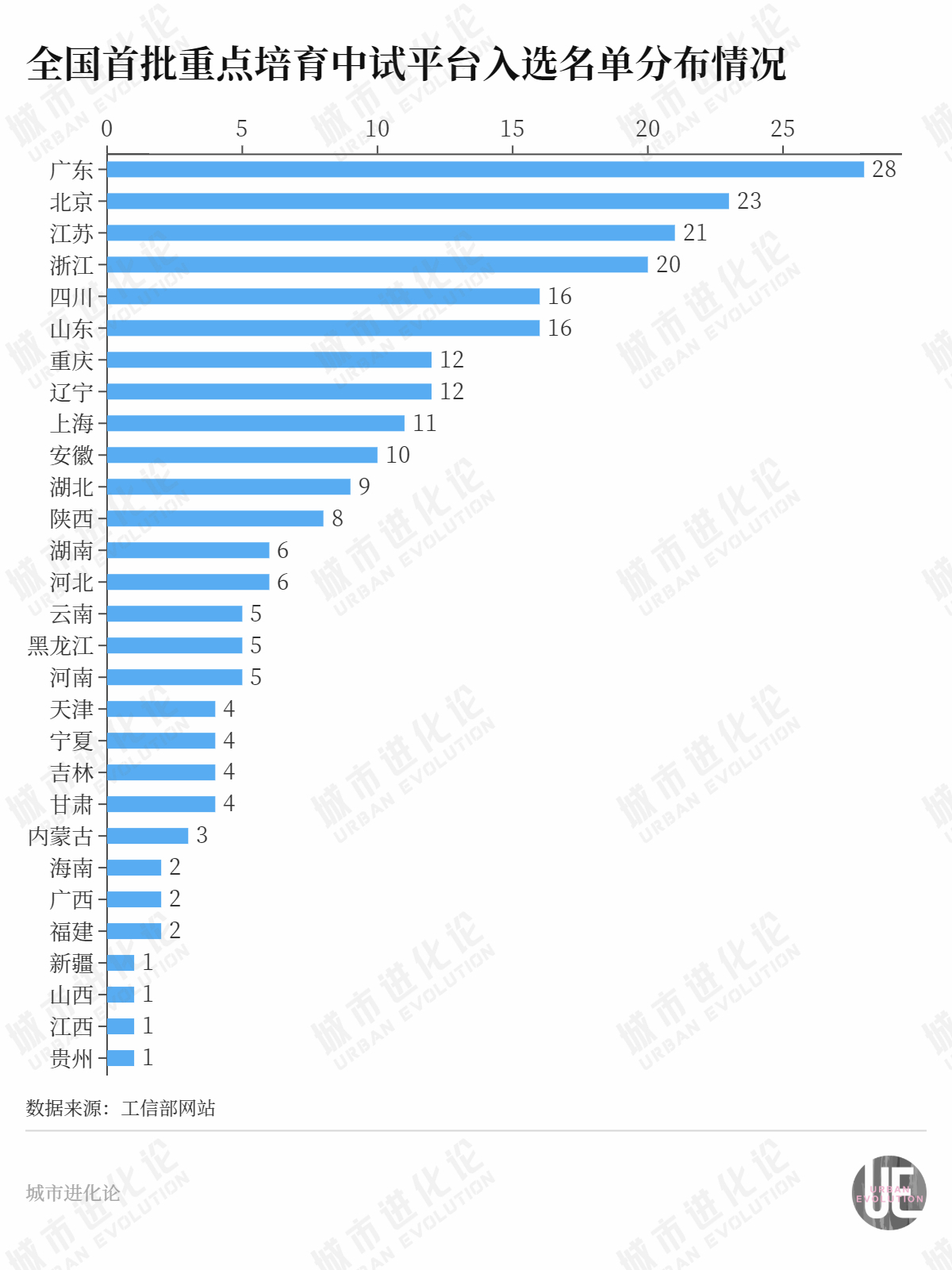
Core Insights - The Ministry of Industry and Information Technology (MIIT) has announced the preliminary list of 242 key pilot platforms for manufacturing, covering six major sectors essential for high-quality development [1][2] - The success of pilot testing is crucial for the industrialization of technological achievements, with a success rate of 80% for those that undergo pilot testing compared to only 30% for those that do not [1] - The government aims to establish provincial and national pilot platforms by 2027 to enhance the engineering breakthroughs and industrial applications of traditional and emerging industries [2] Group 1: Pilot Platforms Overview - The 242 pilot platforms are distributed across 29 provinces, excluding Qinghai and Tibet, with Guangdong, Beijing, Jiangsu, and Zhejiang leading in the number of platforms [2][3] - Guangdong has the highest number of pilot platforms across all six sectors, indicating strong industrial transformation capabilities [3] Group 2: Regional Development Plans - Guangdong plans to establish 30-50 provincial pilot platforms by 2025, with 5-8 expected to reach industry benchmark levels [2] - Shandong aims to create around five exemplary provincial pilot platforms by 2027 in key industrial sectors, striving for national-level recognition [2]