
中诚信—交银理财多元策略大类资产配置指数

Search documents
周报 | 理财公司加快布局指数投资,华夏理财再发5只指数产品
2 1 Shi Ji Jing Ji Bao Dao· 2025-09-24 10:16
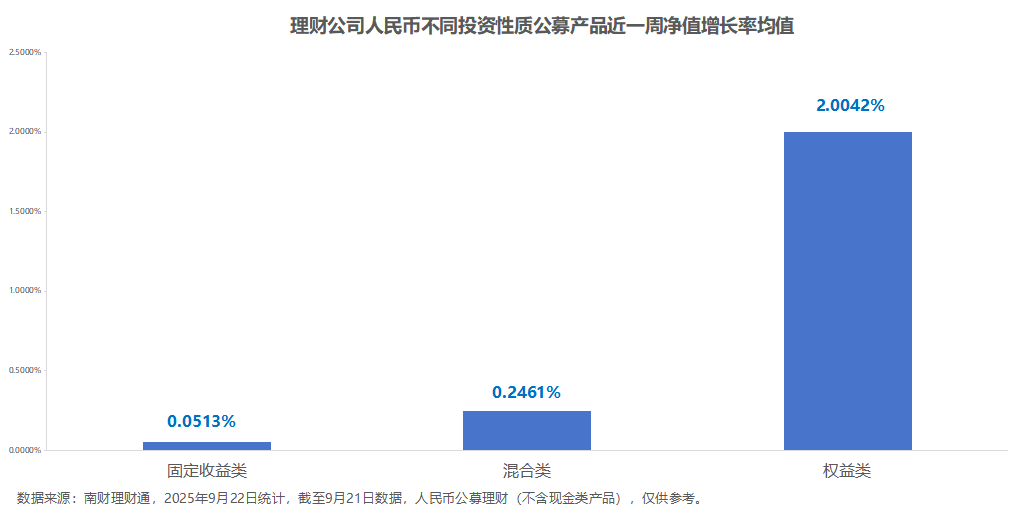
Market Overview - The bond market experienced fluctuations with a tight funding environment, as indicated by a weighted average of DR007 at 1.5096% and a 10-year government bond yield closing at 1.88% [2] - The A-share market showed wide fluctuations, with the ChiNext Index and the Sci-Tech Innovation 50 Index increasing by 2.34% and 1.84% respectively, while the Shanghai Composite Index and the CSI 300 Index decreased by 1.30% and 0.44% respectively [2] Product Performance - The number of products below net asset value remains low, with 26,354 public wealth management products in existence, of which 285 have a cumulative net value below 1, resulting in a comprehensive break-even rate of 1.08% for bank wealth management [3] - The break-even rates for equity and mixed wealth management products are 18.37% and 3.04% respectively, while fixed income public wealth management products have a break-even rate of 0.95% [3] New Product Issuance - A total of 467 wealth management products were issued by 32 wealth management companies from September 15 to September 19, with the highest issuance from joint-stock banks [5] - The newly issued products primarily consist of R2 (medium-low risk), closed-end net value type, and fixed income public products, with mixed and equity products each issuing 5 products [5] - Pricing varied across different term products, with a notable increase of 7 basis points for 3-6 month term products, while 1-3 month and 2-3 year term products saw significant declines of 25 basis points [5] Investment Strategies - Huaxia Wealth Management has intensified its investment in equity products, issuing 5 index tracking products on September 18, which track various indices related to AI, high dividends, and military electronics [6] - The products have a fundraising scale of around 2 million, with the highest being 2.3581 million for the "Tian Gong Ri Kai Product 19" [6] - Other wealth management companies, such as Zhuhai Wealth Management and Jiangyin Wealth Management, are also accelerating their index investment strategies [7] Yield Performance - Fixed income wealth management products saw a slight recovery in average net value growth rate to 0.0513%, while mixed and equity products had average growth rates of 0.2461% and 2.0042% respectively [8] - Among fixed income products, those with a term of over 3 years had the highest average net value growth rate of 0.0975% [8] Industry Trends - Recent announcements from listed companies indicate a shift towards wealth management, primarily using self-owned funds for investments in structured deposits and bank wealth management products, typically with terms of 6 months to 1 year [14] - The demand for wealth management is driven by the need for stable returns and liquidity, with expectations for steady growth in corporate wealth management scale [14] Notable Developments - Zhong Postal Wealth Management participated in the successful IPO of Hesai Technology, marking a significant event in the return of Chinese concept stocks to the market [15] - Shanghai Pudong Development Bank Wealth Management launched its first "Shanghai Sci-Tech Financial Theme" wealth management product, aligning with national innovation strategies [16] - Jianxin Wealth Management successfully issued its first structured wealth management product, combining fixed income assets with derivatives linked to gold [17]

【银行理财】理财公司加码指数化布局:跟踪现有指数、自主构建双策并行——银行理财周度跟踪(2025.9.15-2025.9.21)
华宝财富魔方· 2025-09-23 12:57
Core Viewpoints - The article discusses the increasing trend of wealth management companies in China to develop index-based financial products, driven by the ongoing transformation towards net value management and the acceleration of medium to long-term capital entering the market [3][7]. Regulatory and Industry Dynamics - Wealth management companies are actively launching index-based financial products, with an increase in both the number and issuance of such products in the market [3][7]. - Major banks like 招银理财 and 交银理财 have introduced new index products, with 招银理财 launching its self-developed "湾区全球资产优选配置指数" and 交银理财 collaborating with 中诚信指数服务 to create a new index [7][8]. - The core motivations for this shift towards index-based products include reducing active management risks, enhancing strategy transparency, and meeting customized client demands [8]. Innovations in the Industry - 华夏理财 and 华夏基金 have signed a memorandum to deepen cooperation in the index business, aiming to build a market-influential "双华夏" index ecosystem [9][10]. - 中邮理财 participated in the successful IPO of 禾赛科技, marking it as the largest Chinese concept stock IPO in Hong Kong in four years, reflecting a strategic move towards IPO investments [11][12]. - 浦银理财 launched its first "上海科创金融主题" financial product, raising 220 million yuan, with 80% of the funds directed towards bonds issued by quality technology enterprises in Shanghai [13][14]. Performance of Financial Products - The annualized yield of cash management products was recorded at 1.29%, remaining stable, while money market funds saw a slight increase to 1.19% [15][17]. - The yield on 10-year government bonds slightly increased to 1.80%, influenced by market sentiment and the Federal Reserve's dovish rate guidance [17][19]. Tracking of Net Value - The net value break rate for bank wealth management products decreased to 2.04%, down by 0.61 percentage points, with credit spreads also narrowing [22]. - The relationship between break rates and credit spreads indicates that if credit spreads continue to widen, it may put upward pressure on break rates [22].

银行理财周度跟踪(2025.9.15-2025.9.21):理财公司加码指数化布局:跟踪现有指数、自主构建双策并行-20250923
HWABAO SECURITIES· 2025-09-23 08:58
Investment Rating - The report does not explicitly provide an investment rating for the industry Core Insights - The report highlights a significant trend in the banking wealth management sector, with companies increasingly focusing on index-based products to enhance their offerings and meet market demands [4][11] - The collaboration between financial institutions, such as the partnership between Huaxia Wealth and Huaxia Fund, aims to create a robust index ecosystem to support high-quality development in asset management [13][14] - The report notes the successful IPO of Hesai Technology, marking a significant event in the market, with postal wealth management participating in this investment [15][16] - The introduction of the Shanghai Sci-Tech Financial Theme Wealth Management Product by Puyin Wealth Management reflects a strategic move to align with national innovation policies and support local tech enterprises [18] Summary by Sections 1. Regulatory and Industry Dynamics - Wealth management companies are actively launching index-based products, with an increase in both the number and issuance of such products in the market [4][11] - The core motivation for this shift includes reducing active management risks, enhancing strategy transparency, and meeting customized client demands through self-constructed indices [12] 2. Peer Innovation Dynamics - Huaxia Wealth and Huaxia Fund have signed a memorandum to deepen cooperation in the index business, aiming to build a market-influential index ecosystem [13][14] - Puyin Wealth Management has launched a new product focused on technology finance, raising 220 million yuan to support quality tech enterprises in Shanghai [18] 3. Yield Performance - Cash management products recorded a 7-day annualized yield of 1.29%, remaining stable compared to the previous week, while money market funds saw a slight increase to 1.19% [19][20] - The report indicates a general recovery in annualized yields for fixed-income products across various maturities [23][27] 4. Net Value Tracking - The net value ratio of banking wealth management products decreased to 2.04%, down by 0.61 percentage points, indicating a positive trend in credit spreads [29][32]

年内银行理财子公司指数化投资升温
Zheng Quan Ri Bao· 2025-09-22 16:13
Group 1 - The core viewpoint of the articles highlights the increasing trend of bank wealth management subsidiaries launching index-based financial products, driven by the ongoing transformation towards net value-based management and the acceleration of long-term capital entering the market [1][4]. - Index-based investment is gaining traction as a significant entry point for bank wealth management subsidiaries into the equity market, characterized by clear strategies, stable styles, and ease of understanding [1][4]. Group 2 - Recent activities include the launch of new index products by major bank wealth management subsidiaries such as China Merchants Bank Wealth Management and Bank of Communications Wealth Management, with specific indices developed for diversified asset allocation [2][3]. - The "China Merchants Bank Wealth Management Bay Area Global Asset Preferred Allocation Index" and the "China Chengxin - Bank of Communications Wealth Management Multi-Strategy Asset Allocation Index" are examples of newly introduced indices aimed at quantifying and diversifying risks across global assets [2][3]. Group 3 - As of May 2025, there are nearly 600 existing index-based financial products, reflecting an increase of over 100 products compared to the end of 2024, indicating a rise in both the number and popularity of these products [3]. - The trend of tracking mature indices is also noted, with new products launched that follow established indices such as the MSCI Dividend Index and the China Bond - National Development Bank Bond Total Wealth Index [3]. Group 4 - The average annualized return of newly issued index-based financial products in 2023 is reported at 16.72%, significantly higher than the overall market average of 2.85% [5]. - The demand for index-based investment is increasing, prompting a need for effective performance benchmarks and investment strategies, while balancing return elasticity and risk control remains a common challenge for bank wealth management subsidiaries [5].
从“黑盒”走向“白盒” 银行理财竞逐指数化赛道
Zhong Guo Jing Ying Bao· 2025-09-15 23:03
Core Viewpoint - The rise of index-based products in the wealth management sector is driven by the need for transparency, diversification, and adaptability in a low-interest-rate environment, enhancing investor trust and participation in capital markets [1][4][5]. Group 1: Index Product Development - Financial institutions like交银理财 and 招银理财 are launching various index products, including multi-strategy asset allocation indices, to optimize investment configurations and provide clearer selection paths for investors [1][2]. - The total scale of index products in the fund industry has surpassed 5 trillion yuan, indicating rapid growth and adoption of index-based investment strategies [1]. Group 2: Benefits of Indexation - Index-based benchmarks allow for dynamic adjustments based on the investment scope, improving clarity on returns and volatility for investors, thus reducing discrepancies between expected and actual performance [2][4]. - The introduction of index products is seen as a response to the low-interest-rate environment, enabling wealth management firms to seek enhanced returns while managing risks through diversified asset allocation [2][5]. Group 3: Market Trends and Regulatory Support - Regulatory bodies are encouraging long-term capital market participation, with initiatives like the 2025 action plan aimed at optimizing the index investment ecosystem, presenting new opportunities for index-based investment in the banking wealth management sector [4][6]. - The characteristics of index products, such as transparency, low fees, and diversified investments, are gaining recognition in the market, aligning with investor demands for clearer understanding and lower costs [4][6]. Group 4: Investor Guidance - Investors are advised to choose index products based on their risk tolerance and investment goals, with recommendations to consider asset correlation and historical performance metrics when selecting indices [7][8]. - The trend towards indexation is reshaping the industry, emphasizing the importance of understanding personal risk profiles and adapting investment strategies accordingly [8].