
人工智能(AI)

Search documents
【特稿】美媒:AI巨头将签署自主供电承诺
Xin Hua She· 2026-02-26 07:32
Core Viewpoint - Major tech companies in the U.S. are set to meet with President Trump to sign a commitment to supply or purchase electricity for AI data centers, amid concerns over rising electricity demand and costs for consumers [1][2] Group 1: Government and Policy - The initiative aims to address voter concerns regarding the potential increase in electricity costs due to data centers [1] - Trump announced a "payer protection commitment" during his State of the Union address, indicating that companies have an obligation to meet their own electricity needs [1] - The White House confirmed that the upcoming meeting is focused on ensuring U.S. leadership in AI while reducing living costs for working families [1] Group 2: Industry Response - Several major tech companies, including OpenAI, Amazon, Microsoft, Google, Meta, xAI, and Oracle, are expected to participate in the commitment [1] - Microsoft President Brad Smith stated that the commitment is an "important step" and emphasized that the company will cover its own electricity costs [1] Group 3: Energy Demand and Concerns - The International Energy Agency reported that global data center electricity demand is projected to double by 2030, reaching approximately 945 terawatt-hours, with AI being a significant driver [2] - Some Democratic lawmakers and clean energy organizations argue that the government's measures do not adequately protect public interests and call for comprehensive restrictions on new data centers [2] - Concerns have been raised about the reliability of the electricity grid and capacity limitations affecting the deployment speed of AI technologies [2]
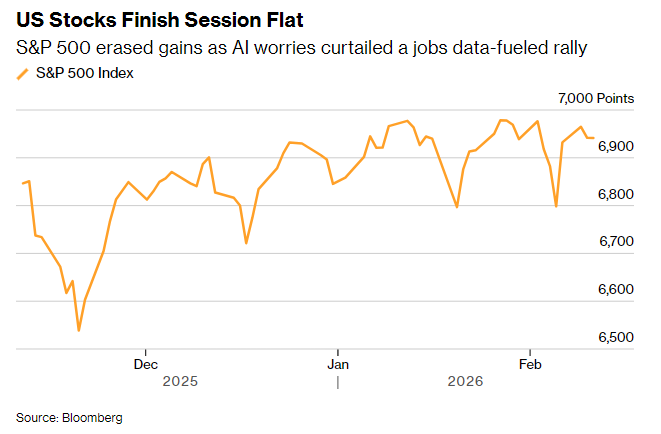
非农新增创逾一年新高难救市!AI恐慌交易主导美股 标普500错失历史新高
Zhi Tong Cai Jing· 2026-02-12 00:43
Market Overview - The U.S. stock market retraced early gains and closed lower despite strong employment data, with concerns over AI's disruptive impact on multiple industries suppressing the rebound [1] - The S&P 500 index slightly declined, while the tech-heavy Nasdaq 100 index rose by 0.3%, reaching a peak increase of 1% during the session [1] - The Chicago Board Options Exchange Volatility Index (VIX) hovered around 18 [1] Employment Data Impact - The employment report showed an unexpected increase of 130,000 non-farm jobs in January, marking the largest gain in over a year, with the unemployment rate unexpectedly dropping to 4.3% [6] - Following the employment report, traders anticipated the first interest rate cut of the year to occur in July, shifting from previous expectations of June [6] - Analysts suggest that the Federal Reserve is likely to maintain current interest rates, despite pressures from the Trump administration for rate cuts [6] Sector Performance - The technology sector faced significant selling pressure, continuing a trend observed over the past few months, with international and value stocks leading the market [1] - An index tracking the "seven giants" of the U.S. stock market fell by 0.6%, and an ETF focused on software stocks dropped by 2.6% [1] - Real estate service stocks also declined, with CBRE Group falling by 12%, and both Jones Lang LaSalle and Cushman & Wakefield experiencing declines [1] AI Concerns - The software sector has been particularly affected by what analysts are calling "AI panic trading," leading to sell-offs in software, private credit, wealth management, and insurance brokerage stocks [2] - Investors are increasingly favoring companies whose business models are less likely to be disrupted by AI technology [1][2] Market Sentiment - The market is currently focused on the upcoming Consumer Price Index (CPI) report, with expectations that if the core CPI is close to or below forecasts, there is a 70% probability that the S&P 500 will rise [2] - Growth and momentum stocks are under the most pressure due to market expectations that interest rates will remain high for an extended period [5]

美股异动|微软市值单日缩水3570亿美元 金额仅次于英伟达创下的纪录
Ge Long Hui A P P· 2026-01-29 23:57
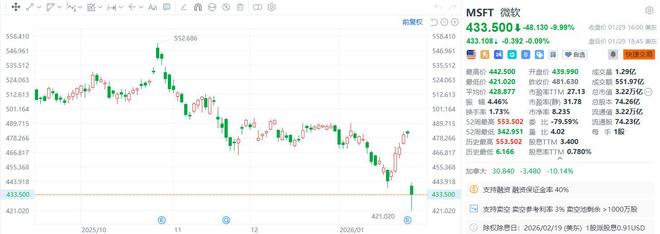
Group 1 - Microsoft experienced a significant stock sell-off, with shares dropping nearly 10% to $433.5, resulting in a market value loss of $357 billion, marking the second-largest single-day market value decline in stock market history [1] - The company's record spending on artificial intelligence (AI) was highlighted in its earnings report, while growth in its core cloud business showed signs of slowing down [1] - The only larger single-day market value loss in history was recorded by Nvidia last year, which saw a $593 billion drop following the launch of a low-cost AI model [1] Group 2 - The market value fluctuation of Microsoft exceeded that of over 90% of the S&P 500 index constituents [1] - Other technology stocks, including Alphabet and Nvidia, also faced significant market value losses, each evaporating over $100 billion on the same day [1]

中经评论:美国科技股高波动态势或加剧
Jing Ji Ri Bao· 2026-01-13 00:22
Group 1 - The core viewpoint of the articles highlights the volatility in the U.S. tech sector driven by concerns over the sustainability of AI investments and the potential for a market correction in 2026 [1][2][3] - In 2025, the AI investment boom significantly boosted global stock valuations, with the Nasdaq index rising approximately 21% and the market capitalization of major tech companies reaching historical highs, including Nvidia surpassing $5 trillion [1][2] - The concentration of market power among the "seven giants" of U.S. tech, which accounted for over 36% of the S&P 500's total market capitalization, raises concerns about the sustainability of their growth, as capital expenditure growth is projected to decline sharply from 48.8% in 2025 to 18.8% in 2026 [2][3] Group 2 - There is a notable shift in market dynamics, with funds moving from large-cap tech stocks to small-cap and cyclical sectors, indicating a transition from valuation expansion to profit verification [1][2] - The debt risk associated with tech giants is increasing, with AI-related borrowing comprising about 30% of the net issuance of U.S. investment-grade bonds, and this trend is expected to continue into 2026 [3] - U.S. tech companies are expanding into emerging markets like Latin America to leverage energy cost advantages and market growth, although this also exposes them to geopolitical and compliance risks [4]
小摩2026年美股“作战图”:“选择性”牛市到来 板块轮动将惠及高质量增长及低波动性股票
智通财经网· 2025-12-19 09:23
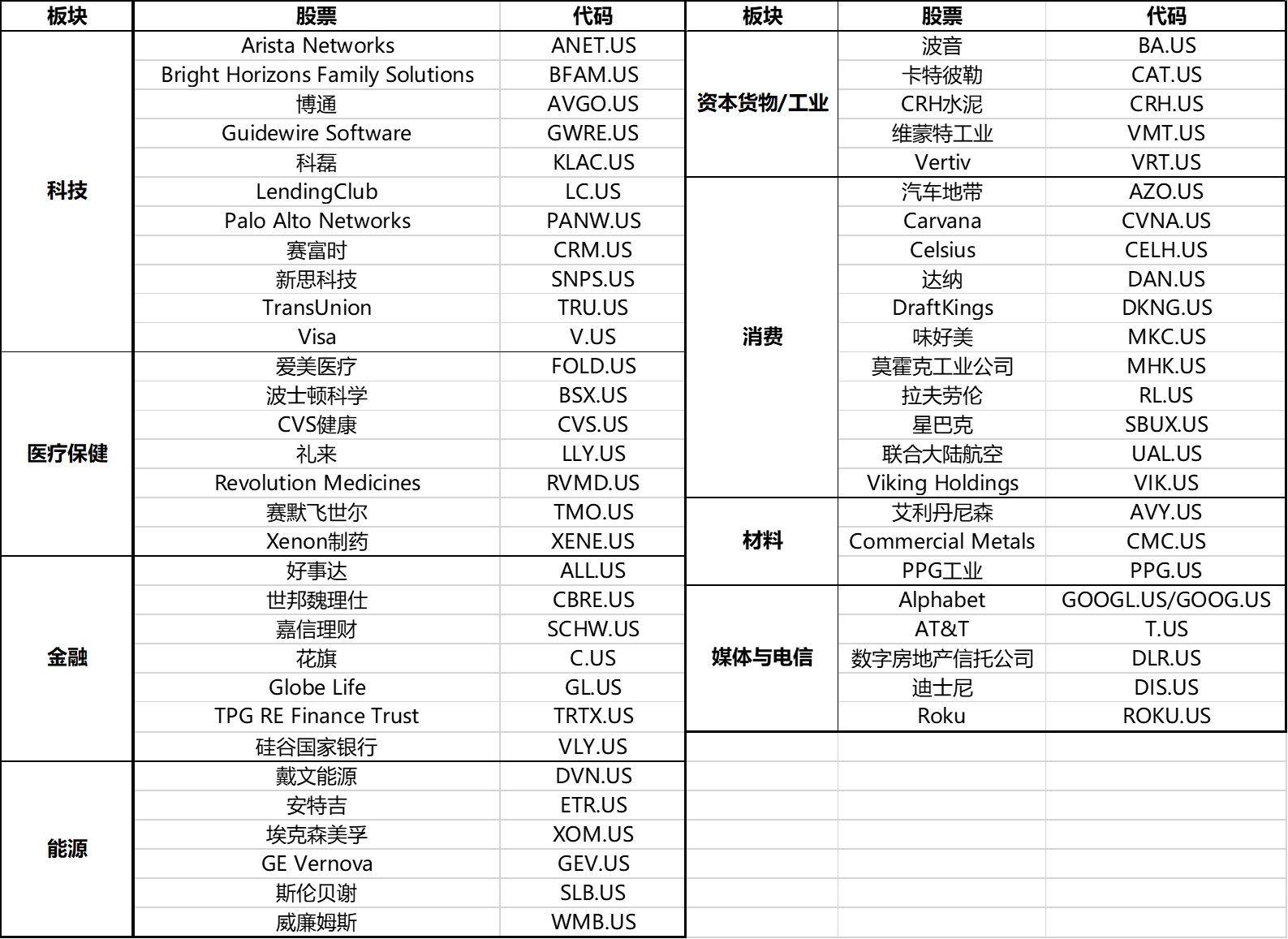
Core Insights - Morgan Stanley's report emphasizes the opportunities and risks faced by various sectors in a K-shaped economy driven by AI, highlighting a constructive but selective investor sentiment [1][3] Group 1: Investment Themes - Key investment themes for 2026 include long-term growth driven by AI and data center expansion, infrastructure development, and a shift towards high-quality growth and operational resilience [1][4] - Companies with strong pricing power, long-term growth drivers, robust balance sheets, and those benefiting from transformative trends like data center expansion and infrastructure investment are recommended [1][4] Group 2: Sector Recommendations - Selected stocks for 2026 include Arista Networks, Broadcom, Guidewire Software, and Palo Alto Networks among others across various sectors [2] - The report anticipates that the U.S. will remain a global growth engine, fueled by a resilient economy and an AI-driven supercycle leading to record capital expenditures and rapid earnings expansion [2][6] Group 3: Economic Outlook - The K-shaped economy is creating distinct winners and losers, with market sentiment indicators likely to remain volatile [3][4] - Despite concerns over AI bubbles and valuation, current high multiples are seen as justified by expected above-trend earnings growth and capital expenditure [4][5] Group 4: Earnings Projections - Morgan Stanley projects S&P 500 earnings growth of 13%-15% over the next two years, with an expected EPS of $315 in 2026 [5][10] - The anticipated capital expenditure cycle may extend beyond AI, with significant investments expected to address infrastructure and computing power imbalances [7][10] Group 5: Market Dynamics - The concentration of high-quality growth stocks is at a historical peak, with AI narratives mitigating concerns over macroeconomic weakness [8] - The U.S. business cycle is slowing but not indicating an end to the expansion, with various factors expected to support economic activity in the near term [9] Group 6: Policy Environment - A dynamic policy environment is expected to drive differentiation among stock themes, with ongoing U.S.-China competition and support for AI and electrification benefiting strategic resources [11] - Regulatory easing is anticipated to gain momentum, particularly in finance and energy sectors, which could foster growth and reduce deficits [11]

谷歌拟90亿美元扩建AI基础设施
3 6 Ke· 2025-08-15 01:21
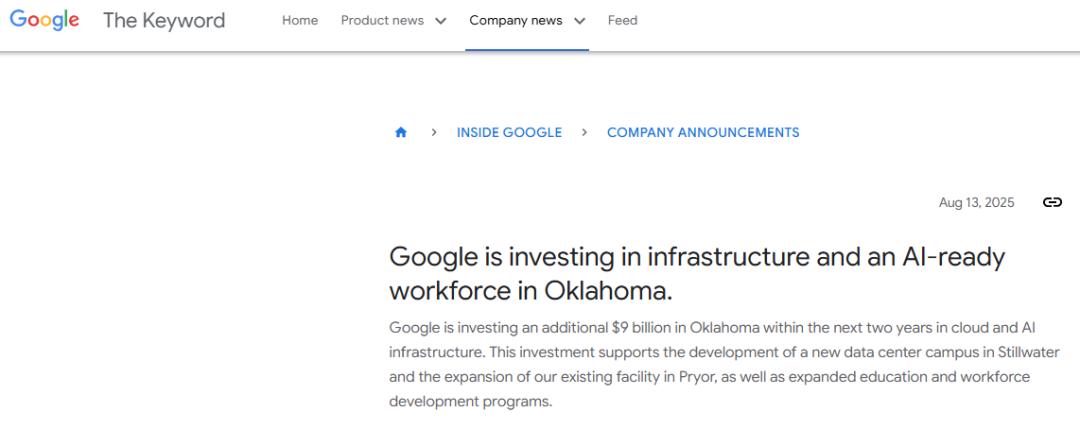
Group 1 - Google CEO Sundar Pichai announced a $9 billion investment in Oklahoma over the next two years to expand cloud computing and AI infrastructure [1][4] - The investment will support the construction of a new data center campus in Stillwater and the expansion of existing infrastructure in Pryor, enhancing domestic AI and cloud computing capabilities [1][4] - Google is collaborating with the University of Oklahoma and Oklahoma State University to provide AI skills and job readiness training for local residents [4] Group 2 - Oklahoma Governor Kevin Stitt expressed optimism about the long-term impact of the $9 billion investment on the local community, highlighting job creation in construction and related industries [5] - Alphabet has raised its annual capital expenditure budget from $75 billion to approximately $85 billion, indicating potential for further increases next year [5] - Competitors like OpenAI, Anthropic, and Amazon are also investing in education initiatives related to AI, reflecting a broader trend in the industry [5][6]

GIC:增加美国投资比重至49%并押注AI 继续评估中国投资机会
Zhi Tong Cai Jing· 2025-07-25 06:50
Group 1 - The core viewpoint of the GIC's annual report indicates an increase in the five-year annualized return rate from 4.4% to 6.1%, reflecting a strategic shift towards U.S. investments and a focus on artificial intelligence [1] - The report highlights a rise in U.S. investment proportion from 44% to 49%, while the Asia-Pacific investment share decreased from 28% to 24%, and Europe, the Middle East, and Africa remained stable at 20% [1] - The allocation to equities increased from 46% to 51%, while fixed investments decreased from 32% to 26%, and asset investments rose from 22% to 23% [1] Group 2 - The CEO emphasizes the need for vigilance in response to unprecedented uncertainties, including fragmented global trade systems, AI advancements, and climate change [1] - The Chief Investment Officer notes that despite the shift away from the Asia-Pacific region, there are still investment opportunities, particularly in Japan, India, and China, with GIC participating as a cornerstone investor in recent IPOs in Hong Kong [1] - GIC acknowledges China's shift towards more expansive fiscal and monetary policies, which may accelerate economic growth and boost investor confidence, particularly in the technology and AI sectors [2]
国际能源署:人工智能的未来变革潜力取决于能源,《2025能源与人工智能报告 》
欧米伽未来研究所2025· 2025-04-17 12:25
" 欧米伽未来研究所 " 关注科技未来发展趋势,研究人类向欧米伽点演化过程中面临的重大机遇与挑战。将不定期推荐和发布世界范围重要科技研究进展和未 来趋势研究。( 点击这里查看欧米伽理论 ) 《能源与人工智能》是国际能源署(IEA)于2025年2月发布的《世界能源展望》特别报告,共304页。该报告探讨了人工智能与能源部门的双向关系:AI需 要多少能源及其供应来源;以及AI如何应用于能源部门以提升安全性、可负担性和可持续性。 报告指出,AI已成为21世纪最具影响力的技术之一,大型AI数据中心耗电量相当于10万户家庭,而最大型的数据中心耗电量将达到20倍。在基准情景 下,数据中心排放将从当前的1.8亿吨增至2035年的3亿吨。 报告强调AI在能源优化方面的潜力,包括优化电力系统运行、资源勘探和能源技术创新。例如,在蛋白质结构测绘领域,AI实现了45,000倍的加速。然 而,能源部门尚未充分利用AI潜力,面临数据获取、数字基础设施和技能缺口等障碍。 报告分为五章:AI与能源关系概述、数据中心能源需求趋势、AI优化能源部门应用、AI推动能源创新、政策与行业影响。 概述 人工智能(AI)能力的阶梯式提升源于计算成本下降、 ...