传统DRAM

Search documents
韩国股票指数年内狂飙46%首破6200点领跑全球!三星海力士合占韩股总市值35%,野村直言还能再涨30%
Xin Lang Cai Jing· 2026-02-26 02:09
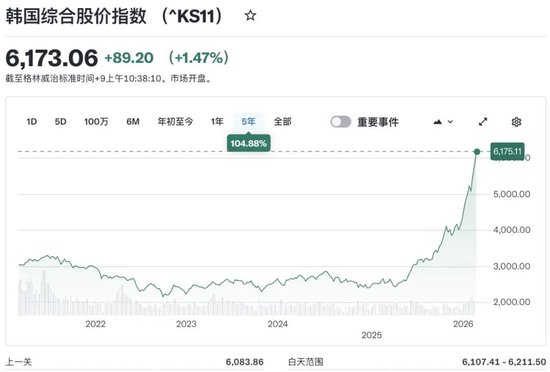
Core Viewpoint - Global investors are increasingly focusing on the South Korean stock market, with the KOSPI index recently breaking historical records and showing significant growth potential [4][18]. Group 1: KOSPI Index Performance - The KOSPI index surpassed 6000 points for the first time and reached over 6200 points, marking a nearly 2% increase [4][16]. - From early 2025, the KOSPI index rose from 2400 points to 4214 points by the end of the year, an overall increase of over 75% [4][17]. - In 2026, the KOSPI index has already seen a cumulative increase of over 46% within two months, leading global stock markets [4][17]. Group 2: Future Projections - Nomura Securities raised its target for the KOSPI index for the first half of 2026 to between 7500 and 8000 points, indicating an expected increase of 23% to 31% from the February 25 closing level [4][18]. - The forecast is based on a projected price-to-earnings ratio of 12-13 times and a price-to-book ratio of 2.1-2.2 times for the South Korean market [4][18]. Group 3: Semiconductor Sector Impact - The rise in the KOSPI index is primarily driven by strong growth in the semiconductor sector, particularly in traditional DRAM and high-bandwidth memory (HBM) [5][19]. - Nomura forecasts a 129% year-on-year increase in earnings per share (EPS) for South Korean companies in 2026, with semiconductor firms expected to contribute 64% of the total net profit [5][19]. - Major players like Samsung Electronics and SK Hynix have seen significant stock price increases, outperforming the KOSPI index [6][19]. Group 4: Structural Changes in Investment - There is a structural shift in South Korean household assets from real estate to financial assets, with household deposits increasing from 50 trillion KRW in early 2024 to 106 trillion KRW by January 2026 [8][21]. - Foreign investment in South Korean stocks surged to 1327 trillion KRW (approximately 916 billion USD) in 2025, nearly double the amount from 2024 [8][23]. - The share of foreign investors in the total market capitalization of the KOSPI rose from 27% in 2024 to 30.8% in 2025, with U.S. investors being the largest group [8][23].

三星半导体利润飙升465.5%,重夺DRAM龙头
半导体行业观察· 2026-01-29 01:15
Core Viewpoint - Samsung Electronics has made a strong comeback, achieving record sales and operating profits in the fourth quarter, driven primarily by its semiconductor business, particularly in high bandwidth memory (HBM) [2][3][4]. Group 1: Financial Performance - In Q4, Samsung's sales increased by 23.8% year-on-year to 93.8374 trillion KRW, while operating profit surged by 209.2% to 20.737 trillion KRW, marking the highest quarterly operating profit in seven years [2]. - For the entire year, sales grew by 10.87% to 333.6 trillion KRW, and operating profit rose by 33.3% to 43.6 trillion KRW [2]. - The semiconductor division (DS) contributed 80% of the total operating profit, with sales in this segment increasing by 46.2% to 44 trillion KRW and operating profit soaring by 465% to 16.4 trillion KRW [2][3]. Group 2: Market Dynamics - The global memory market is in an upward cycle, with traditional DRAM prices soaring by 40% to 50% in Q4, and NAND flash prices also rising throughout the year [3]. - Samsung's market share in DRAM was 38% in Q4 2024, down from 34% in Q1 2023, trailing behind SK Hynix [3][4]. Group 3: Strategic Developments - Samsung has regained its competitive edge in HBM by improving its design and starting to supply HBM3E chips to NVIDIA, Google, and AMD [4]. - The company has completed the development of HBM4, which operates at a leading speed of 11.7 Gbps, and plans to begin full shipments to NVIDIA next month [4]. - Samsung aims to maintain its leadership in the AI semiconductor market through its comprehensive solutions in logic, memory, foundry, and packaging [5]. Group 4: Future Outlook - Analysts predict that Samsung's annual operating profit could reach 180 trillion KRW this year, with a projected year-on-year growth of 314% and an operating profit margin of 37% [4]. - The semiconductor business is expected to continue its growth momentum in Q1, driven by strong demand in AI and server sectors [4].
三星、SK海力士财报同日对决,双双冲刺史上最好业绩,HBM4之争全面升级
Hua Er Jie Jian Wen· 2026-01-22 11:39
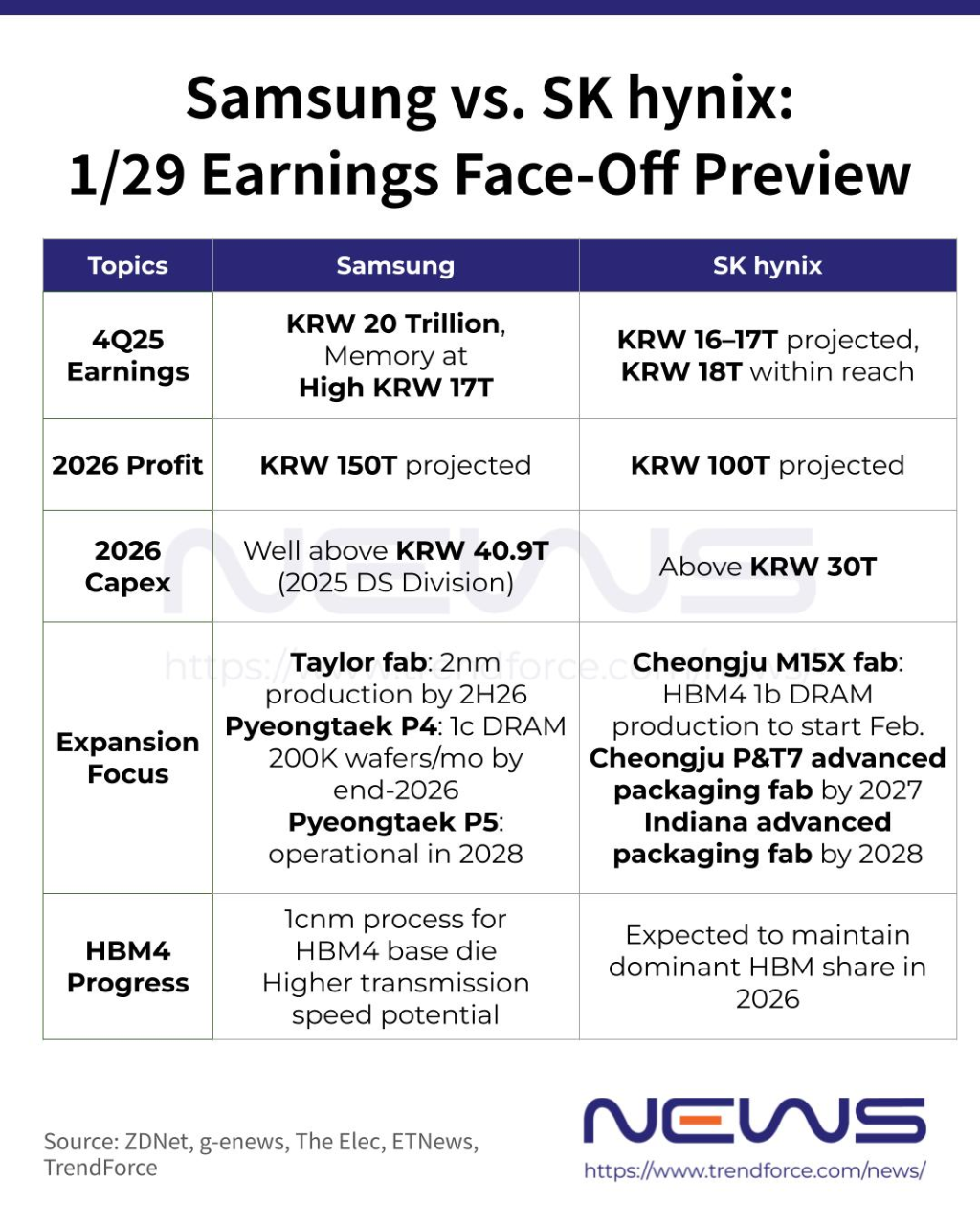
Core Viewpoint - The global memory chip market is experiencing a price surge due to tight supply and strong demand, with Samsung Electronics and SK Hynix set to release their Q4 2025 earnings on January 29, marking a significant moment in the industry's cyclical recovery and competition in profit performance and capital expenditure [1] Group 1: Earnings Projections - Samsung Electronics is expected to report a historic quarterly revenue exceeding 90 trillion KRW, with operating profit projected to surge by 208% year-on-year, potentially making it the first Korean company to achieve over 20 trillion KRW in quarterly operating profit [1][4] - SK Hynix's quarterly operating profit is anticipated to reach at least 18 trillion KRW, despite its reliance on HBM limiting benefits from traditional DRAM price increases [1][4] Group 2: 2026 Performance Outlook - Analysts predict both companies will enter the "100 trillion KRW operating profit club" in 2026, with Samsung's operating profit projected at around 150 trillion KRW and SK Hynix's at over 100 trillion KRW [3][5] - Capital expenditure plans are significant, with SK Hynix expected to exceed 30 trillion KRW in 2026, focusing on the M15X fab and other projects, while Samsung plans to increase investments in HBM production and expand its facilities [3][5] Group 3: HBM4 Technology Competition - The competition in HBM4 technology is intensifying, with both companies delivering paid final samples to Nvidia, which will influence future market share [6] - Samsung aims to challenge SK Hynix by utilizing 1Cnm process technology for HBM4, potentially offering higher transmission speeds, while SK Hynix is expected to maintain a dominant share in HBM supply [6]
记忆芯片需求强劲,SanDisk股价飙27%,美光科技涨10%,均创历史新高
Jin Rong Jie· 2026-01-07 01:53
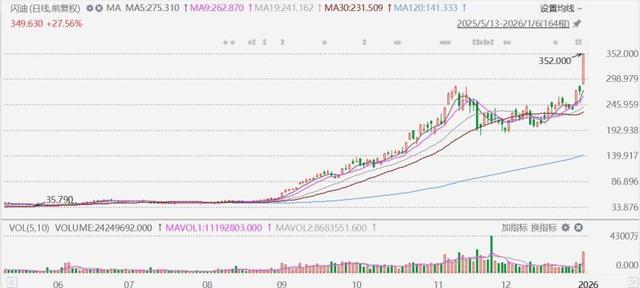
Group 1 - SanDisk's stock price surged by 28.43% to reach a historical high of $352, closing at $349.63, with a market capitalization of $51.2 billion, driven by investor interest in AI-related storage and memory stocks [1] - TrendForce's research predicts a significant increase in NAND flash memory chip contract prices by 33%-38% in March, and traditional DRAM contract prices are expected to rise by 55%-60%, indicating strong growth momentum in the memory chip market this year [1] - Despite the positive market outlook, there are warnings that SanDisk's high valuation may limit its stock price upside potential [1] Group 2 - Micron Technology's stock also rose by 10% to a historical high of $343.43, with a market capitalization of $386.5 billion, reflecting the broader trend in AI chip manufacturers [1]
存储芯片股持续强势,兆易创新、普冉股份等多股创历史新高
Ge Long Hui· 2026-01-07 01:40
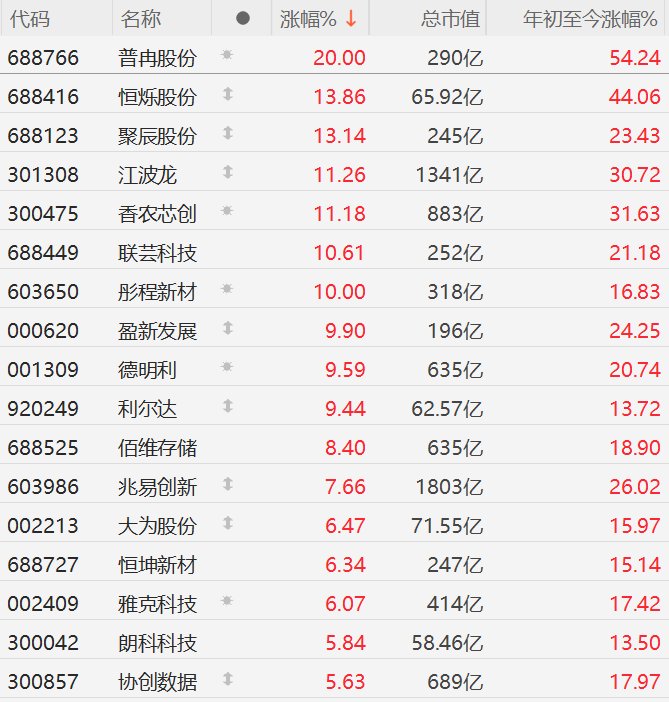
Group 1 - The A-share market for storage chip stocks has shown strong performance, with companies like Puran Co. hitting a 20% limit up, and others such as Hengshuo Co. and Jucheng Co. rising over 13% [1] - Notably, companies like Puran Co., Zhaoyi Innovation, Anji Technology, and others have reached historical highs [1] - According to a TrendForce research report, NAND flash memory chip contract prices are expected to increase by 33%-38% in March, while traditional DRAM contract prices are projected to rise by 55%-60%, indicating strong growth momentum in the memory chip market this year [1] Group 2 - The table lists various companies with their stock performance, including Puran Co. with a market cap of 29 billion and a year-to-date increase of 54.24% [2] - Hengshuo Co. has a market cap of 6.592 billion and a year-to-date increase of 44.06% [2] - Jucheng Co. has a market cap of 24.5 billion and a year-to-date increase of 23.43% [2]



2025年Q3全球半导体营收2163亿美元 增速远超历史平均
Sou Hu Cai Jing· 2025-12-17 06:39
Group 1 - The global semiconductor industry revenue is projected to reach $216.3 billion in Q3 2025, marking a 14.5% quarter-over-quarter increase and surpassing the $200 billion mark for the first time in a single quarter [1][3] - The growth in the semiconductor market is primarily driven by AI and storage products, with a notable increase in the number of contributing segments compared to previous trends [3] - In 2024, the semiconductor market is expected to achieve a record revenue of $650 billion, with a year-over-year growth exceeding 20%, although this growth is heavily concentrated in Nvidia and storage chip manufacturers [3] Group 2 - Excluding Nvidia and storage chips, other semiconductor categories are projected to achieve over 9% quarter-over-quarter growth in Q3 2025, indicating a more balanced recovery [3] - The top four semiconductor companies in Q3 2025 are Nvidia, Samsung, SK Hynix, and Micron, collectively contributing over 40% of the industry's revenue, highlighting the dominance of AI accelerators and high-end storage products [3] - Omdia forecasts that the semiconductor industry revenue for the entire year of 2025 will exceed $800 billion, with an expected year-over-year growth of nearly 20%, and a projected growth rate of around 9% even when excluding Nvidia and storage chips [3]


芯片行业TOP 4:英伟达和存储三巨头
半导体行业观察· 2025-12-12 01:12
Core Viewpoint - The semiconductor market is expected to reach a record revenue of over $800 billion by 2025, driven by strong demand in artificial intelligence and memory products, with a more balanced growth across various segments compared to previous years [2][6][9]. Group 1: Market Performance - In Q3 2025, the semiconductor market revenue reached $216.3 billion, marking a historic high with a quarter-on-quarter growth of 14.5%, the first time the market surpassed $200 billion in a single quarter [2][6]. - The average growth rate for Q3 historically is slightly above 7%, while the market had previously anticipated a growth of about 5% for Q3 2025, indicating a significant outperformance [6][9]. - The overall semiconductor revenue for 2024 is projected to exceed $650 billion, with an annual growth rate of over 20%, although this growth is uneven across the industry [3][9]. Group 2: Segment Contributions - Demand for artificial intelligence and memory products continues to be robust, with both segments outpacing overall market growth [6][10]. - In Q3 2025, the revenue growth exceeded 14% across the semiconductor market, and even when excluding NVIDIA and memory chips, the revenue still grew by over 9% [3][9]. - The top four semiconductor companies by revenue in Q3 2025 were NVIDIA and the three major memory suppliers: Samsung, SK Hynix, and Micron, highlighting the dominance of AI accelerators and advanced memory technologies [3][10][11]. Group 3: Future Outlook - The semiconductor industry is expected to maintain strong momentum into Q4 2025, with predictions of record revenues continuing into the following year [4][11]. - The growth trend for 2025 indicates a shift towards broader industry expansion rather than reliance on a few high-growth segments, with an expected annual growth rate of approximately 9% even when excluding NVIDIA and memory products [3][9].

“电子茅台”内存条一天三价!华强北不敢贴标,瑞银预测传统DRAM将成“新利润引擎”
Jin Rong Jie· 2025-12-10 00:28
Core Viewpoint - UBS believes that the traditional DRAM market is experiencing a tightening supply due to a large-scale shift in industry capacity towards HBM, while demand remains robust, leading to a significant enhancement in pricing power [1] Group 1: DRAM Market Dynamics - The gross margin for Micron's traditional DRAM is expected to reach 67% in Q2 2026, surpassing HBM's 62% for the first time [1] - This advantage is projected to continue expanding, with traditional DRAM gross margins reaching 71% in Q3 and 75% in Q4 [1] Group 2: Market Trends and Pricing - According to reports, memory modules have become "electronic Maotai," with prices rising faster than gold, and a 64G DDR5 memory kit exceeding 4000 yuan, which is 1000 yuan more expensive than a PS5 gaming console [1] - Retailers in Huaqiangbei have stopped labeling prices for memory modules due to rapid price fluctuations, with changes occurring multiple times a day [1] Group 3: Future Outlook for Storage Chips - Wanlian Securities reports that the storage chip sector is likely to enter a new prosperity cycle driven by AI, with stronger demand, accelerated technology iterations, and upgraded supply-side capacity control strategies [1] - The limited new capacity on the supply side in the short term suggests that the supply-demand gap is expected to persist, indicating a stronger sustainability of price increases in the storage industry [1]
三星利润面临连续三季度下滑!
国芯网· 2025-03-31 13:10
Group 1 - The core viewpoint of the article highlights the declining operating profit forecast for Samsung Electronics, predicting a drop of 27.8% year-on-year and 26.6% quarter-on-quarter for Q1 2025, amounting to 4.7 trillion KRW (approximately 3.2 billion USD) [1] - The decline in Samsung's operating profit is attributed to the full capacity production of Chinese DRAM manufacturers, leading to a significant drop in traditional DRAM prices, which severely impacts Samsung as a major supplier [1] - Samsung's operating profit is expected to decrease from 10.4 trillion KRW in Q2 2024 to 9.2 trillion KRW in Q3 2024, and further down to 6.5 trillion KRW in Q4 2024 [1] Group 2 - According to TrendForce's latest survey, the decline in traditional DRAM prices is expected to narrow to between 0% and 5% in Q2 2025 due to the destocking of downstream customers [1] - When including HBM (High Bandwidth Memory) in the calculations, the average price is projected to increase by 3% to 8% quarter-on-quarter, benefiting from the gradual ramp-up of HBM3e 12hi [2]