
人工智能热潮

Search documents
韩国股票指数年内狂飙46%首破6200点领跑全球!三星海力士合占韩股总市值35%,野村直言还能再涨30%
Xin Lang Cai Jing· 2026-02-26 02:09
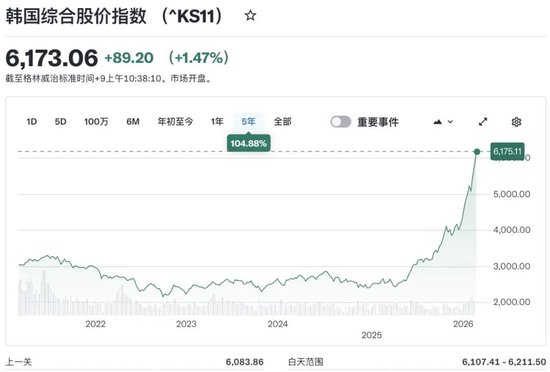
Core Viewpoint - Global investors are increasingly focusing on the South Korean stock market, with the KOSPI index recently breaking historical records and showing significant growth potential [4][18]. Group 1: KOSPI Index Performance - The KOSPI index surpassed 6000 points for the first time and reached over 6200 points, marking a nearly 2% increase [4][16]. - From early 2025, the KOSPI index rose from 2400 points to 4214 points by the end of the year, an overall increase of over 75% [4][17]. - In 2026, the KOSPI index has already seen a cumulative increase of over 46% within two months, leading global stock markets [4][17]. Group 2: Future Projections - Nomura Securities raised its target for the KOSPI index for the first half of 2026 to between 7500 and 8000 points, indicating an expected increase of 23% to 31% from the February 25 closing level [4][18]. - The forecast is based on a projected price-to-earnings ratio of 12-13 times and a price-to-book ratio of 2.1-2.2 times for the South Korean market [4][18]. Group 3: Semiconductor Sector Impact - The rise in the KOSPI index is primarily driven by strong growth in the semiconductor sector, particularly in traditional DRAM and high-bandwidth memory (HBM) [5][19]. - Nomura forecasts a 129% year-on-year increase in earnings per share (EPS) for South Korean companies in 2026, with semiconductor firms expected to contribute 64% of the total net profit [5][19]. - Major players like Samsung Electronics and SK Hynix have seen significant stock price increases, outperforming the KOSPI index [6][19]. Group 4: Structural Changes in Investment - There is a structural shift in South Korean household assets from real estate to financial assets, with household deposits increasing from 50 trillion KRW in early 2024 to 106 trillion KRW by January 2026 [8][21]. - Foreign investment in South Korean stocks surged to 1327 trillion KRW (approximately 916 billion USD) in 2025, nearly double the amount from 2024 [8][23]. - The share of foreign investors in the total market capitalization of the KOSPI rose from 27% in 2024 to 30.8% in 2025, with U.S. investors being the largest group [8][23].

巴克莱:新加坡2026年GDP增长上调 但预计不会立即引发政策收紧
Ge Long Hui· 2026-02-10 06:14
Group 1 - The core viewpoint of the article is that Singapore's government has raised its GDP growth forecast for 2026, but this is unlikely to lead to an immediate tightening of monetary policy by the central bank [1] - Barclays' FICC research department, represented by Brian Tan, indicates that the Monetary Authority of Singapore (MAS) likely considered the more optimistic growth outlook when it maintained the nominal effective exchange rate policy last month [1] - Tan notes that the risks surrounding the GDP growth forecast, particularly the uncertainties brought by the artificial intelligence boom, may inhibit MAS from tightening monetary policy immediately [1] Group 2 - Barclays' fundamental judgment remains that MAS is expected to initiate tightening measures in July [1]
金荣中国:金价早盘低位震荡后反弹,日内再回落后多单布局
Sou Hu Cai Jing· 2026-01-27 04:37
Fundamental Analysis - Gold and silver prices experienced a significant pullback after reaching historical highs, with silver narrowing its gains to 2% at approximately $105 per ounce after previously rising by 14% [1] - Gold's gains were reduced to less than 0.8%, trading around $5020 per ounce after peaking at $5110.86 per ounce, driven by heightened geopolitical tensions and strong safe-haven buying [1] - The geopolitical climate is further strained by President Trump's threats to impose tariffs on Canada and increased tariffs on South Korea, contributing to trade tensions [1] - Crude oil prices are around $60.83 per barrel, with a slight decline as the market assesses the impact of a winter storm on production and ongoing geopolitical risks [1] - The U.S. stock market saw gains, with major indices rising for the fourth consecutive trading day, as investors await upcoming earnings reports from tech giants and the Federal Reserve's interest rate decision [1] Gold Market Insights - The spot gold price rose by 2% to $5077.22 per ounce, with an intraday high of $5110.86, continuing a strong upward trend after a 64% increase in 2025 and nearly 18% year-to-date [3] - Geopolitical and economic uncertainties are the core drivers supporting gold prices, alongside ongoing central bank purchases and a 20% year-on-year increase in gold ETF holdings [3] - Société Générale predicts gold prices could reach $6000 per ounce by year-end, while Morgan Stanley sets a bullish target of $5700 per ounce [3] - Other precious metals also saw significant increases, with silver surging 10.2% to $113.46 per ounce, reaching a historical high of $117.70, driven by strong retail and momentum investor buying [3] Federal Reserve Outlook - The probability of the Federal Reserve maintaining interest rates unchanged this week is at 97.2%, with a 40.2% chance of rates remaining steady until June [4] - The likelihood of a 25 basis point rate cut in January is only 2.8%, while the probability of maintaining rates is 97.2% [4] - By March, the cumulative probability of a 25 basis point cut is 15.5%, with a 40.2% chance of rates remaining unchanged until June [4] Trade Relations - President Trump announced an increase in tariffs on certain South Korean goods to 25% due to the failure of the South Korean National Assembly to ratify a trade agreement with the U.S. [4]

特朗普VS鲍威尔引爆全球担忧!“抛售美国”情绪再次席卷市场
Jin Shi Shu Ju· 2026-01-12 12:34
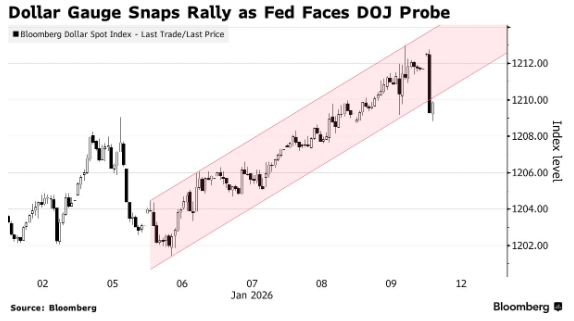
Group 1 - The market sentiment of "selling America" is spreading due to escalating attacks from the Trump administration on the Federal Reserve, raising concerns about the Fed's independence [1][2] - The Bloomberg Dollar Index fell by 0.3%, marking its largest decline since December 23 of the previous year, while S&P 500 futures dropped by 0.7% [1] - The 10-year U.S. Treasury yield rose by 3 basis points to 4.20%, potentially reaching its highest closing price since September of the previous year [1] Group 2 - Strategists warn that if tensions continue to escalate, the sell-off may intensify, with Morgan Stanley highlighting the risk of a steepening U.S. Treasury yield curve [2] - UBS's chief strategist noted that now is not the time for markets to worry about the Fed's independence, as inflation in the U.S. may rise in the coming months [2] - The debate centers on the extent to which the President can influence national interest rate policy, which has traditionally been insulated from political interference [2] Group 3 - The news of the Fed receiving a subpoena may further diminish the attractiveness of U.S. assets, as noted by a strategist from Invesco [3] - Concerns about the Fed's independence could lead macro traders to increase short positions on the dollar [3] - The pressure to "sell America" is unlikely to dissipate as trading unfolds into 2026 [4] Group 4 - Some analysts maintain a cautious outlook, suggesting that any pullback could present a buying opportunity due to the dollar's strong reserve currency status and the liquidity of U.S. Treasuries [4] - The investigation facing Powell appears more like a smokescreen than a real threat, but its long-term implications could be significant [4]
政治风险压顶!美联储传票风波引爆信任危机 “抛售美国”潮再起
智通财经网· 2026-01-12 08:52
Core Viewpoint - The Trump administration's recent attacks on the Federal Reserve have raised concerns about the independence of the central bank, leading to a market sell-off and questioning the extent of presidential influence on national interest rates [1][3]. Group 1: Market Reactions - Following comments from Fed Chair Jerome Powell regarding criminal charges, the dollar, U.S. Treasury bonds, and U.S. stock futures all experienced declines during Asian trading [1]. - The Bloomberg Dollar Index fell by as much as 0.38%, with the dollar weakening against nearly all G10 currencies [3]. - S&P 500 futures dropped by 0.51%, and Nasdaq 100 futures fell by 0.76% [3]. Group 2: Investor Sentiment - Investors are increasingly questioning whether to reduce exposure to U.S. assets and the dollar, reminiscent of market reactions to Trump's previous tariff announcements [1]. - Concerns about the potential impact on long-term monetary policy have led to increased market volatility, with the dollar becoming a focal point [3]. - Some strategists warn that if tensions escalate, the sell-off could intensify, with predictions of a steeper U.S. Treasury yield curve [4]. Group 3: Asset Attractiveness - The attractiveness of U.S. assets is perceived to be declining, with some analysts suggesting that the U.S. is becoming more predatory while also retracting within its borders [6]. - Despite concerns, some investors view potential pullbacks as buying opportunities due to the dollar's strong reserve currency status and the liquidity of the U.S. Treasury market [6]. - The ongoing investigation into Powell is seen as having uncertain but potentially profound long-term implications for the market [6].
AI时代造就年轻亿万富翁:创业不到三年就暴富,马斯克都比不上
Feng Huang Wang· 2025-12-30 03:07
Group 1 - The AI boom has significantly increased the wealth of notable billionaires like Jensen Huang and Sam Altman, as well as created new young billionaires from small startups [1][2] - New AI billionaires include founders of companies like Scale AI, Cursor, and others, with valuations skyrocketing due to investor interest [1][2] - The rapid rise in wealth among these AI entrepreneurs is reminiscent of the tech booms of the past, with comparisons made to the railroad tycoons of the 19th century [2][7] Group 2 - Many of the new AI billionaires have achieved their wealth in less than three years, particularly after the launch of OpenAI's ChatGPT [3][4] - Companies like Thinking Machines Lab and Safe Superintelligence have reached valuations of $100 billion and $320 billion respectively, despite not having released products [4][5] - The AI legal software company Harvey saw its valuation increase from $3 billion to $8 billion within a year, significantly boosting the wealth of its founders [5][6] Group 3 - The trend of young billionaires in the tech industry continues, with many founders being in their twenties, such as the team behind Mercor and Cursor [8][9] - The majority of new AI billionaires are male, with only a few women like Lucy Guo and Mira Murati reaching similar wealth levels, highlighting a trend of homogeneity in the tech sector [9]

美元颓势难逆转,2026年或陷多重逆风
Sou Hu Cai Jing· 2025-12-22 11:19
Core Viewpoint - The US dollar index is projected to decline by approximately 9% in 2025, marking its worst annual performance in eight years, driven by expectations of Federal Reserve rate cuts, narrowing interest rate differentials with other major currencies, and concerns over the US fiscal deficit and political uncertainty [1] Group 1: Factors Influencing Dollar Weakness - The primary factors driving the dollar's weakness include expectations of Federal Reserve rate cuts, narrowing interest rate differentials with other major currencies, and concerns regarding the US fiscal deficit and political uncertainty [1] - The actual effective exchange rate index of the dollar was reported at 108.7 in October, down from a record high of 115.1 in January, indicating that the dollar remains overvalued despite the decline [1] Group 2: Future Projections - The market widely anticipates that the dollar will continue to weaken in 2026, with the rationale being a potential convergence in global growth, a narrowing of the US economic growth advantage, and factors such as fiscal stimulus in Germany and economic improvement in the Eurozone that may reduce the dollar's attractiveness [1] - Divergence in monetary policy is another significant source of pressure, with expectations that the new Federal Reserve chair may adopt a more dovish stance and continue rate cuts, while other major central banks like the European Central Bank may maintain rates or even consider rate hikes [1] Group 3: Short-term Considerations - Investors caution that despite the long-term bearish trend for the dollar, there may be short-term rebounds due to inflows into the stock market driven by the AI boom [1] - Any significant blow to US economic growth could serve as an additional drag on the dollar [1]
董少鹏:“牛市情绪”再次受冲击,发生了什么?
Xin Lang Cai Jing· 2025-12-16 14:27
Core Viewpoint - The recent decline in Chinese stock indices is attributed to external factors and market sentiment, despite positive economic indicators showing steady growth in the economy [3][4][9]. Economic Indicators - From January to November, the retail sales of consumer goods increased by 4% year-on-year, fixed asset investment (excluding rural households) grew by 0.8%, industrial added value above designated size rose by 6.0%, high-tech manufacturing added value increased by 9.2%, and smart consumer equipment manufacturing added value grew by 7.6% [3][4]. Market Sentiment and Policy Support - Regulatory bodies have introduced measures to encourage long-term investment, with financial institutions like insurance companies entering the stock market through index ETFs. Monetary policy tools such as increased repurchase agreements and securities swaps have also played a role in stabilizing market sentiment [4][9]. - Despite these supportive measures, the market has experienced significant daily declines, with instances of drops exceeding 1%, and even 6% to 7% in some cases. Experts attribute this to large shareholder sell-offs and quantitative trading, but the core issue is identified as insufficient long-term capital in the market [4][9]. Market Dynamics and Communication - The communication environment in the Chinese stock market is considered poor, with major investment institutions failing to provide positive guidance on market information. This has led to the spread of negative narratives that exacerbate market volatility [4][5]. - The dominance of foreign market influences over local decision-making is criticized, suggesting that the Chinese stock market should be driven by domestic capital and institutional decisions rather than external risk preferences [5][9]. Call to Action for Institutions - There is a call for large institutional investors to actively support the Chinese stock market and address issues such as large shareholder sell-offs and quantitative trading that create public anxiety [10][11].

JP Morgan strategist predicts 2026 inflation outlook
Youtube· 2025-12-13 10:01
Core Viewpoint - The Federal Reserve's recent rate cut is seen as more dovish than anticipated, with implications for inflation and consumer spending in the upcoming year [2][3]. Federal Reserve Actions - The Fed cut the federal funds rate by 25 basis points, but market adjustments resulted in an effective cut of 31 basis points [2]. - Majority of the committee members expect only one rate cut in the next year, indicating a short-term dovish stance but a hawkish outlook longer term [3]. Consumer Stimulus - A significant tax bill passed in the summer will lead to retroactive tax cuts, resulting in larger tax refunds for consumers, projected to increase from an average of $3,200 this year to $4,000 next year [4][5]. - This increase in tax refunds is expected to provide a boost to consumer spending in the first half of the year, alongside positive trends from the AI boom and stock market performance [5]. Inflation Outlook - Anticipated consumer spending surge may lead to inflation peaking between 3.5% and 4% by June next year, before potentially returning to the Fed's 2% target by year-end [8][10]. - Retailers may pass on tariff increases to consumers due to the influx of tax refunds, contributing to inflationary pressures [6][7]. Economic Disparities - The current economic environment is characterized by a K-shaped recovery, where wealthier households are thriving while lower-income households continue to face inflationary pressures [11][12]. - The top 10% of earners hold 50% of the income, indicating significant income inequality that affects overall consumer confidence and spending behavior [12][13]. Investment Strategy - Investors are advised to rebalance their portfolios, particularly as many are heavily concentrated in mega-cap tech stocks, which may face volatility [15][16]. - A balanced portfolio is recommended as a prudent strategy heading into 2026, considering potential risks in speculative areas [16].
德意志银行、高盛认为美联储降息将重启美元跌势
Xin Lang Cai Jing· 2025-12-12 10:31
Core Viewpoint - Major Wall Street investment banks, including Deutsche Bank and Goldman Sachs, predict that the US dollar will resume its downward trend next year as the Federal Reserve continues to lower interest rates [1][5]. Group 1: Dollar Weakness Predictions - The dollar experienced its largest decline since the early 1970s in the first half of this year due to market turmoil caused by President Trump's trade war, but has stabilized over the past six months [1]. - Strategists expect the dollar to weaken again by 2026, driven by the Fed's continued implementation of loose monetary policy while other major central banks maintain or gradually increase interest rates [1][6]. - A consensus forecast compiled by Bloomberg predicts that a widely tracked dollar index will depreciate by approximately 3% by the end of 2026 [1]. Group 2: Economic Implications - The anticipated decline in the dollar is expected to have a chain reaction on the overall economy, leading to increased import costs, higher value of overseas profits for companies, and a boost in exports [6]. - The weakening dollar may be welcomed by the Trump administration, which has consistently complained about the US trade deficit [6]. Group 3: Emerging Markets and Currency Trends - The flow of funds into emerging markets for higher yields has led to the largest returns from carry trades since 2009, with JPMorgan and Bank of America optimistic about further appreciation of emerging market currencies [7]. - Analysts from Goldman Sachs noted that as economic data from multiple countries improves, market expectations for currencies like the Canadian dollar and Australian dollar are being revised upward [7]. Group 4: Diverging Economic Outlooks - Some contrarian investors believe the dollar may appreciate against certain major currencies, citing the strong performance of the US economy, particularly driven by the AI boom [7]. - Citigroup and Standard Chartered analysts suggest that the growth in the US economy will attract significant investment inflows, potentially boosting the dollar's value [7]. Group 5: Federal Reserve's Policy Impact - The Federal Reserve has raised its economic growth forecast for 2026, indicating a potentially better-than-expected economic outlook, despite announcing a 25 basis point rate cut and plans for another cut next year [8]. - Fed Chair Jerome Powell alleviated market concerns about a shift towards tightening monetary policy, emphasizing the focus on the weak labor market and inflation above target levels [8].

