
低轨通信卫星

Search documents
长城基金尤国梁:商业航天后续或仍有诸多催化
Xin Lang Cai Jing· 2026-01-20 08:00
Core Viewpoint - The commercial aerospace sector is experiencing a capital surge in early 2026, with active performance in related stocks, although there has been a recent cooling off after a period of rapid growth [1][8]. Group 1: Market Dynamics - The recent fluctuations in the commercial aerospace sector are normal and do not indicate a trend reversal, as the previous surge was driven by multiple factors including industrial transformation, favorable policies, and international developments [2][10]. - Key events that contributed to the previous rise include a significant increase in rocket launch frequency in the second half of last year and the successful launch of reusable rockets, which addressed domestic capacity constraints and laid the foundation for commercialization [2][10]. - The government has recognized commercial aerospace as one of the three strategic emerging industries, highlighting its importance in national planning and strategy [2][10]. Group 2: Future Catalysts - There are still numerous positive events expected to catalyze the sector, such as successful recovery of reusable rockets, low-orbit communication satellite applications, second-generation satellite tenders, and IPOs of key commercial aerospace companies [2][10]. - The future market dynamics will likely depend on which sector—rockets, satellite manufacturing, or applications—experiences significant advancements or catalysts [3][11]. Group 3: Growth Potential - Commercial aerospace is viewed as a burgeoning industry with substantial growth potential, particularly in low-orbit satellite internet, which has already connected a large user base and demonstrated viable business models [4][12]. - The industry chain is extensive, involving various segments such as satellite research and manufacturing, rocket production and launch, ground equipment, and satellite application services [4][13]. - The development of satellite applications and services is expected to mirror telecommunications operators, potentially capturing greater value in the long term [4][13]. Group 4: Investment Considerations - Valuation concerns exist within the commercial aerospace sector, as the overall industry valuation was already high before the recent market surge [5][14]. - The market tends to price new industries based on long-term growth potential rather than current financial metrics, necessitating ongoing assessment of industry developments [5][14]. - Investors should differentiate between temporary market corrections and long-term risks, focusing on companies with competitive advantages and technological barriers while avoiding speculative investments [6][14].
重庆巴南2026年首次集中签约项目29个
Ke Ji Ri Bao· 2026-01-08 02:59
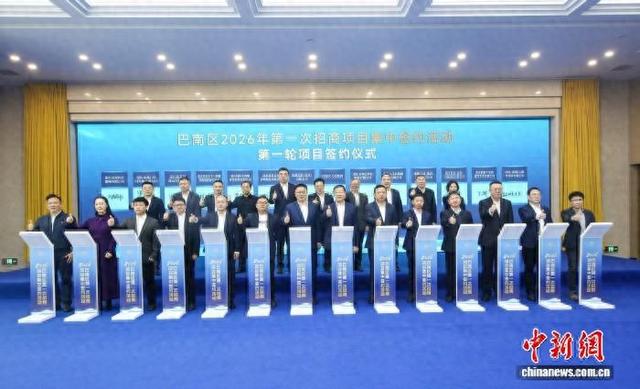
Group 1 - The core event is the signing of 29 investment projects in Banan District, Chongqing, with a total investment of approximately 22 billion yuan, focusing on key industries such as biomedicine, electronic information, and intelligent connected new energy vehicles [1] - The projects are characterized by high investment intensity, technological content, and strong industrial driving force, aligning with the development direction of Banan District's leading industries [1] - A strategic cooperation agreement was signed between the Banan District government and Guoxin Holdings (Chongqing) Co., Ltd., aiming to integrate the advantages of central enterprises and local government for a new development model [1] Group 2 - Banan District is focusing on the "312" technology innovation layout and the "1+3+X" future industry layout to attract cutting-edge technology projects [2] - The Yengyu Muxing Satellite Intelligent R&D and Production Base project aims to establish an intelligent production capacity system for 300 satellites annually, utilizing platform-based, modular, and AI-enabled technologies [2] - Other projects include the construction of a comprehensive international food smart park and a cultural service ecosystem platform, contributing to the acceleration and quality enhancement of the productive service industry in Banan District [2]
奋战“开门红” 重庆巴南2026年集中签约220亿元
Xin Lang Cai Jing· 2026-01-07 08:59
Group 1 - The core event is the signing of 29 investment projects in Banan District, Chongqing, with a total investment of approximately 22 billion yuan, focusing on key industries such as biomedicine, electronic information, intelligent connected new energy vehicles, technology services, financial services, and modern logistics [1][3] - The signed projects are characterized by high investment intensity, technological content, and strong industrial driving force, aligning with Banan's main industry development direction [1][3] - A significant advanced manufacturing project includes the establishment of a precision manufacturing base for components, new energy vehicle systems, and 5G communication products, covering an area of 227 acres [3] Group 2 - A notable project is the YG Space Satellite Intelligent R&D Production Base, which aims to produce 300 satellites annually, leveraging AI and modular technology for high-resolution and high-performance satellite development [3] - The signing event also includes modern service industry projects in technology services, financial services, modern logistics, trade services, and cultural services, aimed at enhancing the quality and capacity of productive services [3] - A strategic cooperation agreement was signed between Banan District Government and Guoxin Holdings (Chongqing) Co., Ltd., focusing on improving capital operation efficiency and local economic development [4]

技术硬件与设备行业研究报告之二:火箭增效,卫星加速
Guoyuan Securities· 2025-12-21 12:13
Investment Rating - The report maintains a "Buy" recommendation for the satellite communication industry, particularly focusing on low Earth orbit (LEO) satellite systems [6]. Core Insights - The low Earth orbit (LEO) satellite communication sector is entering a critical phase of large-scale deployment and commercialization, driven by the acceleration of global digitalization and the emergence of new application scenarios [2][3]. - The report highlights the significant improvements in system efficiency and cost reduction due to technological advancements, such as enhanced on-board processing (OBP) capabilities and the maturity of phased array antenna technology [3][4]. - The Chinese government has included satellite internet in its "new infrastructure" initiatives, supporting the development of autonomous LEO satellite constellations [2][3]. Summary by Sections Industry Overview - The global satellite industry is projected to generate approximately $293 billion in revenue by 2024, with a compound annual growth rate (CAGR) of about 1.57% from 2019 to 2024 [12]. - The revenue from satellite manufacturing is expected to reach $20.1 billion in 2024, reflecting a year-on-year growth of approximately 17% [15][16]. Technological Trends - The report emphasizes that the enhancement of OBP capabilities allows satellites to perform more data routing and computing functions, reducing reliance on ground stations [3][4]. - The widespread use of reusable launch vehicles is expected to alleviate launch bottlenecks and continuously lower the cost per bit of transmission, facilitating large-scale user access [3][4]. Market Dynamics - The report indicates that the revenue from ground equipment is currently the highest in the global satellite industry, but as OBP technologies mature, the reliance on ground stations is expected to decrease, leading to increased revenue shares for satellite manufacturing and services [4]. - The demand for consumer broadband terminals, IoT devices, and specialized communication equipment is anticipated to grow, presenting unprecedented market opportunities for domestic companies with core hardware development capabilities [4][5]. Investment Recommendations - The report suggests focusing on leading suppliers of satellite payload manufacturing and navigation modules, as the optimization of launch costs and operational efficiencies is expected to drive growth in downstream service applications [5].



商业航天深度报告:星辰为路,领航新纪元
2025-12-16 03:26
Summary of Commercial Aerospace Conference Call Industry Overview - The commercial aerospace sector faces core challenges related to capacity and cost, with breakthroughs in reusable rocket technology being crucial [1] - SpaceX has launched nearly 10,000 satellites, validating the commercial potential of the industry [1][2] - China is actively advancing reusable rocket testing and has entered a period of intensive launches by private companies, which will accelerate commercialization [1][3] Key Points and Arguments - The information technology segment is vital for commercial aerospace, encompassing remote sensing, measurement and control, CAE simulation, and data transmission, all requiring software service support [1][4] - Space computing is emerging as a solution to address power consumption and land resource constraints, offering long-term economic viability [1][4] - The U.S. has incentivized private sector participation in aerospace through policy simplifications, while China has supported private enterprises since 2020, forming four major industrial belts to reduce operational costs [5] - The Shanghai Aerospace Bureau has been established with a high-quality development plan, indicating increased support during the 14th and 15th Five-Year Plans [6] Market Dynamics - The commercial aerospace sector is not new, having gained attention since 2022, with steady development in China's aerospace industry transitioning from specialized to civilian applications [2] - The core issues in commercial aerospace remain cost reduction and economic feasibility, with significant advancements in technology observed globally [2][3] - The market is witnessing a surge in low Earth orbit satellite projects from various entities in China, which could enhance satellite commercialization once capacity constraints are overcome [3] Technological Developments - Intelligent measurement and control technologies are critical for satellite operational safety, with automation and standardization processes being essential [2][8] - Satellite testing technologies ensure successful missions by simulating space environments and verifying stability and reliability through various testing phases [10] - CAE simulation technology enhances research and development efficiency and product safety, significantly shortening design cycles [11][12] Future Prospects - Space computing is a burgeoning area with immense potential, addressing the data transmission pressures from increasing satellite numbers [13] - The U.S. leads in space computing, with companies like NASA and SpaceX making significant advancements, including the Starlink network [15][16] - China is also making strides, with the Tianzhi series satellites and the launch of the world's first space computing constellation [17] Challenges and Solutions - The development of space computing faces challenges such as heat management and maintenance costs, which can be mitigated through advancements in rocket reusability and lightweight materials [19] - The advantages of space computing include reduced land resource competition and the ability to utilize solar energy, making it a viable alternative to ground-based data centers [18] Investment Opportunities - Recommended focus on state-owned enterprises and leading private aerospace companies, such as Electric Science, Aerospace Systems, and related supporting companies, which are integral to the industry chain and poised to benefit from future trends [20]