债券策略产品

Search documents
资本市场回暖推动私募业绩走高
Xin Lang Cai Jing· 2026-01-25 22:24
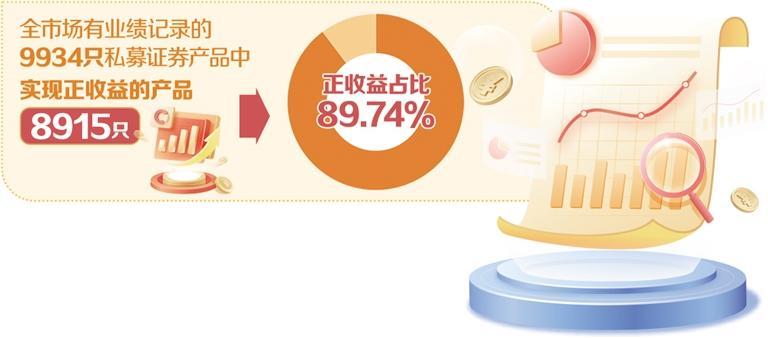
Core Insights - In 2025, private securities products demonstrated strong performance, with 89.74% of 9,934 products achieving positive returns and an average return rate of 25.68% [2] - The management scale of private funds reached a historical high of 22.09 trillion yuan by the end of November 2025, driven by the growth of private securities investment funds [2] Market Environment - The outstanding performance of private securities products in 2025 is attributed to three main factors: a favorable macro environment, strong liquidity support, and strategic alignment with market structure [3] - The A-share market experienced an overall upward trend, supported by innovations in AI and new energy sectors, which boosted market confidence [3] Strategy Performance - Among various strategies, the stock strategy led in returns, with 90.19% of 6,298 products achieving positive returns and an average return rate of 29.99% [3] - Quantitative long strategies showed remarkable performance, with a positive return rate of 95.81% among 1,360 products and an average return rate of 39.51% [4] - Multi-asset strategies achieved a positive return rate of 90.61% among 1,321 funds, with an average return rate of 22.06%, demonstrating strong risk management capabilities [4] Specific Strategy Insights - Combination funds, which diversify investments across different strategies and managers, achieved a positive return rate of 96.19% among 315 funds, catering to conservative investors [4] - Bond strategies maintained stable performance, with 89.93% of 745 bond products achieving positive returns, serving as a reliable asset allocation choice for low-risk investors [5]

2025年私募产品备案、业绩“双丰收”
Jin Rong Shi Bao· 2026-01-13 01:30
Core Insights - The private equity securities industry is experiencing rapid growth in 2025, with product scale surpassing 7 trillion yuan and a significant increase in product registrations, nearly doubling from 2024, becoming the core engine of industry growth [1][2] - Nearly 90% of private equity securities products achieved positive returns, indicating a strong performance and increasing market recognition, leading to a more stable and sustainable growth trajectory for the industry [1][5] Product Registration and Strategy - A total of 12,645 private equity securities products were registered in 2025, a 99.54% increase from 6,337 in 2024, with stock strategies being the preferred choice, accounting for 65.86% of all registered products [2] - Quantitative products showed remarkable growth, with 5,617 registered, reflecting a 114.31% increase and making up 44.42% of total registrations, up from 41.68% in 2024 [2][3] Performance Metrics - Among the 9,934 private equity securities products with performance records, 8,915 achieved positive returns, resulting in a positive return rate of 89.74% and an average return rate of 25.68% [5] - Combination funds demonstrated strong performance, with 96.19% achieving positive returns and an average return rate of 18.30%, while multi-asset strategies also performed well with a 90.61% positive return rate [5] Industry Trends - The private equity securities industry is characterized by a solid core position of stock strategies, while multi-asset and derivative strategies are rapidly emerging, optimizing the strategic structure of the industry [4] - The rise of quantitative investment is becoming a strategic focus for leading institutions, with future competition expected to concentrate on specialization and refinement in niche areas [4][6]
2025年私募业绩亮眼 平均收益率超25%
Zheng Quan Shi Bao Wang· 2026-01-12 06:47
Group 1 - The private equity securities investment products in 2025 have shown impressive performance, with 8,915 out of 9,934 products achieving positive returns, resulting in a positive return rate of 89.74% and an overall average return rate of 25.68% [1] - The stock strategy emerged as the top performer, with 5,680 out of 6,298 products yielding positive returns, a positive return rate of 90.19%, and an average return rate of 29.99%, indicating strong investment opportunities in the stock market for 2025 [1] - Among stock strategy sub-strategies, quantitative long strategies performed exceptionally well, with a positive return rate of 95.81% and an average return rate of 39.51% [1] Group 2 - The multi-asset strategy achieved a positive return rate of 90.61% with an average return rate of 22.06%, demonstrating strong risk management through flexible allocation across various asset classes [2] - Combination funds stood out as the most stable strategy in 2025, with a positive return rate of 96.19%, although the average return rate of 18.30% was lower than that of stock and multi-asset strategies [2] - Futures and derivatives strategies also performed well, with 84.86% of products achieving positive returns and an average return rate of 17.24% [2] Group 3 - The bond strategy maintained stable performance in 2025, with 670 out of 745 products achieving positive returns, resulting in a positive return rate of 89.93% and an average return rate of 9.56%, serving as a reliable asset allocation choice for low-risk investors [3] - The strong performance of private equity securities products in 2025 is attributed to three main factors: the resonance between macroeconomic environment and market trends, strong liquidity support from policy guidance, and the alignment of strategies with market structure [3] - The A-share market experienced an overall upward trend, with the ChiNext Index rising approximately 50%, providing a solid foundation for returns from stock strategy-focused private equity products [3]
去年私募新发产品超1.2万只,百亿量化私募成主力军
Sou Hu Cai Jing· 2026-01-08 07:12
Core Insights - In 2025, there was a significant surge in the registration of private securities products, with a total of 12,645 products registered, marking a year-on-year increase of 99.54% [1] - Stock strategies remain the preferred choice for private equity firms, with 8,328 stock strategy products registered, accounting for 65.86% of all registered products, indicating strong investor interest in stock assets [1] - Quantitative products showed remarkable performance, with 5,617 registered products, reflecting a year-on-year growth of 114.31%, and stock strategy quantitative products dominated this category [1][2] Group 1: Product Registration Trends - The registration of multi-asset strategies, futures, and derivatives strategies ranked second and third, with 1,806 and 1,274 products registered, representing 14.28% and 10.08% respectively [1] - Bond strategies and combination funds had 492 and 512 products registered, making up 3.89% and 4.05% of the total, contributing to a diversified landscape that caters to different risk preferences [1] Group 2: Quantitative Strategy Insights - Within the quantitative stock strategy segment, quantitative long strategies were particularly prominent, with 2,746 products registered, accounting for 48.89% of the total quantitative products [2] - Market-neutral strategies in the stock sector had 1,114 products registered, representing 19.83%, appealing to risk-averse investors due to their stable return characteristics [2] - Futures and derivatives quantitative strategies had 773 products registered, with quantitative CTA strategies being the core segment, comprising 12.93% of the total quantitative products [2] Group 3: Institutional Trends - The registration landscape showed a clear concentration among leading firms, with 26 out of 29 private equity firms that registered at least 50 products being billion-yuan firms [2] - Among these, Mingcang Investment led with 157 registered products, followed by Century Frontier, Black Wing Asset, and Kuande Private Equity with 147, 138, and 127 products respectively [2] - Quantitative investment has become the dominant strategy among leading private equity firms, with 24 out of 29 firms adopting this approach, highlighting its competitive advantages in discipline, risk control, and stable returns [3]
长城证券“烽火杯”火热进行中 《烽火论剑》栏目解码2026资产配置主线
Zhong Zheng Wang· 2025-12-17 11:37
Group 1 - The "Fenghuo Cup" private equity selection event organized by Changcheng Securities has attracted over 600 private equity institutions and more than 1,600 products since its launch in October 2025, covering seven core strategies including stock, index enhancement, neutral, arbitrage, CTA, bond, and combination strategies [1] - The event aims to provide ample time for participating institutions to showcase their investment capabilities, with registration open until June 2026 [1] - The initiative is part of Changcheng Securities' effort to create a supportive ecosystem for quality private equity growth, offering diverse resources and platforms for trading execution, investment support, and financing solutions [1] Group 2 - In the macroeconomic context, the current economic cycle is perceived to be in a relatively early stage, with policies aimed at supply-side reform generating positive expectations, although actual progress remains to be verified [2] - The consensus among fund managers is that there are still reasonably valued targets in the market, such as the food and beverage index's price-to-earnings ratio and the Hang Seng Index's price-to-book ratio, both at historical lows [2] - Investment opportunities in the technology sector are highlighted, particularly in AI, with a focus on hardware that has reasonable valuations and is part of new major industry chains [2] Group 3 - Looking ahead to 2026, it is anticipated that more aggressive monetary and fiscal policies will be implemented, with potential further declines in risk-free interest rates and an increase in the value of credit bond allocations [3] - The stock market outlook favors relatively undervalued sectors such as banking, food and beverage, and consumer electronics, alongside technology leaders in AI chips, semiconductor equipment, and computing power [3] - The difficulty of stock selection and timing is expected to increase, making industry ETFs a more cost-effective option for investment [3]

产品备案数量仅次于股票策略,私募多资产策略为何越来越火?
Xin Lang Cai Jing· 2025-11-27 05:43
Core Insights - Multi-asset strategy private equity products have gained popularity in 2023, with 1,400 products registered from January to October, second only to stock strategy products [1] - The appeal of multi-asset strategies is attributed to significant global asset price fluctuations expected in 2024-2025, evolving investor demands for risk-return matching, and the search for absolute returns by long-term funds [1][8] Performance Overview - As of November 14, multi-asset strategy products have an average annual return of 20.37%, ranking just below stock strategies, with a slightly higher Sharpe ratio and lower volatility and drawdown [2][3] - The performance metrics for various strategies are as follows: - Stock Strategy: 29.54% average return, 93.14% positive return ratio, 35.96% volatility [3] - Multi-Asset Strategy: 20.37% average return, 91.73% positive return ratio, 25.84% volatility [3] - Composite Fund: 18.98% average return, 96.34% positive return ratio, 39.15% volatility [3] - Futures and Options: 13.79% average return, 82.49% positive return ratio, 48.73% volatility [3] - Bond Strategy: 8.46% average return, 92.10% positive return ratio, 11.76% volatility [3] Sub-strategy Performance - Among sub-strategies, macro strategies outperform in average return, positive return ratio, and Sharpe ratio [4] - Macro Strategy: 25.09% average return, 97% positive return ratio, 25.48% volatility [5] - Composite Strategy: 21.14% average return, 90.93% positive return ratio, 1.63 Sharpe ratio [7] - Arbitrage Strategy: 8.87% average return, 89.95% positive return ratio, lowest volatility and drawdown [7] Market Dynamics - The macro strategy focuses on dynamic allocation across major asset classes based on global macroeconomic analysis [6] - Bridgewater's "All Weather Strategy" exemplifies macro strategies, aiming for stable performance across different economic environments [6] - Local macro strategy firms like Honghu and Banxia are emerging as key players in the market [7] Challenges and Considerations - Successfully implementing multi-asset strategies requires more than just combining different assets; it necessitates creating a synergistic portfolio [8] - The complexity of the Chinese market, with significant differences in Sharpe ratios and economic cycles, demands experienced management and a tailored methodology [8] - A robust IT system covering research, trading, risk control, and operations is essential for distinguishing the capabilities of multi-asset strategy private equity firms [8]

私募新产品发行持续火爆 10月新备案数量近1000只
Zheng Quan Shi Bao Wang· 2025-11-05 07:23
Core Insights - The A-share market has seen a resurgence in 2023, leading to a significant increase in the issuance of private equity products, with a total of 994 private securities products registered in October, a 19.90% increase compared to the same month last year [1][3] - Stock strategy products remain the dominant category, accounting for 68.31% of the total registered products, indicating strong investor demand for equity assets [1][2] - Multi-asset strategy products have gained popularity, with 122 products registered in October, representing 12.27% of the total, reflecting a trend towards diversified investment strategies among private equity firms [1][2] Strategy Distribution - Quantitative stock strategy products have shown steady growth, with 333 out of 432 registered quantitative products being stock strategies, making up 77.08% of the total [2] - Futures and derivatives strategies have also emerged as a significant area for quantitative investment, with 50 products registered, accounting for 11.57% of the total quantitative products [2] - Bond strategies and combination funds have seen similar registration numbers, with 49 and 36 products respectively, representing 4.93% and 3.62% of the total [2] Market Dynamics - The increase in private securities product registrations is attributed to multiple factors, including the Shanghai Composite Index surpassing 4000 points, highlighting structural market opportunities [3] - Third-party sales institutions have intensified marketing efforts, further stimulating investor interest in private equity products [3] - The influx of northbound capital and a stable funding environment have provided favorable conditions for private equity operations, allowing firms to enhance product returns and innovate strategies [3]
同比大增89%!前三季度私募备案数据出炉,量化产品暴增102.66%!
私募排排网· 2025-10-21 03:34
Core Viewpoint - The private equity securities product registration market has significantly rebounded in the first three quarters of 2025, with a total of 8,935 products registered, representing a year-on-year increase of 89.38% [2]. Group 1: Factors Driving Growth - The growth in private equity securities product registrations is driven by three main factors: 1. Continuous improvement in market conditions, with strong performance in small-cap indices like the CSI 1000 and CSI 2000, enhancing investor willingness to allocate funds [2]. 2. Regulatory guidance that has improved industry transparency and credibility, attracting more capital [2]. 3. Active business expansion by private equity firms, with leading firms accelerating product line development and smaller firms seeking growth through new product registrations [2]. Group 2: Strategy Distribution - Among the registered products, equity strategies dominate with 5,849 registrations, accounting for 65.46% of the total, and showing a year-on-year increase of 99.35% [3]. - Multi-asset strategies follow with 1,278 registrations, representing 14.30% of the total and a year-on-year growth of 84.68% [5]. - Futures and derivatives strategies have 913 registrations, making up 10.22% of the total, with a year-on-year increase of 66.00% [5]. - Bond strategies and combination funds have similar registration numbers, with 363 and 362 products respectively, each around 4% of the total, and year-on-year increases of 75.36% and 79.21% [5]. Group 3: Quantitative Products - Quantitative private equity products have shown remarkable growth, with 3,958 registrations, accounting for 44.30% of all private equity securities products, and a year-on-year increase of 102.66% [6]. - The surge in quantitative product registrations is attributed to: 1. Superior performance of quantitative strategies compared to subjective strategies in the current market environment, attracting continuous capital inflow [6]. 2. Ongoing technological advancements, including the application of AI and machine learning in strategy development, enhancing model adaptability and profitability [6][7]. 3. Leading quantitative firms leveraging scale advantages to create a virtuous cycle of performance improvement and product registration growth [7]. Group 4: Concentration of Registrations - The number of private equity managers with registered products reached 2,322, with a significant concentration in the number of products registered, as 1,879 managers have 5 or fewer products [12]. - In terms of management scale, the largest group consists of managers with assets under management (AUM) of 0-5 billion, totaling 1,560 [12]. - Notably, among the 26 managers with at least 40 registered products, 23 are billion-dollar managers, indicating a strong concentration of registration among larger firms [14].

年内私募分红逾140亿元
Sou Hu Cai Jing· 2025-10-16 23:09
Core Insights - The report highlights that among 5344 products with performance data, 1038 products have distributed dividends this year, totaling 1291 distributions and an aggregate amount of 14.085 billion yuan, with an average dividend ratio of 27.59% [1] Group 1: Dividend Distribution by Strategy - Stock strategy products accounted for 752 distributions, with an average dividend ratio of 31.8%, totaling 10.735 billion yuan, representing 76.22% of the total dividend amount [1] - Multi-asset strategy products had 190 distributions, with an average dividend ratio of 23.78%, totaling 1.267 billion yuan, which is 9% of the total [1] - Futures and derivatives strategy and bond strategy had similar dividend amounts, with 155 and 140 distributions respectively, totaling 0.933 billion yuan and 0.880 billion yuan, representing 6.63% and 6.25% of the total [1] - The average dividend ratio for futures and derivatives strategy was 23.18%, significantly higher than the bond strategy's 13.45% [1] Group 2: Performance of Billion-Yuan Private Equity - Billion-yuan private equity firms emerged as the main contributors to dividend distributions, with 131 distributions this year, an average dividend ratio of 34.62%, and a total amount of 4.999 billion yuan, accounting for 35.49% of the total [1]
平均赚超20%!逾九成私募产品年内正收益
券商中国· 2025-09-13 23:36
Core Viewpoint - The year 2025 is expected to be favorable for private equity firms, with significant returns observed in private securities products and a resurgence of star stock private equity funds [1]. Group 1: Performance of Private Equity Products - As of August 31, 2025, 10,135 private securities products recorded an average return of 20.41%, with 9,208 products achieving positive returns, resulting in a positive return rate of 90.85%. The 5th percentile return reached 60.64% [3]. - Among 6,473 stock strategy products, 6,026 achieved positive returns, representing 93.09%, with an average return of 25.38% and a 5th percentile return of 72.23%. This strong performance is attributed to structural opportunities in the market, with A-shares showing an upward trend and a focus on small and mid-cap stocks, as well as technology growth and resource cyclical stocks [3]. - Multi-asset strategies also performed well, with 1,279 products recording an average return of 15.61% and a positive return rate of 89.91%. The 5th percentile return for these products was 52.84% [3]. Group 2: Strategy Performance Breakdown - Combination fund strategies had the highest positive return rate, with 398 products showing 95.98% positive returns and an average return of 14.12%, while the 5th percentile return was 36.38% [4]. - Futures and derivatives (CTA) strategies underperformed, with 1,212 products achieving a 77.15% positive return rate and an average return of 8.55%. The 5th percentile return for these products was 37.61% [4]. - Bond strategies remained stable, with 773 products achieving a 92.50% positive return rate and an average return of 7.89%, while the 5th percentile return was 26.59% [4]. Group 3: Research Activities of Private Equity Firms - As of September 11, 2025, 2,366 private equity firms participated in A-share company research, covering 1,999 stocks across 30 primary industries, with a total of 35,168 research instances [5]. - The top private equity firms in terms of research frequency include Panjing Investment with 350 instances, followed by Gao Yi Asset and He Xie Hui Yi Asset, both exceeding 200 instances [5][6]. - Many large private equity firms have increased their overseas research efforts, with some focusing on long-term investments in non-ferrous enterprises and conducting multiple research trips to Africa to assess overseas mineral projects [7].