
智能耳机

Search documents
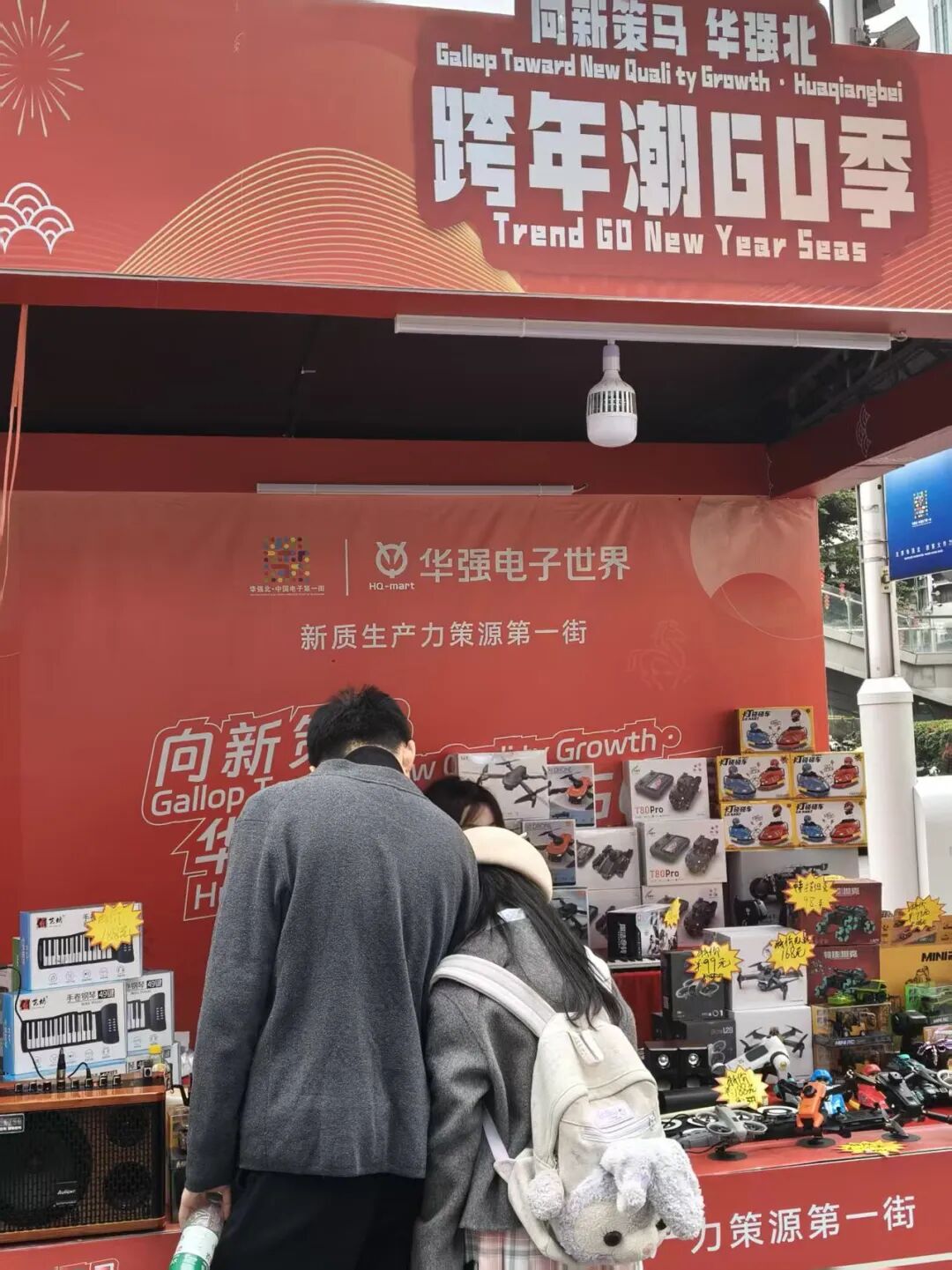
新春走基层丨华强北的人潮与新潮
Zhong Guo Zheng Quan Bao - Zhong Zheng Wang· 2026-02-15 12:51
Core Insights - The article highlights the vibrant consumer electronics market in Shenzhen's Huaqiangbei, showcasing a bustling atmosphere as customers flock to purchase various tech products ahead of the Spring Festival [1][2]. Industry Overview - Huaqiangbei is recognized as "China's first electronics street," demonstrating robust growth in the consumer electronics sector, with a daily foot traffic of 700,000 to 800,000 people, including over 7,000 foreign customers [5][6]. - The core business district spans approximately 1.45 square kilometers and houses 35 specialized markets and 115,000 business entities, covering the entire supply chain from R&D to cross-border trade [5][6]. Product Trends - Popular products during the "New Year Shopping Season" include AI wearables, AI toys, smart headphones, drones, and robots, with significant increases in both inquiries and sales reported by merchants [6][8]. - Companies like Shenzhen Xiaocheng Times Technology Co., Ltd. and Shenzhen Rouguo Technology Co., Ltd. are actively developing AI products, with Xiaocheng planning to launch AI glasses priced between 299 yuan and over 4,000 yuan, and Rouguo reporting sales of over 5,000 AI toys in 2025 [3][5]. Market Dynamics - The market is transitioning from concept validation to large-scale growth, with consumer demographics expanding from children to all age groups [5]. - Huaqiangbei's unique advantages include high innovation density, rapid industry speed, and strong market sensitivity, supported by the comprehensive manufacturing system of the Guangdong-Hong Kong-Macao Greater Bay Area [8]. Future Outlook - The trading volume in Huaqiangbei is projected to exceed 480 billion yuan by 2025, with a growing share of new productivity-related products such as smart terminals and drones [8]. - The district is becoming a global benchmark for electronic products, attracting more international buyers and innovators who view it as a key observation point for trends in the AI hardware industry [8].

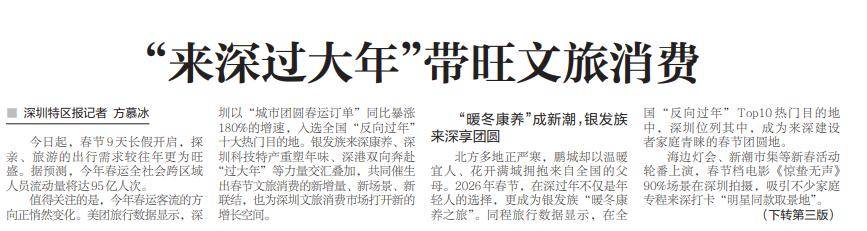
【深圳特区报】“来深过大年”带旺文旅消费
Sou Hu Cai Jing· 2026-02-15 02:18
Group 1 - The core viewpoint of the articles highlights the significant increase in travel demand during the Spring Festival, with a projected 9-day holiday leading to 9.5 billion cross-regional trips, indicating a shift in travel patterns towards cities like Shenzhen for family reunions and tourism [1] - Shenzhen has emerged as a top destination for the "reverse New Year" trend, with a 180% year-on-year increase in travel orders, driven by factors such as the aging population seeking warm winter experiences and the city's unique cultural offerings [1][2] - The introduction of specialized care services for elderly visitors during the Spring Festival addresses the needs of families, enhancing the overall experience for the silver-haired demographic [2] Group 2 - The concept of "Cyber New Year" is gaining popularity, with technological innovations redefining traditional celebrations, such as drone performances and interactive cultural events, attracting younger audiences and enhancing the festive atmosphere [4] - The cross-border consumption between Shenzhen and Hong Kong is thriving, with cultural activities at border points transforming them into vibrant community spaces, fostering closer ties between residents of both regions [5][6] - The "Hong Kong Residents' Peace of Mind Tour" initiative provides convenient transportation and multilingual services, enhancing the overall experience for visitors and positioning the border as a cultural landmark rather than just a transit point [6]
广州家电数码以旧换新新春福利加码 发票抽奖“省上加省”
Guang Zhou Ri Bao· 2026-02-14 05:04
Core Viewpoint - The Guangzhou consumer market is experiencing a surge in activity as the Spring Festival approaches, driven by multiple subsidy programs and promotional activities aimed at enhancing consumer spending and ensuring supply of essential goods [1][5]. Group 1: Consumer Subsidy Programs - The "Lego New Year" special event initiated by the Ministry of Commerce and nine other departments is providing substantial cash subsidies to consumers [2]. - The national subsidy for home appliances and digital products offers a 15% discount, with maximum subsidies of 500 yuan for digital products and 1500 yuan for home appliances [2]. - The Guangdong "优品购" program provides differentiated subsidies, including a 10% discount on digital and specialty products, and a 15% discount on home appliances, with maximum subsidies of 500 yuan and 1000 yuan respectively [2]. Group 2: Consumer Engagement and Promotions - Major retailers in Guangzhou, including 广百友谊, 京东MALL, and 苏宁易购, are implementing a "Spring Festival not closing" strategy, offering various promotional activities to enhance consumer engagement [3][4]. - Promotions include discounts ranging from 8.5% to 9.5% on regular-priced appliances, with additional benefits such as 100 yuan off for purchases over 800 yuan and up to 300 yuan off for bundled purchases [4]. - 京东MALL is offering a comprehensive discount system that combines government subsidies with store-specific promotions, allowing consumers to enjoy discounts of up to 50% during the promotional period [4]. Group 3: Market Supply and Consumer Experience - The Guangzhou Municipal Bureau of Commerce is committed to ensuring a stable supply of essential goods and enhancing consumer experience during the Spring Festival [5]. - The bureau is promoting various activities to encourage major commercial enterprises to remain operational during the holiday, ensuring that services are not compromised [5].

县区动态|淮阴区商务局开展促消费政策进企业活动
Sou Hu Cai Jing· 2026-02-12 16:34
Group 1 - The core objective of the event is to promote consumer policies directly to enterprises, facilitating precise connections between supply and demand [1] - The Huaiyin District Commerce Bureau conducted an on-site activity to explain and guide employees on the standards, application processes, and timelines for subsidies related to the replacement of old automobiles, home appliances, and digital products [3] - The event featured local home appliance company Nian Nian Wang and China Mobile, providing immersive experiences with electronic products such as smartphones, smartwatches, and tablets [5] Group 2 - The Huaiyin District Commerce Bureau plans to continue deepening the "Five Advances" consumer replacement initiative, aiming to expand the coverage and influence of the policy [5] - The bureau aims to stimulate market potential by ensuring that policy strength resonates with market enthusiasm [5]

外国人来深圳华强北“扫货”,空箱来满载归
Xin Lang Cai Jing· 2026-02-04 15:22
Core Insights - The article highlights the surge in consumer activity in Shenzhen's Huaqiangbei area as the Spring Festival approaches, with a notable increase in foreign tourists purchasing technology products [1][3]. Group 1: Consumer Behavior - Foreign tourists are specifically visiting Huaqiangbei to buy "tech New Year goods" such as AI glasses, drones, translation devices, smart headphones, portable cameras, and electronic guitars, often returning with full luggage [3][4]. - The influx of foreign visitors has led to a 10%-15% increase in foot traffic compared to previous events, with a significant rise in foreign and out-of-town buyers [7]. Group 2: Sales Performance - Sales of consumer electronics, smart devices, and AI wearables have increased by approximately 30% compared to regular days, driven by the festive season [7]. - A specific electronics retailer reported that their daily sales doubled compared to the previous month, indicating a strong demand for electronic musical instruments as gifts for the New Year [9]. Group 3: Economic Impact - The booming sales of technology products have positively impacted the surrounding industries, with restaurant and service sector revenues increasing by about 8% due to heightened consumer activity [10]. - Huaqiangbei serves as a central hub for the global electronics industry, with an annual transaction volume of 480 billion yuan and daily logistics exceeding 3 million items, showcasing its role as an innovation accelerator [6].


曾经的科技潮玩 如今的贴身伙伴
Huan Qiu Wang Zi Xun· 2026-01-27 01:41
Core Insights - The article discusses the integration of wearable technology into the daily lives of the younger generation, highlighting how these devices have become essential tools for health monitoring and lifestyle management [5][6][10]. Group 1: Integration into Daily Life - Wearable devices like smartwatches, smart glasses, and fitness trackers are deeply embedded in the routines of Generation Z, serving as health companions and enhancing their daily experiences [5][6]. - Data from IDC indicates that by 2024, China will become the largest market for wrist-worn devices, driven by government subsidies and increasing sales of smartwatches and bands [5][6]. - Young consumers, particularly those aged 18-35, are the primary drivers of the wearable technology market, with a significant focus on health monitoring features [5][6][7]. Group 2: Health Monitoring and Lifestyle Changes - A survey shows that 45.48% of Chinese consumers purchase smartwatches primarily for health data monitoring, indicating a shift towards a health-conscious lifestyle [7]. - The use of wearables has led to a quantifiable approach to health, with users sharing their achievements on social media, thus creating a culture of "data-driven" self-improvement [8][9]. - The article notes a phenomenon termed "data dependency," where users may feel pressured to meet health goals set by their devices, leading to potential anxiety [12][13]. Group 3: Fashion and Self-Expression - Wearable devices are increasingly viewed as fashion items, with 44.71% of young consumers prioritizing design and individuality in their purchasing decisions [10][11]. - The trend of customizing smartwatches and other wearables reflects a desire for personal expression, with users seeking unique designs that resonate with their identities [10][11]. Group 4: Balancing Technology and Life - There is a growing concern among users about the potential for wearables to dictate their lifestyles, leading to a search for balance between technology use and personal freedom [12][14]. - Some users have reported a sense of relief when disconnecting from their devices, suggesting a need for a more mindful approach to technology integration in daily life [14][15].
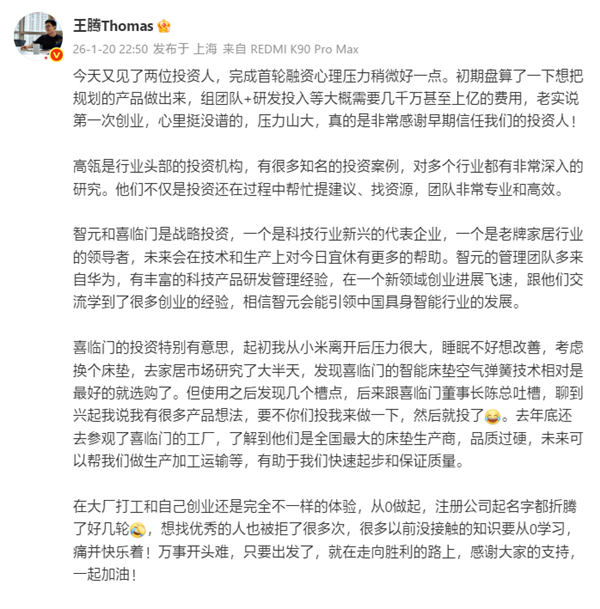
王腾称创业压力山大:更理解雷总的勇气了
Xin Lang Cai Jing· 2026-01-21 10:30
Core Viewpoint - Wang Teng, former general manager of Xiaomi's China marketing and REDMI brand, has successfully established a new company named "Today Yixiu" and completed a seed round financing of several tens of millions, with investors including Hillhouse Capital, Zhiyuan Robotics, and Xilinmen [1][11]. Group 1 - The initial financing has alleviated some psychological pressure for Wang Teng [1][11]. - Wang Teng expressed gratitude towards early investors for their trust in his first entrepreneurial venture, acknowledging the significant pressure he feels [2][12]. - The core team of "Today Yixiu" consists of members from Xiaomi, Huawei, and other tech companies, focusing on developing sleep health-related products [5][15]. Group 2 - Wang Teng indicated that product development is progressing slowly, with a planned product launch event expected in the second half of the year [6][16]. - Initial estimates for product development, team formation, and research investment range from several tens of millions to over one hundred million [6][16]. - The new products are expected to integrate with the Xiaomi ecosystem, potentially including smart pillows, smart headphones, smart wristbands, and multifunctional sensors, which can interact with various Xiaomi smart home devices to enhance sleep quality [7][16].


融资数千万仍觉得没谱?王腾:创业后才懂雷军有多牛
Sou Hu Cai Jing· 2026-01-21 04:00
Core Insights - The article discusses the launch of a new company "Today Sleep" by Wang Teng, who completed a seed round financing of several tens of millions within just 12 days of founding the company [2][3] - The investment round was led by Hillhouse Capital, with participation from institutions like Zhiyuan Robotics and Xilinmen, indicating a strong backing for the startup [3] - Wang Teng's previous experience at Xiaomi and Huawei, along with a focus on the sleep technology market, positions the company well for growth in a sector projected to reach $27.46 billion by 2025 and exceed $100 billion by 2033, with a compound annual growth rate of nearly 18% [7] Company Overview - Wang Teng's team consists of veterans from Xiaomi and Huawei, bringing significant hardware and software development experience to the startup [7] - The company aims to develop sleep technology products, potentially including smart pillows, smart headphones, and smart wristbands, which will integrate with Xiaomi's ecosystem [9] - The new products are expected to utilize sensors and AI models to adjust the sleep environment based on human data, enhancing user experience [9] Market Context - The sleep technology market is characterized as a blue ocean, indicating ample opportunities for innovation and growth due to increasing sleep disorders among modern individuals [7] - The collaboration with established players like Hillhouse and Xilinmen provides a robust resource network for rapid startup development, including access to production capabilities [7][10] - Wang Teng's entrepreneurial journey reflects a significant transition from a corporate environment to startup challenges, highlighting the pressures and responsibilities of leading a new venture [4][10]

AI初创公司掀起“听觉革命”浪潮
Ke Ji Ri Bao· 2026-01-14 01:17
Core Insights - The article discusses the emergence of smart headphones as a strategic interface for artificial intelligence (AI), moving beyond traditional uses to become multifunctional devices capable of translation, recording, and even brain signal interpretation [1]. Group 1: Evolution of Smart Headphones - Ten years ago, companies like Waverly Labs and Maimanu introduced real-time translation capabilities in headphones, transforming them from passive audio devices to active communication tools [2]. - Google launched a voice-activated AI assistant in 2020, furthering the smart capabilities of headphones, while Apple and Samsung focused on noise-cancellation technology to enhance audio experiences [2]. - Startups like OSO and Future Intelligence are innovating with features such as meeting recording, speaker identification, and cross-platform compatibility, making AI accessible to a broader audience [2]. Group 2: Advancements in Neural Perception - The next generation of smart headphones is moving towards neural perception, with companies like Naqi Logix developing devices that can interpret facial muscle signals to control technology [3]. - Neurable's MW75 Neuro LT headset aims to facilitate communication through thought by monitoring brain activity, representing a significant leap in user interaction [3]. Group 3: Advantages and Limitations - Supporters argue that headphones have inherent advantages such as affordability, portability, and the ability to continuously collect biometric data, making them ideal for creating personal digital twins [4]. - However, challenges remain, including limited usage scenarios, a lack of visual interaction capabilities, and concerns over privacy and data security [5].
曾以“价格免谈、关税也免谈”硬刚美国客户,67岁“亚洲笔王”:明年要在发展中国家市场跑马圈地,还要做AI生意
Mei Ri Jing Ji Xin Wen· 2025-12-30 13:20
Core Viewpoint - The chairman of Beifa Group, Qiu Zhiming, emphasizes the theme of "change" for 2025, highlighting the rapid shifts in global trade dynamics, intensifying competition in traditional industries, and the acceleration of AI and digital technology development [1][7]. Group 1: Company Strategy and Market Position - Beifa Group holds a 16.5% share of China's pen export market, reaching over 1.7 billion people globally [1]. - The company is adapting to international trade challenges, particularly the U.S. tariffs, by enhancing its operational agility and preparing for potential future trade conflicts [6][16]. - Beifa plans to expand its AI product line and aims to establish 30 national flagship stores, 300 city-level stores, and 3,000 county-level stores within three years [5][22]. Group 2: Customer Dynamics and Market Segmentation - U.S. customers are categorized into three types: politically driven clients, value-driven clients, and innovation-driven clients, each responding differently to trade dynamics and tariffs [7][8][10]. - The company recognizes the necessity for Chinese manufacturers to adapt to diverse market needs across developed and developing countries, emphasizing the importance of building valuable channels and brands [12][14]. Group 3: International Expansion and Production Strategy - Beifa has established "outbound teams" targeting markets in Vietnam, Egypt, and Mexico, with a focus on expanding production capacity and adapting to local market conditions [13][15]. - The company is positioning Vietnam as a manufacturing hub to mitigate tariff risks and enhance supply chain capabilities [13][14]. Group 4: AI Product Development and Future Outlook - Beifa's AI product strategy has evolved to include communication, cultural creativity, health, and companionship, driven by the need for efficiency and improved user experience [18][22]. - The company has adopted a phased testing approach for AI products to minimize risks and ensure market readiness, with plans to launch over 50 related projects [21][22]. - Looking ahead to 2026, Beifa aims for strategic growth in traditional markets while aggressively expanding in developing countries, targeting a fivefold increase in those regions [23].
