
华安黄金易ETF

Search documents
FOF买手“变心”了!四季度重仓基金“清单”曝光,黄金不在头号,求稳成主旋律?
Sou Hu Cai Jing· 2026-01-29 03:44
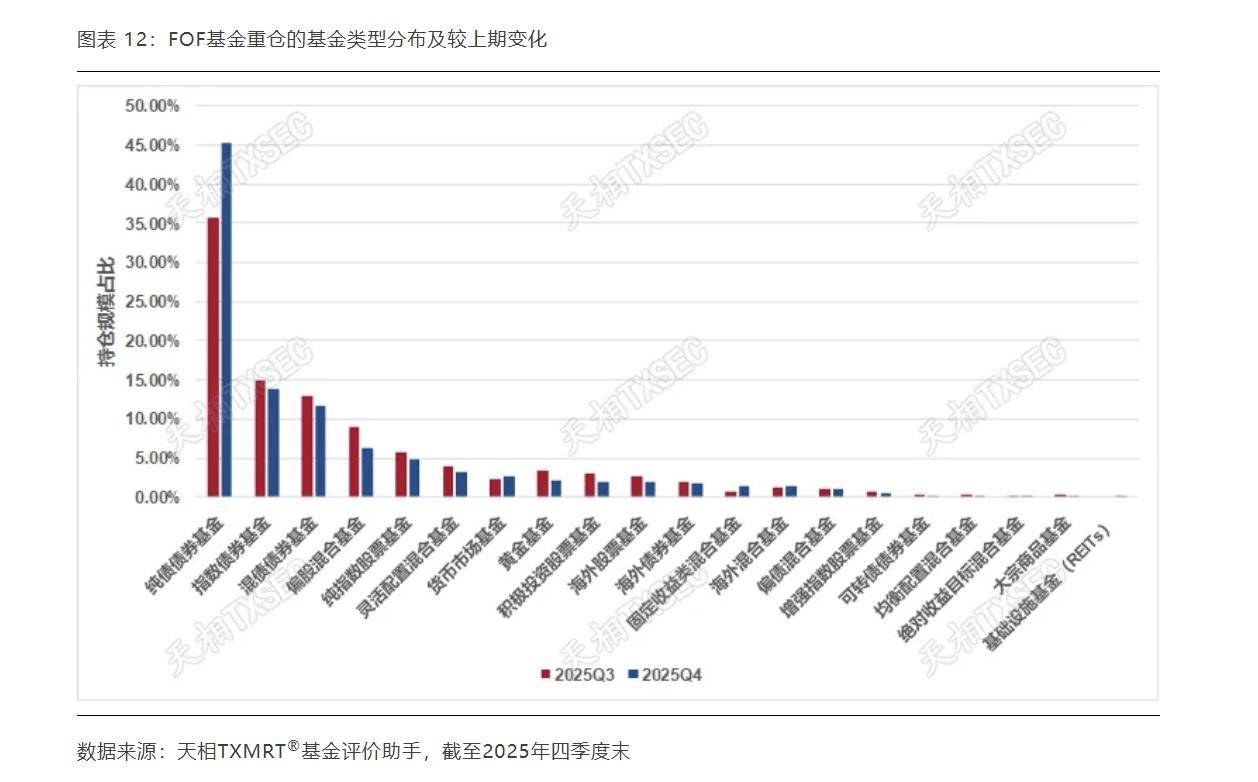
Core Insights - The FOF (Fund of Funds) managers have shown a significant shift in their investment preferences, with a clear trend towards risk aversion and stability for the fourth quarter of 2025 [1] - The total holdings in pure bond funds reached 56.52 billion yuan, accounting for 45.22% of all fund types, a notable increase from 35.64% in the previous quarter [1] - Conversely, the allocation to equity mixed funds decreased from 8.94% to 6.30%, marking the most significant decline among fund categories [1] Investment Preferences - The most favored product among FOF managers is the Hai Fu Tong Zhong Zheng Short Bond ETF, which has been held by 119 FOFs with a total market value of approximately 5.98 billion yuan [3] - Other notable bond ETFs in the top ten holdings include Peng Yang Zhong Dai-30 Year Treasury ETF, Ping An High-Grade Corporate Bond ETF, and Fu Guo Zhong Dai 7-10 Year Policy Financial Bond ETF, indicating a strong preference for bond instruments [3] - There has been a structural adjustment in attitudes towards gold-related assets, with traditional gold ETFs like Hua An Gold ETF seeing a decline in holdings, while ETFs tracking gold industry stocks have been increased [3] Performance Analysis - The average return for bond-type FOFs in the fourth quarter was 0.24%, while equity-type FOFs experienced an average decline of 2.48%, reflecting the performance alignment with their holding structures [4] - Notably, the CITIC Securities Rui Xuan 6-Month Holding Mixed FOF achieved a net value increase of 6.41%, leading the market, with significant allocations to gold ETFs and resource sector funds [5] - Similarly, the Qianhai Kaiyuan Yu Ze FOF also exceeded a 4% increase, with a focus on gold ETFs and sectors like communication equipment and brokerage [5]

腰部基金公司规模“突围”!“爆款基”密集现身
Zhong Guo Zheng Quan Bao· 2026-01-22 23:19
Group 1 - The total scale of public funds reached 37.26 trillion yuan by the end of Q4 2025, with a quarter-on-quarter increase of over 1.3 trillion yuan [2] - The largest growth came from money market funds, which increased by 571.93 billion yuan, followed by bond funds with an increase of 446.94 billion yuan, and stock funds with an increase of 155.08 billion yuan [2] - The top two fund companies by total management scale are E Fund and Huaxia Fund, each managing over 2 trillion yuan, while eight other companies manage over 1 trillion yuan [2] Group 2 - The largest increase in non-money management scale was seen in Guotai Fund, which grew by 62 billion yuan, followed by Invesco Great Wall Fund with a growth of 53.12 billion yuan [3] - Several large fund companies experienced significant growth, with notable products contributing over 20 billion yuan in scale increase, such as the Huaxia CSI 500 ETF and the Invesco Great Wall Jing Sheng Dual Income Bond [3] - Mid-sized fund companies showed considerable changes, with several becoming "dark horses" in Q4 2025, such as Changcheng Fund and Dongcai Fund, which saw increases of over 20 billion yuan [4] Group 3 - Smaller fund companies like Shanzheng Asset Management and Huayin Fund also reported substantial growth in non-money management scale in Q4 2025 [4] - The rebranding of Beixin Ruifeng Fund to Huayin Fund led to a rapid increase in scale, reaching 26.75 billion yuan with a growth of 6.1 billion yuan [4] - Notable products from smaller firms, such as the Debon Xin Xing Value Fund, contributed significantly to their growth [4]
公募基金规模环比大增 腰部机构黑马频现
Zhong Guo Zheng Quan Bao· 2026-01-22 22:42
Core Insights - The public fund management scale increased by over 1.3 trillion yuan in Q4 2025, driven mainly by money market funds, bond funds, commodity funds, and index funds [1][2] Group 1: Fund Management Scale - As of the end of Q4 2025, the total scale of public funds reached 37.26 trillion yuan, with significant contributions from various fund types: stock funds at 5.997 trillion yuan, mixed funds at 3.769 trillion yuan, bond funds at 10.907 trillion yuan, money market funds at 14.969 trillion yuan, overseas investment funds at 0.971 trillion yuan, commodity funds at 0.04268 trillion yuan, fund of funds (FOF) at 0.02188 trillion yuan, and other funds at 0.0001367 trillion yuan [2] - The largest growth in scale was seen in money market funds, which increased by 571.93 billion yuan, followed by bond funds with an increase of 446.94 billion yuan, and stock funds with an increase of 155.08 billion yuan, primarily from index stock funds [2] Group 2: Competitive Landscape - The top two fund companies, E Fund and Huaxia Fund, each managed over 2 trillion yuan, while eight other companies managed over 1 trillion yuan [3] - Among the top twenty fund companies by non-money management scale, most experienced growth in Q4 2025, with Guotai Fund leading the increase at 62 billion yuan, followed by Invesco Great Wall Fund at 53.11 billion yuan [3][4] Group 3: Emerging Players - The mid-tier fund companies saw significant changes, with several emerging as "dark horses" in Q4 2025, such as Changcheng Fund with over 20 billion yuan growth, and Dongcai Fund, Zhongjia Fund, Guotai Haitong Asset Management, Morgan Fund, and Rongtong Fund each growing by over 15 billion yuan [5] - Notably, Dongcai Fund's growth was driven by its bond fund, while Morgan Fund's growth was attributed to its index funds [5][6] Group 4: Small Fund Companies - Smaller public fund institutions like Shanzheng Asset Management, Huayin Fund, and Debang Fund also saw substantial growth in their non-money management scales [6] - Huayin Fund, after rebranding from Beixin Ruifeng Fund, achieved a scale of 26.753 billion yuan, with a significant contribution from a single product [6]
公募基金规模环比大增腰部机构黑马频现
Zhong Guo Zheng Quan Bao· 2026-01-22 20:56
Core Insights - The public fund management scale increased by over 1.3 trillion yuan in Q4 2025, driven primarily by money market funds, bond funds, commodity funds, and index funds [1][2] Fund Scale Growth - As of the end of Q4 2025, the total scale of public funds reached 37.26 trillion yuan, with significant contributions from various fund types: stock funds at 5.997 trillion yuan, mixed funds at 3.769 trillion yuan, bond funds at 10.907 trillion yuan, money market funds at 14.969 trillion yuan, overseas investment funds at 0.971 trillion yuan, commodity funds at 0.043 trillion yuan, fund of funds (FOF) at 0.022 trillion yuan, and other funds at 0.0000137 trillion yuan [1][2] - The largest growth was seen in money market funds, which increased by 571.93 billion yuan, followed by bond funds with an increase of 446.94 billion yuan, and stock funds with an increase of 155.08 billion yuan, primarily from index stock funds [2] Competitive Landscape - The top two fund companies, E Fund and Huaxia Fund, both managed over 2 trillion yuan, while eight other companies, including GF Fund and Southern Fund, managed over 1 trillion yuan [2] - The top twenty fund companies in non-money management scale saw most companies achieve growth, with Guotai Fund leading with an increase of 62 billion yuan, followed by Invesco Great Wall Fund with an increase of 53.12 billion yuan [3] Emerging Players - The mid-tier fund companies experienced significant changes, with several emerging as "dark horses" in Q4 2025, such as Changcheng Fund, which grew by over 20 billion yuan, and Dongcai Fund, among others, which saw increases exceeding 15 billion yuan [3][4] - Notably, Dongcai Fund's growth was primarily driven by its bond fund, while Morgan Fund's growth stemmed from its index funds [4] Small Fund Institutions - Smaller public fund institutions, including Shanzheng Asset Management and Huayin Fund, also experienced substantial growth in non-money management scale [4] - After rebranding, Beixin Ruifeng Fund, now known as Huayin Fund, saw rapid growth, reaching a non-money management scale of 26.75 billion yuan, with a significant contribution from a single product [4]
2.6万亿元! 公募去年整体盈利,宽基ETF表现抢眼
Shang Hai Zheng Quan Bao· 2026-01-22 18:37
Group 1 - The core viewpoint of the articles highlights that despite a loss of 110.1 billion yuan in Q4 2025 for public funds, the overall annual profit exceeded 2.6 trillion yuan, indicating a strong performance in equity assets throughout the year [1][2] - In Q4 2025, mixed and stock funds collectively lost over 180 billion yuan, while QDII funds lost 71.047 billion yuan, and public FOFs had a slight loss of 213 million yuan [1] - Fixed income products emerged as the main profit contributors in Q4 2025, with bond products earning 57.725 billion yuan, money market funds earning 44.18 billion yuan, and commodity funds profiting 39.266 billion yuan [1] Group 2 - For the entire year of 2025, all types of public funds achieved profitability, with mixed and stock funds collectively earning nearly 2 trillion yuan, showcasing the characteristics of a strong equity year [2] - The top 10 profitable fund products in Q4 were predominantly gold ETFs and related funds, with six gold ETFs making the list, indicating a significant shift in capital market dynamics [2] - The Huatai-PB CSI 300 ETF was the standout performer, earning 78.516 billion yuan, making it the only product to exceed 70 billion yuan in profit [3]
行业竞争激烈 黄金类ETF产品不断优化
Shang Hai Zheng Quan Bao· 2026-01-18 18:40
Core Viewpoint - The gold market is experiencing significant growth, leading to an increase in the scale of related ETFs, with competition among similar products intensifying [1][3]. Group 1: ETF Adjustments - E Fund announced adjustments to its gold ETF, reducing the minimum subscription and redemption units from 300,000 shares to 100,000 shares, and the minimum gold contract from 3,000 grams to 1,000 grams, effective January 19, 2026 [2]. - The ETF will only accept the Au99.99 spot contract from the Shanghai Gold Exchange for physical transactions, enhancing liquidity and execution efficiency [2]. Group 2: Market Competition - The net subscription volume for gold ETFs reached nearly 20 billion shares in 2025, with the Huazhong Gold ETF surpassing 100 billion yuan in scale by January 15, 2026 [3]. - Fund companies are accelerating product optimization, as seen with the Huazhong CSI Hong Kong Gold Industry ETF, which revised its dividend policy to enhance flexibility in profit distribution [3]. Group 3: Industry Dynamics - The gold ETF market is dominated by five major fund companies: Huazhong, E Fund, Bosera, Guotai, and Huaxia, indicating a "Matthew Effect" where the strong continue to grow stronger [4]. - The demand for gold as an asset class is expected to drive long-term growth in gold ETFs, necessitating continuous product optimization by fund companies to enhance competitiveness [4].
黄金多空分歧加剧
Xin Lang Cai Jing· 2025-12-03 06:08
Core Viewpoint - The divergence between bullish and bearish sentiments in the gold market is becoming more pronounced, with investors facing a critical decision on whether to sell or hold their positions as gold prices fluctuate above $4200 per ounce [2][10]. Group 1: Market Dynamics - In November, the trading volume of gold ETFs exceeded 203 billion yuan, indicating a relatively high level of activity despite being lower than the previous month during significant market volatility [2][10]. - The ongoing battle between bullish and bearish investors is intensifying as gold prices experience increased volatility [2][10]. Group 2: Bearish Sentiment - Historical trends show that gold prices do not only rise; there have been significant declines in the past, particularly during a 20-year bear market from 1980 to 2000 when many central banks sold off gold [11][12]. - Recent actions by central banks, such as the Philippines and Russia selling gold, are seen as significant signals that may indicate a shift in market dynamics [12][13]. - Some investors express caution, recalling past experiences of being trapped in gold investments for years, leading them to sell their holdings amid fears of a potential price bubble [13]. Group 3: Bullish Sentiment - Despite short-term caution, bullish investors maintain that the long-term outlook for gold remains positive, with significant net purchases in gold ETFs, totaling over 2 billion shares in November [14][15]. - The perception of gold as a strategic reserve is contrasted with the view that some countries, like the Philippines, treat gold as a trading tool, while others, like Russia, sell gold to meet budgetary needs [14][15]. - Analysts from various fund companies express optimism about gold's long-term value, citing geopolitical risks and the current monetary policy environment as supportive factors for gold investments [15].
黄金类ETF连续反弹4000美元关口资金逢低流入
Shang Hai Zheng Quan Bao· 2025-11-09 17:28
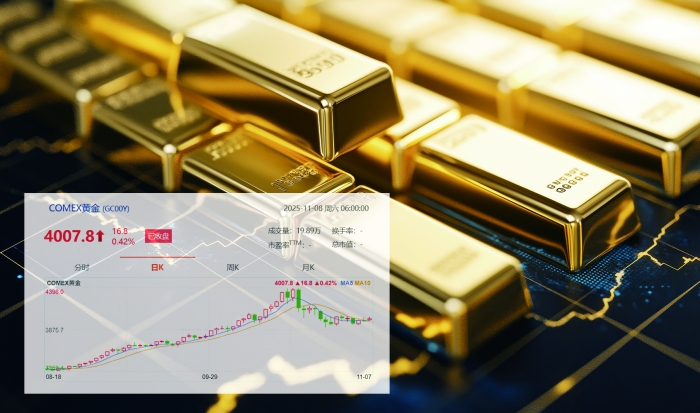
Core Viewpoint - The recent adjustments in gold and gold stocks are primarily due to a temporary easing of risk aversion, leading to some profit-taking, but the long-term bullish logic for gold remains unchanged [2][4] Group 1: Market Performance - After a significant rise since August, COMEX gold peaked at $4,398 per ounce in late October and has since consolidated around the $4,000 mark, closing at $4,007.8 on November 7, with a slight increase of 0.42% [2] - As of November 7, domestic gold ETFs have seen a total net subscription of 27.3 million shares in November, with the largest being Huaan Gold ETF, which gained 6.97 million shares [3] Group 2: Investment Trends - Several funds have begun recommending gold ETFs, with a notable allocation of 15% to Huaan Gold ETF by a wealth management product, reflecting a strategic shift towards gold amid increased market volatility [4] - The fund managers believe that the recent gold price adjustments are indicative of a temporary easing of geopolitical risks, and they anticipate a new cycle for gold driven by its monetary attributes in response to dollar credit issues [4] Group 3: Tax Implications and Investment Strategy - The recent tax changes on gold do not directly affect gold prices but increase the transaction costs for physical gold, while gold ETFs remain unaffected as they do not involve physical delivery [5] - It is recommended to adopt a dollar-cost averaging strategy for long-term investments in gold ETFs, with a suggested allocation of 5% to 15% of total assets [5]
黄金4000美元徘徊!资金还在流入
Shang Hai Zheng Quan Bao· 2025-11-09 04:37
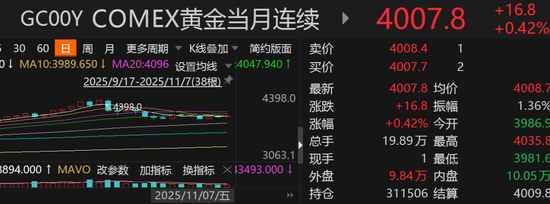
Core Viewpoint - The recent fluctuations in gold prices, particularly around the $4000 per ounce mark, have raised questions about its investment value, with a notable increase in inflows into gold ETFs despite recent price corrections [3][5]. Group 1: Gold Price Movements - After reaching a new high of $4398 per ounce in late October, COMEX gold has since corrected and is currently stabilizing around $4000 per ounce, with a slight increase of 0.42% to $4007.8 per ounce on November 7 [1]. - The total net subscription for gold ETFs has reached approximately 273 million shares since the beginning of November, indicating strong investor interest [4]. Group 2: Fund Inflows and Performance - Several gold ETFs have experienced a rebound, with some products seeing a cumulative increase of over 3% from November 5 to November 7, 2023 [4]. - The largest domestic gold ETF, Huaan Gold ETF, has seen a net subscription of 69.7 million shares, while another ETF, Huaxia Gold ETF, followed closely with 67 million shares [4]. Group 3: Investment Strategies and Outlook - Fund managers suggest that the recent adjustments in gold prices are primarily due to a temporary easing of risk aversion, but the long-term investment logic for gold remains intact [5]. - The ongoing trend of de-dollarization and potential interest rate cuts by the Federal Reserve are expected to support gold's long-term performance, with recommendations for investors to consider a systematic investment approach in gold ETFs, maintaining a portfolio allocation of 5% to 15% [5][6].
黄金“变盘” 机构研判后市投资节奏
Shang Hai Zheng Quan Bao· 2025-10-22 18:10
Core Viewpoint - Recent adjustments in gold prices follow a significant surge, with a notable decline of over 6% in COMEX gold futures from October 21 to 22, indicating a need for cautious short-term investment strategies while long-term value remains intact [1][3] Price Movement - COMEX gold futures reached a historical high of $4,398 per ounce before experiencing a sharp decline, with a single-day drop exceeding 5% on October 21, and prices falling below $4,090 per ounce by October 22 [1] - On the same day, the Shanghai Gold Exchange saw AU9999 drop to a low of 932 CNY per gram, closing at 951.41 CNY per gram [1] ETF Impact - The decline in gold prices led to significant drops in several gold ETFs, including the CCB Shanghai Gold ETF, E Fund Gold ETF, and Huaan Gold ETF, all of which fell by over 4% on October 22 [1] Market Analysis - Analysts attribute the recent price adjustments to geopolitical developments that have increased market risk appetite, leading to a temporary decline in safe-haven demand [1][2] - The rapid increase in gold prices had previously heightened market congestion, prompting strong profit-taking among investors, compounded by increased margin requirements from domestic and international futures exchanges [2] Long-term Outlook - Multiple institutions suggest that while short-term fluctuations in gold prices may occur, the long-term fundamental factors supporting gold's value remain unchanged, indicating potential upward movement in prices [3] - Investment strategies may involve gradually entering the market during price dips, as potential buying interest could limit further declines [3]