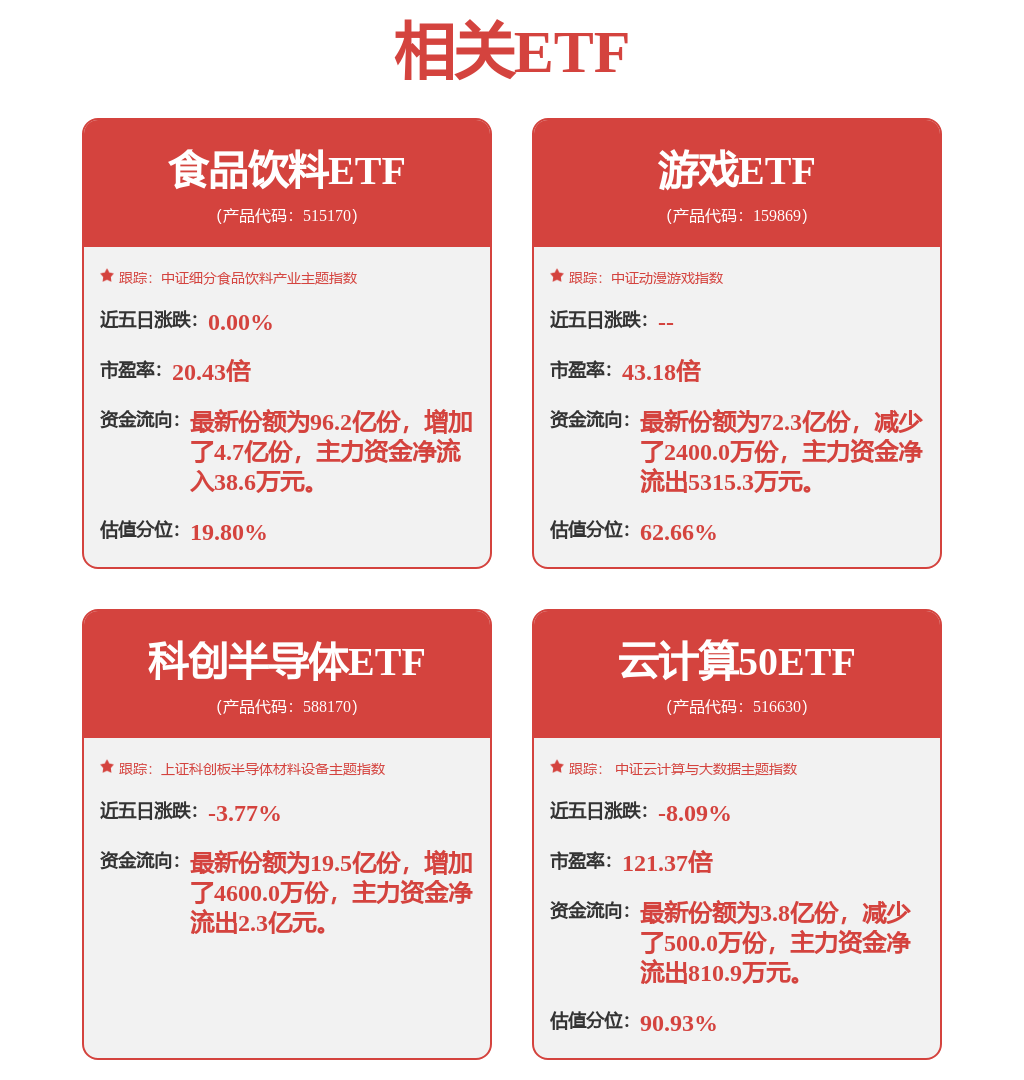
卫星互联网终端

Search documents
启动报名|3/12-13 上海「聚链成势·智启未来」智能终端产业链创新峰会正式官宣
CINNO Research· 2026-02-26 23:07
Core Viewpoint - The article emphasizes the profound adjustment in the global industrial landscape, driven by de-globalization and complex geopolitical relationships, presenting both challenges and strategic transformation opportunities for Chinese companies in the smart terminal industry [2]. Group 1: Event Overview - AWE2026, one of the most influential exhibitions in the global home appliance and consumer electronics sector, will be held in Shanghai, adopting a "one exhibition, two zones" model [3][15]. - The total exhibition area for AWE2026 will reach 170,000 square meters, attracting over 1,200 top domestic and international companies to showcase innovations in technology and smart products [15]. Group 2: Summit Focus - The summit will cover the entire smart terminal industry chain, focusing on macro guidance, technology-driven discussions, market foresight, and core supply chain localization processes [4][5][6]. - Key topics include interpreting national industrial development policies, exploring how AI and other cutting-edge technologies reshape the consumer electronics industry, and identifying new growth opportunities in global markets [4][5][6]. Group 3: Exhibition Zones - The Shanghai New International Expo Center will serve as the core exhibition area, focusing on smart home, AI appliances, and health technology, showcasing innovations from over 1,000 domestic and international brands [18]. - The Shanghai Oriental Hub International Business Cooperation Zone will highlight advanced technologies in consumer electronics, including AI smartphones, humanoid robots, and low-altitude economy products [20]. Group 4: Consumer Engagement Activities - AWE2026 will host various consumer engagement activities, including the "AWE Renewal Consumption Festival," which aims to convert innovative results into market consumption momentum, with last year's event driving appliance sales exceeding 2 billion yuan [24]. - The event will also feature live streaming sessions to enhance consumer interaction and showcase new products, with expectations to surpass last year's sales of over 1 billion yuan during the live streaming nights [24]. Group 5: Forums and Discussions - AWE2026 will feature a record number of high-level forums and activities, focusing on topics such as industry upgrades, new consumption trends, and the integration of AI in household services [28][29]. - The event aims to solidify its position as a global benchmark for smart living and foster strong momentum for global technological cooperation and economic development [29].


盛洋科技:公司于2026年1月公告的CANAL+项目进展顺利,预计将于5月前完成交付
Zheng Quan Ri Bao Zhi Sheng· 2026-02-25 11:13
Core Viewpoint - The company is making steady progress on the CANAL+ project, with expectations to complete delivery by May 2026, and is currently in the small-batch trial production phase for three satellite internet terminals [1] Group 1: Project Progress - The CANAL+ project is advancing as planned, with an announcement expected in January 2026 [1] - Delivery is anticipated to be completed before May, aligning with project acceptance schedules [1] Group 2: Production and Capacity - Three satellite internet terminals have entered small-batch trial production [1] - Production capacity will be dynamically adjusted based on customer validation progress and order demand [1] Group 3: Market Expansion - The company plans to advance mass production and large-scale delivery in coordination with cooperation progress in regions such as South America, Europe, and Africa [1]

盛洋科技(603703.SH):目前三款卫星互联网终端已进入小批量试生产阶段
Ge Long Hui· 2026-02-25 07:48
Core Viewpoint - The company is making steady progress on the CANAL+ project, with expectations to complete delivery by May 2026 [1] Group 1: Project Progress - The CANAL+ project is advancing as planned, with the company announcing successful progress on January 2026 [1] - Three satellite internet terminals have entered small-batch trial production, with production capacity to be adjusted dynamically based on customer validation and order demand [1] - The delivery schedule will align with project acceptance arrangements [1] Group 2: Future Plans - The company will continue to advance mass production and large-scale delivery in coordination with cooperation progress in regions such as South America, Europe, and Africa [1]
盛洋科技:目前三款卫星互联网终端已进入小批量试生产阶段
Ge Long Hui· 2026-02-25 07:47
Core Viewpoint - The company is making steady progress on the CANAL+ project, with expectations to complete delivery by May 2026 [1] Group 1: Project Progress - The CANAL+ project is advancing as planned, with the company announcing successful progress on January 2026 [1] - Three satellite internet terminals have entered small-scale trial production, with production capacity to be adjusted based on customer validation and order demand [1] - The delivery schedule will align with project acceptance arrangements [1] Group 2: Future Plans - The company will continue to advance mass production and large-scale delivery in coordination with cooperation progress in regions such as South America, Europe, and Africa [1]
盛洋科技:公司目前尚未与SpaceX开展合作
Zheng Quan Ri Bao Wang· 2026-01-19 13:43
Core Viewpoint - The company, Shengyang Technology, has confirmed that its subsidiary FTA's satellite internet terminal has the technical capability for multi-path reception, theoretically compatible with systems like Starlink, but currently has no collaboration with SpaceX [1] Group 1 - The satellite internet terminal developed by FTA can theoretically adapt to systems such as Starlink [1] - There is currently no partnership between the company and SpaceX [1] - The satellite resources provided by the telecom service partners do not include Starlink [1] Group 2 - The company will disclose any relevant developments in accordance with regulations [1]
盛洋科技卫星通信业务多点突破:FTA中标CANAL+GROUP项目,南美合作稳步推进
Zheng Quan Shi Bao Wang· 2026-01-06 06:28
Core Viewpoint - The company, Shengyang Technology, has successfully won a procurement project for satellite signal receiving equipment from CANAL+GROUP, valued at approximately $5.2 million, which will support global satellite internet construction and is expected to be delivered by May 2026 [1] Group 1: Company Developments - Shengyang Technology's subsidiary, FTA Communication Technologies, has established strategic partnerships with major global players in the satellite communication sector, including Eutelsat and another leading satellite operator, enhancing its international market presence [2] - FTA's proprietary DVB-NIP technology, which integrates satellite and IP technologies, is a key driver for these international collaborations, enabling diverse applications such as remote education and emergency communication [2][3] - The company is progressing steadily with its South America project, focusing on software licensing and customized development, while planning to expand terminal coverage in collaboration with local operators [3] Group 2: Product and Market Strategy - Shengyang Technology is implementing a "dual-line parallel" strategy, enhancing international cooperation while also focusing on domestic market opportunities, including the production of 5G satellite television terminals [4] - The company has plans to develop low Earth orbit satellite communication terminals, with a focus on flat antennas and portable terminals, aiming for a product launch by 2027 [4] - The satellite internet terminal market is expanding due to ongoing national policies and global networking efforts, positioning Shengyang Technology to capitalize on this growth and establish a second growth curve for the company [5]
10月盘点:成都重要投融资事件及产业环境数据汇总
Sou Hu Cai Jing· 2025-11-04 09:52
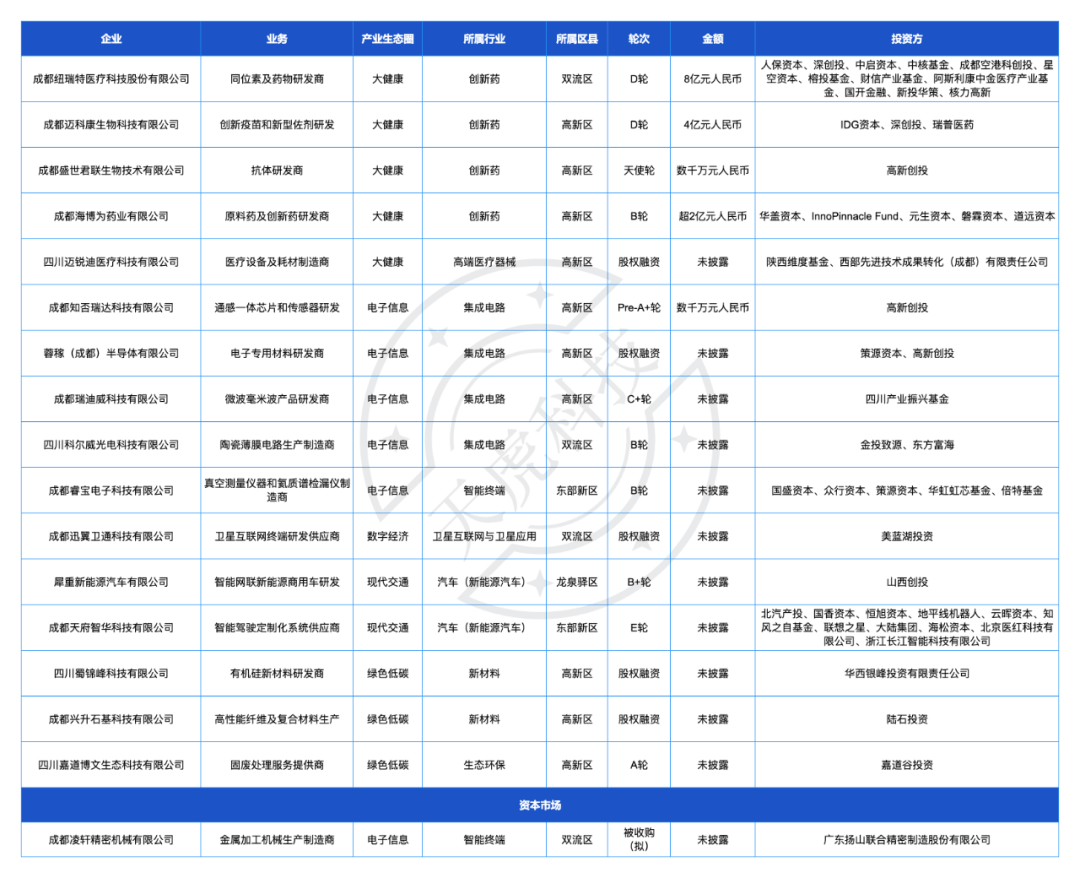
Core Insights - In October, Tianhu Technology recorded 17 investment events related to technology innovation and entrepreneurship in Chengdu, indicating a vibrant investment landscape in the region [1] Investment Events Summary - Chengdu Nuowei Medical Technology Co., Ltd. completed a D round financing of approximately 800 million RMB, with investors including Shenchuang Capital and others [2][11] - Chengdu Maikang Biological Technology Co., Ltd. raised over 400 million RMB in D round financing, supported by IDG Capital and others [2][12] - Chengdu Shengshi Junlian Biotechnology Co., Ltd. completed an angel round financing of several million RMB, with investment from High-tech Venture Capital [2][13] - Chengdu Haibo Pharmaceutical Co., Ltd. secured over 200 million RMB in B round financing, led by Huagai Capital [2][14] - Sichuan Mairedi Medical Technology Co., Ltd. completed equity financing, with undisclosed amounts, focusing on medical devices and consumables [2][15] - Chengdu Zhifang Ruida Technology Co., Ltd. completed Pre-A+ round financing, with several million RMB raised from High-tech Venture Capital [2][5] - Guanjia (Chengdu) Semiconductor Co., Ltd. completed seed round financing, with undisclosed amounts, focusing on semiconductor materials [2][6] - Sichuan Keerwei Optoelectronic Technology Co., Ltd. completed B round financing, with undisclosed amounts, specializing in ceramic film circuits [2][7] - Chengdu Ruidiwei Technology Co., Ltd. completed C+ round financing, with funds aimed at R&D and market expansion [2][8] - Chengdu Rui Bao Electronic Technology Co., Ltd. completed B round financing, focusing on vacuum measurement instruments [2][9] - Chengdu Xunyi Weitong Technology Co., Ltd. completed equity financing, focusing on satellite internet terminals [2][10] - Xizhong New Energy Automobile Co., Ltd. completed B+ round financing, focusing on smart connected new energy commercial vehicles [2][19] - Chengdu Tianfu Zhihua Technology Co., Ltd. completed E round financing, focusing on intelligent driving systems [2][20] Industry Distribution - The health sector and electronic information sector emerged as the hottest investment areas in Chengdu, with 29.4% of the 17 projects related to these industries [4] - The majority of financing events were in the B round stage, indicating a trend towards more mature investment opportunities [3]
放大招!上海AI终端政策落地
Guo Ji Jin Rong Bao· 2025-10-15 11:16
Core Insights - Shanghai aims to strengthen its smart terminal industry, targeting a total scale exceeding 300 billion yuan by 2027, with the goal of establishing over three globally influential consumer terminal brands and nurturing two leading enterprises [1] Group 1: Smart Terminal Development - The action plan includes ten initiatives focusing on artificial intelligence computers, AI smartphones, robotic terminal capabilities, smart glasses, and satellite internet terminal products [2][3] - Shanghai plans to cultivate leading brands in AI computers and establish production bases with an annual capacity of ten million units, transitioning traditional computer production to AI computers [2] - The initiative emphasizes the development of AI smartphones to fill existing gaps in Shanghai's smartphone production capabilities [3] Group 2: Robotics and Smart Glasses - The plan aims to create humanoid robots with advanced capabilities, supporting R&D and mass production of these products while enhancing the industrial robot sector [3] - Shanghai will accelerate the development of smart glasses, focusing on AR, MR, and VR technologies, and aims to establish a complete product matrix for various market segments [3] Group 3: Satellite Internet and Elderly Care - The action plan includes the establishment of a satellite terminal production line, targeting a production scale of 100,000 units and fostering the development of supporting industries [4] - Shanghai will support the development of innovative products for the elderly, such as AI hearing aids and smart assistive devices, enhancing the functionality of smart terminals [4] Group 4: Industrial Applications - The plan encourages the development of industrial terminal products that align with advanced AI technology trends, aiming to transform production models and improve efficiency in smart factories [5] Group 5: Key Technology Development - The action plan outlines five initiatives to strengthen key technologies, including enhancing AI chip layouts and promoting next-generation display technologies [6][7] - Shanghai will focus on lightweight, low-power, high-resolution display technologies, supporting innovations in Micro LED and OLED technologies [7] Group 6: Industry Ecosystem Optimization - The plan proposes five measures to optimize the industry ecosystem, including financial support for key components and services related to smart terminals [8] - Shanghai will leverage various funding mechanisms to support terminal enterprises and encourage mergers and acquisitions in the sector [8] Group 7: Application Promotion - The initiative will support the integration of smart terminal products in various sectors such as industry, education, and healthcare, promoting innovative applications [9] - Shanghai aims to develop key areas like Pudong and Songjiang into industrial clusters for smart terminals, fostering competitive enterprises and innovation [9]

刚刚 利好来了!
Zhong Guo Ji Jin Bao· 2025-10-14 14:50
Core Viewpoint - The Shanghai Municipal Economic and Information Commission has issued the "Shanghai Intelligent Terminal Industry High-Quality Development Action Plan (2026-2027)", aiming to enhance the city's intelligent terminal industry, targeting a total scale exceeding 300 billion yuan by 2027 and establishing over three globally influential consumer terminal brands [1][17]. Group 1: Key Product Development Actions - Promote the rapid development of artificial intelligence computers, aiming for an annual production capacity of 10 million units and a complete transition from traditional computers to AI computers [3][18]. - Develop artificial intelligence smartphone products to fill the production capacity gap in the city, focusing on AI-enabled interaction methods and real-time scene understanding [3][18]. - Enhance the scale of intelligent computing terminals by accelerating the deployment of edge computing integrated machines and developing lightweight inference products [4][18]. - Strengthen the capabilities of humanoid robots, supporting R&D and mass production of products with emotional intelligence and skills [5][19]. - Support the advancement of smart glasses, focusing on AR, MR, and VR products, and creating a complete product matrix for various market segments [6][20]. - Cultivate satellite internet terminal products to meet low-orbit satellite constellation deployment needs, aiming for a production scale of 100,000 satellite terminals [7][20]. - Stimulate the silver economy by supporting the development of AI hearing aids, autonomous wheelchairs, and other innovative products for the elderly [8][20]. - Launch industrial terminal products that adapt to advanced AI technology trends, promoting smart factory transformations [9][20]. - Accelerate the R&D of future terminals, focusing on next-generation mobile communication and quantum computing technologies [10][20]. - Innovate new consumer terminal products, including smart vehicle terminals, wearables, and smart home devices [11][21]. Group 2: Key Technology Foundations - Strengthen the layout of edge AI chips, focusing on SoC and CPU development across major technology routes [12][22]. - Enhance the performance of edge models, supporting the development of competitive edge model products [14][22]. - Promote software and hardware collaborative innovation to improve the efficiency and energy efficiency of edge models [13][22]. - Reinforce intelligent module capabilities by integrating multi-modal sensing and developing edge computing modules [23][22]. - Advance next-generation display technologies, focusing on lightweight, low-power, and high-resolution innovations [15][24]. Group 3: Industry Ecosystem Optimization Actions - Enhance the competitiveness of Shanghai's intelligent terminal brands through targeted policies and support for brand operations [25][26]. - Build large-scale production bases for intelligent terminals, improving support for technological upgrades and smart factory initiatives [26][26]. - Accelerate the formation of industrial agglomeration effects by developing key areas for intelligent terminal industries [26][26]. - Increase financial support for the industry through investment funds and encourage participation from various enterprises [26][26]. - Promote the application and adoption of intelligent terminal products across various sectors, leveraging government procurement to drive innovation [26][26].
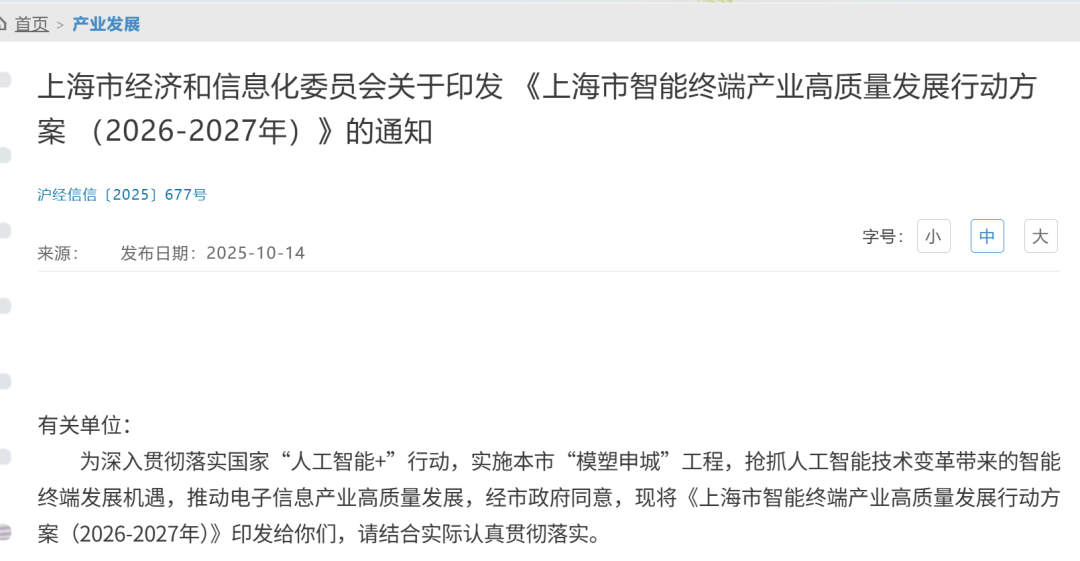
刚刚,利好来了!上海,重磅发布!
Zheng Quan Shi Bao Wang· 2025-10-14 11:45
Core Viewpoint - Shanghai's government has released the "Action Plan for High-Quality Development of the Intelligent Terminal Industry (2026-2027)", aiming to strengthen the intelligent terminal industry, targeting a scale exceeding 300 billion yuan by 2027 and fostering globally influential consumer terminal brands [1][2]. Group 1: Industry Development Goals - The plan aims for the intelligent terminal industry in Shanghai to exceed 300 billion yuan by 2027, with the establishment of over three globally influential consumer terminal brands and two leading enterprises [1][2]. - It targets the production of over 10 million units each for AI computers, AI smartphones, and AI new terminals [1][2]. Group 2: Key Product Development Initiatives - The plan emphasizes the acceleration of AI computer development, aiming to create a leading brand and a production base with an annual capacity of 10 million units [2][3]. - It includes the enhancement of intelligent computing terminal scales and the development of edge computing integrated machines to support various industries [2][3]. Group 3: Technological Advancements - The plan outlines the need to strengthen the layout of edge AI chips, focusing on core chips like SoC and CPU across major technology routes such as X86, ARM, and RISC-V [4][5]. - It promotes the development of multi-modal perception capabilities and the integration of various sensor data to enhance traditional terminal products' intelligence [5]. Group 4: Industrial Ecosystem Optimization - The plan highlights the importance of financial support for the industry, encouraging investment funds to back Shanghai's terminal enterprises and promoting mergers and acquisitions among quality firms [5]. - It aims to create industrial clusters by enhancing collaboration between districts and fostering competitive enterprises within the intelligent terminal supply chain [5].