合生汇

Search documents
从合生汇到缦云!合生创展凭“有内容”的打磨,霸榜商业与楼市双赛道
Guo Ji Jin Rong Bao· 2026-02-05 01:40
Core Insights - The article discusses the rise of the "Kaojiang" brand, a popular grilled fish restaurant, which gained significant attention through a social media voting campaign for its first store location in Shanghai [3][5] - The voting campaign saw a surprising turn of events as students from the Wujiaochang area rallied to support their local choice, leading to Wujiaochang winning the vote with over 50% [4][5] - The brand plans to expand beyond its original Sichuan-Chongqing region, with its first national store set to open in Beijing, aiming to tap into the northern market [6][8] Company Performance - On its opening day, the Kaojiang restaurant at the Beijing Chaoyang He Sheng Hui achieved a record of 2,000 tables in queue, with peak wait times during the National Day holiday reaching 2,894 [9] - The restaurant has consistently ranked high on popular food review platforms, maintaining its position for over 100 days [10] Market Dynamics - He Sheng Hui has emerged as a significant commercial IP, with the Beijing location projected to generate nearly 8.5 billion yuan in sales and attract over 41 million visitors, while the Shanghai location surpassed 6.6 billion yuan in sales with 39 million visitors [11] - The success of He Sheng Hui is attributed to its focus on "traffic operation + scene creation," emphasizing content-driven strategies and user engagement [12][14] Industry Trends - The article highlights a shift in commercial real estate towards creating vibrant, engaging spaces rather than traditional property leasing models, with a focus on catering to the needs of target consumer groups [12][15] - The He Sheng Hui projects are characterized by their unique offerings tailored to local demographics, such as young consumers and nearby residents [12][18] Financial Strategy - The company has successfully reduced its debt by approximately 44.9 billion HKD over three and a half years, allowing it to maintain its product philosophy and operational integrity [19][20] - This financial prudence has positioned the company to benefit from the recovery of the commercial real estate market, with its assets likely to be revalued positively [21]


告别高周转,房地产开始做起慢生意
Xi Niu Cai Jing· 2026-01-13 07:20
Core Viewpoint - The real estate industry in China is transitioning from a "high turnover" model characterized by rapid land acquisition and construction to a "slow business" model that emphasizes quality, operational resilience, and deep understanding of customer needs [2][3][12]. Group 1: Industry Transition - The industry is moving away from the "456" high turnover model, which relied on high leverage and rapid expansion, towards a long-term strategy focused on low leverage and operational excellence [3][12]. - By 2025, the real estate sector is expected to face a debt maturity of approximately 525.7 billion yuan, indicating a significant increase in financial pressure [3]. - The market is shifting from new development to stock competition, where the ability to manage projects throughout their lifecycle is becoming crucial [3][12]. Group 2: Characteristics of "Slow" Companies - "Slow" companies like Hejing Chuangzhan, Binhai Group, and Chenjia Development are emerging as benchmarks in the industry due to their careful financial strategies and focus on high-end products in core cities [2][9]. - These companies prioritize product quality and service over rapid expansion, leading to unique offerings that meet market demands [9][11]. - The operational strategies of these firms include localized product design and a focus on understanding the values of new-generation consumers [3][11]. Group 3: Financial Performance and Business Models - Hejing Chuangzhan's commercial segment is projected to contribute 2.2 billion HKD in revenue in the first half of 2025, accounting for over one-third of the company's total revenue [6]. - The company has successfully implemented a "light asset" model, with commercial project management accounting for over 70% of new projects in 2025 [6][11]. - The "Mian" brand of Hejing Chuangzhan has achieved a gross margin of 39% in the first half of 2025, surpassing the industry average, demonstrating the effectiveness of its operational strategies [10]. Group 4: Market Dynamics and Future Outlook - The industry is evolving towards a comprehensive model that balances development, operation, and service, moving beyond mere construction and sales [5][12]. - The focus on quality living and sustainable urban development is becoming increasingly important, aligning with the broader goal of enhancing the quality of life for residents [12][13]. - As the market transitions, companies that can provide high-quality living products and create long-term value in urban operations will be better positioned for success [17].
靠两张王牌,这家房企躲过了“斩杀线”
3 6 Ke· 2026-01-13 02:05
Core Insights - The real estate industry is facing significant challenges, with many companies experiencing a sharp decline in fortunes due to market cooling and high land acquisition costs, leading to a situation where selling properties results in losses while holding them leads to cash flow issues [1] - Successful real estate companies, particularly private enterprises, have managed to survive by minimizing errors and maintaining high-quality products, allowing them to generate cash flow even during market downturns [3][4] Group 1: Financial Challenges and Market Dynamics - The real estate sector has a fundamental flaw where properties cannot be produced on an order basis, requiring substantial upfront investment in land and construction before sales can occur, exposing risks only at the point of sale [3] - Companies that have survived the downturn typically possess strong product lines and have been able to sell properties regardless of market fluctuations, with examples like Luhuk and He Sheng demonstrating resilience [4][5] Group 2: Importance of Quality Products - High-quality products not only sell well but also help companies save costs, as evidenced by the rapid sales rates of successful projects like Luhuk and the consistent demand for He Sheng's products [6][7] - The speed of sales directly impacts financing costs, with quicker project turnover leading to significant savings in interest payments [5] Group 3: Strategic Adaptation and Business Models - Companies that have avoided the "slaughter line" share common traits, including a focus on financial discipline and strategic consistency, which have allowed them to navigate market fluctuations effectively [8] - Successful firms often develop secondary revenue streams through commercial operations and light asset businesses, providing a stable cash flow that supports their primary real estate activities [9][10] Group 4: Long-term Viability and Market Positioning - The current market environment necessitates a shift in strategy, where companies must focus on core competencies and profitable business lines to ensure long-term survival rather than rapid growth [12][15] - The industry's competitive landscape is tightening, emphasizing the importance of maintaining strong product offerings and operational efficiency to thrive in a contracting market [14][15]
环球房产周报:房地产融资协调机制调整,万科郁亮退休,多家房企发布2025年销售业绩……
Huan Qiu Wang· 2026-01-12 02:10
Policy News - The State Council held a meeting on January 9 to implement a package policy for fiscal and financial coordination to boost domestic demand, emphasizing the need to guide social capital in promoting consumption and expanding investment, particularly in supporting resident consumption upgrades and private investment development [1] - The People's Bank of China emphasized the continuation of moderately loose monetary policy during its 2026 work meeting, aiming to support stable growth in the real economy and financial market, while also addressing financial risks in key areas [1] - Recent adjustments to the real estate financing coordination mechanism allow projects on the "white list" to extend loans for up to five years, compared to the previous maximum of two and a half years [1] Market News - In 2025, the total land transfer fees for residential land in 300 cities decreased by 10.6% year-on-year, with a total of 2.3 trillion yuan, and the planned building area for residential land transactions fell by 13.5% to 620 million square meters [4] - The top 20 cities accounted for 52% of the national residential land transfer fees, indicating a concentration of land acquisition by major enterprises in core cities [4] Real Estate Company News - Vanke announced that Yu Liang has retired due to age, resigning from his positions as director and executive vice president, with no impact on the board's operation [8] - Country Garden's four bonds resumed trading on January 9 after early cash repayment was completed on December 26, 2025 [12] - Sunac China reported three new overdue debts totaling approximately 640 million yuan, with the main reasons being unpaid principal [13] - R&F Properties disclosed that as of November 30, 2025, the total overdue debt reached 38.7 billion yuan, primarily due to various financial obligations not being repaid [14] - Several real estate companies reported their 2025 sales performance, with Poly Developments achieving a signed sales amount of 253.03 billion yuan and China Overseas Development reaching 251.23 billion yuan [15]



合生商业:从“开发”到“运营” 多业态协同韧性生长
Zheng Quan Ri Bao Wang· 2026-01-07 08:13
Core Insights - The commercial real estate industry in 2025 is characterized by the rise of the experience economy, revitalization of existing assets, and deepening ecological collaboration, with the company’s commercial operations serving as a strategic pillar providing stable cash flow and profit support [1] Group 1: Business Performance - The company demonstrates robust growth across multiple business lines, including shopping centers, office buildings, hotels, and apartments, achieving a high-quality development performance [2] - The shopping center segment, as the core engine, shows strong brand value with significant sales figures, such as nearly 8.5 billion yuan in sales and over 41 million visitors at the Beijing Chaoyang shopping center, making it the top shopping center in Beijing [2] - The company has introduced over 265 new brands in its shopping centers, focusing on matching regional consumer demands and enhancing the "first store economy" [5] Group 2: Operational Strategy - The company emphasizes sustainable commercial vitality by focusing on customer value extraction and ecological collaboration, aligning with the industry trend of transitioning from developers to operators [1][5] - In the office and commercial property sector, the company achieved over 90% leasing rates and 100% occupancy in key projects, reflecting excellent asset management and customer service capabilities [3] - The company’s hotel and apartment business has gained market recognition through service quality upgrades and meticulous operations, exemplified by the successful hosting of a national sports event [3] Group 3: Innovative Practices - The company is committed to creating unique commercial scenes by integrating local culture and ecology, enhancing cultural recognition and consumer emotional resonance [4] - The operational strategy includes over 20 upgrades in hardware and services, focusing on enhancing customer experience through detailed and emotional engagement [5] - The company’s light-asset expansion model has shown stability and value-adding capabilities, acquiring seven light-asset projects in high-potential cities, which is expected to generate stable management fees and performance-sharing income [6] Group 4: Long-term Vision - The company’s approach to deepening operations with a long-term perspective and user-centric innovation in scenes and content is key to building lasting competitiveness [6] - By creating meaningful connections and vibrant commercial spaces, the company is actively contributing to urban consumption vitality and cultural richness, embodying the evolution of modern commercial spaces from transaction venues to lifestyle hubs [6]
高铁上海宝山站正加速推进建设
Jie Fang Ri Bao· 2025-09-05 00:34
Core Insights - Shanghai Baoshan Station is set to become the fourth largest railway station in Shanghai, with an expected annual passenger volume of 54 million after its completion in June 2027 [1][2] - The station will serve as a major high-speed rail hub, featuring a unique design that integrates multiple transportation modes, including high-speed rail and metro [1] - A commercial complex of approximately 115,000 square meters will be developed alongside the station, enhancing the "seamless shopping" experience for passengers [1] Group 1 - The excavation of the station's foundation pit has commenced, reaching a depth of 32.75 meters [1] - The station will feature a dual-layer design, with an elevated level for the Huhang Railway and an underground level for the Huto Railway [1] - The total construction area of the station is approximately 390,000 square meters, with the station square business district already under development [1] Group 2 - Shanghai Baoshan Station will serve as the northern terminus of the under-construction Metro Line 19 and will connect with Metro Line 3 [2] - The station has reserved conditions for the integration of the Baojia Line, creating a comprehensive transportation network [2] - The design aims to facilitate "seamless transfer" among various transportation modes, enhancing overall connectivity [2]
合生创展上半年毛利率升至39% 高端产品压舱与轻资产转型构筑护城河
Zheng Quan Ri Bao Wang· 2025-08-29 10:31
Core Viewpoint - The company achieved a core profit of approximately 790 million HKD by focusing on high-end markets in core cities, optimizing its debt structure, and accelerating the transformation of its light asset business [1] Financial Performance - As of mid-2025, the company's total assets were approximately 256.7 billion HKD, with current assets totaling about 148.4 billion HKD, and a debt-to-asset ratio of 57% after excluding contract liabilities, indicating a reasonable level [2] - The company has reduced its total debt by approximately 44.9 billion HKD over the past three and a half years, achieving a cumulative reduction of about 39% [2] - The average financial cost decreased to 5.41% in the first half of 2025, down 0.58 percentage points from 2024, with expectations for further declines in 2025 [2] Debt Management - The company has eliminated its offshore public market debt, with only one remaining domestic public market debt backed by commercial property assets, significantly lower than its peers [3] - The management emphasized a prudent financial policy to enhance financial risk control and ensure stable operations [3] Business Strategy - The company is increasingly relying on operational drivers and internal growth to enhance performance quality, with a focus on developing its light asset business [4] - As of mid-2025, the company managed a total of 1.89 million square meters in its commercial sector, with plans for further expansion in cities like Shanghai and Jinan [4] - The company’s light asset strategy has led to significant sales contributions, with notable projects achieving high sales figures and price increases [4] Competitive Advantage - The company's light asset development model combines high-end product lines with light asset strategies, creating a differentiated competitive barrier [5] - This shift from traditional scale expansion to improving profitability and internal growth is seen as a crucial insight for real estate companies navigating market cycles [5]
实干:大吴淞加速规划落地
Sou Hu Cai Jing· 2025-05-15 07:39
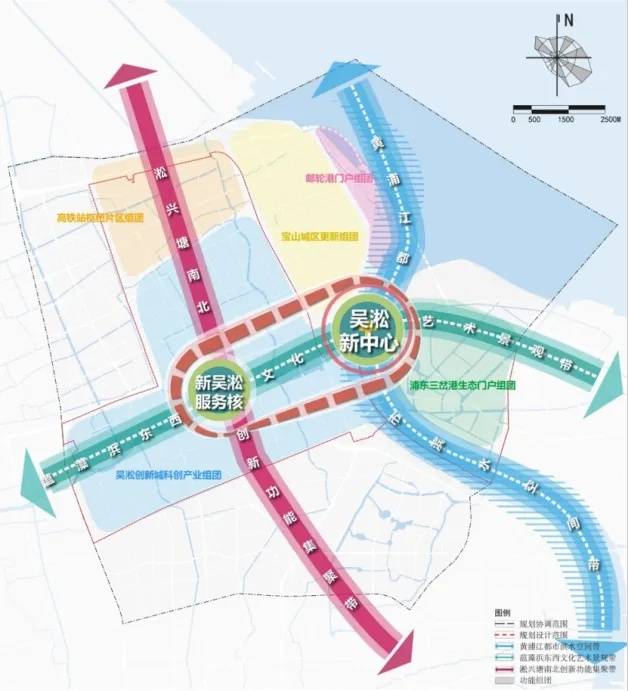
Group 1 - The core viewpoint of the news is that the implementation of the "Dawusong District Special Plan" is accelerating development in northern Shanghai, particularly in the Baoshan area, with significant projects being launched [1][2][4] - The special plan covers an area of approximately 110 square kilometers across Baoshan, Pudong, Jing'an, and Yangpu districts, aiming to transform the region into a model for industrial transformation and green development [2][4] - The plan emphasizes a spatial layout of "one core, three belts, and five groups," with over one-third of the area dedicated to blue-green spaces, promoting ecological and urban integration [2][4] Group 2 - The first phase of the Baoshan High-speed Railway Station's surrounding supporting projects has been initiated, focusing on a mixed-use development that includes commercial, office, and residential spaces, covering a total area of 343,900 square meters [6][11] - The project aims to enhance connectivity between the high-speed railway and urban transit systems, facilitating economic exchanges and regional integration [6][14] - The surrounding TOD (Transit-Oriented Development) areas near the 18th line stations have also seen rapid development, with significant land parcels being auctioned at premium rates, indicating strong market interest [15][19] Group 3 - The high-end commercial brand "He Sheng Hui" has signed a management agreement for the commercial operations at the Baoshan High-speed Railway Station, marking a significant step in establishing a new urban landmark that combines transportation and commercial experiences [19][20] - The market response to residential products in the area has been overwhelmingly positive, with high visitor numbers indicating strong demand and confidence in the future of the Dawusong development [19][20] - Future projects, including the Jiangyang South Road dual-track project and the TOD Steel Park Phase I, are being planned to further enhance the region's functionality and attractiveness [21][22]