商品和服务

Search documents
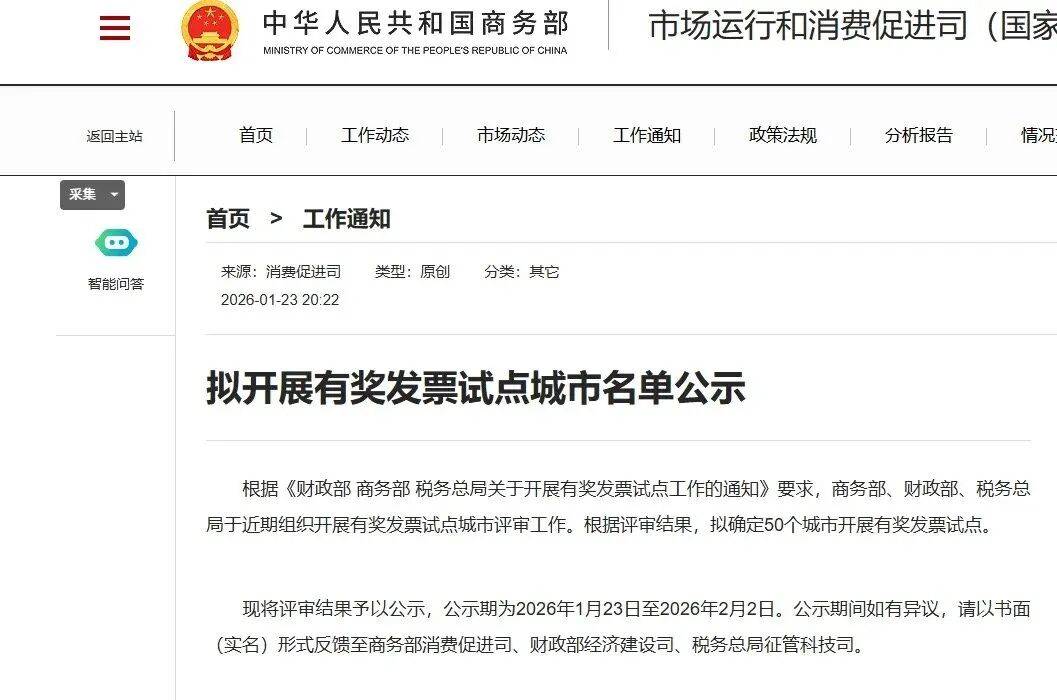
购物吃饭等消费开具发票有可能中奖,50城开展有奖发票试点!海口在列
Sou Hu Cai Jing· 2026-01-24 17:00
Core Viewpoint - The Ministry of Finance, Ministry of Commerce, and State Taxation Administration have initiated a pilot program for prize invoices in 50 cities, aimed at stimulating consumer spending and enhancing tax compliance [1] Group 1: Pilot Program Details - The pilot program will involve 50 cities, including 4 municipalities directly under the central government and 5 sub-provincial cities [1] - The selected cities for the pilot program are: Beijing, Tianjin, Shanghai, Chongqing, Dalian, Qingdao, Ningbo, Xiamen, and Shenzhen, along with 41 other cities [1] Group 2: Implementation and Regulations - Consumers will be eligible for a lottery if they purchase goods and services from specified industries and obtain invoices above a certain amount [1] - The minimum invoice amount for eligibility will not be less than 100 yuan, and the prize amount for a single invoice will not exceed 800 yuan [1] - Each pilot city will determine the winning invoice threshold, winning ratio, and prize structure, and will be responsible for timely subsidy payments [1]

中央财办:明年中国完全有条件推动内需实现持续增长
Zhong Guo Xin Wen Wang· 2025-12-16 14:48
Core Viewpoint - The Central Financial Office indicates that China is fully capable of promoting sustained growth in domestic demand next year, focusing on both consumption and investment strategies to stimulate economic activity [1][2]. Group 1: Consumption Strategies - The shift in consumer behavior from primarily goods consumption to a balanced focus on both goods and services is highlighted, with strong demand in sectors like cultural tourism, elderly care, and childcare [1]. - Plans to enhance residents' income and improve employment quality are set to boost consumer spending capacity, including increasing basic pensions for urban and rural residents [1]. - The government aims to expand the supply of quality goods and services, fostering new consumption growth points in sectors such as home services and health tourism [1]. Group 2: Investment Initiatives - There is a call to combine investments in physical infrastructure and human capital, emphasizing the need for effective investment in consumer infrastructure like parking lots and charging stations [2]. - The government plans to leverage various funding sources, including central budget investments and special bonds, to support significant projects and stimulate effective investment [2]. - Measures to invigorate private investment are outlined, encouraging private enterprises to engage in major projects in sectors like railways and nuclear power, while guiding investments towards high-tech and service industries [2].
新华社评论员:坚持内需主导,建设强大国内市场——三论学习贯彻中央经济工作会议精神
Xin Hua She· 2025-12-14 15:01
Group 1 - The core viewpoint emphasizes the importance of domestic demand as the main driver of economic growth and the need to build a strong domestic market as a strategic foundation for China's modernization [1][2] - The Central Economic Work Conference has identified eight key tasks for economic work in the coming year, with the first being to "insist on domestic demand as the main driver and build a strong domestic market" [1][2] - The contribution rate of final consumption expenditure to economic growth reached 53.5% in the first three quarters, an increase of 9 percentage points compared to the previous year, highlighting the role of domestic demand in driving economic growth [2] Group 2 - Expanding domestic demand is seen as a strategic measure to counter external shocks and promote high-quality development, with a focus on creating a complete domestic demand system [3] - The construction of a strong domestic market requires prioritizing the stimulation of consumption, with plans to increase residents' consumption rates and enhance consumer capacity [4] - Investment plays a crucial role in optimizing supply structure, with a call for government investment to stabilize and increase, while also encouraging private investment through new policy tools [5]
美国8月贸易逆差显著下降
Xin Hua She· 2025-11-19 16:09
Core Viewpoint - The U.S. trade deficit in goods and services for August was reported at $59.6 billion, a significant decrease of $18.6 billion or 23.88% from the previous month [1] Group 1: Trade Deficit Data - The August trade deficit reduction was primarily due to a decrease in the goods trade deficit, which fell by $18.1 billion to $85.6 billion [1] - U.S. exports of goods and services in August amounted to $280.8 billion, showing a slight increase of 0.1% month-over-month [1] - Imports decreased by 5.1% to $340.4 billion in August [1] Group 2: Import Breakdown - The decline in the goods trade deficit was influenced by a $11.3 billion reduction in industrial materials imports, including a notable drop of $9.3 billion in non-monetary gold imports [1] - Imports of consumer goods, capital goods, and food and beverages decreased by $3.7 billion, $3.4 billion, and $1.6 billion, respectively [1]
从商家的促销说起
Sou Hu Cai Jing· 2025-11-03 14:10
Group 1 - The prevalence of promotions indicates a developed commercial environment but also suggests a decline in consumer purchasing power [1][3] - Online shopping festivals initially generated high transaction volumes but have since seen a decline, with increased returns and consumer skepticism about pricing strategies [3][4] - Businesses often manipulate prices by raising them before sales events and then advertising discounts, leading to consumer confusion and a lack of rational purchasing behavior [3][4] Group 2 - Offline retailers also employ similar tactics, using free giveaways to attract customers, but ultimately, consumer decisions are driven by perceived value and price [4][6] - Economic growth relies on stimulating consumer spending, which requires both affordable goods and sufficient disposable income among consumers [6][8] - The burden of housing and car loans has constrained young consumers' spending power, leading to a cautious approach to consumption despite potential income [6][8] Group 3 - To effectively stimulate consumption, there is a need for lower prices and higher wages across various sectors, rather than superficial subsidies that may lead to price inflation [6][8] - The current economic strategy should focus on direct financial support to consumers, similar to practices in developed capitalist countries, rather than relying solely on promotional tactics [6][8]

疯王与关税
雪球· 2025-04-13 04:07
Group 1 - The article discusses the basic principles of trade, emphasizing that trade surplus is a means while trade deficit is an end goal, ultimately for spending money [2] - It highlights that in international trade, the U.S. has maintained a trade deficit for decades, which is unsustainable in the long run [7][10] - The article points out that the U.S. dollar's status as the world's reserve currency allows the country to print money and maintain a trade deficit, but this creates a looming risk if the dollar's credibility is questioned [8][10] Group 2 - The article argues that the U.S. faces two major problems: the credibility of the dollar is under scrutiny, and the manufacturing sector is being pressured by global competition, particularly from China [10][13] - It suggests that the current administration's contradictory policies aim to maintain the dollar's international status while also seeking a trade surplus, which is inherently impossible [15] - The article emphasizes that high tariffs may increase trade friction costs but will not necessarily lead to the intended outcomes due to issues like transshipment and smuggling [18][19] Group 3 - The article discusses the implications of rising U.S. Treasury yields, noting that a sudden increase could lead to higher borrowing costs for companies and potentially trigger widespread bankruptcies [26][27] - It warns that a significant drop in Treasury prices could undermine the dollar's credibility, leading to a feedback loop where countries start selling off U.S. debt [29][30] - The article concludes that investors should focus on valuation rather than being swayed by political rhetoric, as the complexities of the global economy are far more significant than any single political figure [20][21]