国债期货合约

Search documents
中长期纯债基金四季报分析:业绩有所回暖,负久期策略助力风险对冲
Guoxin Securities· 2026-01-23 14:11
Group 1 - The core viewpoint indicates that the performance of medium- and long-term pure bond funds has shown signs of recovery, aided by a negative duration strategy for risk hedging [1][50] - As of the end of Q4 2025, there are 2,112 medium- and long-term pure bond funds, accounting for 15.5% of the total fund market, with a significant decrease in issuance and scale compared to the previous quarter and the same period last year [9][50] - The total assets and net assets of these funds are reported at 69,425 billion and 58,042 billion respectively, reflecting a decline of 2,038 billion and 1,633 billion from the previous quarter [10][50] Group 2 - The average leverage ratio for medium- and long-term pure bond funds at the end of Q4 2025 is 1.20, remaining stable compared to the previous quarter but down 0.02 from the end of the previous year [14][50] - The average net value growth rate for these funds in Q4 2025 is 0.56%, showing a significant recovery compared to the previous quarter, with 92.1% of the funds reporting positive growth [19][50] Group 3 - In terms of asset allocation, bond assets constitute the highest proportion at 97.1%, with a slight increase from the previous quarter, while bank deposits have increased to 1.2% [24][50] - The main types of bonds held by these funds include interest rate bonds, financial bonds (excluding policy financial bonds), and corporate bonds, which account for 47.0%, 21.4%, and 28.1% of total bond assets respectively [25][50] Group 4 - As of Q4 2025, 39 medium- and long-term pure bond funds hold government bond futures, with a majority focusing on hedging and duration management [37][51] - The negative duration strategy is employed by certain funds, with the 平安惠嘉纯债 fund having an estimated duration of -1.96 years and 嘉实稳华纯债 fund at -0.74 years [48][49][51]
《金融》日报-20260108
Guang Fa Qi Huo· 2026-01-08 06:54
Report on Precious Metals Investment Rating Not provided Core View - Gold: As funds quickly exit the market before the Spring Festival, the price has corrected. The market may focus on the impact of US economic data on Fed policies and geopolitical tensions in South America. Uncertainties are expected to keep precious metals highly volatile in January. Gold long positions above $4300 should be held [1]. - Silver: Long - position funds have significantly increased their holdings through ETFs and physical delivery, driving up the price. However, high prices may suppress industrial demand. The "irrational" price increase driven by short - term funds is expected to end, and attention should be paid to the risk of passive reduction due to the re - balancing of global commodity indices. A light - position and low - buying strategy above $70 is recommended [1]. - Platinum and Palladium: With strong macro and supply - demand fundamentals and relatively undervalued prices compared to gold, value re - evaluation is being driven by funds. They are expected to continue to rise in the medium - to - long - term. Short - term speculation has weakened, and with a strong external market, long positions are recommended on the 20 - day line [1]. Summary by Category - **Futures Prices**: Most domestic and foreign precious metal futures prices declined on January 7, 2026. For example, the AU2602 contract fell by 0.60% to 998.90 yuan/gram, and the COMEX gold主力合约 dropped by 0.86% to 4467.10 [1]. - **Spot Prices**: Most spot precious metal prices also declined. London gold fell by 0.87% to 4456.07 dollars/ounce, and the Shanghai Gold Exchange's gold T + D decreased by 0.27% to 999.20 yuan/gram [1]. - **Basis**: The basis of gold TD - Shanghai gold主力 and silver TD - Shanghai silver主力 increased, with historical 1 - year quantiles of 95.10% and 98.30% respectively [1]. - **Ratios**: The COMEX gold/silver ratio rose by 3.26% to 57.29, while the NYMEX platinum/palladium ratio decreased by 2.89% to 1.26 [1]. - **Interest Rates and Exchange Rates**: The 10 - year US Treasury yield decreased by 0.7% to 4.15%, and the US dollar index rose by 0.14% to 98.74 [1]. - **Inventory and Positions**: The Shanghai Futures Exchange's gold inventory decreased by 0.05% to 97653, and the silver inventory dropped by 4.82% to 553429 kilograms [1]. Report on Treasury Bond Futures Spreads Investment Rating Not provided Core View Not provided Summary by Category - **Basis**: On January 7, 2026, the TS basis was 1.3387, the TF basis was 1.5487, the T basis was 1.4478, and the TL basis was 1.5565. Their changes and historical quantiles are also reported [2]. - **Inter - delivery Spreads**: There are various inter - delivery spreads for different Treasury bond futures contracts, such as the TS, TF, T, and TL. For example, the TS's "current quarter - next quarter" spread was - 0.0300 [2]. - **Inter - variety Spreads**: There are also inter - variety spreads, like TS - TF, TS - T, etc. For instance, the TS - TF spread was - 3.1680 [2]. Report on Stock Index Futures Spreads Investment Rating Not provided Core View Not provided Summary by Category - **Spot - Futures Spreads**: The IF spot - futures spread was - 23.67, the IH was - 1.32, the IC was - 72.48, and the IM was - 146.22 on January 7, 2026, along with their changes and historical quantiles [4]. - **Inter - delivery Spreads**: There are multiple inter - delivery spreads for different stock index futures contracts. For example, the IF's "next month - current month" spread was - 4772.80 [4]. - **Inter - variety Ratios**: There are various inter - variety ratios, such as the ratio of the CSI 500 to the SSE 300, which was 1.6487, and its change and historical quantiles are also given [4]. Report on Container Shipping Industry Investment Rating Not provided Core View Not provided Summary by Category - **Shipping Indexes**: The SCFIS (European route) increased by 15.11% to 1312.71, and the SCFIS (US West route) rose by 28.24% to 1107.32. The Shanghai export container freight rates also showed increases for different routes [7]. - **Futures Prices and Basis**: Most container shipping futures prices declined on January 7, 2026. For example, the EC2602 contract fell by 5.00% to 1779.1. The basis of the main contract was - 220.3 [7]. - **Fundamental Data**: The global container shipping capacity supply remained stable, with a 0.00% change. The port punctuality rate in Shanghai decreased by 18.50%, while the port calls increased by 5.83%. The monthly export amount increased by 8.23% [7]. - **Overseas Economy**: The Eurozone's composite PMI decreased by 2.46% to 51.50, and the US manufacturing PMI decreased by 0.62% to 47.90 [7].
Arthur Hayes 博文:SRF 的启用与隐性量化宽松
Sou Hu Cai Jing· 2025-11-05 04:25
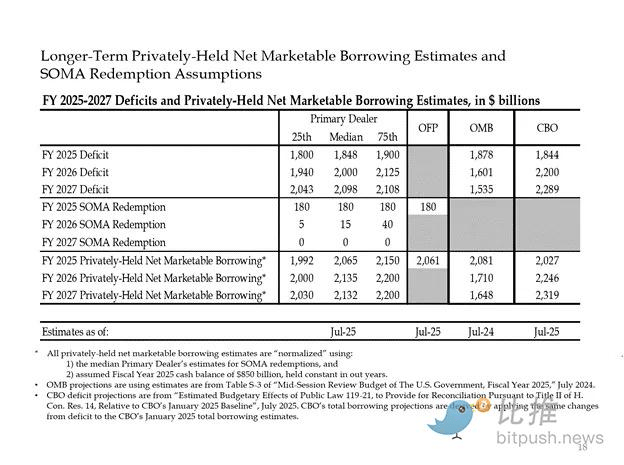
Group 1 - The article discusses the inevitability of government debt and the political incentives behind it, emphasizing that governments prefer to issue debt rather than raise taxes to fund expenditures [2][3] - It highlights the relationship between government borrowing and the Federal Reserve's balance sheet, suggesting that an increase in government debt will lead to an increase in the money supply, benefiting the liquidity of the dollar and potentially driving up the prices of Bitcoin and other cryptocurrencies [3][32] - The article outlines the projected federal deficits, estimating around $2 trillion annually, and discusses the implications for U.S. Treasury bond issuance and financing [6][7] Group 2 - The article identifies the primary buyers of U.S. debt, including foreign central banks, the private sector, and commercial banks, concluding that the marginal buyers are RV hedge funds, particularly those based in the Cayman Islands [9][14][12] - It explains the trading strategies of RV funds, which involve buying U.S. Treasury bonds and financing these purchases through repurchase agreements (repos) [19][21] - The article discusses the role of the Federal Reserve in managing short-term interest rates and how it influences the liquidity in the market, particularly through tools like the Standing Repo Facility (SRF) [22][28] Group 3 - The article warns of a potential liquidity crisis if RV funds cannot secure financing at favorable rates, which would hinder their ability to purchase U.S. debt and impact government financing [27][26] - It introduces the concept of "stealth quantitative easing," suggesting that the SRF will become a primary channel for injecting liquidity into the financial system without being labeled as traditional quantitative easing [32][31] - The article concludes that the current market stagnation presents opportunities, particularly as the government prepares to release additional liquidity once operations resume, which could reignite interest in cryptocurrencies [33]