
国际股票

Search documents
“终结黄金大牛市的,只能是更大事件!” 美银最新研判
华尔街见闻· 2026-02-01 10:01
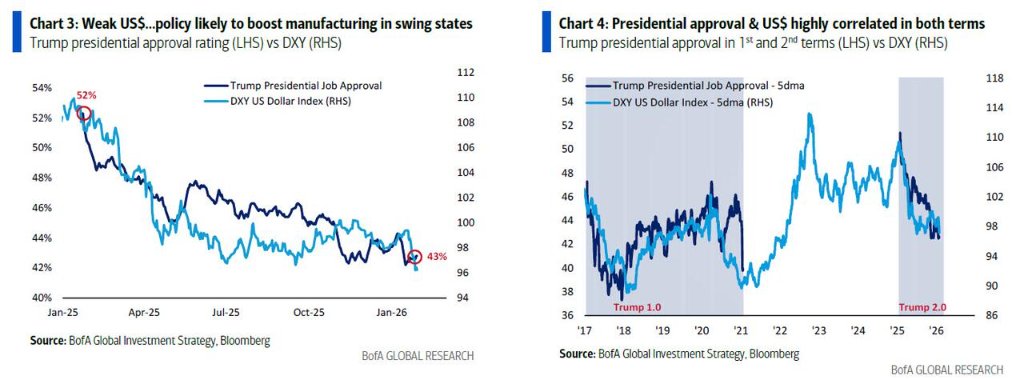
Core Viewpoint - The recent market volatility, including a sharp decline in stocks and a rebound in the dollar, has led to significant drops in gold and silver prices, indicating a turbulent economic environment driven by macroeconomic factors [2][3]. Group 1: Market Dynamics - The chief investment strategist at Bank of America, Michael Hartnett, emphasizes that currency devaluation remains the fundamental scenario, suggesting that despite short-term volatility, the macroeconomic logic supporting the rise of gold and physical assets is still intact [3]. - Investors should be cautious of potential liquidity deleveraging risks in the first half of the year, which could lead to a significant cleansing of "greed" sentiment in the market [4]. - Hartnett notes that since Trump's inauguration, the dollar has actually depreciated by 12%, a trend that is seen as a policy-driven outcome [5]. Group 2: Economic and Political Implications - The weak dollar is viewed as a crucial means to boost manufacturing in swing states like Pennsylvania, Michigan, and Wisconsin, highlighting the intersection of economic and political survival [6][7]. - Historical data shows a strong correlation between presidential approval ratings and dollar performance, with an average decline of 30% in dollar bear markets since 1970, suggesting that gold and emerging market stocks typically perform well in such environments [7]. Group 3: Investment Strategies - Hartnett advocates for a shift from the traditional 60/40 stock-bond strategy to a "permanent portfolio" consisting of equal parts stocks, bonds, gold, and cash, which has shown impressive returns of 8.7% over ten years, the best performance since 1992 [9][10]. - The "permanent portfolio" achieved a remarkable 23% return in 2025, marking the best year since 1979, underscoring the importance of including gold and cash in asset allocation during times of currency devaluation and inflation volatility [11][15]. Group 4: Future Outlook - Hartnett predicts that the investment trend of the 2020s will be dominated by war, inflation, protectionism, and wealth redistribution, with current gold price levels indicating negative real interest rates in the U.S. [16]. - He warns that a significant capital outflow could occur if non-U.S. investors reduce their holdings in U.S. equities and government bonds by just 5%, potentially impacting the U.S. economy given its current account and budget deficits [19]. - Looking ahead to 2026, Hartnett suggests a "BIG + MID" strategy, focusing on Bitcoin, international stocks, gold, and mid-cap stocks, aiming to capture asset classes that may outperform in the new macroeconomic paradigm [22].



美银Hartnett:终结"黄金大牛市"的只能是"更大的事件"
Hua Er Jie Jian Wen· 2026-02-01 06:54
Core Viewpoint - The recent market volatility, including a significant drop in stocks and a rebound in the dollar, has led to a record single-day plunge in silver prices, yet the macroeconomic logic driving the rise of gold and physical assets remains intact, according to Michael Hartnett, Chief Investment Strategist at Bank of America [1][10]. Group 1: Market Dynamics - The dollar has declined by 12% since Trump's inauguration, which is seen as a policy-driven move to boost manufacturing in key swing states like Pennsylvania, Michigan, and Wisconsin [2][4]. - Historical data shows that since 1970, the average decline in a dollar bear market is 30%, indicating ongoing long-term downward pressure on the dollar, which supports physical assets [4]. Group 2: Investment Strategies - The traditional 60/40 stock-bond strategy is no longer suitable; instead, a "permanent portfolio" consisting of 25% stocks, 25% bonds, 25% gold, and 25% cash is recommended, which has shown impressive performance [6][7]. - The "permanent portfolio" strategy recorded a remarkable 23% return in 2025, marking the best performance since 1979 [7]. Group 3: Future Outlook - Hartnett suggests that the investment trends of the 2020s will be dominated by factors such as war, inflation, protectionism, and wealth redistribution, with gold prices reflecting negative real interest rates in the U.S. [10]. - The potential for a significant capital outflow exists if non-U.S. investors reduce their holdings in U.S. equities and government bonds by just 5%, which could lead to a $1.5 trillion capital outflow [12]. - Hartnett emphasizes that the great bull market in gold can only be ended by "greater events," and the current bullish sentiment may trigger a deleveraging risk in the first half of the year [14]. Group 4: 2026 Trading Strategy - Looking ahead, Hartnett maintains a contrarian view, suggesting that the reverse trade in 2026 may be to go long on bonds, despite acknowledging the risks associated with high global debt levels [17]. - The recommended trading strategy for 2026 includes a "BIG + MID" combination, focusing on Bitcoin, international stocks, gold, and mid-cap stocks, aiming to capture outperforming asset classes under a new macro paradigm [17].
“新全球秩序=新全球牛市=金银牛市!” 美银:黄金有望突破6000
华尔街见闻· 2026-01-19 09:46
Core Viewpoint - The article discusses the emergence of a "New World Order = New World Bull Market" driven by global fiscal expansion under Trump's leadership, with a bullish outlook on gold and silver, while highlighting risks associated with the rapid appreciation of East Asian currencies [2][3]. Group 1: Global Market Dynamics - Hartnett believes that the market is entering a phase of global rebalancing, moving away from American exceptionalism, with international stocks being favored [3]. - The article notes that since 2020, U.S. stock funds have seen inflows of $1.6 trillion, while global funds have only attracted $0.4 trillion, indicating a significant imbalance that is expected to correct [3]. Group 2: Investment Recommendations - Hartnett recommends going long on international stocks and assets related to economic recovery, particularly favoring small and mid-cap stocks, homebuilders, retail, and transportation sectors [12]. - The article suggests that gold is expected to break the historical high of $6,000, with a current allocation of only 0.6% among high-net-worth clients, indicating potential for significant price appreciation [8][10]. Group 3: Economic Indicators and Risks - The article highlights that the sustainability of the optimistic outlook depends on the U.S. unemployment rate remaining low and Trump's ability to lower living costs to improve his approval ratings [12][15]. - A major risk identified is the potential rapid appreciation of the Japanese yen, South Korean won, and New Taiwan dollar, which could lead to a tightening of global liquidity [16][18]. Group 4: Geopolitical Context - China is identified as a key market, with the end of deflation expected to catalyze bull markets in Japan and Europe [4]. - The stability of Middle Eastern markets, such as the Tehran Stock Exchange's 65% increase since last August, is seen as a positive signal for global oil supply and market conditions [4].

如何对冲“AI泡沫”?美银提出2020年代投资新公式:B.I.G
Zhi Tong Cai Jing· 2025-09-15 02:42
Group 1 - The core investment theme on Wall Street is the "BIG" combination, which includes Bonds, International Stocks, and Gold [1] - A barbell strategy of going long on BIG can help mitigate market volatility caused by the AI bubble [1] Group 2 - Bonds are regaining their status as a risk-hedging tool as nominal GDP growth peaks, with 5-year U.S. Treasury yields approaching 3% and 30-year yields nearing 4% [2] - The end of the "ABB" theme (anything but bonds) is favorable for small-cap stocks sensitive to bonds, which currently have a rolling return rate of -4% relative to large-cap stocks, close to a century low [2] - International assets are expected to benefit from a weaker dollar, the end of deflation in the EU and Japan, and the conclusion of excessive fiscal expansion in the EU and Asian economies, with Chinese tech stocks being the optimal choice for hedging against the U.S. AI bubble [2] - Gold serves as a hedge against risks of anarchy and dollar depreciation, with its price expected to continue rising despite transitioning from a "quiet increase" to a "strong rise" [2]
做多黄金连续三月蝉联“拥挤交易”,美银:别怕,4000美元仍在路上
Jin Shi Shu Ju· 2025-06-19 05:28
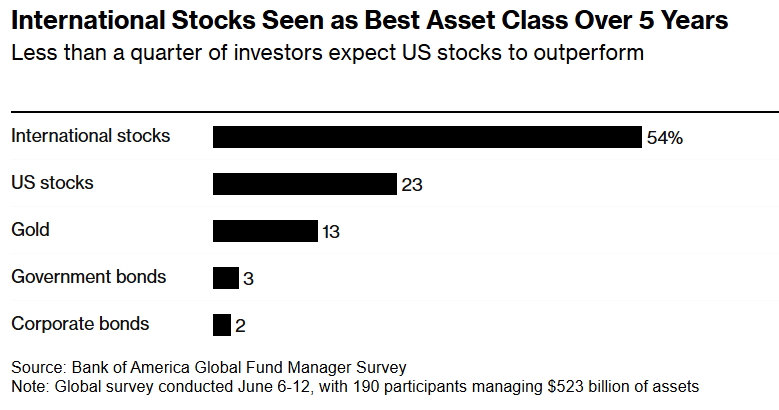
Group 1 - The core sentiment in the gold market remains bullish, but there are increasing downward risks as market sentiment is extremely optimistic, raising concerns among fund managers [1] - According to a recent Bank of America fund manager survey, 41% of respondents indicated that "long gold" is currently the most crowded trade for the third consecutive month, although this sentiment has declined from its peak in May [1] - 20% of fund managers view "shorting the dollar" as the third most crowded position in the global market [2] Group 2 - The survey indicates that the main contrarian trades currently are long dollar and short gold, with 13% of fund managers believing gold will be one of the best-performing assets over the next five years, while 54% believe international stocks will outperform during this period [3] - Investor sentiment has improved, with only 36% of participants expecting a recession in the U.S., down from 44% in April, and 66% anticipating a soft landing for the economy [3] - Despite recent speculative risks, the survey highlights some potential long-term positive trends for gold, with 59% of respondents expecting the U.S. government funding bill to fail, while 81% anticipate an increase in the government budget deficit [3] Group 3 - Analysts note that despite a significant weakening of the dollar index, many commodity analysts believe gold is not at risk from a potential bullish resurgence of the dollar, as the negative correlation between gold and the dollar has diminished [4] - Bank of America commodity analysts reiterated that gold could potentially reach $4,000 per ounce this year due to ongoing concerns about the growing government deficit [4] - Analysts suggest that while gold has been viewed as a crowded trade in recent months, historically, it has not consistently attracted investor attention, and there is still growth potential as gold-backed ETF holdings remain significantly below the historical highs set in 2020 [4]
美股光环逐渐褪去?美银调查:超五成基金经理押注未来五年国际股票跑赢美股
贝塔投资智库· 2025-06-18 04:17
Core Viewpoint - A significant shift in investment sentiment is observed, with 54% of fund managers believing that international stocks (excluding the US) will outperform US stocks over the next five years, indicating a decline in the dominance of the US stock market [1][2]. Group 1: International Stocks vs. US Stocks - The term "international stocks" refers to stock markets outside the US, including both developed and emerging markets such as Europe, Japan, Canada, Australia, and various emerging markets like China, India, and Brazil [2]. - This is the first time Bank of America has asked institutional investors to predict the best-performing asset class over a five-year horizon, reflecting a growing trend of "Sell America" since April [2][3]. - If fund managers' predictions hold true, it would reverse the trend of heavily investing in US stocks, which have outperformed international stocks in 13 out of the last 15 years [2][3]. Group 2: Market Performance and Trends - The S&P 500 index has recorded its largest underperformance against the MSCI World Index (excluding the US) since 2009, with European stocks showing a rare trend of outperforming US stocks by 20% after adjusting for currency fluctuations [3]. - Amundi SA's report indicates that ongoing uncertainty in US government policy and a growing budget deficit will create a challenging environment for the economy and markets, prompting a shift in focus towards European and emerging markets [3][4]. - Jeffrey Gundlach, CEO of DoubleLine Capital, suggests that the "American exceptionalism" narrative is collapsing, predicting a long-term depreciation of the US dollar and continued outperformance of international stocks [4]. Group 3: Fund Manager Sentiment - In the latest Bank of America survey, 59% of institutional investors do not expect a boost in US economic activity from the government's spending plans [5]. - 21% of respondents anticipate an increase in US Treasury yields over the next year, the highest proportion since August 2022 [5]. - There is a notable shift in asset allocation preferences, with a net 31% of investors planning to reduce their holdings in the US dollar and a net 36% planning to reduce their exposure to US stocks [5].

美股光环逐渐褪去? 美银调查:超五成基金经理押注未来五年国际股票跑赢美股
智通财经网· 2025-06-17 13:25
Core Insights - The Bank of America survey indicates that global stock markets, excluding the U.S., are expected to outperform the U.S. stock market over the next five years, suggesting a shift in investor sentiment away from U.S. dominance in equity markets [1][5] - 54% of fund managers believe that international stocks will be the best-performing asset class, while only 23% favor U.S. stocks [1][5] - The survey reflects a growing trend of "Sell America" trades among institutional investors, particularly in light of U.S. government policies and budget deficits [2][5] Summary by Category International Stocks - International stocks are defined as stocks outside the U.S., including developed markets (e.g., Europe, Japan) and emerging markets (e.g., China, India) [1] - The performance of international stocks is compared to U.S. stocks, with a notable shift in expectations for future returns [1][5] U.S. Market Sentiment - The survey marks the first time Bank of America has asked institutional investors to predict the best-performing asset class over a five-year horizon [2] - Historical data shows that the U.S. stock market has outperformed international stocks in 13 out of the last 15 years, but this trend is changing [5] Economic Outlook - 59% of institutional investors do not expect a boost in U.S. economic activity from the government's spending plans [8] - There is a significant negative sentiment towards the U.S. dollar and U.S. stocks, with net 31% and net 36% of investors planning to reduce their holdings, respectively [8]
美国银行调查:投资者对美元净低配比例达20年来最高
news flash· 2025-06-17 10:00
Group 1 - Investors' net underweight position in the US dollar is at 31%, the highest in 20 years, marking it as the "most extreme view" in Bank of America's June global fund manager survey [1] - 47% of investors believe that a trade war triggering an economic recession remains the biggest tail risk, down from 80% in April [1] - There is an improvement in global economic outlook, with a net 46% of respondents expecting economic weakness, compared to a record net 82% in April [1] Group 2 - A net 54% of investors consider international stocks to be the best-performing asset class over the next five years, followed by US stocks (23%), gold (13%), and bonds (5%) [1] - Investors are rotating stock funds from other regions into emerging markets, with an overweight position of 28%, the highest since August 2023 [1] - The overweight position for European markets is at 34%, while the net underweight for the US market stands at 36% [1] Group 3 - In the June fund manager survey, investors increased allocations to energy, banks, telecommunications, and industrials, while reducing allocations to utilities, staples, and healthcare [1]