
城市NOA功能

Search documents
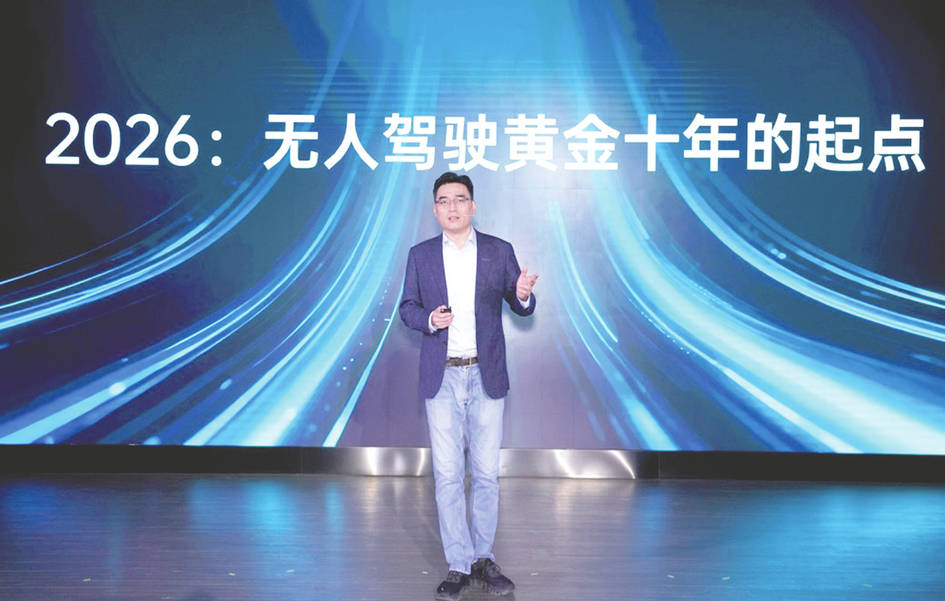
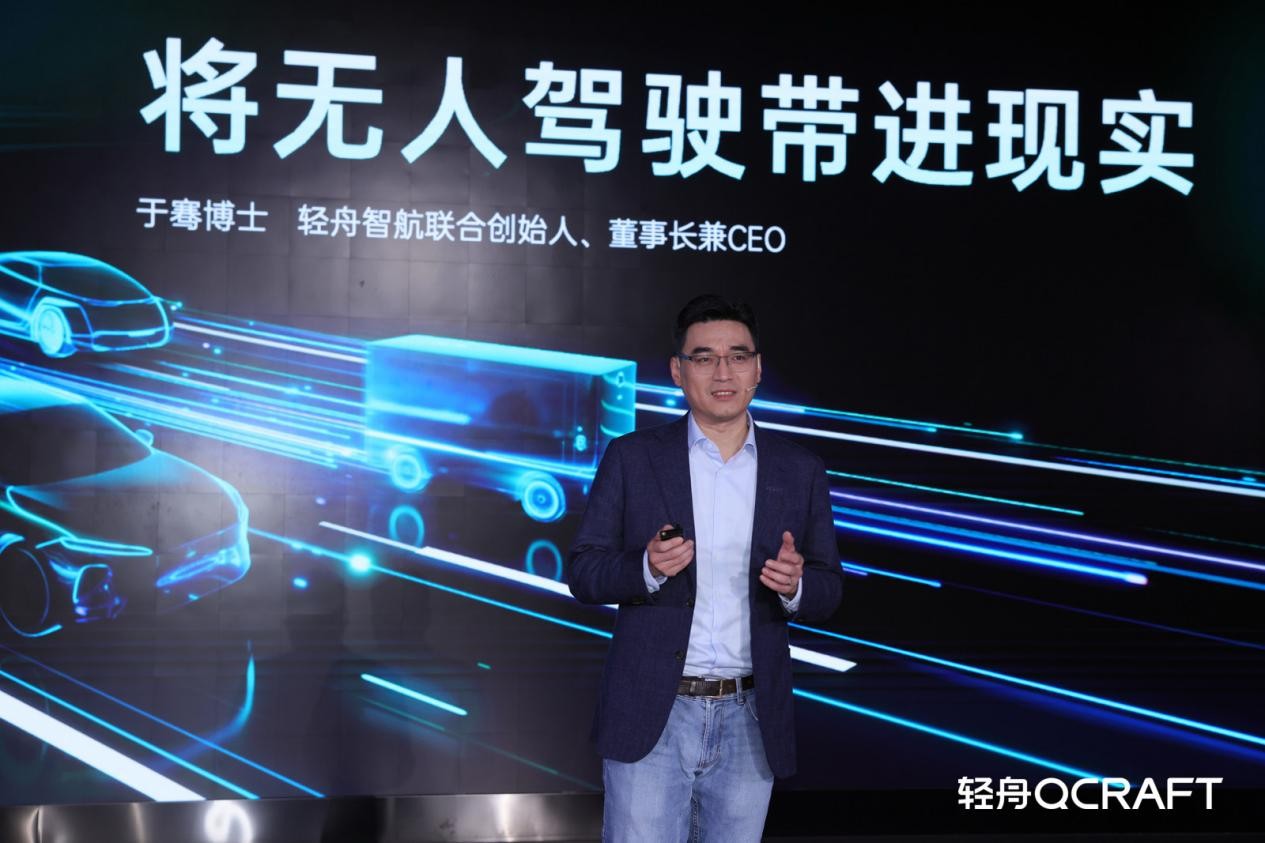
轻舟智航联合创始人、董事长兼CEO于骞:2026年开启无人驾驶黄金10年,10万元级车将普及城市NOA
Sou Hu Cai Jing· 2026-01-29 12:57
Core Insights - 2026 marks the beginning of a golden decade for autonomous driving, driven by technological advancements and the adoption of "end-to-end" architecture [1] - The introduction of VLA (Vision-Language-Action) models and world models will enable autonomous systems to learn from vast amounts of real and generated data, achieving safety levels over 10 times that of human drivers [1] - The market is expected to see widespread adoption of urban NOA (Navigation On Autopilot) features in vehicles priced around 100,000 yuan by 2026, a significant improvement compared to the capabilities of many L4 autonomous vehicles just two years prior [1] Market Trends - The penetration rate of passenger cars equipped with L2-level driving assistance features reached 64% in the first three quarters of 2025, with a year-on-year growth of 21.2% [4] - By November 2025, the cumulative sales of passenger cars with urban NOA features reached 3.129 million, accounting for 15.1% of insured passenger vehicles [4] - The majority of urban NOA-equipped vehicles are expected to be priced below 150,000 yuan, with over 68.9% of mainstream models under 300,000 yuan featuring this technology [4] Competitive Landscape - The autonomous driving sector is becoming increasingly competitive, with companies transitioning from traditional technologies like "LiDAR + high-definition maps" to AI-driven solutions [7] - The industry is witnessing a divergence in development directions, particularly between VLA and world models, with a consensus forming around the evolution of autonomous driving technology [7] - The successful differentiation in the market will depend on the ability to translate technology into tangible user experiences rather than just technical concepts [7] Strategic Insights - The million-unit deployment of autonomous driving systems is seen as a critical milestone, with few suppliers able to achieve this level [6] - The compatibility of QCraft's solutions with both new energy vehicles and traditional fuel vehicles provides a strategic advantage for global expansion [5] - The entry of Tesla's FSD into the Chinese market is viewed as a positive development that will expand the overall market rather than just intensifying competition [3][8]

华为Momenta合计占第三方城市NOA市场八成,月搭载量均达 8-10 万量级
凤凰网财经· 2026-01-28 14:15
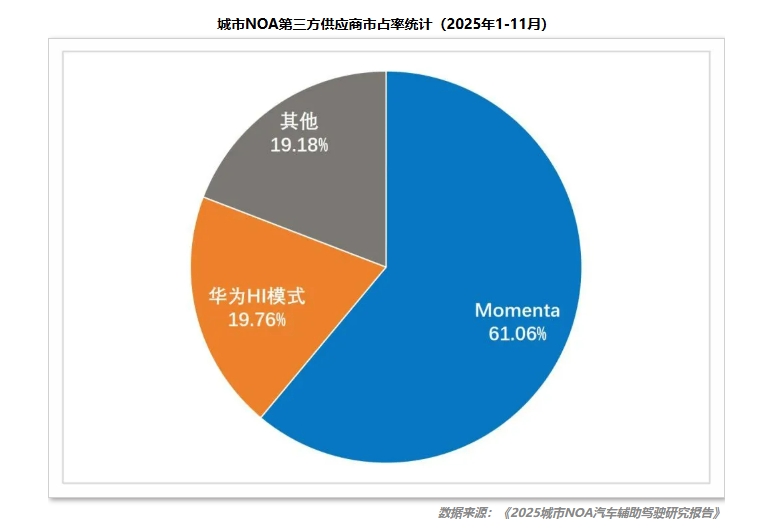
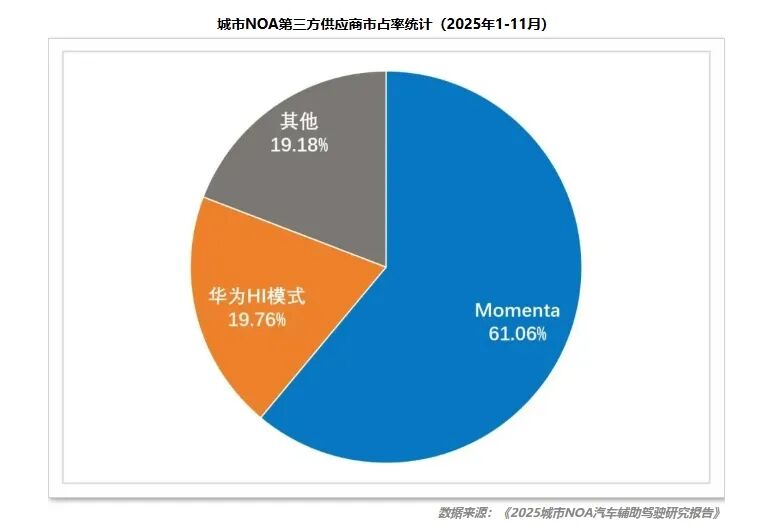
Core Insights - The report indicates that by November 2025, the cumulative sales of passenger cars equipped with urban NOA functionality in China reached 3.129 million units, highlighting rapid industry growth [1] - Momenta and Huawei's HI model dominate the market, collectively accounting for approximately 80% of the third-party supplier market share, with both companies achieving monthly installation volumes in the range of 80,000 to 100,000 units, establishing a strong "dual strong pattern" [1] Group 1 - The urban NOA market is characterized by a "dual-wheel drive" model, where car manufacturers either develop the technology in-house or collaborate with third-party suppliers to seize market opportunities [3] - In the period from January to November 2025, Momenta's urban NOA installation volume reached 414,400 units, representing about 61.06% of the third-party supplier market share, and it collaborates with 8 out of the top 10 global automotive manufacturers [3] - Huawei's HI model achieved an installation volume of approximately 134,100 units, accounting for about 19.76% of the third-party supplier market share, with a notable increase in installations by November 2025 [3] Group 2 - Domestic brands sold 2.5373 million units equipped with urban NOA functionality, making up 81.1% of the total, showcasing the innovation and competitiveness of domestic brands in the smart connected vehicle sector [3] - Global automotive brands such as Mercedes-Benz, BMW, Audi, Cadillac, Buick, and Toyota are actively collaborating with leading Chinese smart driving suppliers to implement urban NOA functionality and enhance technology [4] - The report emphasizes that third-party technology suppliers like Huawei and Momenta provide a "Chinese solution" for the global smart driving industry, attracting renowned automotive brands from Germany, the United States, Japan, and South Korea to collaborate deeply with Chinese tech companies [6]
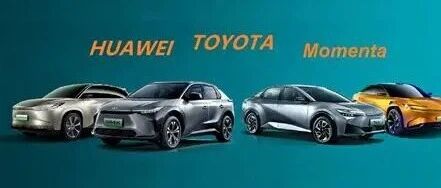
“智驾双强”格局已定!华为、Momenta月搭载量进入8—10万量级
Zheng Quan Ri Bao Wang· 2026-01-28 13:44
Group 1 - The report indicates that from January to November 2025, the cumulative sales of passenger cars equipped with urban NOA functions in China reached 3.129 million units, highlighting rapid industry expansion [1] - Momenta and Huawei's HI model dominate the market, collectively accounting for approximately 80% of the third-party supplier market share, with both companies achieving monthly installation volumes in the range of 80,000 to 100,000 units, establishing a strong "dual strong pattern" [1][2] - The urban NOA market is characterized by a "dual-wheel drive" model, where most automakers opt to collaborate with third-party suppliers to implement urban NOA, aiming to seize market opportunities [2] Group 2 - Momenta's urban NOA installation volume reached 414,400 units, representing about 61.06% of the third-party supplier market share, and it collaborates with 8 out of the top 10 global automakers [2] - Huawei's HI model, through strong partnerships, achieved an installation volume of approximately 134,100 units, accounting for about 19.76% of the third-party supplier market share [2] - Domestic brands sold 2.5373 million units of passenger cars equipped with urban NOA, making up 81.1% of the total, showcasing their innovation and competitiveness in the smart connected vehicle sector [2] Group 3 - The report emphasizes that third-party technology suppliers like Huawei and Momenta provide a "Chinese solution" for the global smart driving industry, attracting renowned automotive brands from Germany, the US, Japan, and South Korea to collaborate with Chinese tech companies [3] - This collaboration not only promotes the global reach of China's smart driving technology but also enhances China's influence in the global automotive industry's value chain [3]
轻舟智航CEO于骞:智驾市场会留存4-5家企业|36氪专访
3 6 Ke· 2026-01-26 05:57
Core Insights - The autonomous driving industry is at a critical transition point, with a shift towards mass production and lower vehicle price segments while also pursuing advanced levels of automation like L3 and L4 [3][4] - The company, Lightyear, has survived previous industry eliminations by making strategic decisions that balance dependence and independence in partnerships with automakers and chip manufacturers [4][5] Company Strategy - Lightyear has transitioned from focusing on L4 capabilities to delivering L2 mass production software, becoming one of the first companies to relieve itself of the "technical burden" associated with L4 [3][4] - The company maintains a close yet independent relationship with automakers and chip manufacturers, allowing it to adapt to various platforms while developing its own algorithms and simulation tools [4][30] Market Position - Lightyear's passenger vehicle assistance systems have surpassed one million units in deployment, with expectations to exceed 50 models by 2026, nearly all featuring urban NOA capabilities [5][6] - The autonomous driving market is expected to retain 4-5 leading companies, similar to the engine or battery industries, rather than consolidating into a monopoly [6][37] Product Development - Lightyear plans to expand its L2 product offerings and increase investments in L4 technologies, including applications in unmanned logistics [6][44] - The company has outlined a product matrix with three tiers: Air, Pro, and Max, targeting various market segments and price points [9][12] Technological Focus - The company emphasizes an end-to-end solution that optimizes resource use for better user experience, avoiding unnecessary complexity in models and hardware [8][23] - Lightyear is exploring advanced technologies like VLA and world models, focusing on enhancing model generalization and virtual training capabilities [12][14] Industry Trends - The penetration rate of autonomous driving is currently below 5% but is projected to rise to 50% in the coming years, driven by the electrification of vehicles [35] - The trend of integrating autonomous driving features into lower-priced vehicles is expected to continue, making advanced safety and convenience features accessible to a broader audience [36]
华为吃高端,Momenta占中端:智驾的“圈地运动”谁能终结?
3 6 Ke· 2026-01-22 09:39
Core Insights - In 2025, the adoption of intelligent driving in China is expected to experience explosive growth, with L2 level vehicles' sales projected to reach a penetration rate of 66.1% by the end of the year, indicating that intelligent driving has become a standard feature in vehicles [1][2][3] Group 1: Market Trends - The intelligent driving industry is facing a significant downturn despite the growth in adoption, leading to a "survival of the fittest" scenario [2][3] - The competition is shifting focus from high-speed NOA (Navigation on Autopilot) to urban NOA, with over 3.129 million vehicles equipped with urban NOA sold from January to November 2025 [12][13] - Mainstream models priced below 300,000 yuan contributed 68.9% of urban NOA sales, indicating a move towards mass-market adoption [14][15] Group 2: Technological Pathways - Two main technological pathways are emerging: the "Vision-Language-Action" (VLA) route, which emphasizes rapid iteration and compatibility with existing hardware, and the "World Model" route, which focuses on deeper cognitive paradigms [5][7][10] - Companies like XPeng and Li Auto are strong proponents of the VLA route, while Huawei represents the World Model approach [6][9] Group 3: Competitive Landscape - The market is characterized by a trend of "self-research dominance" with a high concentration of third-party suppliers, where domestic brands accounted for 81.1% of urban NOA vehicle sales [18][19] - The collapse of companies like Haomo and the shift towards third-party suppliers highlight the challenges faced by automakers in self-research capabilities [20][21] - Leading third-party suppliers, such as Huawei and Momenta, dominate the market, with Momenta holding approximately 61.06% market share [25][26] Group 4: Future Outlook - The competition is expected to intensify, with predictions that only two or three intelligent driving companies may survive by 2026 [32] - The integration of software and hardware is becoming crucial for companies to build competitive advantages, with a focus on deep collaboration between chip design and software development [35][39] - Companies like Horizon Robotics are positioning themselves as challengers to the dominant players by targeting cost-sensitive markets and offering integrated solutions [44][47]
2025年超300万辆,城市NOA规模化加速,华为、Momenta成「双强格局」
3 6 Ke· 2026-01-20 02:46
Core Insights - The report indicates that the cumulative sales of passenger cars equipped with urban NOA functions in China reached 3.129 million units from January to November 2025, marking a significant expansion in the industry [1][2] - The urban NOA market is characterized by a "dual strong" pattern dominated by Huawei and Momenta, which together hold approximately 80% of the third-party supplier market share [1][3] Group 1: Market Overview - The penetration rate of urban NOA-equipped passenger cars in China was 15.1% of the insured passenger car volume from January to November 2025, an increase of 5.6 percentage points compared to 2024 [2] - The report highlights that the urban NOA market has entered a phase of large-scale popularization, with profound changes in market structure and competitive factors [1][3] Group 2: Competitive Landscape - The market is driven by both self-research by car manufacturers and partnerships with third-party suppliers, with domestic brands accounting for 81.1% of the sales of urban NOA-equipped passenger cars [3] - Momenta leads the third-party supplier market with a total of 414,400 units equipped with urban NOA, representing about 61.06% of the third-party supplier share, while Huawei's HI model has approximately 134,100 units, accounting for about 19.76% [3][4] Group 3: Technological Advancements - The report emphasizes that algorithm, data loop capability, and mass production experience are critical factors determining the market position and development speed of auxiliary driving suppliers [6][8] - Momenta's R6 reinforcement learning model is noted as the first in China to achieve mass production based on an end-to-end architecture, enhancing safety and efficiency [8] Group 4: Future Trends - The urban NOA is expected to accelerate systemic changes in intelligent driving technology routes, core architectures, and industrial ecosystems, extending applications from highway NOA to urban NOA [9] - The competitive landscape is evolving with a focus on end-to-end models, pushing for integrated system architecture and the maturation of vehicle-road-cloud collaboration and regulatory standards [9]
氪星晚报|国内首只千亿黄金ETF诞生;英国通信管理局称将继续调查X平台伪造图像事件;“十五五”国网公司固定资产投资预计4万亿元
3 6 Ke· 2026-01-15 15:53
Group 1 - The UK communications regulator will continue its formal investigation into the fake image incident involving the X platform and its AI chatbot Grok, despite welcoming recent policy adjustments by xAI [1] - Ericsson plans to lay off nearly 1,600 employees in Sweden to improve cost conditions while maintaining critical investments for its technological leadership and strategic execution [2] - Major Chinese securities firms, including CITIC Securities and Huatai Securities, have begun hiring junior and mid-level bankers to quickly rebuild their investment banking capabilities while controlling costs [3] Group 2 - Xi Bei, a restaurant chain, confirmed the closure of 102 stores, which represents 30% of its total outlets [4] - KKR and RWE have formed a strategic partnership to jointly develop offshore wind projects in the UK, with a total installed capacity expected to reach approximately 3 GW and total investment exceeding $15 billion [5] - XSKY announced a strategic shift from IT to Data Intelligence, launching its AIMesh product suite at a recent event [6] Group 3 - "Xieying Technology" completed nearly 100 million yuan in Series B financing, which will be used for upgrading its intelligent reconfigurable operating system and expanding its market presence in strategic emerging sectors [7] - The lemon tea brand "Linli LINLEE" secured tens of millions in Series A financing, with a valuation nearing 1 billion yuan, aimed at brand building and supply chain upgrades [8] - The Huazhang Gold ETF has reached a circulation scale of 100.76 billion yuan, becoming the first gold ETF in China to surpass the 100 billion yuan mark [9] Group 4 - The South Korean Ministry of Industry will closely monitor the U.S. tariff dynamics on AI semiconductor chips to minimize impacts on the domestic industry [10] - U.S. asset management giant PIMCO is selling dollar assets to diversify risks in response to rapid policy changes from the U.S. government [11] - The cumulative sales of passenger cars equipped with urban NOA functions in China reached 3.129 million units, with a penetration rate of 15.1%, an increase of 5.6 percentage points from the previous year [12] Group 5 - The State Grid Corporation of China is expected to invest 4 trillion yuan in fixed assets during the 14th Five-Year Plan period, representing a 40% increase from the previous plan to promote high-quality development of the new power system supply chain [13]
中汽协2025城市NOA报告发布:Momenta第三方供应商市场市占率超60%
Zhong Jin Zai Xian· 2026-01-15 03:01
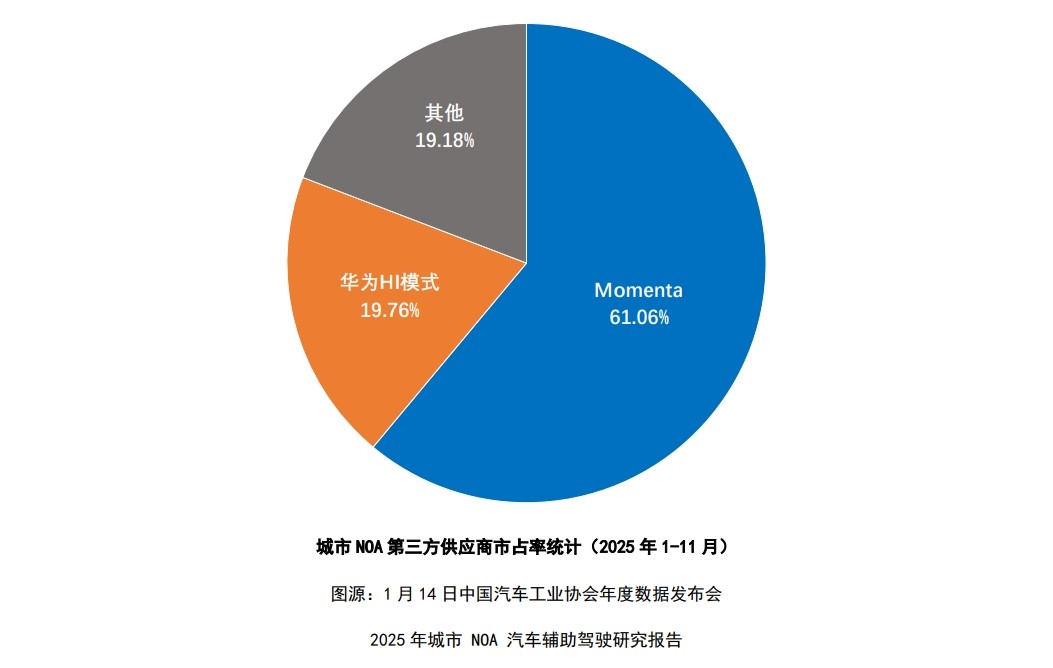
Core Insights - The report highlights the rapid growth of the urban NOA (Navigation on Autopilot) market in China, with a cumulative sales of 3.129 million passenger cars equipped with urban NOA from January to November 2025, achieving a penetration rate of 15.1%, an increase of 5.6 percentage points compared to the entire year of 2024 [3][4]. Group 1: Market Dynamics - The urban NOA market is characterized by a "dual strong" pattern among third-party suppliers, with Momenta and Huawei leading the market, together accounting for over 80% of the market share among third-party suppliers [3][4]. - Momenta has a leading position with 414,400 units of urban NOA equipped vehicles, representing approximately 61.06% of the third-party supplier market, while Huawei's HI model has around 134,100 units, accounting for about 19.76% [3][4]. Group 2: Competitive Landscape - Domestic brands have shown significant strength, with sales of urban NOA-equipped vehicles reaching 2.5373 million units, making up 81.1% of total sales, indicating their innovation and competitiveness in the smart connected vehicle sector [4]. - Global automotive brands are increasingly collaborating with leading domestic third-party suppliers to enhance their smart driving capabilities, with notable partnerships including Mercedes-Benz, BMW, Audi, Cadillac, Buick, and Toyota [4]. Group 3: Technological Advancements - The report emphasizes that algorithms, data closed-loop capabilities, and experience in large-scale production are critical factors determining the market position and development speed of autonomous driving suppliers [4][5]. - The end-to-end large model has become the core engine for the iteration of NOA auxiliary driving technology, promoting a shift from modular architecture to an integrated perception and planning system [5][6]. Group 4: Future Trends - The competition among autonomous driving suppliers is evolving from a focus on single technical indicators to a comprehensive capability that includes product experience, technological potential, and scalability [7]. - The integration of multi-modal models and end-to-end technology, along with continuous upgrades of computing platforms, is expected to enhance the safety experience of urban NOA technology [6][7].
车企自研、第三方合作“双轮驱动”,城市NOA规模化加速
Zhong Guo Jing Ji Wang· 2026-01-15 02:12
Core Insights - 2025 is identified as a critical year for the commercialization of urban NOA (Navigation Assisted Driving) in China, with a projected market scale growth [1] - The report indicates that from January to November 2025, the cumulative sales of passenger cars equipped with urban NOA reached 3.129 million units, with a penetration rate of 15.1%, an increase of 5.6 percentage points compared to the entire year of 2024 [1] Industry Background - NOA technology is seen as a key driver for smart connected vehicles, bridging advanced driver assistance and fully autonomous driving, which is crucial for enhancing user travel experience and asserting China's competitive voice in the global automotive industry [3] - The report highlights that among the passenger cars sold with urban NOA, domestic brands accounted for 2.5373 million units, representing 81.1% of the total, showcasing innovation and competitiveness in the smart connected vehicle sector [3] Market Dynamics - The current market for urban NOA is characterized by a dual-driven model of self-research by car manufacturers and collaboration with third-party suppliers [5] - Major players in self-research include Tesla, NIO, Xpeng, Li Auto, Xiaomi, and others, while approximately 29 brands collaborate with third-party suppliers [5] - The third-party supplier market is dominated by two key players, Momenta and Huawei, which together hold about 80% market share; Momenta's urban NOA installations reached 414,400 units, accounting for 61.06% of third-party suppliers, while Huawei's HI model accounted for 19.76% with 134,100 units [5] Technological Advancements - The rapid iteration of technology and market competition is driving systemic changes in smart driving technology, core architecture, and industrial ecology [9] - The report emphasizes that end-to-end large models are becoming the core engine for NOA technology iteration, facilitating a shift from modular architecture to integrated systems [10] - New energy vehicle manufacturers are building technological barriers through full-stack self-research, while traditional automakers are accelerating technology deployment through partnerships with third-party suppliers [10] Future Outlook - The report anticipates that by 2030, urban NOA will become a mainstream feature in both assisted and autonomous driving [10] - Recommendations for enhancing the high-quality development of NOA include improving top-level design, strengthening technological innovation, enhancing industry collaboration, and exploring global competitiveness for supply chain enterprises [11]


2025城市NOA汽车辅助驾驶研究报告发布 搭载城市NOA功能的乘用车销量超300万辆
Zhong Zheng Wang· 2026-01-14 13:18
Core Insights - The report indicates that 2025 will be a pivotal year for the commercialization of urban NOA (Navigation Assisted Driving) in China, with rapid market growth expected [1] - By 2030, urban NOA is projected to become a mainstream feature in assisted and autonomous driving [1] Group 1: Market Growth and Projections - In the first three quarters of 2025, new car sales in China with Level 2 (L2) driving assistance features increased by 21.2% year-on-year, achieving a penetration rate of 64%, expected to rise to 66.1% by the end of 2025 [1] - By November 2025, cumulative sales of passenger cars equipped with urban NOA reached 3.129 million units, with a penetration rate of 15.1%, an increase of 5.6 percentage points compared to the entire year of 2024 [2] Group 2: Industry Dynamics and Competitiveness - Major automotive manufacturers are accelerating the adoption of intelligent driving assistance, with domestic brands accounting for 81.1% of urban NOA-equipped passenger car sales, totaling 2.5373 million units [2] - Global automotive brands, including Mercedes-Benz, BMW, Audi, Cadillac, Buick, and Toyota, are collaborating with leading domestic third-party suppliers to achieve breakthroughs in intelligent driving assistance [2] Group 3: Future Outlook and Challenges - The Ministry of Industry and Information Technology anticipates that by 2030, combined driving assistance and connected collaborative functions will be widely adopted, with advanced autonomous driving features entering the market at scale, potentially creating trillions in value for the automotive industry [2] - Challenges remain for the high-quality development of NOA, including insufficient core technology, the need for enhanced data security and computing power, and the necessity for a more comprehensive standards and regulatory framework [2]