多策略产品

Search documents
中信证券:多资产策略兼顾不同市场间的收益,同时具备Alpha和Beta端获益潜力
Xin Lang Cai Jing· 2026-01-31 03:25
Group 1 - The core viewpoint of the report indicates that the private equity market will see significant performance improvements due to a better equity market environment in 2025, with a projected industry scale rising to approximately 7.2 trillion yuan [1] - The leading positions among fund managers remain stable, with a notable increase in the share of quantitative products compared to the beginning of the year [1] - The stock strategy is expected to outperform in a fluctuating market in 2025, with products linked to high market correlation, macro strategies, multi-strategies, and FoF/MoM also yielding substantial returns [1] Group 2 - The current A-share market is active, and private equity managers exhibit strong confidence in the market, with increased consensus among investors [1] - Attention is drawn to the accelerated short-term rotations in high-risk and low-risk assets, while the commodity market experiences increased volatility, making subjective CTA products more valuable due to their flexibility [1] - Multi-asset strategies are highlighted for their ability to balance returns across different markets, possessing potential for both Alpha and Beta gains [1]

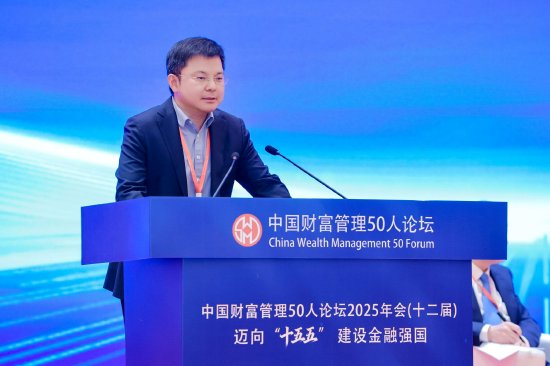
周向勇:公募基金需强化能动性 聚焦科技赋能与内需消费主线
Xin Lang Cai Jing· 2025-12-27 12:07
Core Viewpoint - The China Wealth Management 50 Forum 2025 Annual Meeting emphasizes the theme of "Building a Financial Powerhouse during the 14th Five-Year Plan" and discusses the role of asset management in supporting the real economy [1][6]. Group 1: Role of Asset Management - The fundamental basis of China's real economy provides a solid foundation for the development of capital markets, which have not fully exerted their influence on the economic foundation in recent years [3][8]. - During the 14th Five-Year Plan, the core task of public funds is to enhance their proactivity and provide higher quality services to support economic transformation [3][8]. - The functionality and profitability of asset management institutions are not in conflict; public funds should prioritize functionality to achieve profitability in the long run, ensuring a positive interaction and balance between the two [3][8]. Group 2: Focus Areas for Public Funds - Two core focus areas are identified for public funds to serve the real economy: technology as a key driver of economic and social development, and the transition from real estate-led investment to a technology-centric development model [4][9]. - The 14th Five-Year Plan emphasizes high-level technological self-reliance, and public funds should not only support advanced technology research but also promote the application of technological achievements across various sectors [4][9]. - There is a need for long-term capital that can accompany the economy through its critical transformation period, and public funds must create real value to encourage investors to keep their funds in the capital market for the long term [4][9]. Group 3: Future Directions - Public funds will focus on high-quality development under national strategic guidance, aiming to facilitate the transformation of the real economy and the implementation of planning [5][10]. - Continuous enhancement of product innovation and research capabilities will be essential to better serve technological development and expand domestic demand, promoting the formation of long-term capital [5][10]. - The goal is to assist China in transitioning from a financial power to a financial powerhouse, allowing the capital market to play a crucial role in the economy [5][10].

西南财经大学信托与理财研究所所长翟立宏:多资产、多策略是增厚投资收益的重要抓手
Mei Ri Jing Ji Xin Wen· 2025-12-25 14:57
Core Viewpoint - The banking wealth management market is undergoing a critical transformation in its revenue sources and product structure due to the intertwined macroeconomic backdrop of low interest rates and "asset scarcity" [1] Group 1: Restructuring of Wealth Management Product Revenue Sources - The low interest rate environment and "asset scarcity" are reshaping the revenue sources of wealth management products, presenting both challenges and opportunities for the banking wealth management industry [2] - Traditional fixed-income products are facing significant yield constraints, while the exploration of equity assets is seen as a primary direction for enhancing product yield flexibility [2] - The product structure is expected to shift towards "fixed income plus" products and multi-strategy offerings, with a focus on themes like retirement, ESG, and technology innovation [2] Group 2: Role of Banking Wealth Management in Retirement Planning - Banking wealth management is a core component in building the third pillar of retirement, leveraging its extensive distribution network and customer trust to promote personal pension schemes [3] - New regulations encourage the issuance of long-term products, which can channel significant "long money" into essential sectors like infrastructure and healthcare, supporting long-term economic development [3] - By lowering investment thresholds and optimizing management fees, banking wealth management enhances accessibility to professional retirement investment services [3] Group 3: Advantages and Challenges of Retirement Wealth Management - Compared to funds and insurance products, retirement wealth management offers a better fit for the long-term, stable, and risk-controlled needs of retirement funds [4][5] - Retirement wealth management products have an average annualized return of approximately 3.91% with a volatility of only 0.17%, highlighting their risk control advantages [4] - The development of retirement wealth management faces challenges from demand, supply, and investment sides, including a lack of long-term investment awareness among residents and product homogeneity [6] Group 4: Future Development of Banking Wealth Management - Small and medium-sized banks without wealth management subsidiaries are transitioning to a distribution model, focusing on localized services and customer trust [7] - By 2026, the banking wealth management market is expected to enter a phase of high-quality development centered on professional active management capabilities [8] - The industry is likely to see increased concentration, with a shift towards licensed wealth management companies and a significant optimization of product structures [8] Group 5: Investment Strategies for Investors - Investors are advised to set reasonable investment goals and expectations, focusing on long-term sustainable returns within their risk tolerance [9] - A scientific asset allocation strategy is recommended, utilizing cash management and fixed-income products for defensive purposes while capturing market opportunities with "fixed income plus" and mixed products [9] - Maintaining a long-term holding strategy is essential to smooth out short-term volatility and avoid emotional trading based on market fluctuations [9]
投资中的择时难题被我破解了!
雪球· 2025-12-11 13:00
Core Viewpoint - The article discusses the differences in investment experiences between the Chinese A-share market and the US stock market, highlighting the challenges of timing the market in A-shares compared to the more stable performance of US stocks [3][4][6]. Group 1: Market Performance Comparison - Over the past 20 years, the annualized returns of the CSI 300 and the S&P 500 have been similar, around 8%-9% [3]. - Despite similar returns, investors feel that making money in the US stock market is easier due to its relatively stable performance [4][6]. - The A-share market experiences significant volatility, with most returns concentrated in short bursts, making it difficult for investors to profit without precise timing [9][10]. Group 2: Challenges of Market Timing - Market timing is inherently difficult due to unpredictable short-term fluctuations influenced by sudden events, emotions, and policies [19]. - Successful market timing requires a strong psychological disposition, as it involves buying during significant downturns and selling during peaks, which is challenging for most investors [21][28]. - Ordinary investors lack the advantages that institutional investors have in terms of information, research capabilities, and tools, making it harder for them to time the market effectively [28]. Group 3: Strategies for Investment - To navigate the difficulties of market timing, the article suggests focusing on investment strategies that yield stable and consistent returns over time, reducing the need for precise timing [30][32]. - A diversified approach across different assets and strategies can help ensure that some components of the portfolio remain effective regardless of market conditions, leading to smoother returns [39][47]. - The "Snowball Three-Point Method" is highlighted as a strategy that emphasizes asset diversification and the use of various fund strategies to mitigate risks and enhance long-term returns [47].