
多资产FOF

Search documents
金融产品每周见:多资产FOF:策略比较分析与竞争格局展望-20260324
Shenwan Hongyuan Securities· 2026-03-24 13:46
1. Report Industry Investment Rating No relevant content provided. 2. Core Views of the Report - FOF has become a highly - concerned category in the public - offering industry since 2026, with its scale exceeding 30 billion yuan, and the initial offering scale of multi - asset FOF exceeding 6 billion yuan in 2026. The average initial offering scale of single - FOF has reached a new high since 2018, and it is expected to break the historical record in 2026 [3][7][11]. - The public - offering FOF has entered the 3.0 era, focusing on developing multi - asset FOF under the demand for absolute returns. Since 2025, the top 20 FOFs in terms of initial offering scale are all multi - asset strategies, with the weighted position of the benchmark below 25%, mostly around 10% [12][15]. - The main channels of multi - asset FOF include exclusive bank plans (such as the Changying Plan of China Merchants Bank, the Longying Plan of China Construction Bank, and the Huitou Plan of Bank of China) and Internet platforms (such as the Stable Wealth Management of Ant Fortune and the Dajiaying of Tencent Financial Management) [20][23]. - Compared with low - position fixed - income plus funds, multi - asset FOF has higher returns and better maximum drawdown control in the past six months. Although the two types of products have similar trends in most periods, the excess correlation between them weakens significantly in some periods [56]. - Multi - asset FOF can achieve absolute returns through dynamic trading and position adjustment. Most multi - asset FOF were not sensitive to gold in October 2025 but became more sensitive in January 2026, and the sensitivity of some FOFs decreased after mid - March [88]. - The challenges of multi - asset FOF include the poor performance of investable superior assets, limited QDII fund quotas, and QDII fund premiums [4]. - Based on the Bootstrap method, a multi - asset allocation scheme can be achieved by superimposing common requirements such as drawdown/Sharpe on the probability space of asset returns. The annualized return of the long - term portfolio is generally between 5% - 7% since 2019 [4]. 3. Summary According to the Directory 3.1 Multi - asset FOF: Product Positioning and Risk - return Preferences of 5 Major Channels - **Market Status**: In 2026, FOF has become a popular category in the public - offering industry. The total initial offering scale of public - offering funds is 260.404 billion yuan (274 funds), and the initial offering scale of FOF is 61.973 billion yuan (40 funds), accounting for 23.80% (14.60% in terms of quantity). The average initial offering scale of single - FOF is 1.549 billion yuan, a new high since 2018 [7][11]. - **Development Stages of Public - offering FOF**: It has gone through three stages: focusing on pension FOF before 2020, developing fixed - income plus FOF from 2020 - 2021, and developing multi - asset FOF since 2025 [15]. - **Product Channels**: - **Bank Exclusive Plans**: - **Changying Plan (China Merchants Bank)**: Launched in 2024, it provides a one - stop asset allocation solution with four product positions: Anwenying, Andingying, Anxinying, and Anyiying, each with different return targets, maximum drawdown targets, and equity positions [28][31]. - **Longying Plan (China Construction Bank)**: Launched in January 2026, it has four categories, with low - volatility multi - asset FOF and medium - low - volatility multi - asset FOF having existing targets, aiming to provide asset allocation services for mass investors [32][35]. - **Huitou Plan (Bank of China)**: Launched in January 2026, it creates four product lines: Huiwen (ultra - low - volatility positioning), Huiying (low - volatility positioning), Huili (medium - volatility positioning), and Huiyi (high - volatility positioning) [36][40]. - **Internet Platforms**: - **Stable Wealth Management (Ant Fortune)**: Aims for a return of 2% - 4%, mainly investing in fixed - income assets such as bonds, with a small amount of equity allocation. Currently, it mainly consists of pure - bond funds and first - tier bond funds, with few FOFs [44][48]. - **Dajiaying (Tencent Financial Management)**: Selects products based on users' actual profit situations, aiming for a return of over 4%. Currently, it mainly includes fixed - income plus funds, and Xingquan Youxuan Wenjian Six - month Holding is the only FOF selected so far [41][43]. 3.2 Strategy Comparison Analysis: How 15 Managers Achieve Absolute Returns - **Market Competitiveness**: Compared with low - position fixed - income plus funds, multi - asset FOF has a higher return of 2.27% and a better maximum drawdown of - 1.15% in the past six months, with a Calmar ratio of 4.68 [52][56]. - **Asset Allocation**: - **Equity Funds**: Some institutions mainly allocate active equity funds (such as Wells Fargo, E Fund), some mainly allocate passive funds (such as China Europe, GF Fund), some have a relatively balanced allocation (such as Xingquan, China Asset Management), and some do not directly invest in equity funds (such as Guotai, Southern Fund) [59]. - **Absolute Return and Bond Funds**: Some institutions prefer internal investment (such as Wells Fargo, China Europe), some prefer to allocate fixed - income plus funds (such as E Fund, GF Fund), and some do not allocate fixed - income plus funds (such as Guotai, Boshi) [69]. - **Commodity Funds**: Most institutions allocate gold, nearly half also allocate soybean meal ETFs. Guotai focuses on silver LOF, and Hua'an invests in energy - chemical ETFs and non - ferrous ETFs [70][73]. - **Direct Stock Investment**: Only nine representative products choose to invest directly in stocks, with high differentiation in configuration themes [76]. 3.3 Thoughts on the Product: 3 Challenges and the Application of the Multi - asset Back - testing Control Model - **Challenges**: - **Poor Performance of Investable Superior Assets**: When the US stocks and gold assets fluctuated in 2025, FOF also suffered drawdowns, and the diversification effect of multi - assets was limited [101][102]. - **Limited QDII Fund Quotas**: Domestic fund companies have limited QDII quotas, and multi - asset FOF cannot freely allocate QDII funds [103]. - **QDII Fund Premiums**: There have been three periods of high premium rates in history (2020, 2024, and 2025), mainly related to the overseas investment boom [107][108]. - **Multi - asset Back - testing Control Model**: Based on the probability space of asset returns, by superimposing common requirements such as drawdown/Sharpe, a multi - asset allocation scheme under the Bootstrap method can be achieved. Different drawdown targets (2%, 3.5%, 5%, 15%) lead to different asset allocation characteristics [110][111].
写在2026丙午马年前:四分之一转弯处的大众理财
Sou Hu Cai Jing· 2026-02-11 10:29
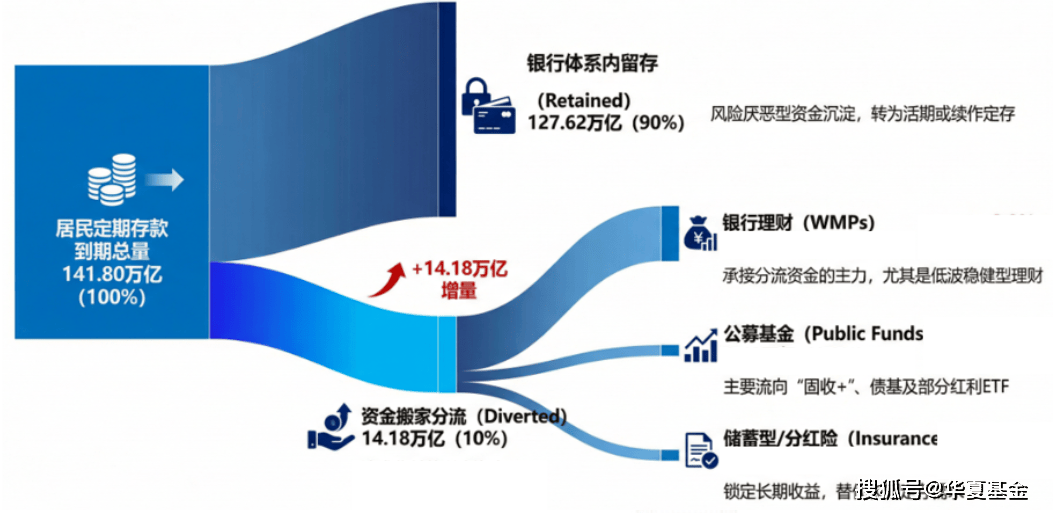
Core Insights - The article discusses the evolving landscape of personal finance in China, highlighting key trends and investment strategies as the Chinese New Year approaches [1][2]. Group 1: Investment Trends - The five most popular investment keywords for this year are identified as "gold awakening," "new three golds," "deposit migration," "A-share slow bull," and "AI narrative finance" [1]. - The concept of "new three golds" refers to a combination of money market funds, bond funds, and gold funds, which have gained popularity among investors [15]. - The A-share market is experiencing a slow bull phase, with the index surpassing 4000 points for the first time in ten years, indicating a potential recovery in investor confidence [8][12]. Group 2: Market Dynamics - A significant amount of over 50 trillion yuan in 2-5 year fixed deposits is expected to mature by 2026, leading to a potential influx of capital back into savings accounts [3][20]. - The decline in risk-free interest rates has resulted in lower returns from money market funds, which have dropped from over 6% in early 2014 to around 1% currently [3]. - The public fund industry is adapting to these changes, with products like low-volatility fixed income and multi-asset funds becoming more prominent as alternatives to traditional savings [6][8]. Group 3: Gold Investment - Gold has emerged as a key asset for investors seeking to hedge against uncertainty and inflation, with its appeal growing among younger demographics [15][20]. - The price of gold has seen significant volatility, with rapid increases in value over short periods, indicating a shift in market sentiment towards gold as a safe haven asset [16][18]. - The article emphasizes the importance of understanding the dual nature of gold as both a speculative asset and a hedge against market instability [16][18]. Group 4: ETF Popularity - The use of ETFs has surged, with 20.95 million A-share investors reportedly achieving higher returns through ETFs compared to traditional stock trading [12]. - The total scale of ETFs has increased from 4 trillion yuan to 6 trillion yuan, reflecting a growing acceptance of low-cost investment tools among the public [12]. - The article suggests that ETFs are becoming a preferred investment vehicle for ordinary investors, providing a more equitable opportunity for wealth generation [12]. Group 5: Future Outlook - The article anticipates a more diversified investment landscape in 2026, with a focus on asset allocation and the recognition of the value of various financial tools [20][21]. - The potential for three interest rate cuts by the Federal Reserve in 2026 could impact gold prices and investor strategies, prompting a reevaluation of gold holdings [18]. - Overall, the article highlights a collective shift in how individuals approach wealth management and investment in the current economic climate [20].

读研报 | 理解增量资金,别总盯着总量
中泰证券资管· 2026-01-20 11:33
Core Viewpoint - The article discusses the importance of incremental capital as a market confidence indicator and a key factor in assessing market trends, highlighting the challenges in accurately predicting its inflow [1] Group 1: Incremental Capital Estimates - Different research reports provide varying estimates for incremental capital inflow in 2026, with projections ranging from 1.6 trillion to 3 trillion yuan, indicating significant discrepancies [1] - The analysis suggests that understanding the sources and types of capital is more practical than merely estimating total amounts [1] Group 2: 2025 Incremental Capital Breakdown - According to the Guosen Securities strategy report, the incremental capital for 2025 is divided into two phases: the first half sees retail investors transferring 240 billion yuan, foreign capital returning approximately 100 billion yuan, and long-term investments from insurance funds amounting to about 420 billion yuan [2] - The second half of 2025 is expected to see significant inflows from private equity and leveraged trading, with an estimated 700 billion yuan entering the market since July and around 400 billion yuan from private equity funds [2] - The sectors attracting the most capital in the first half include technology and dividend stocks, while the second half sees inflows into non-ferrous metals, electronics, and new energy sectors [2] Group 3: 2026 Main Sources of Incremental Capital - The Huatai Securities strategy report identifies three main sources of incremental capital for 2026: high-risk preference retail funds, medium-low risk preference retail funds, and long-term capital [4] - High-risk preference funds include retail, financing, and private equity funds, while medium-low risk funds consist of maturing fixed deposits with an estimated 8% allocated to non-monetary asset management products [4] - The Huaxin Securities report anticipates public funds, wealth management funds, and insurance funds as the top three sources of incremental capital [4] Group 4: Market Outlook - The article suggests that if a slow bull market becomes the prevailing trend, the main sources of incremental capital will likely be insurance and absolute return-focused funds, indicating potential investment opportunities [5]

四季度以来近2000亿元资金流入权益类ETF
Shang Hai Zheng Quan Bao· 2025-11-24 18:03
Core Viewpoint - The equity ETFs have seen significant inflows, with a total net subscription of 196.48 billion yuan since the beginning of the fourth quarter, indicating strong investor interest despite market fluctuations [1][2]. Fund Inflows - As of November 21, the net subscription for equity ETFs reached 40.79 billion yuan in a single day, marking the highest daily inflow since April 9 [1][2]. - The inflow pattern shows a "barbell" configuration, with strong interest in both underperforming broker-themed ETFs and technology growth ETFs [3]. ETF Performance - Broker-themed ETFs have attracted substantial capital, with notable net subscriptions including 9.27 billion yuan for Guotai Junan ETF and 5.70 billion yuan for Huabao Broker ETF [3]. - Technology growth ETFs also received significant attention, with net subscriptions of 7.31 billion yuan for Huaxia Sci-Tech 50 ETF and 4.58 billion yuan for Jiashi Sci-Tech Chip ETF [3]. Market Outlook - The upcoming launch of new ETFs is expected to bring additional capital into the market, with 54 funds currently in issuance and 24 about to start [4]. - Analysts predict that absolute return funds will be a key source of new liquidity, driven by the conversion of household deposits [4]. - Public funds currently maintain a relatively high stock position, with an average equity position of 89.09% as of November 21 [4]. Investment Strategy - The market is currently in a policy and earnings lull, leading to a potential for short-term volatility without new catalysts [5]. - Long-term fundamentals for A-shares remain strong, with a focus on balanced investment across sectors such as consumption, real estate, and non-bank financials [5]. - Mid-term attention should be directed towards sectors benefiting from manufacturing recovery and technology growth, including AI and innovative pharmaceuticals [5].
介绍一个多元资产配置工具
Xin Lang Ji Jin· 2025-11-06 07:39
Core Viewpoint - The current market environment has led to increased volatility in the A-share market, with technology stocks experiencing significant pullbacks, making multi-asset FOF products an attractive option for investors seeking stability [1][2]. Group 1: Multi-Asset FOF Benefits - Multi-asset allocation effectively responds to economic cycle fluctuations, helping to mitigate risks and smooth out portfolio volatility by including assets with low correlations [2][5]. - FOF funds aim to balance returns and drawdowns by diversifying across low-correlation assets, enhancing the Sharpe ratio while minimizing portfolio drawdowns [3][6]. - The FOF index has shown a 12.96% increase from November 1, 2020, to October 31, 2025, outperforming both the equity fund index and the CSI 300 index during downturns [3][4]. Group 2: Market Trends and FOF Growth - As of September 30, 2023, public FOF shares increased by 35.3 billion shares (27% growth) and the scale rose by 54.6 billion yuan (41% growth), indicating market recognition of FOF products for risk diversification [4]. - The evolution of FOF has transitioned from a focus on selecting stock funds to a comprehensive asset allocation tool across various categories and markets [4][5]. Group 3: Professional Management and Strategy - FOFs are managed by professional fund managers who conduct in-depth market research and adjust allocations based on macroeconomic conditions [6][8]. - The investment philosophy emphasizes absolute returns, focusing on controlling risks from asset valuation, price volatility, and macroeconomic factors [8][10]. - The recent performance of the Guotai Minze Balanced Pension Target Three-Year Holding Period FOF achieved a 13.52% return over the past year, exceeding its benchmark by 5.29% [8][10]. Group 4: Market Outlook - The market is currently experiencing a slight contraction around the 4000-point mark, with a shift from extreme differentiation to balance, suggesting a stable medium-term upward trend despite short-term adjustments [10][11]. - The conclusion of major events and the release of quarterly reports are expected to reduce uncertainty, allowing for new investment opportunities in quality assets [11].
