
学生公寓

Search documents
克拉科夫-房地产市场2026
莱坊· 2026-03-05 13:20
Investment Rating - The report indicates a positive investment outlook for the Krakow real estate market, particularly in the office, retail, and hotel sectors, driven by strong demand and limited supply [5][28][50]. Core Insights - Krakow is evolving into a hub for high-skilled jobs and R&D activities, moving away from simple process-based models, which enhances its attractiveness for businesses [4]. - The office market in Krakow is characterized by a total stock of 1.84 million square meters, making it the largest office market in Poland outside Warsaw, with a historical peak in demand expected by 2025 [14][28]. - The retail market is experiencing steady growth, supported by rising private consumption and low vacancy rates, with a current vacancy rate of only 2.6% [31][39]. - The hotel market remains robust, with Krakow being a leading tourist destination, recording significant increases in visitor numbers and hotel occupancy rates [54][60]. Summary by Sections Office Market - Krakow's office market has a total stock of 1.84 million square meters, with a vacancy rate of 18.4% and a limited new supply of only 12,000 square meters expected in 2025, the lowest in two decades [9][17]. - The demand for office space is driven primarily by IT and BSS sectors, which accounted for 26% and 15% of total leasing activity in 2025, respectively [19][25]. - The preference for high-quality, future-proof assets remains strong, with 85% of leasing transactions occurring in green-certified buildings [19][21]. Retail Market - The retail market in Krakow is characterized by a low vacancy rate of 2.6%, reflecting strong fundamentals and increasing foot traffic in shopping centers [31][39]. - Major retail projects include Bonarka City Center and Galeria Bronowice, contributing to a total retail stock of approximately 658,000 square meters [32][36]. - The market is expected to see a slight increase in new retail supply after two years of stagnation, with a focus on high-density shopping formats [30][32]. Warehouse Market - The warehouse market in Krakow is relatively small but stable, with a total inventory of over 1.2 million square meters and a low vacancy rate of 2.8% [41][43]. - The demand for logistics services is growing, supported by a strong economic foundation and limited land availability for new developments [41][42]. - The market is expected to face a significant slowdown in new supply, with only 8,000 square meters under construction by the end of 2025 [43][45]. Hotel Market - Krakow's hotel market features 196 hotels with approximately 14,300 rooms, making it the largest hotel market in Poland by number of establishments [50][51]. - The market is driven by a diverse mix of leisure and business travel, with a significant increase in hotel occupancy rates, reaching levels close to pre-pandemic figures [60][65]. - New hotel developments are focused on high-end and luxury segments, with several projects underway, including a Nobu hotel and a Le Méridien [58][71].
CBRE世邦魏理仕发布《2026年中国投资者意向调查》专题报告
Sou Hu Cai Jing· 2026-01-28 08:11
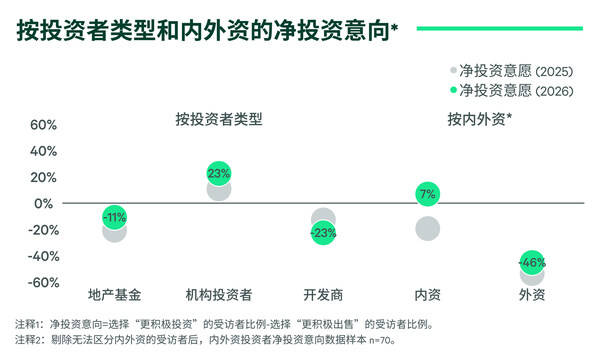
Core Insights - The Chinese commercial real estate investment market is expected to recover in 2026 despite cautious investor sentiment, with a slight increase in the proportion of respondents planning to invest and sell more actively [1] - Domestic net investment intentions have turned positive due to institutional investors and real estate funds, while foreign investors continue to show a net selling intention [2] Investment Sentiment - 43% of respondents plan to adopt a more aggressive investment strategy in 2026, and 52% are inclined to sell more actively, indicating a potential increase in transaction willingness [1] - 39% of respondents intend to increase their real estate asset allocation, up 3 percentage points from the previous year, with 12% planning significant increases, a rise of 6 percentage points [5] Property Preferences - Industrial logistics, rental residential, and retail properties remain the top three preferred property types among investors [6] - In alternative assets, student apartments have gained significant attention due to a supply-demand gap in higher education dormitory space, followed by infrastructure and life sciences real estate [9] Financing Environment - Nearly 80% of investors expect further interest rate cuts by the People's Bank of China in 2026, and new regulations on merger loans have improved the financing environment for large-scale commercial real estate investments [10] - The rental residential sector is expected to continue its growth trend, supported by policies for urban renewal and the integration of private-public REITs [10] ESG Considerations - Investors are shifting from general concern to a more focused approach regarding Environmental, Social, and Governance (ESG) standards, with 83% already adopting or planning to adopt ESG criteria in real estate investments [11] - Green buildings are recognized for their competitive advantage in attracting and retaining tenants, contributing to improved cash flow performance [11]


内地生赴港读书潮催热“宿舍生意” 学生公寓成当红投资标的
Mei Ri Jing Ji Xin Wen· 2026-01-27 13:20
Core Insights - The student accommodation market in Hong Kong is attracting significant global capital, with increased interest from Chinese institutions, large listed companies, and Southeast Asian funds, alongside traditional foreign and local investors [1][3][5] - The Hong Kong government is actively promoting the "Study in Hong Kong" initiative, aiming to position the region as a higher education hub, which is driving demand for student housing [3][4] Investment Trends - In 2025, there has been a noticeable acceleration in capital investments in student accommodation, with a total of 16 transactions amounting to over HKD 6.1 billion from January to October [5] - The majority of these transactions involve converting hotels into student accommodations, with six hotel conversions totaling HKD 4 billion [5] - Notable investments include a HKD 4.35 million acquisition by Hong Kong's Cheung Kong Property and a US private equity fund for a hotel in Mong Kok, expected to be transformed into student housing [5][6] Market Demand - The demand for student accommodation is driven by an increasing number of international and mainland students studying in Hong Kong, coupled with a significant shortfall of over 70,000 bed spaces for student housing [7][8] - The Y83 student accommodation project, which offers 600 beds, has achieved a 100% occupancy rate, indicating strong demand [9] Operational Dynamics - The student accommodation market primarily consists of repurposed existing properties, with limited new developments, as companies acquire and renovate older hotels or buildings [10] - Investment strategies typically involve partnerships between foreign funds and local operators, focusing on property acquisition, renovation, and subsequent leasing [10][11] Future Outlook - The short-term risk of oversupply in the student accommodation market is considered low, as demand from both local and non-local students continues to exceed supply [11][12] - The investment return rate for student accommodations is generally between 5% and 5.5%, calculated based on total acquisition and renovation costs against rental income [12]

专访第一太平戴维斯吴睿:外资回流,中国商业地产迎来新机遇
Nan Fang Du Shi Bao· 2026-01-27 06:35
Core Insights - The year 2026 marks the beginning of China's "14th Five-Year Plan," which outlines the development blueprint until 2030, focusing on the transformation of economic drivers, upgrading development paradigms, and reshaping the global landscape [1] - The real estate sector is at a critical juncture of stabilization and structural transformation, with new characteristics and opportunities emerging in both residential and commercial real estate markets [1][3] Real Estate Market Outlook - The overall real estate market is expected to maintain a stabilization trend in 2026, with significant structural differentiation; first-tier cities and prime locations are likely to see a rebound, while third and fourth-tier cities will continue to face inventory pressures [3][4] - Key indicators for market recovery include the reduction of first-hand housing inventory, the volume of second-hand housing transactions, and the participation of private enterprises in land auctions [6][7] - The core driving force for the real estate market's recovery is the overall macroeconomic improvement, which will stimulate demand and investment [7] Commercial Real Estate Opportunities - The global direct investment in real estate is projected to exceed $1 trillion in 2026, with China’s commercial real estate market poised to attract foreign capital, particularly in stable niche sectors like long-term rentals and quality community commercial projects [8][9] - The investment activity in China's commercial real estate is expected to improve, with core assets in first-tier cities returning to long-term investment value ranges, presenting structural opportunities for investors [11] - Domestic investors are encouraged to focus on high-quality, stable-return assets in prime locations, as these present a favorable window for investment amid the ongoing market adjustments [10][11]

世邦魏理仕:2026年中国投资者意向调查报告
Sou Hu Cai Jing· 2026-01-24 13:23
Investment Intentions - The overall sentiment of investors remains cautious for 2026, with 43% planning to invest more actively and 52% intending to sell more actively, indicating a slight increase from the previous year [16][9] - Domestic investors, driven by institutional investors and real estate funds, have shifted their net investment intention from negative to positive (+7%), while foreign investors continue to show a strong net selling intention [16][10] - 39% of respondents plan to increase their real estate asset allocation, with the main drivers being reasonable asset price adjustments and opportunities in distressed assets [18][10] Investment Strategies - Core and core-plus strategies are favored by 58% of investors, reflecting a heightened focus on cash flow stability [34][10] - The top three property types of interest are industrial logistics, rental residential, and retail properties, with high-standard warehouses in East China and Central-West regions expected to see cyclical opportunities [24][10] - There is a significant increase in interest in alternative assets, particularly student apartments and infrastructure, with data centers becoming the most optimistic property type due to AI computing demand [30][10] Financing and Interest Rate Environment - 77% of investors expect further interest rate cuts from the central bank, with most anticipating a reduction of up to 50 basis points [2][10] - The easing of merger loan regulations provides more flexible financing support, although refinancing gaps remain a major concern for investors [2][10] Environmental, Social, and Governance (ESG) - 83% of investors have already incorporated or plan to incorporate ESG factors into their investment decisions, with a focus on green buildings, renewable energy facilities, and green financing [2][10] - 66% of investors recognize the premium associated with ESG assets, although their attitudes are becoming more cautious [2][10] Market Trends - Shanghai remains the most favored investment destination, with 64% of respondents selecting it, followed by Beijing at 22% [36][10] - The focus on second and third-tier cities has increased by 5 percentage points, with retail properties becoming a focal point for investors [36][10] - The main risks identified for the real estate market include economic recession (68%) and geopolitical uncertainties (47%) [21][10]

调研150个家办后发现:大家热衷于地产投资,尤其是豪宅
Hu Xiu· 2025-05-12 05:39
Group 1 - The core viewpoint of the report is that family offices are increasingly favoring real estate investments due to its growth potential and wealth preservation capabilities [1][2] - Real estate constitutes a significant portion of family office investment portfolios, ranking just behind stocks and cash, with office buildings (20%), luxury residences (17%), industrial properties (14%), and hotels (12%) being the most allocated sectors [2][3] - Approximately 70% of real estate investments are domestic, with New Zealand (93%), Australia (90%), and the United States (86%) showing the highest domestic investment focus [2] Group 2 - Family offices view real estate as part of a broader investment strategy, balancing it with listed stocks, venture capital, or other private investments, and some see it as a strategic asset for core business operations [3] - Two-thirds of family offices manage private residential properties, primarily for family use and inheritance (44%), capital preservation (29%), and diversification (20%), with rental income being a lesser priority [5] - The most sought-after real estate sectors by family offices include living spaces (14%), industrial/logistics (13%), and luxury residences (12%) [7] Group 3 - Family offices express interest in expanding their real estate investments, particularly in living spaces, logistics, luxury residences, and hotels, but face challenges such as finding reliable partners (23%), tax regulations (20%), and asset competition (19%) [8] - In commercial real estate, opportunities are identified in gateway city office buildings, which are seen as volatility hedges, especially in light of increasing geopolitical risks [10][11] - Investors are also focusing on sectors with structural tailwinds, such as logistics and living spaces, while retail real estate in developed markets remains a point of interest [12][13] Group 4 - The report highlights a growing interest in ESG assets, with 90% of institutional investors setting social goals, and 73% focusing on workplace well-being [14][16] - The wine industry presents investment opportunities, particularly in vineyards, with prices in certain regions expected to decline significantly, while others remain stable [17][18] - The luxury goods market is experiencing mixed performance, with some sectors showing growth while others, like art and wine, are facing declines [22][24] Group 5 - The issue of inheritance is pressing, with 58% of family offices indicating that the next generation is involved in investment decisions, leading to changes in investment strategies [27][28] - Cultural and moral differences between generations affect investment strategies, with a notable shift towards sustainable investments among millennials compared to baby boomers [29]