
租赁住宅

Search documents
2月百城二手房价格跌幅继续收窄,房价结束急跌阶段?
中指研究院· 2026-03-15 02:09
Investment Rating - The report indicates a cautious outlook on the real estate market, suggesting that 2026 is a critical year for stabilization after a period of decline [3][12]. Core Insights - In February 2026, the average price of second-hand residential properties in 100 cities decreased by 0.54% month-on-month, with the decline narrowing by 0.31 percentage points compared to the previous month. Year-on-year, the price fell by 8.78% [3][4]. - The average price of new residential properties in February 2026 was 17,107 RMB per square meter, showing a slight month-on-month decrease of 0.04% but a year-on-year increase of 2.37% [3][4]. - The rental market saw a slight decline, with the average rent in 50 cities at 33.96 RMB per square meter per month, down 0.11% month-on-month and 3.79% year-on-year [3][4]. Summary by Sections Second-hand Residential Market - The month-on-month decline in second-hand residential prices across first, second, and third/fourth-tier cities was 0.42%, 0.57%, and 0.54%, respectively, with year-on-year declines of 7.85%, 9.44%, and 8.51% [8]. - A total of 5 cities experienced price increases, while 95 cities saw declines [8]. New Residential Market - In February, first-tier cities saw a 0.07% month-on-month decrease in new residential prices, while second-tier cities experienced a 0.08% increase. Year-on-year, first-tier cities rose by 6.51% and second-tier cities by 1.70% [8]. - 15 cities reported price increases, while 84 cities saw declines, with one city remaining stable [8]. Rental Market - The rental market showed a month-on-month decline of 0.11% in February, with a year-on-year decrease of 3.79% [3][4]. - The report highlights that short-term rental demand increased in some cities due to the Spring Festival, impacting rental prices [3][4]. Policy and Market Outlook - The report emphasizes that February's performance is crucial for the real estate market's trajectory in 2026, with March expected to be a key observation point for market trends [4][12]. - The government is expected to continue focusing on policies aimed at controlling supply and improving housing quality, with a gradual approach to real estate development [10][12].
中国房地产指数系统百城价格指数报告(2026年2月)
中指研究院· 2026-03-08 03:11
Investment Rating - The report does not explicitly provide an investment rating for the real estate industry. Core Insights - The average price of new residential properties in 100 cities decreased by 0.04% month-on-month but increased by 2.37% year-on-year, with the average price at 17,107 yuan per square meter [3][7]. - The average price of second-hand residential properties in 100 cities fell by 0.54% month-on-month and decreased by 8.78% year-on-year, with the average price at 12,835 yuan per square meter [11][12]. - The average rental price in 50 cities was 33.96 yuan per square meter per month, down 0.11% month-on-month and down 3.79% year-on-year [16][18]. Summary by Sections New Residential Prices - In February, the average price of new residential properties in 100 cities was 17,107 yuan per square meter, with a month-on-month decrease of 0.04% and a year-on-year increase of 2.37% [7]. - Among first-tier cities, the average price decreased by 0.07% month-on-month but increased by 6.51% year-on-year [7]. - The number of cities with rising new residential prices was 15, while 84 cities saw a decline [8]. Second-hand Residential Prices - The average price of second-hand residential properties in 100 cities was 12,835 yuan per square meter, with a month-on-month decrease of 0.54% and a year-on-year decrease of 8.78% [11]. - In first-tier cities, the average price fell by 0.42% month-on-month and decreased by 7.85% year-on-year [11]. - 5 cities experienced an increase in second-hand residential prices, while 95 cities saw a decline [12]. Rental Prices - The average rental price in 50 cities was 33.96 yuan per square meter per month, with a month-on-month decrease of 0.11% and a year-on-year decrease of 3.79% [16]. - 11 cities saw an increase in rental prices, while 38 cities experienced a decline [17]. - The rental price in Beihai increased by 0.36%, while Nanchang saw the largest decrease at 0.43% [17].
中指研究院:2026年1月全国百城二手住宅均价环比下跌0.85%
智通财经网· 2026-02-26 08:46
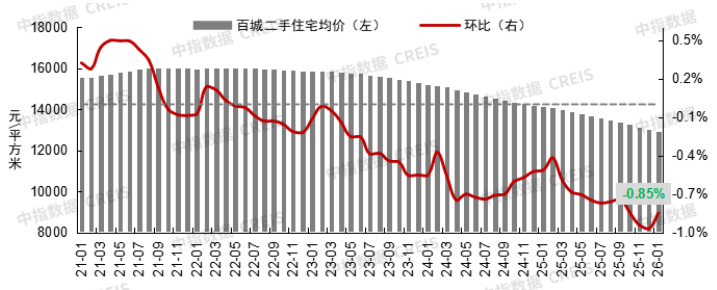
Summary of Key Points Core Viewpoint - The real estate market in China is experiencing a decline in second-hand residential prices across major cities, with a national average price of 12,905 yuan per square meter in January 2026, reflecting a month-on-month decrease of 0.85% and a year-on-year decrease of 8.67% [1]. Group 1: Second-Hand Residential Market - The average price of second-hand residential properties in first-tier, second-tier, and third/fourth-tier cities has decreased by 1.14%, 0.87%, and 0.73% month-on-month, respectively, with year-on-year declines of 7.64%, 9.34%, and 8.43% [1]. - In January, Beijing saw a transaction volume of 15,000 units, down 12.3% month-on-month but up 20.8% year-on-year due to the impact of the previous year's holiday [3]. - Shanghai's second-hand residential transactions reached approximately 20,000 units, with a month-on-month increase of 0.9% and a year-on-year increase of 27.5%, while prices fell by 1.22% month-on-month and 7.61% year-on-year [3]. - Guangzhou's second-hand residential prices decreased by 1.04% month-on-month and 9.04% year-on-year, indicating ongoing market pressure [3]. Group 2: New Residential Market - The average price of new residential properties across 100 cities is 17,114 yuan per square meter, reflecting a month-on-month increase of 0.18% and a year-on-year increase of 2.52% [6]. - High-end improvement projects in cities like Chengdu, Shanghai, and Hangzhou have contributed to a structural increase in new home prices [6]. Group 3: Rental Market - The average rental price for residential properties in 50 cities is 34.00 yuan per square meter per month, showing a month-on-month decrease of 0.45% and a year-on-year decrease of 3.67% [6]. Group 4: Transaction Volume and Year-on-Year Changes - Notable year-on-year transaction increases were observed in cities such as Shaoxing (46.9%), Wuxi (45.4%), and Ningbo (43.6%) [7][8]. - Conversely, cities like Chengdu (-11.3%), Suzhou (-19.4%), and Wenzhou (-21.9%) experienced significant declines in transaction volumes [9].

CBRE世邦魏理仕发布《2026年中国投资者意向调查》专题报告
Sou Hu Cai Jing· 2026-01-28 08:11
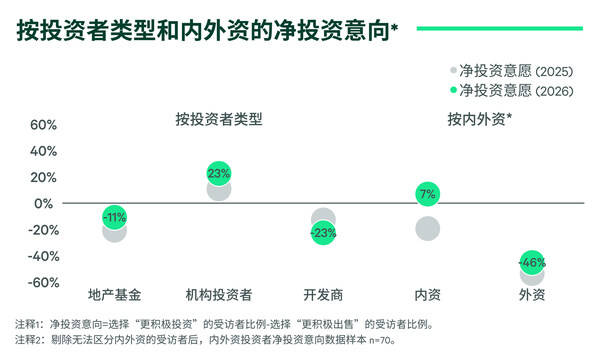
Core Insights - The Chinese commercial real estate investment market is expected to recover in 2026 despite cautious investor sentiment, with a slight increase in the proportion of respondents planning to invest and sell more actively [1] - Domestic net investment intentions have turned positive due to institutional investors and real estate funds, while foreign investors continue to show a net selling intention [2] Investment Sentiment - 43% of respondents plan to adopt a more aggressive investment strategy in 2026, and 52% are inclined to sell more actively, indicating a potential increase in transaction willingness [1] - 39% of respondents intend to increase their real estate asset allocation, up 3 percentage points from the previous year, with 12% planning significant increases, a rise of 6 percentage points [5] Property Preferences - Industrial logistics, rental residential, and retail properties remain the top three preferred property types among investors [6] - In alternative assets, student apartments have gained significant attention due to a supply-demand gap in higher education dormitory space, followed by infrastructure and life sciences real estate [9] Financing Environment - Nearly 80% of investors expect further interest rate cuts by the People's Bank of China in 2026, and new regulations on merger loans have improved the financing environment for large-scale commercial real estate investments [10] - The rental residential sector is expected to continue its growth trend, supported by policies for urban renewal and the integration of private-public REITs [10] ESG Considerations - Investors are shifting from general concern to a more focused approach regarding Environmental, Social, and Governance (ESG) standards, with 83% already adopting or planning to adopt ESG criteria in real estate investments [11] - Green buildings are recognized for their competitive advantage in attracting and retaining tenants, contributing to improved cash flow performance [11]

中指研究院:2025年12月百城二手住宅均价同比下跌8.36%
智通财经网· 2026-01-27 23:53
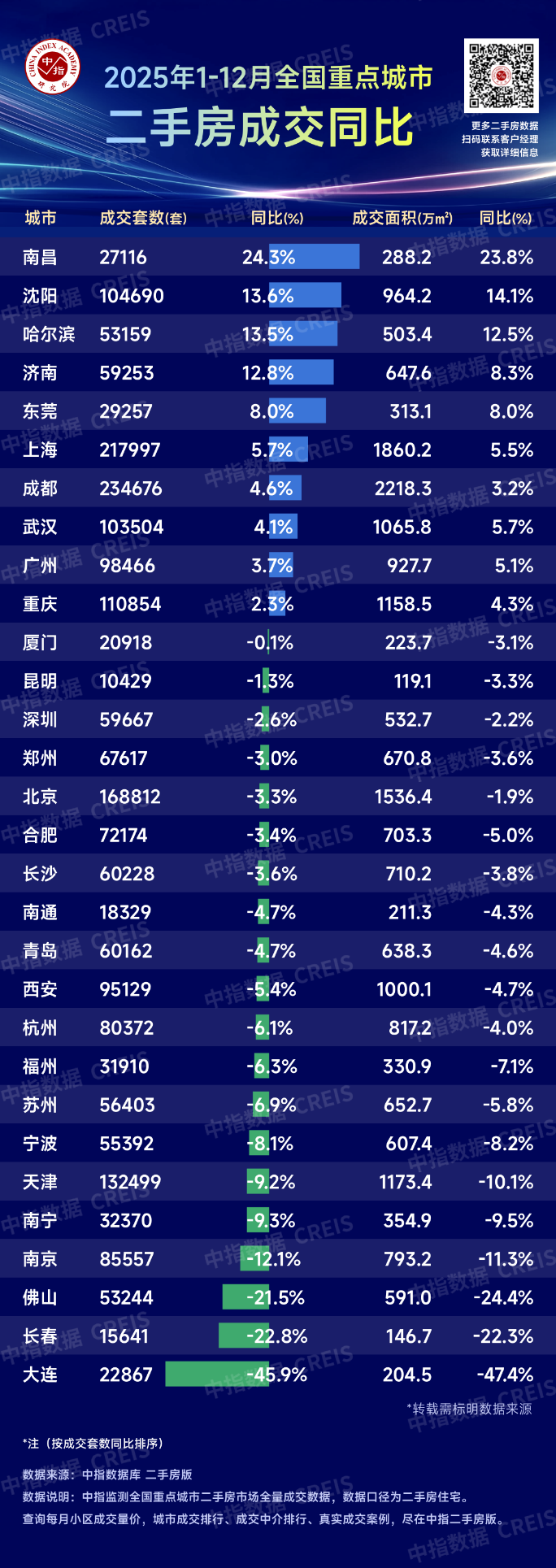
Core Insights - The report from the China Index Academy indicates that the average price of second-hand residential properties in 100 key cities dropped to 13,016 yuan per square meter in December 2025, reflecting a month-on-month decline of 0.97% and a year-on-year decrease of 8.36% [1][5][8] - In contrast, the average price of new residential properties in December 2025 was 17,084 yuan per square meter, showing a month-on-month increase of 0.28% and a year-on-year increase of 2.58% [1][5] - The rental market experienced a downturn, with the average rent in 50 cities falling to 34.16 yuan per square meter per month, down 0.60% month-on-month and 3.62% year-on-year [1] Second-hand Housing Market Performance - In December 2025, the total number of second-hand housing transactions in major cities showed varied performance, with cities like Nanchang and Shenyang experiencing significant year-on-year increases of 24.3% and 13.6%, respectively [2][3] - Conversely, cities such as Shenzhen and Beijing saw declines in transaction volumes, with year-on-year decreases of 2.6% and 3.3%, respectively [3][8] - The overall trend indicates that while some cities are recovering, many are still facing challenges in the second-hand housing market [5][9] New Housing Market Trends - The new housing market saw structural price increases in December 2025, driven by the introduction of high-end improvement projects in cities like Shenzhen, Beijing, and Shanghai [1][5] - The average price of new homes rose by 0.28% month-on-month, contrasting with the decline in second-hand housing prices [1][5] Rental Market Analysis - The rental market remains subdued, with average rents declining in December 2025, reflecting low demand during the traditional off-peak season [1][5] - The rental price drop of 0.60% month-on-month and 3.62% year-on-year indicates ongoing pressure in the rental sector [1][5] Price Index Overview - The cumulative decline in second-hand residential prices across 100 cities in 2025 was 8.36%, with the decline in second-tier cities being the most pronounced at 9.08% [5][8] - The report highlights that first-tier cities experienced a smaller decline of 6.72%, indicating a relative resilience compared to lower-tier cities [5]
2026日本房产市场前瞻:东京「独涨」还能走多远?
Sou Hu Cai Jing· 2026-01-26 11:39
Core Insights - The Japanese real estate market, particularly in Tokyo, is transitioning from a phase of "overall increase" to one requiring "fine judgment" among investors [1] - The upcoming 2026 market is characterized by Tokyo's dominance, but underlying structural differentiation and a ceiling effect in urban tower prices are changing market dynamics [2] Macroeconomic Environment - The Bank of Japan raised the policy interest rate to 0.75% in December 2025, signaling a departure from the "ultra-low interest rate era" and a consensus on rising funding costs [4] - Despite the macroeconomic changes, the Tokyo real estate market is increasingly driven by investment rather than basic housing needs, leading to a significant price increase [6] Investment Trends - The influx of foreign capital is a key driver of the robust performance in Japan's real estate investment market in 2025, as geopolitical tensions prompt a search for "safe, transparent, and predictable" investment destinations [6] - Japan remains an attractive option for foreign investors, with a projected total real estate investment of approximately 6 trillion yen in 2025, continuing into 2026 [8] Market Characteristics - The proportion of foreign buyers in new condominium projects in central Tokyo is rising, with some developments seeing over 20% foreign ownership [10] - High-end projects in areas like Minato have over 50% ownership by foreign entities and corporations, indicating a trend towards financialization of Tokyo's residential market [11] Housing Market Dynamics - The income required to purchase new condominiums in central Tokyo is substantial, with families needing an annual income of 20 to 30 million yen [11] - The supply of new condominiums is nearing a bottom, leading to limited price increase potential, while the second-hand market shows signs of inventory buildup [11] Policy Changes - Recent tax reforms have expanded the eligibility for housing loan tax deductions, which may inadvertently drive up housing prices in the short term [13][14] - The market is expected to see price adjustments in the second half of 2026, particularly in the second-hand market, as demand weakens [15] Future Outlook - The Japanese real estate market is entering a new phase where asset allocation and operational capabilities will determine success [16] - The investment logic is shifting from "buy and hold" to a focus on asset selection, location, and cash flow [17] - Investors are advised to adopt a rational approach rather than emotional decision-making in the current market environment [18]
世邦魏理仕:2026年中国投资者意向调查报告
Sou Hu Cai Jing· 2026-01-24 13:23
Investment Intentions - The overall sentiment of investors remains cautious for 2026, with 43% planning to invest more actively and 52% intending to sell more actively, indicating a slight increase from the previous year [16][9] - Domestic investors, driven by institutional investors and real estate funds, have shifted their net investment intention from negative to positive (+7%), while foreign investors continue to show a strong net selling intention [16][10] - 39% of respondents plan to increase their real estate asset allocation, with the main drivers being reasonable asset price adjustments and opportunities in distressed assets [18][10] Investment Strategies - Core and core-plus strategies are favored by 58% of investors, reflecting a heightened focus on cash flow stability [34][10] - The top three property types of interest are industrial logistics, rental residential, and retail properties, with high-standard warehouses in East China and Central-West regions expected to see cyclical opportunities [24][10] - There is a significant increase in interest in alternative assets, particularly student apartments and infrastructure, with data centers becoming the most optimistic property type due to AI computing demand [30][10] Financing and Interest Rate Environment - 77% of investors expect further interest rate cuts from the central bank, with most anticipating a reduction of up to 50 basis points [2][10] - The easing of merger loan regulations provides more flexible financing support, although refinancing gaps remain a major concern for investors [2][10] Environmental, Social, and Governance (ESG) - 83% of investors have already incorporated or plan to incorporate ESG factors into their investment decisions, with a focus on green buildings, renewable energy facilities, and green financing [2][10] - 66% of investors recognize the premium associated with ESG assets, although their attitudes are becoming more cautious [2][10] Market Trends - Shanghai remains the most favored investment destination, with 64% of respondents selecting it, followed by Beijing at 22% [36][10] - The focus on second and third-tier cities has increased by 5 percentage points, with retail properties becoming a focal point for investors [36][10] - The main risks identified for the real estate market include economic recession (68%) and geopolitical uncertainties (47%) [21][10]

盘中必读|房地产板块再度活跃,城投控股、大悦城等多股涨停
Xin Lang Cai Jing· 2026-01-20 05:53
Group 1 - The real estate sector experienced a significant rally on January 20, with stocks such as Dayuecheng and Wo Ai Wo Jia hitting the daily limit, following a surge in Chengtou Holdings and other companies like China Merchants Shekou and Poly Developments [1][2] - Chengtou Holdings, a comprehensive listed company controlled by Shanghai Urban Investment Group, has transformed from a government financing platform to a city comprehensive service provider, focusing on real estate development, operation, and financial investment [2][4] - The company has a diversified product system covering residential and commercial properties, and has participated in major urban development projects, contributing to the construction of affordable housing and rental residences in Shanghai [4] Group 2 - The recent rally in the real estate sector was driven by the Ministry of Finance and other departments extending the personal income tax preferential policy for residents' housing purchases until the end of 2027 [2] - The stock market saw a decline in major indices, with the Shenzhen Component Index dropping over 1% and the ChiNext Index falling more than 2%, despite the real estate sector's performance [2] - Chengtou Holdings has invested in the construction of 6.7 million square meters of affordable housing and 800,000 square meters of rental housing, benefiting approximately 200,000 citizens [4]


中国房地产指数系统百城价格指数报告(2025年12月)
中指研究院· 2026-01-11 01:36
Investment Rating - The report does not explicitly provide an investment rating for the real estate industry. Core Insights - The average price of new residential properties in 100 cities in December was 17,084 RMB/square meter, with a month-on-month increase of 0.28% and a year-on-year increase of 2.58% [3][8] - The average price of second-hand residential properties in the same cities was 13,016 RMB/square meter, showing a month-on-month decrease of 0.97% and a year-on-year decrease of 8.36% [3][12] - The average rental price in 50 cities was 34.16 RMB/square meter/month, reflecting a month-on-month decrease of 0.60% and a year-on-year decrease of 3.62% [3][17] Market Performance - In December, new residential prices saw structural increases in cities like Shenzhen, Beijing, and Shanghai, while the overall market remains in a bottoming phase [5][6] - The second-hand housing market continues to experience high listing volumes, with significant month-on-month price declines [5] - The rental market is in a traditional off-season, with low demand and continued price declines in rental properties [5] Policy Developments - The Central Economic Work Conference emphasized stabilizing the real estate market and implementing city-specific policies to control inventory and improve supply [4] - Recent policy changes include reducing the value-added tax on personal housing sales and easing purchase restrictions for non-local residents and families with multiple children in cities like Beijing and Shanghai [4] - The government aims to accelerate the construction of affordable housing and improve the housing provident fund system [4][6] Price Index Analysis - In December, 26 cities experienced an increase in new residential prices, while 68 cities saw declines [9] - The average price of new residential properties in first-tier cities increased by 0.81% month-on-month, while second-tier cities saw a 0.16% increase [8] - For second-hand properties, 100 cities reported a uniform price decline, with 27 cities experiencing declines exceeding 1% [13] Future Outlook - The year 2026 is expected to be crucial for stabilizing the real estate market, with policies likely to be implemented to optimize restrictions in core cities and promote the acquisition of existing properties [6] - The report forecasts a 6.2% year-on-year decrease in new residential sales area in 2026, with price performance expected to remain differentiated [6]
房地产行业:中国房地产指数系统百城价格指数报告(2025年11月)
中指研究院· 2025-12-27 08:19
Investment Rating - The report does not explicitly provide an investment rating for the real estate industry. Core Insights - In November, the average price of new residential properties in 100 cities increased by 0.37% month-on-month and 2.68% year-on-year, reaching 17,036 CNY per square meter. In contrast, the average price of second-hand residential properties decreased by 0.94% month-on-month and 7.95% year-on-year, standing at 13,143 CNY per square meter [3][12]. - The rental market showed a decline, with the average rent in 50 cities falling by 0.60% month-on-month and 3.57% year-on-year, averaging 34.36 CNY per square meter per month [17][19]. Summary by Sections New Residential Prices - The average price of new residential properties in 100 cities was 17,036 CNY per square meter, with a month-on-month increase of 0.37% and a year-on-year increase of 2.68%. Among first-tier cities, prices rose by 0.75% month-on-month and 6.66% year-on-year [8][10]. - In November, 31 cities experienced a month-on-month price increase, while 64 cities saw a decrease. The cities with the highest month-on-month increases included Shanghai (1.39%), Chengdu (1.34%), and Hangzhou (1.27%) [9][11]. Second-hand Residential Prices - The average price of second-hand residential properties in 100 cities was 13,143 CNY per square meter, with a month-on-month decrease of 0.94% and a year-on-year decrease of 7.95%. First-tier cities saw a month-on-month decline of 1.15% and a year-on-year decline of 5.62% [12][14]. - All 100 cities reported a month-on-month decline in second-hand residential prices, with Nanjing experiencing the largest drop at 1.83% [13][15]. Rental Market - The average rent in 50 cities was 34.36 CNY per square meter per month, reflecting a month-on-month decline of 0.60% and a year-on-year decline of 3.57% [17][19]. - Only one city saw a month-on-month rent increase, while 49 cities experienced declines, with the largest drop in Xi'an at 1.32% [18][19].