客户服务

Search documents
中信国安信息产业股份有限公司第八届董事会第二十一次会议决议公告
Shang Hai Zheng Quan Bao· 2026-01-23 19:05
Group 1 - The board of directors of CITIC Guoan Information Industry Co., Ltd. held its 21st meeting on January 23, 2026, with all 7 directors present, and the meeting was chaired by Chairman Wang Meng [1][3][11] - The board approved several proposals, including the establishment of a "Director's Compensation Management Method," a "Director's Departure Management Method," and a "Board Diversity Policy," all aimed at enhancing corporate governance and decision-making [3][5][7] - The board also approved the estimated daily related transactions for 2026 and the re-evaluation of the borrowing limit from related parties, which includes a request to increase the borrowing limit by up to 5 billion yuan [8][9][33] Group 2 - The company plans to hold its first temporary shareholders' meeting of 2026 on February 9, 2026, to review the proposals approved by the board, with a record date of February 2, 2026 [11][52][56] - The estimated daily related transactions for 2026 involve providing services to CITIC Bank and CITIC Securities, as well as purchasing commercial insurance from CITIC Prudential Life Insurance [16][18] - The company has applied for a borrowing limit of up to 10 billion yuan from CITIC Group and its subsidiaries, with a borrowing term of no more than 5 years, and plans to increase this limit by an additional 5 billion yuan [32][49][50]

收官之年,券商IT“成色”几何?
Zhong Guo Ji Jin Bao· 2025-12-28 06:05
Core Viewpoint - The securities industry is undergoing a digital transformation driven by technology and AI, with increasing regulatory scrutiny on compliance in IT operations [1][4]. Group 1: Digital Transformation and Investment - The securities industry has significantly increased its investment in information technology, with 44 firms disclosing a total expenditure of 28.11 billion yuan in 2023, where 14 firms invested over 1 billion yuan, accounting for 70.46% of total investments [2]. - The focus of IT investment is shifting from quantity to quality, emphasizing optimization and application rather than mere expansion, with efficiency and output becoming key metrics [2]. - The introduction of domestic AI models like DeepSeek has accelerated the localization of AI deployment in the financial sector, with firms exploring AI applications across various business scenarios [2]. Group 2: Role of Chief Information Officers (CIOs) - The role of Chief Information Officers (CIOs) has become increasingly critical in securities firms, with many firms appointing new CIOs who possess strong backgrounds in both IT and securities management [3]. - CIOs are seen as key figures in driving digital transformation, responsible for coordinating IT strategy, governance, and risk management within the firm [3]. Group 3: Regulatory Environment and Compliance - Regulatory scrutiny in the IT sector has intensified, with several firms receiving penalties for inadequate risk management and compliance failures, highlighting the importance of system security and data compliance [4][5]. - The regulatory focus includes zero tolerance for system failures that affect investor rights, strict penalties for IT-related misconduct, and accountability measures extending to individual CIOs [5]. - The need for enhanced compliance management is emphasized, with firms required to adapt their IT departments from a purely operational role to one that integrates business management and compliance [6][7]. Group 4: Upgrading Compliance Management - The rapid development of financial technology necessitates a stronger emphasis on data permissions and compliance, with regulatory bodies stressing the importance of information isolation and monitoring [6]. - Firms are encouraged to improve their IT governance capabilities, enhance service continuity, and strengthen defenses against information security risks [7].

尚福林:“AI+金融”非简单技术叠加 而是一场系统性变革
Xin Lang Cai Jing· 2025-12-28 02:12
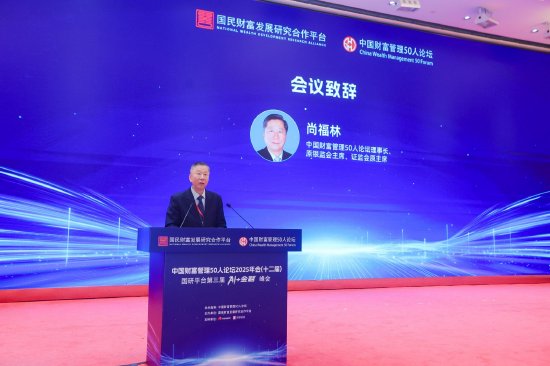
Core Insights - The 2025 Annual Meeting of the China Wealth Management 50 Forum focuses on "Building a Financial Powerhouse in the 14th Five-Year Plan" [1] - Artificial intelligence (AI) is evolving from a singular technological tool to a foundational capability that significantly reshapes industrial structures and economic operations, particularly impacting the financial sector [3][7] Group 1: AI's Impact on Finance - AI's rapid development provides new tools for enhancing financial business efficiency while also presenting challenges to financial operating mechanisms, risk control models, and governance systems [3][7] - The application of AI in finance has deepened, improving areas such as investment research, risk identification, fraud prevention, compliance management, customer service, and internal operations [3][7] - AI is becoming an integral part of financial infrastructure, moving towards a systematic and sustainable phase in the "AI + Finance" initiative [3][7] Group 2: Challenges and Considerations - There is a need to balance technological innovation with prudent management, ensuring that risk control and compliance are not compromised in the pursuit of efficiency [4][9] - Issues such as data governance, model interpretability, and responsibility boundaries are becoming increasingly prominent, with potential risks arising from non-compliant data sources and opaque decision-making processes [4][9] - The digital divide may lead to structural disparities among institutions, necessitating a focus on inclusivity while encouraging innovation and supporting leading institutions [4][9] Group 3: Future Governance and Development - The integration of AI in finance demands higher governance capabilities, requiring traditional regulatory frameworks to adapt to new technological environments [4][10] - Promoting the healthy development of "AI + Finance" hinges on balancing innovation with regulation, efficiency with safety, and ensuring that AI serves the real economy and technological innovation [5][10] - The initiative presents both significant opportunities for enhancing the efficiency and resilience of the financial system and new uncertainties and risks that must be managed [5][10]

斐雪派克亮相2025 Dreamforce大会
Jin Tou Wang· 2025-12-08 03:46
Group 1 - The 2025 Dreamforce conference showcased the digital transformation achievements of Fisher & Paykel, highlighting its role as a benchmark in digital marketing, IT infrastructure, and customer service [1] - In marketing, Fisher & Paykel utilized AI technology to enhance personalized experiences, resulting in a 33% increase in order conversion rates and a 75% efficiency improvement through internalized advertising content and automated operations [1] - In customer service, the company reduced user inquiries by half and shortened service wait times by nearly one-third through AI and automation technologies [1] - Fisher & Paykel's IT platform underwent significant digital transformation, enabling seamless data flow from order to service, which is essential for providing a high-end customer experience [1] - The company's digital practices reflect its commitment to designing for a changing world and responding to the demands of the digital age, offering valuable insights for the industry [1] Group 2 - Digital transformation has effectively driven market growth, with Fisher & Paykel and Haier holding the top sales share in the Australia-New Zealand market, achieving a 20% share in Australia and over 40% in the New Zealand white goods market [2]
A股百亿市值美妆公司冲刺港股
3 6 Ke· 2025-08-07 04:53
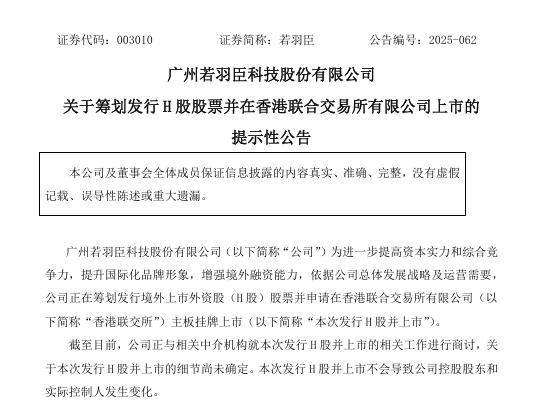
Core Viewpoint - Guangzhou Ruoyuchen Technology Co., Ltd. is planning to issue H-shares and apply for listing on the Hong Kong Stock Exchange, following other beauty TP companies, indicating a trend of dual listing in the beauty industry [1][2][3] Company Overview - Ruoyuchen, established in 2011 and listed on the Shenzhen Stock Exchange in 2020, is a beauty TP enterprise that provides comprehensive e-commerce services for brand owners, including online store operations and marketing [3][4] - The company has expanded its business from maternal and infant products to beauty, health products, and household cleaning, establishing itself as a global consumer brand digital management company [3][4] Financial Performance - For the first half of 2025, Ruoyuchen's net profit is projected to be between 63 million and 78 million yuan, a year-on-year increase of 61.81% to 100.33% compared to 38.93 million yuan in the same period last year [3][4] - In 2024, Ruoyuchen achieved revenue of 1.766 billion yuan, a year-on-year growth of 29.26%, and a net profit of 106 million yuan, up 94.58% from the previous year [4][6] Industry Context - The beauty TP industry is currently undergoing a deep adjustment period, with many companies struggling to survive. The total revenue of six listed beauty TP companies dropped from 9.99 billion yuan in 2022 to 7.653 billion yuan in 2024, a cumulative decline of 23.3% [4][5] - Despite the industry's downturn, Ruoyuchen has emerged as a rare success story, demonstrating strong growth resilience [5][7] Business Transformation - Ruoyuchen is transitioning from a "TP operator" to a "comprehensive brand service provider," focusing on self-owned brands and brand management to achieve structural growth [8][12] - The company's brand management business has rapidly grown, with revenue increasing from 160 million yuan in 2023 to 501 million yuan in 2024, marking a growth of 212.24% [10][11] Strategic Positioning - Ruoyuchen has diversified its business model by developing a balanced portfolio across various categories, reducing reliance on a single category. In 2024, the beauty category accounted for 34%, while household cleaning, maternal and infant products, and health products made up 28%, 21%, and 13%, respectively [12]