导航系统

Search documents
我国可回收火箭再获关键突破,星云二号发动机密集点火验证,海上回收助力商业航天迈入新阶段
Xin Lang Cai Jing· 2026-02-11 10:16
Group 1 - Hailanxin (300065) is a core enterprise in the field of smart ocean and commercial aerospace measurement and control, with a contract amount of 458 million yuan for a project related to reusable rocket recovery [1][25] - Jieli Suoju (002342) is a leading company in the domestic rigging industry, providing intercept nets and ultra-high molecular weight polyethylene ropes for rocket recovery, with a single set of capture arms valued at 15-20 million yuan [2][26] - Chaojie Co., Ltd. (301005) specializes in precision structural components, supplying key components for rockets, with a single set valued at 25-30 million yuan and securing 30 orders for 2026-2028 [3][27] Group 2 - Taisheng Wind Power (300129) is a leader in wind power towers, providing structural components for rockets and planning to cover 60% of launch tasks by 2025 [4][28] - Zhongheng Design (603017) is a leading engineering design firm, providing design and construction services for rocket recovery bases, supporting industry landing [5][29] - Yitong Century (300310) focuses on communication technology services, providing communication support for rocket recovery processes [6][30] Group 3 - Aerospace Electronics (600879) is a leading company in aerospace electronics, providing landing leg actuators for reusable rockets, with a projected increase in value by 3-5 times after commercialization in 2026 [7][31] - Mengsheng Electronics (688331) specializes in satellite navigation systems, providing core navigation systems for reusable rockets, supporting centimeter-level positioning [8][32] - Sry New Materials (688102) is a leader in high-strength copper alloy materials, supplying core materials for rocket engines, ensuring stable operation for recovery [9][34] Group 4 - AVIC Optoelectronics (002179) is a leading company in aerospace connectors, ensuring reliable signal transmission for rocket recovery processes [10][35] - Guokai Military Industry (688543) provides solid engine power modules for rockets, which are critical components for recovery [11][36] - Parker New Materials (605123) specializes in aerospace forgings, supplying key components for rockets, ensuring structural stability for recovery [12][37] Group 5 - Hanyu Technology (688239) focuses on titanium alloy forgings for rockets, supporting stable engine operation for recovery [13][38] - Race Intelligent (002979) provides specialized motors for rocket engines, crucial for thrust adjustment during recovery [14][39] - Aerospace Universe (688523) specializes in composite materials, supporting lightweight structures for rockets [15][40] Group 6 - Guoguang Electric (688776) provides electrical equipment for rockets, supporting electrical control and signal transmission during recovery [16][41] - Aerospace Hongtu (688066) offers satellite remote sensing services, providing environmental monitoring for rocket recovery [17][42] - Chunzong Technology (603516) provides ground measurement and control equipment for rocket launches and recoveries [18][43] Group 7 - Aerospace Electromechanical (600151) supplies solar panels and power systems for rockets, supporting energy management during recovery [19][44] - Wuzhou Xinchun (603667) supplies bearings for recovery systems, with annual orders valued at 120-180 million yuan [20][45] - Aerospace Morning Light (600501) provides ground support systems for rocket recovery, ensuring efficient execution of recovery operations [21][46] Group 8 - Aerospace Technology (000901) specializes in measurement and control services for rockets, ensuring precise control during recovery [22][47] - Aerospace Power (600343) provides fluid components for rocket engines, ensuring reliable fluid control during recovery [23][48]


汽车芯片,日本出招了
半导体芯闻· 2026-01-22 10:39
Core Viewpoint - Japanese automakers are collaborating with semiconductor manufacturers to share automotive semiconductor information, aiming to strengthen the supply chain against geopolitical risks and natural disasters [1]. Group 1: Collaboration and Database Development - Approximately 20 suppliers, including Japan's Renesas Electronics and Rohm, as well as Germany's Infineon Technologies, are expected to participate in this initiative [1]. - The plan is projected to cover 80%-90% of the semiconductors used by Japanese automakers, although no Chinese chip manufacturers will be involved [1]. - The initiative will involve registering product specifications, production start dates, and origins to simplify the identification of unstable supply sources [1]. - A blockchain technology will be utilized to prevent information leakage to other automakers [1]. - The Japan Automobile Manufacturers Association and the Japan Automobile Parts Industry Association are leading the development of the semiconductor database, with a target completion date set for April [1]. Group 2: Importance of Semiconductors in the Automotive Industry - Semiconductors are crucial in various automotive applications, from navigation systems to electric motors, and are vital for production and economic security [1]. - The global chip shortage during the COVID-19 pandemic significantly reduced automotive production [1]. - Honda anticipates that the chip shortage will reduce its operating profit by 150 billion yen (approximately $950 million) for the fiscal year ending March 2026 [1]. Group 3: Understanding Supply Chain Risks - The new system aims to enhance understanding of the risks associated with the sourced chips, enabling quicker responses to geopolitical events or natural disasters that disrupt production [2]. - Non-Japanese automakers can apply to use the system, indicating a broader potential impact on the automotive industry [2]. - The automotive industry is evolving towards autonomous driving and artificial intelligence, increasing the importance of semiconductors [2]. - According to the Japan Electronics and Information Technology Industries Association, the global automotive semiconductor market is expected to reach approximately $159.4 billion by 2035, growing over 80% from 2025 [2].



50亿美元政策红利!美扩大无人机禁令至零部件,本土产业链迎国产替代潮?
智通财经网· 2025-12-24 07:09
Core Insights - The new regulatory measures introduced by the U.S. government to restrict foreign-manufactured drones and their components are expected to reshape the domestic drone market and accelerate procurement activities starting next year [1][2]. Regulatory Changes - The FCC has officially included foreign-produced unmanned aerial systems and drone components from key foreign sources in the "regulated list" after completing national security assessments [1]. - This designation means that affected drones and components will not receive FCC authorization, effectively banning their import and sale in the U.S. unless exempted by the Department of Defense or the Department of Homeland Security [1]. Market Impact - The ruling is anticipated to limit the participation of foreign drone manufacturers, particularly large Chinese suppliers, in the U.S. market [2]. - The new "domestic procurement" requirements will gradually shift market demand towards U.S.-based drone and component manufacturers [2]. Funding and Support Initiatives - The FCC's actions are part of a broader strategy to support the development of drone systems, including the "Drone Dominance" initiative, which has allocated over $1 billion for small drone projects [3]. - Recent legislative and budget measures are estimated to add over $5 billion in funding for drone-related projects, which may lead to increased procurement activities, especially in defense-grade and expendable drone platforms starting in 2026 [3]. Industry Opportunities and Challenges - The regulatory restrictions combined with funding support present growth opportunities for U.S. drone and component suppliers [3][4]. - However, the transition away from existing foreign-manufactured systems will take time, and key factors such as defense procurement pacing, regulatory enforcement, and supply chain expansion capabilities may pose risks [3].
2025年珠三角地区北斗导航行业发展现状分析 综合产值接近1000亿元【组图】
Qian Zhan Wang· 2025-12-19 06:09
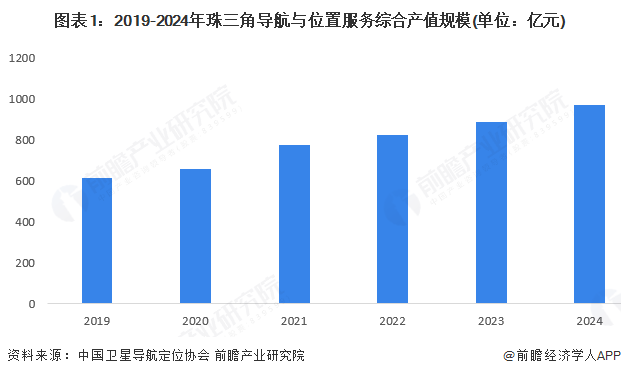
Core Insights - The comprehensive output value of the Beidou navigation and positioning services in the Pearl River Delta region is approaching 100 billion yuan, maintaining a growth trend since 2022, with an estimated value of around 1000 billion yuan in 2024, accounting for 21.1% of the national total, ranking first among five major industrial regions [1][2]. Group 1: Industry Overview - The Pearl River Delta has cultivated a number of representative companies in the Beidou navigation industry, including Haige Communication, Tongyu Communication, and Shenglu Communication, covering areas such as chips, antennas, and navigation systems [3]. - As of the first half of 2025, Haige Communication achieved a revenue scale of 2.23 billion yuan, leading among listed companies in the Beidou industry [5]. Group 2: Industrial Parks - There are four Beidou industrial parks in the Pearl River Delta, with a total of 39 related industrial parks nationwide as of October 27, 2025. Guangzhou and Huizhou each have two parks [6]. - The names and registered enterprise numbers of the parks include: - Zhongdian Beidou·Chip Innovation Valley, Huizhou: 127 enterprises - Haige Communication·Beidou Industrial Park, Guangzhou: 77 enterprises - Beidou Technology Industrial Park, Guangzhou: data not specified - Jimi Vehicle Networking and Smart Terminal Beidou Industrial Production Base, Huizhou: 142 enterprises [7]. Group 3: Policy Support - The Pearl River Delta continues to promote production upgrades and innovative development in the Beidou navigation system, with multiple policies released in 2024 by Guangdong Province emphasizing the application of Beidou navigation across various fields [8]. - Specific policies include: - In April 2024, Guangzhou issued implementation opinions to accelerate the construction of a Beidou industrial ecosystem, aiming for an industry scale of 60 billion yuan by the end of 2026 [10]. - In May 2024, a plan was introduced to promote high-quality development of the low-altitude economy, integrating Beidou and satellite internet technologies [10].

*ST亚太重整:每10股转增5股 北京星箭牵头注资4.04亿
2 1 Shi Ji Jing Ji Bao Dao· 2025-12-10 02:58
Core Viewpoint - *ST Asia Pacific (000691.SZ) has disclosed a restructuring plan aimed at resolving over 338 million yuan in debt through a combination of capital reserve conversion to share capital and the introduction of restructuring investors [1] Group 1: Restructuring Plan - The company plans to convert its existing total share capital of 323 million shares at a ratio of 5 shares for every 10 shares, resulting in an increase of 162 million shares [1] - The newly issued shares will not be allocated to existing shareholders but will be fully subscribed by restructuring investors [1] - Beijing Xingjian, the industrial investor, will acquire 75 million shares at 2.4 yuan per share, while strategic investor Lanzhou Financial Holdings will acquire 23.2754 million shares at the same price [1] Group 2: Financial Contributions - The restructuring investors will inject a total of 404 million yuan to support the company's business transformation [1] - A deposit of 73 million yuan has been donated by the restructuring investors to alleviate the company's liquidity pressure [1] - The debt repayment plan indicates that secured creditors will receive full cash repayment within the assessed value of the collateral, while ordinary creditors will have a tiered repayment scheme [1] Group 3: Business Transformation - Post-restructuring, the company aims to leverage the technological advantages of the industrial investor in the military guidance field to gradually introduce smart devices and navigation systems [1] - The company plans to optimize the product structure of its subsidiary, Lingang Yanuo, and extend into the new energy sector, specifically lithium battery electrolyte additives [1] - The company anticipates that its net assets will turn positive after the restructuring is completed [1]

最新医保政策解析:手术和治疗辅助操作,统一收费框架!
思宇MedTech· 2025-12-08 12:20
Core Viewpoint - The article discusses the issuance of the "Guidelines for the Pricing of Surgical and Treatment Auxiliary Operations" by the National Medical Insurance Administration, which aims to standardize and categorize auxiliary surgical operations within the medical insurance system, enhancing transparency and adaptability to new technologies [2][3]. Policy Background - The introduction of a unified pricing guideline addresses structural challenges in China's medical service pricing system, such as regional disparities and the lack of standardized pricing for auxiliary operations [3]. - The guidelines represent the first systematic classification of auxiliary operations in surgery, covering advanced technologies like 3D imaging, navigation systems, and remote surgery [3][4]. Key Components of the Guidelines - The pricing project consists of seven core elements: project name, service output, price composition, additional charges, expansion items, pricing units, and pricing explanations [4]. - The guidelines include 36 auxiliary operations categorized into six systems based on service output attributes, facilitating understanding across disciplines [5][6]. Categories of Auxiliary Operations - **3D Technology Chain**: This category includes operations related to 3D reconstruction, modeling, and printing, which enhance pre-surgical planning and individualization of treatment [6][8]. - **Tracing and Imaging Enhancement**: This category focuses on technologies that improve intraoperative information clarity, such as tracers and advanced imaging techniques [7][9]. - **Energy Instrument Assistance**: This category includes various energy devices used in surgery, emphasizing the separation of technical costs from device usage [10][11]. - **Intraoperative Imaging Guidance**: This category standardizes the pricing of imaging guidance during surgery, enhancing its role in risk management [12][13]. - **Surgical Path Navigation**: This category includes navigation systems that provide real-time tracking and positioning during surgeries [14][15]. - **Surgical Robotics and Remote Surgery**: This category recognizes the role of robotic assistance and remote surgery as significant advancements in surgical capabilities [16][18]. Understanding the Pricing System - The guidelines emphasize that "service output" is the sole basis for establishing pricing projects, allowing for flexibility in technical paths as long as the output remains consistent [20]. - The guidelines allow for existing projects to accommodate technological improvements without the need for new pricing applications, reducing barriers to innovation [21][22]. Implications for Hospitals and Enterprises - The new pricing framework is expected to lead to a comprehensive restructuring of cost management, quality control, and payment mechanisms within hospitals [26][30]. - Hospitals will be better equipped to assess the real costs and values of auxiliary operations, promoting transparency and accountability in surgical practices [30][31]. - Enterprises will need to shift their focus from equipment-centric models to service output-oriented strategies, enhancing their data capabilities to comply with new regulatory requirements [36][38]. Observations on Systemic Evolution - The guidelines represent a significant shift from fragmented technical approaches to a cohesive capability system, facilitating clearer communication of technological value [44][45]. - The formal recognition of independent pricing for capabilities, such as robotic assistance, aligns with international trends towards technology-neutral and capability-oriented regulatory frameworks [46]. - The requirement for data retention and reporting will transform surgical practices from experience-based to data-driven methodologies, supporting future research and clinical improvements [47][48].
【行业深度】洞察2025:中国北斗导航行业竞争格局及市场份额(附市场份额、企业竞争力分析等)
Qian Zhan Wang· 2025-11-13 02:09
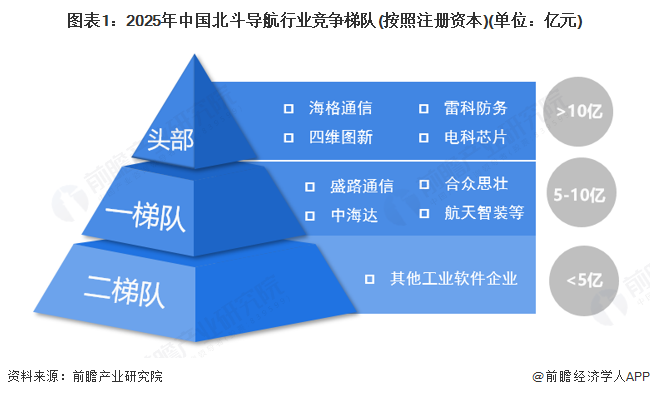
Core Insights - The article discusses the competitive landscape and market dynamics of the Beidou navigation industry in China, highlighting key companies, revenue figures, and market concentration levels. Group 1: Industry Competitive Landscape - The Beidou navigation industry features a tiered competition structure based on registered capital, with companies like Haige Communication, Siwei Map, and others in the first tier, having over 1 billion yuan in capital [1] - The second tier includes companies with registered capital between 500 million and 1 billion yuan, while those with less than 500 million yuan fall into the third tier [1] - Major companies such as Huace Navigation, Hezhong Shizhuang, and Tongyu Communication are projected to achieve over 500 million yuan in Beidou-related revenue by the first half of 2025, leading the industry [5][14] Group 2: Market Share and Concentration - In 2024, market shares for leading companies are relatively low, with Huace Navigation at 2.4% and others like Hezhong Shizhuang and Beidou Star Communication ranging from 0.3% to 1% [9] - The overall market concentration in the Beidou navigation industry is low, with the top three companies holding only 4.2% of the market share and nine representative companies collectively holding 6.9% [11] Group 3: Company Revenue and Business Focus - Revenue figures for the first half of 2025 indicate that Huace Navigation leads with 1.83 billion yuan, followed by Hezhong Shizhuang at 660 million yuan and Tongyu Communication at 520 million yuan [15] - The primary focus of these companies remains on domestic markets, with significant emphasis on navigation chips and systems [14][15] Group 4: Competitive Dynamics - The Beidou navigation industry is characterized by a large number of small to medium-sized enterprises, leading to intense competition and a low concentration ratio [17] - Despite existing technological barriers, the industry is in a rapid growth phase, attracting external entrants [17] - The supply chain dynamics show that upstream suppliers of essential components like chips have significant bargaining power due to high technical requirements [17]
美股异动丨霍尼韦尔盘前涨超1% 推进航空航天业务分拆计划
Ge Long Hui· 2025-10-23 08:56
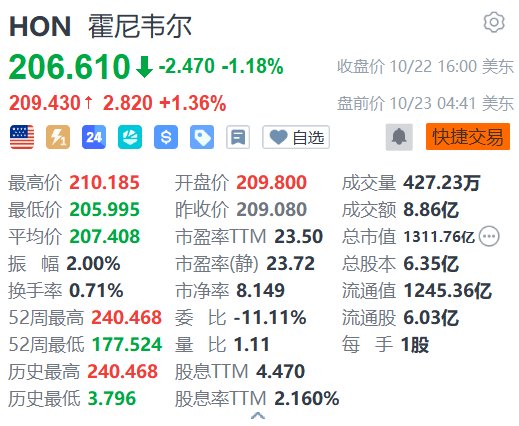
Core Viewpoint - Honeywell (HON.US) is actively pursuing a plan to spin off its aerospace technology business, aiming to establish an independent publicly traded aerospace company by the second half of 2026. This move is seen as a significant step towards simplifying operations and focusing on industrial automation and digital transformation [1]. Company Summary - Honeywell's stock price increased by 1.36% to $209.43 in pre-market trading [1]. - The aerospace technology business spinoff will provide propulsion systems, cockpit systems, navigation systems, and auxiliary power systems for both commercial and military aircraft [1]. - The company reported a closing price of $206.61, down 1.18%, with a market capitalization of $131.18 billion [1]. Financial Metrics - The stock's highest price was $210.185, with a trading volume of 4.27 million shares [1]. - The price-to-earnings (P/E) ratio is reported at 23.50, while the price-to-book (P/B) ratio stands at 8.149 [1]. - The stock has a 52-week high of $240.468 and a low of $177.524, indicating a significant range in its trading performance [1].

霍尼韦尔(HON.US)推进航空航天业务分拆计划 2026年独立上市
智通财经网· 2025-10-23 07:09
Core Viewpoint - Honeywell (HON.US) is actively pursuing the spin-off of its aerospace technology business, which is expected to be completed in the second half of 2026, resulting in the establishment of an independent publicly traded aerospace company [1][2] Group 1: Business Restructuring - Honeywell has initiated a broader business portfolio restructuring, focusing on three core business segments: building automation, industrial automation, and process automation and technology [1] - The financial reporting structure will change on January 1, 2026, with performance disclosed across four segments: aerospace technology, building automation, industrial automation, and process automation and technology [1] Group 2: Management and Tax Implications - Post-spin-off, Honeywell's remaining business will concentrate on automation technologies in industrial, building, and process sectors, with specific management roles assigned to Billal Hammoud, Peter Lau, Jim Masso, and Ken West [2] - The spin-off of the aerospace technology business is expected to be tax-free for shareholders at the federal income tax level in the United States [2]
青鸟消防强势入局消防机器人赛道:技术沉淀破解行业痛点,场景适配直击实战需求
Ge Long Hui A P P· 2025-09-12 06:23
Core Viewpoint - The urgent need for the firefighting industry to upgrade from traditional human-based methods to machine intelligence is highlighted, with Qingniao Firefighting's strategic focus on firefighting robots being a natural evolution based on over 20 years of experience in fire electronic technology [1][5]. Group 1: Technological Foundation - Qingniao Firefighting has established a long-term technological reserve, focusing on key areas such as machine vision, autonomous navigation, and multi-sensor collaboration, which are essential for the autonomous operation of firefighting robots in extreme environments [3]. - The company is developing a navigation system capable of precise operation in scenarios with network interruptions, utilizing technologies like positioning navigation, laser radar, and visual SLAM, ensuring robots can locate fire sources even in signal-deprived areas [3]. - Qingniao's self-developed thermal imaging system can penetrate smoke to identify flames and high-temperature points, while also integrating various sensors to provide accurate data for subsequent operations [3]. Group 2: Scene Adaptation - Qingniao Firefighting is creating specialized firefighting robots tailored for extreme environments, ensuring they can operate effectively in conditions such as smoke, high temperatures, and complex terrains [4]. - The robots are designed not only for inspection but also for firefighting and maintenance tasks, equipped with professional firefighting tools like pulse water cannons and dry powder spraying devices, significantly enhancing operational efficiency compared to manual efforts [4]. - The upcoming launch of the "Lingbao" robot at the Beijing International Fire Exhibition on October 13 is a testament to Qingniao's capability in scene adaptation, showcasing its ability to operate in extreme conditions and collaborate with various sensors [4][5]. Group 3: Strategic Roadmap - Qingniao plans to advance in three phases: - In the first 1-2 years, the focus will be on optimizing existing robots' stability and operational precision to reach domestic leading levels, particularly in large factories and data centers [6]. - In the next 2-3 years, the goal is to achieve global competitiveness by addressing challenges in complex fire scene operations and launching products suitable for high-standard markets like Europe and the US [6]. - Over the next 3-5 years, the aim is to cover all scenarios in high-risk inspections, firefighting, and maintenance, while also exploring new areas like home safety, ultimately creating a complete ecosystem of "vehicles + technology + scenes + services" [6].