
小鹏人形机器人Iron

Search documents
小鹏汽车突围,智能化布局日益显露
2 1 Shi Ji Jing Ji Bao Dao· 2025-11-29 14:37
Core Insights - The new energy vehicle (NEV) market is experiencing significant shifts, with XPeng surpassing NIO and Li Auto to become the largest NEV company by market capitalization as of Q3 2025, valued at 160.2 billion yuan [2] - Li Auto, which previously achieved profitability through its "range extender + family" strategy, is losing its competitive edge as other companies enter the range extender market [2] - NIO, once the highest valued NEV company, is now focusing on core automotive products due to financial burdens from its expansive business model [2] - XPeng's recovery from internal management issues and high supply chain costs has led to a resurgence in sales and a renewed focus on advanced technologies like autonomous driving and robotics [3][4] Company Performance - XPeng's Q3 report shows a gross margin exceeding 20% for the first time, with a year-on-year revenue growth of 100% [3] - The company has launched popular models such as the XPeng P7+ and Mona M03, contributing to its improved performance [2] - XPeng's strategic partnerships, particularly with Volkswagen for autonomous driving technology, are expected to enhance its market position [4] Technological Ambitions - XPeng is focusing on autonomous driving, Robotaxi services, and humanoid robots, with plans to launch three Robotaxi models by 2026 [4] - The company aims to start mass production of advanced humanoid robots by the end of 2026, targeting various service applications [4] - XPeng's self-developed Turing chip has received procurement certification from Volkswagen, marking a significant milestone in its technology development [4] Competitive Landscape - The NEV sector is entering a new phase of competition centered around AI technologies, with Li Auto and NIO also announcing their AI commercialization strategies [4] - Li Auto plans to launch its first AI glasses in December, while NIO's self-developed Dimensity chip will open for external collaboration in Q4 [4] - XPeng's technological focus positions it favorably in the ongoing AI competition, although it faces challenges in commercializing its Robotaxi and humanoid robot initiatives [5] Strategic Direction - XPeng's management emphasizes a strategy of "steady progress" to ensure long-term success, indicating that strong vehicle sales will support its technological explorations [6]

小鹏X9超级增程定价背后的战略逻辑:一场“艰难决定”与规模化破局
Feng Huang Wang· 2025-11-24 05:11
Core Insights - Xiaopeng Motors has launched the X9 Super Extended Range vehicle with a starting price of 309,800 yuan, which has caused significant industry impact [2] - The company aims to leverage AI and hardware-software integration to enhance competitive barriers in the automotive market, anticipating a more intense competitive landscape in 2026 [4] Pricing Strategy - The pricing of 309,800 yuan was a challenging decision for the company, aimed at serving users of traditional fuel vehicles and those in areas with limited charging infrastructure [2] - The competitive pricing is attributed to cost reductions achieved through scale and technological integration, with a goal of increasing sales volume by 2025 without passing costs onto consumers [2] - The target demographic for the X9 includes high-net-worth families with a focus on long-distance travel and quality of life [2] Technological Innovations - The X9 features an 800V high-voltage platform and 5C ultra-fast charging technology, allowing for a range of 313 km with just 10 minutes of charging [3] - Safety considerations led to the choice of lithium iron phosphate batteries, while a platform-based battery cell strategy ensures stable production capacity [3] - The vehicle incorporates advanced noise reduction technologies, including double-layer soundproof glass and active noise cancellation, significantly improving quietness in urban conditions [3] Market Expansion and Future Outlook - Xiaopeng Motors plans to expand its presence to nearly 60 countries and regions this year, with further international growth anticipated [4] - The company predicts that competition in the automotive market will become "more brutal and bloody" by 2026, and aims to build barriers through technology, business strategies, globalization, and systemic capabilities [4] - The company has invested 2.4 billion yuan in R&D in the third quarter, with plans for increased investment in the fourth quarter, focusing on AI and hardware-software integration for future competitiveness [4]

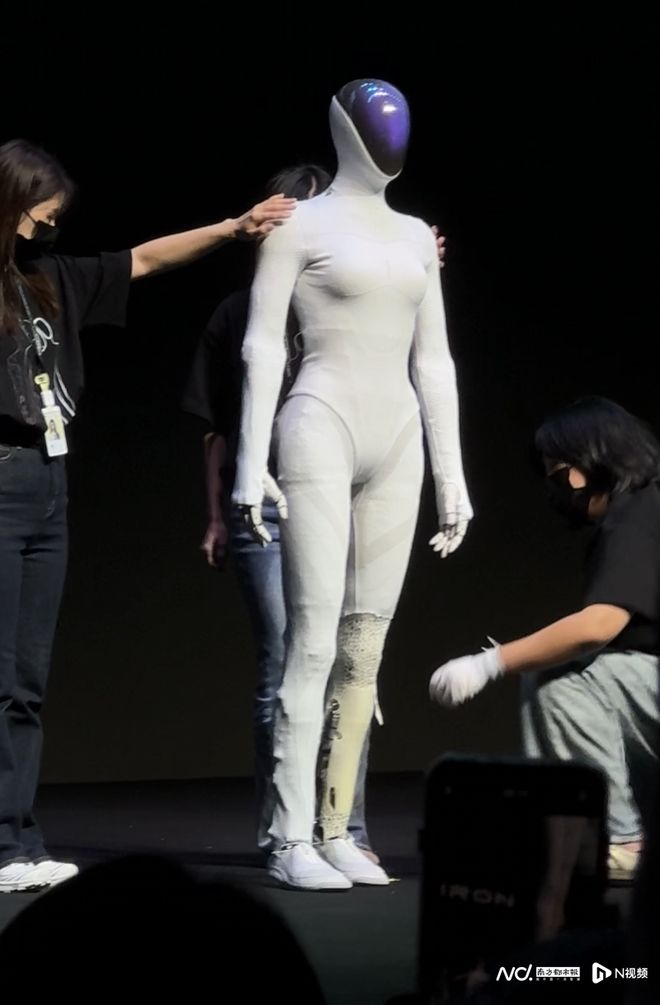
小鹏人形机器人再破“人扮”质疑,发布会现场“解剖”自证
Nan Fang Du Shi Bao· 2025-11-06 14:49
Core Viewpoint - Xiaopeng Motors' Iron humanoid robot is not a "real person in disguise," as clarified by CEO He Xiaopeng during the product launch event, following public skepticism about the robot's authenticity [2][3] Group 1: Product Launch and Public Response - The Iron robot was first publicly showcased on November 5, 2023, and is planned for mass production by 2026, featuring the industry's first application of solid-state batteries [2] - The launch event sparked significant online discussion, with some questioning whether the robot contained a real human inside, prompting a live demonstration to reveal its internal structure [2] - He Xiaopeng expressed hope that this would be the last time the authenticity of the Iron robot would need to be proven, aiming to build public trust in the product [2] Group 2: Design Philosophy and Future Outlook - Xiaopeng Motors' VP of Robotics, Mi Liangchuan, stated that the design approach does not focus on short-term scenarios but rather on long-term technological planning, prioritizing core technology [3] - The decision not to include a human-like face on the robot is based on a balance between humanoid design and public acceptance, with ongoing research into facial design to enhance acceptance [3] - He Xiaopeng anticipates that within the next three years, Chinese robotics startups will introduce more advanced humanoid robots capable of language interaction, autonomous movement, and performing simple tasks [3]

奇瑞墨甲10月公开发布并开启招商 车企造人形机器人加速“上岗”
Xin Lang Cai Jing· 2025-09-11 05:29
Core Insights - Tesla's founder Elon Musk announced that the Optimus V3 humanoid robot is expected to enter mass production, while domestic manufacturers are accelerating their own humanoid robot developments [1] - Chery's Moja Robot is set to publicly launch its products in October 2023, targeting both dealers and individual consumers [1][2] Company Developments - Moja Robot, established in January 2023 with a registered capital of 100 million yuan, is fully owned by Chery and focuses on the sales and development of intelligent and industrial robots [2] - The Moja humanoid robot "Mo Yin" was first showcased at Chery's intelligent strategy launch in March 2023 and has since demonstrated its capabilities in various settings, including a global delivery of 220 units to overseas dealers [2][3] - Chery's Moja Robot aims to expand its application from 4S dealership scenarios to public services and eventually to home services [2] Product Specifications - The Moja Robot stands 167 cm tall, weighs 65 kg, has 41 degrees of freedom, and can walk at a maximum speed of 1 m/s with a battery capacity of 0.7 kWh, providing a 2-hour operational time [3] Industry Trends - Over 20 domestic and international automakers, including Xiaomi, SAIC, and BYD, are reportedly advancing into the humanoid robot sector, indicating a growing trend in the automotive industry [4] - The integration of automotive manufacturing expertise into humanoid robotics is expected to enhance production efficiency and product quality, leveraging shared technologies such as sensors and AI [4]
行业周报:人形机器人订单潮来袭,商业化拉开序幕-20250602
KAIYUAN SECURITIES· 2025-06-02 05:08
Investment Rating - The industry investment rating is "Overweight" [6] Core Viewpoints - The humanoid robot market is experiencing a surge in orders, marking the beginning of commercialization, with significant demand reported from various companies [2][11] - The year 2025 is seen as the inaugural year for humanoid robot mass production, with a focus on key technologies that hold competitive advantages [42] - Major tech giants, led by Tesla, are accelerating the deployment of humanoid robots, with companies like Huawei, Xiaomi, and Apple making significant advancements in their AI and robotics capabilities [3][24][38] Summary by Sections Humanoid Robot Order Surge - Companies like Yushu Technology and Songyan Power have reported substantial order volumes, with Yushu's projects nearing the total for 2024 within the first five months of 2025 [2][13] - Songyan Power's N2 robot orders have surpassed 2000 units, while Leju Robotics has seen a 200% year-on-year increase in orders for Q1 2025 [2][15] - The primary application areas for humanoid robots include factory production and research education, with expansion into sectors like telecommunications and power [19][22] Global Tech Giants Accelerating Industry Deployment - Tesla has established a comprehensive AI system that integrates models, data, algorithms, and computing power, leading the humanoid robot sector [3][23] - Huawei is developing a robust AI ecosystem, collaborating with companies like UBTECH to enhance humanoid robot capabilities [24][26] - Xiaomi and XPeng are leveraging their automotive technology to enter the humanoid robot market, with plans for significant production in the coming years [32][34] Focus on Key Technologies - The report emphasizes the importance of common key technologies such as operating systems, actuators, motors, reducers, lead screws, and sensors for the humanoid robot industry [42] - Companies like Dongtu Technology and Zhenyu Technology are highlighted as beneficiaries in the operating system and assembly sectors, respectively [44] Beneficiary Stocks - Recommended stocks include Dongtu Technology for operating systems, Zhenyu Technology for assemblies, and various companies for lead screws, reducers, motors, sensors, and equipment [44]



机器人行业周报:小鹏车展展出人形机器人Iron,计划2026年量产-20250427
Southwest Securities· 2025-04-27 14:01
Investment Rating - The report maintains an "Outperform" rating for the machinery equipment industry [1]. Core Insights - The robotics index outperformed the market, with the CSI Robotics Index rising by 4.6%, surpassing the Shanghai Composite Index by 4.0 percentage points and the CSI 300 Index by 4.2 percentage points during the week of April 21 to April 27, 2025 [5][14]. - Tesla's Optimus project is still in development, with expectations to produce thousands of robots by the end of 2025, aiming for a million units by 2029/2030 [19]. - XPeng showcased its humanoid robot Iron at the Shanghai Auto Show, which is set for mass production in 2026 [19]. - The establishment of a high-precision reducer R&D and production base by Zhizhong Technology, with a total investment of approximately 300 million yuan, is expected to enhance the domestic industrial robot and humanoid robot manufacturing capabilities [22]. - Kepler's K2 "Bumblebee" humanoid robot demonstrated its capabilities in practical training with SAIC-GM, showcasing superior endurance and load capacity [23][24]. Summary by Sections Market Review - The robotics index showed strong performance, with a 4.6% increase, outperforming major indices [5][14]. Industry Dynamics - Tesla's Optimus project remains in development, with limited production expected in 2025 and a target of one million units by 2029/2030 [19]. - XPeng's humanoid robot Iron features advanced capabilities and is set for mass production in 2026 [19]. - Zhizhong Technology's new project aims to establish a leading center for high-precision reducers, with a total investment of around 300 million yuan [22]. - Kepler's K2 "Bumblebee" robot demonstrated high endurance and efficiency in real-world applications [23][24]. Financing Dynamics - Parsini received investment from BYD, increasing its registered capital and expanding its operational capabilities in the robotics sector [26]. - The Shanghai Embodied Intelligence Fund was established with a target size of 1 billion yuan, focusing on investments in the robotics industry [26].
