尘白禁区

Search documents
中国邮政称已下架与尘白禁区的联名快闪!否认印上录取通知书
Nan Fang Du Shi Bao· 2026-02-27 12:08
Core Viewpoint - The game "Dust White Zone" announced a collaboration with China Post for a pop-up event, which was later canceled due to concerns over inappropriate content [1] Group 1: Event Details - The pop-up event was scheduled to take place from February 28 to March 6 in cities including Chengdu, Nanjing, Shenzhen, Beijing, and Shanghai [1] - A limited edition commemorative gift box was also planned to be released alongside the event [1] Group 2: Public Reaction - Many netizens expressed concerns about the collaboration, arguing that the game has previously faced controversies regarding vulgar content, which could negatively influence minors [1] - An internal source from China Post confirmed that the collaboration has been officially retracted and labeled rumors about the game appearing on university admission envelopes as completely unfounded [2]


尘白禁区删除与中国邮政联动活动,终止活动
Xin Lang Cai Jing· 2026-02-26 11:30
Core Viewpoint - China Post has halted its collaboration with the mobile game "Dust White Zone" following public controversy regarding the game's adult content and its appeal to minors [1] Group 1: Company Response - China Post has officially responded to the controversy by terminating the related offline activities associated with the game [1] - The postal service indicated that the relevant post offices have stopped providing the service linked to the game [1] Group 2: Game Controversy - "Dust White Zone," launched in 2023, has transitioned to an adult-oriented game, prohibiting minors from logging in across all channels [1] - The game has faced criticism for its portrayal of female characters, which includes revealing clothing and exaggerated body shapes, leading to accusations of being vulgar [1] Group 3: Social Media Actions - As of February 26, the official Weibo account of "Dust White Zone" has removed all related content regarding the collaboration [1] - The WeChat public account initially retained the announcement of the offline event but later deleted all content related to the controversial activity [1] - The termination of the event was also announced on the official account of Bilibili [1]

次世代游戏公司,困在性别里
3 6 Ke· 2025-12-05 08:15
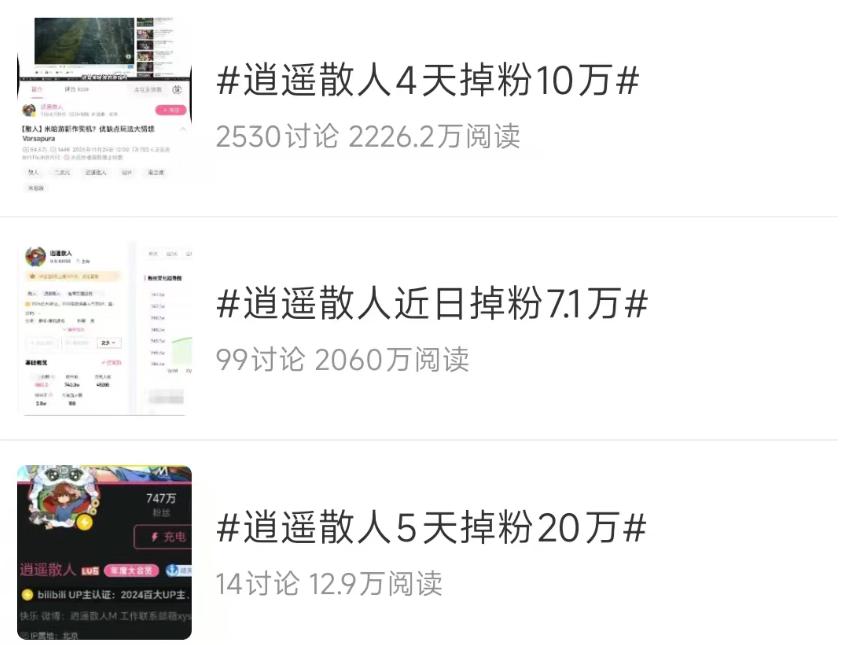
Core Viewpoint - The incident involving the content creator "逍遥散人" highlights the challenges faced by next-generation gaming companies in navigating gender issues and community expectations, particularly in relation to the game "Varsapura" [1][4][28]. Group 1: Incident Overview - The release of a gameplay video for "Varsapura" led to a significant backlash against the content creator, resulting in a loss of 450,000 followers and the termination of collaborations with brands [1][3]. - The creator's response to fans urging him to delete the video was perceived as a betrayal by his predominantly female audience, leading to further scrutiny of his past statements [3][4]. Group 2: Industry Trends - The gaming company miHoYo has shifted its strategy, releasing multiple game trailers in a year, contrasting with its previous approach of lengthy development cycles [7][8]. - The company has introduced diverse game types, yet the core narrative remains consistent with its established style, which may not meet the evolving expectations of its audience [9]. Group 3: Gender Dynamics in Gaming - The incident reflects a broader issue within the gaming industry where companies are labeled based on gender perceptions, impacting their ability to innovate and expand their offerings [19][21]. - Players' emotional investments in gendered branding create a challenging environment for companies attempting to diversify their game portfolios, often leading to backlash when they deviate from established norms [22][27]. Group 4: Consequences of Labeling - The labeling of companies as "female-friendly" or "male-oriented" can restrict their market strategies, making them hesitant to explore new genres or themes [28][34]. - The cycle of backlash against companies attempting to break gender norms can lead to a reduction in the diversity of games available to players, ultimately harming the gaming ecosystem [36].
金山软件旗下西山居高管变动 郭炜炜辞任CEO
Xi Niu Cai Jing· 2025-12-04 03:10
Group 1 - The CEO of Xishanju, Guo Weiwei, has submitted his resignation due to personal career planning, which has been accepted by the board of directors [2] - Guo Weiwei will continue to serve as the chief producer at Xishanju after stepping down as CEO, while Zou Tao, the CEO of Kingsoft, will act as the interim CEO of Xishanju [2] - Guo Weiwei has been with Xishanju since 2004, holding various positions including executive planner and CEO, and has been instrumental in the development of the game "Jian Wang 3" [3] Group 2 - Kingsoft's Q3 financial report indicates that revenue from online games and other businesses was 898 million yuan, representing a year-on-year decline of 47% and a quarter-on-quarter decline of 6% [3] - The decline in game revenue is attributed to decreased income from "Jian Wang 3" and "Chen Bai Jin Qu," while the new game "Jie Xian Ji" is still in its early development phase [3]


金山软件三季度净利大幅下滑48%,游戏业务拖后腿
Xin Lang Cai Jing· 2025-11-19 13:36
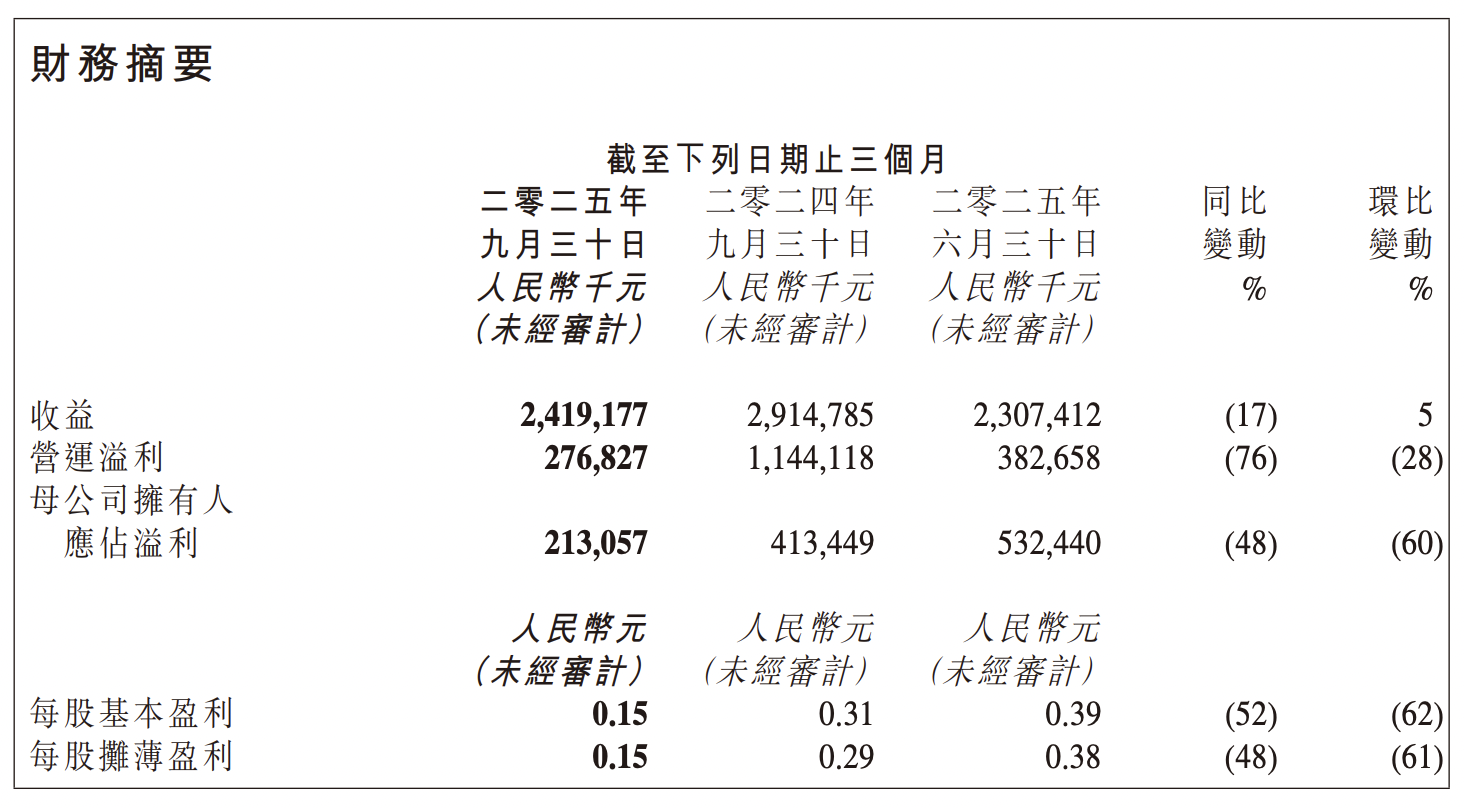
Core Insights - Kingsoft Software (03888.HK) reported a significant decline in total revenue for Q3 2025, amounting to 2.42 billion RMB, a year-on-year decrease of 17%, with net profit dropping 48% to 213 million RMB [1][2] Financial Summary - Total revenue for Q3 2025: 2.42 billion RMB, down from 2.91 billion RMB in Q3 2024 [2] - Operating profit: 277 million RMB, a decrease from 1.14 billion RMB in the previous year [2] - Net profit attributable to shareholders: 213 million RMB, down from 413 million RMB in Q3 2024 [2] - Basic earnings per share: 0.15 RMB, compared to 0.31 RMB in the same quarter last year [2] Business Performance - Office software and services revenue reached 1.52 billion RMB, showing a growth of 26% year-on-year, driven by WPS software and WPS 365 [1][2] - Network gaming and other business revenue fell to 900 million RMB, a decline of 47% year-on-year, attributed to reduced contributions from existing games and the early-stage development of new titles [1][3] User Metrics - WPS Office monthly active devices reached 669 million, a 9% increase year-on-year [3] - Paid personal users for Kingsoft Office totaled 41.79 million, up 10% from the previous year [3] Gaming Segment Insights - The flagship game "Jian Wang 3" has been operational for over 16 years but faces challenges from new gaming genres [5] - New game "Jie Xian Ji" has gained attention in the mech game segment, while other international IP games are set to launch in upcoming quarters [5] - Marketing and distribution expenses increased by 55% year-on-year to 564 million RMB, reflecting higher promotional spending related to gaming [5]

游戏圈洗牌:腾讯网易稳坐龙头,十强门槛逼近50亿
第一财经· 2025-05-16 13:45
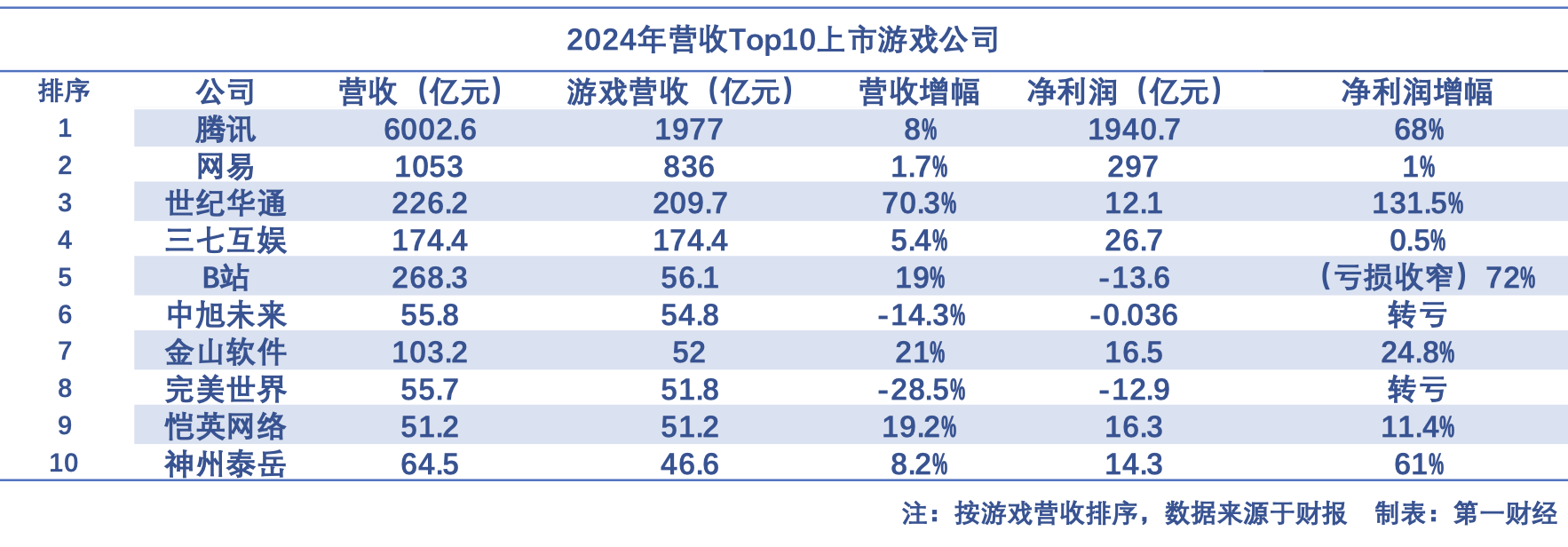
Core Viewpoint - The Chinese gaming industry is experiencing a "two extremes" situation, with top companies achieving record growth while mid-sized firms face declines and losses, leading to intensified competition and market concentration [2][4]. Group 1: Industry Overview - The top ten gaming companies in China are seeing significant shifts in their rankings, with the revenue threshold for entering the top ten increasing from 40 billion yuan in 2022 to 47 billion yuan in 2024 [2][9]. - Tencent and NetEase dominate the market, accounting for over 80% of the top ten's revenue, with Tencent's gaming revenue reaching 1,977 billion yuan in 2024, a 9.9% increase year-on-year [3][4]. - The overall gaming industry revenue, including domestic and overseas markets, is estimated at around 4,500 billion yuan, with the top ten companies contributing nearly 80% of this total [4][9]. Group 2: Company Performance - Tencent's gaming business has rebounded strongly, with a notable increase in revenue driven by both long-standing games and new releases, achieving a quarterly revenue peak of 595 billion yuan in Q1 2025 [5][6]. - NetEase's gaming revenue for 2024 was 836 billion yuan, with a modest growth of 2.5%, facing challenges in maintaining its dual-hit strategy due to a lack of new blockbuster games [7][8]. - Century Huatong's revenue surged by 70.3% to 226.2 billion yuan, largely due to the success of its hit game "Whiteout Survival" [3][10]. Group 3: Market Dynamics - The gaming industry is becoming increasingly concentrated, making it harder for smaller companies to compete, while opportunities still exist for mid-sized firms to create hit games [9][11]. - Companies like Bilibili and Kingsoft have made significant gains by launching successful titles, with Bilibili's gaming revenue growing by 40% to 56.1 billion yuan in 2024 [10][11]. - The decline of previously strong companies like Perfect World, which reported a net loss of 12.88 billion yuan in 2024, highlights the challenges of strategic misalignment and market competition [12][13]. Group 4: Future Outlook - The gaming industry is shifting from broad expansion to a focus on quality and innovation, with companies needing to either leverage resources to build ecosystems or specialize in niche markets to survive [13][14].



游戏圈洗牌:腾讯网易稳坐龙头,十强门槛逼近50亿
第一财经网· 2025-05-16 09:54
Core Insights - The Chinese gaming industry is experiencing a bifurcation, with top-tier companies achieving record growth while mid-tier and smaller firms face declines and challenges in transformation [1] - The revenue threshold for the top ten gaming companies has increased significantly, indicating a trend towards greater market concentration [1][11] - Tencent and NetEase dominate the market, with their combined revenue exceeding 80% of the top ten companies' total revenue [4][5] Industry Overview - The gaming industry is witnessing a slowdown in growth, with the top ten companies generating approximately 3.5 trillion yuan in gaming revenue for 2024, accounting for nearly 80% of the total industry revenue [4][11] - The revenue threshold for entering the top ten has risen to 4.7 billion yuan, reflecting a 17.5% increase from 2022 [11] - The competitive landscape is intensifying, with companies like Century Huatong and Bilibili leveraging hit games to improve their standings [1][12] Company Performance - Tencent's gaming revenue for 2024 reached 197.7 billion yuan, marking a 9.9% year-on-year increase, driven by both legacy and new titles [5][6] - NetEase's gaming revenue was 83.6 billion yuan, with a modest growth of 2.5%, indicating challenges in maintaining momentum [8][10] - Century Huatong's revenue surged by 70.3% to 22.62 billion yuan, largely due to the success of its hit game [3][12] Market Dynamics - The industry is increasingly favoring larger companies, making it difficult for smaller firms to compete effectively [1][11] - Companies that can innovate and create blockbuster games are more likely to survive, while those lacking in IP and product cycles may struggle [12][17] - The trend of focusing on long-standing games is becoming a more viable strategy for growth amid rising development costs [7][10] Future Outlook - The gaming market is shifting towards quality competition, with a clear divide between companies that can leverage resources to build ecosystems and those that focus on niche markets [17] - The potential for smaller companies to carve out niches remains, but they must innovate and adapt to changing market conditions [12][17] - The success of companies like Bilibili and Century Huatong suggests that opportunities still exist for those willing to invest in quality and creativity [12][13]