平乡童车

Search documents
四中全会精神在基层|陆港牵手集群 冀货加速出海
Xin Lang Cai Jing· 2026-01-31 23:41
Core Viewpoint - The article highlights the strategic development of the Shijiazhuang International Land Port as a key logistics hub for international trade, emphasizing its role in enhancing the export capabilities of Hebei's local industries through innovative logistics solutions and cross-border warehousing services [1][2]. Group 1: Development of Shijiazhuang International Land Port - The Shijiazhuang International Land Port has established 18 stable international routes, covering over 50 countries and regions in Asia and Europe, positioning itself as a central hub for the China-Europe Railway Express in North China [1]. - The port aims to not only facilitate transportation but also integrate services with local industries, adopting a "channel + hub + industry" development model to enhance operational efficiency [1][2]. Group 2: Cross-Border Warehousing Innovations - The introduction of the cross-border warehouse model allows logistics nodes to be located directly at the doorstep of industrial clusters, providing one-stop services such as booking, consolidation, warehousing, and customs clearance [2]. - This model has significantly reduced costs for small and medium-sized enterprises (SMEs) by enabling them to consolidate shipments, thus lowering export costs by approximately 10% and increasing shipping speed [2]. Group 3: Enhanced Services and Future Outlook - The functionality of cross-border warehouses is evolving into comprehensive service platforms, with new facilities being developed to streamline the supply chain for various industries, including textiles and cable manufacturing [3]. - The port is committed to expanding its service network and enhancing the integration of logistics with local industries, which is expected to optimize regional supply chains and contribute to high-quality economic development in Hebei [3].
民生直通车丨带动就业数千万人 全国近2500个劳务品牌持续擦亮“金名片”
Xin Hua Wang· 2025-11-20 07:29
Core Insights - The development of labor brands in China has significantly boosted employment, with nearly 2,500 labor brands currently active, creating jobs for tens of millions of people [1][2] - Labor brands are increasingly recognized as comprehensive vehicles for promoting employment, economic development, and improving livelihoods, showcasing regional characteristics and industry-specific skills [1][2] Group 1: Employment and Skills Development - Labor brands have strong employment-driving capabilities, with examples like the "Lüliang Mountain Caregivers" brand, which has trained over 90,000 caregivers, generating a total annual income exceeding 1.6 billion yuan [1] - Various regions are enhancing employment skills training through labor brands, such as Jiangxi's "Gan Brand" labor brand, which has established 31 training bases and 33 employment service centers [2] - In Guangxi, the "Eight桂 Series" labor brands have conducted skills training for 710,000 people, leading to over 1 million job opportunities [2] Group 2: Economic Impact and Industry Integration - Labor brands are contributing to significant economic impacts, with Zhejiang's labor brands linked to the digital economy generating over 500 billion yuan in income [3] - The "Enshi Red and Green Tea Master" labor brand in Hubei has helped small enterprises increase their output value by 40% through technical upgrades [3] - The "Chuan Zhong Lithium Workers" labor brand in Sichuan is focusing on training technical talent for the lithium battery industry, supplying over 60,000 workers to local companies [3] Group 3: Collaborative Mechanisms and Future Development - China is enhancing labor collaboration mechanisms, expanding from traditional labor input-output to comprehensive cooperation in skills training, job matching, and social security [4] - The Ministry of Human Resources and Social Security plans to accelerate the growth of labor brands by improving participation mechanisms and focusing on skill enhancement and market demand [4][5] - The aim is to foster a cluster development of labor brands by establishing leading enterprises and industry alliances [5]
全国近2500个劳务品牌持续擦亮“金名片”
Ren Min Ri Bao Hai Wai Ban· 2025-11-20 00:41
Core Insights - The development of labor brands in China is becoming a comprehensive vehicle for promoting employment, economic development, and improving people's livelihoods, with nearly 2,500 labor brands currently in operation, creating millions of jobs [1][2] Group 1: Labor Brand Development - Labor brands are characterized by regional, industry, and skill features, significantly enhancing employment capabilities [1] - The "Lüliang Mountain Caregivers" labor brand has trained over 90,000 caregivers, generating a total annual income exceeding 1.6 billion yuan [1] - The "Wuqing Silk Flower Craft" labor brand emphasizes the importance of training in skill development, showcasing the intricate processes involved in creating silk flowers [1] Group 2: Employment Skills Training - Various regions are enhancing employment skills training through labor brands, such as Jiangxi's "Gan Brand" labor brand, which has established 31 training bases and 33 employment service centers [2] - In Guangxi, over 710,000 people have been trained under the "Eight桂系列" labor brand, leading to more than 1 million employment opportunities [2] - The integration of labor brands with local industries, such as rice noodles and home services, is creating strong employment effects [2] Group 3: Economic Impact - In Zhejiang, labor brands have contributed to an increase in income exceeding 500 billion yuan through deep integration with the digital economy [3] - The "Enshi Red and Green Tea Master" labor brand has helped 12 tea companies enhance their technology, resulting in a 40% increase in output value for small enterprises [3] - The "Chuan Zhong Lithium Workers" labor brand has trained over 60,000 individuals for the lithium battery industry, facilitating a shift from manual labor to technology-driven roles [3] Group 4: Collaborative Mechanisms - China is enhancing labor cooperation mechanisms, expanding from traditional labor input-output to comprehensive collaboration including skills training and job matching [4] - The Ministry of Human Resources and Social Security aims to accelerate the growth of labor brands by establishing a multi-party participation mechanism and promoting the development of leading labor brand enterprises [4]
“买全球、卖全球” 跨境电商扬帆出海
Sou Hu Cai Jing· 2025-06-10 20:16
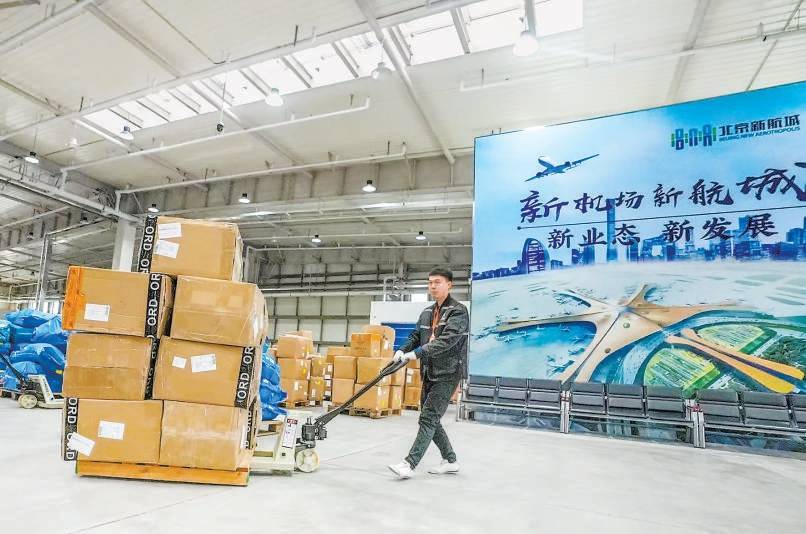
Core Viewpoint - The Daxing Airport area is emerging as a significant hub for cross-border e-commerce, leveraging its strategic location and various policy advantages to attract both international giants and domestic companies [4][5][6]. Group 1: Airport and Economic Growth - Daxing Airport handled 21.86 million passengers and 146,000 tons of cargo from January to May this year, marking a year-on-year increase of 9.1% and 13.1% respectively [4]. - The Daxing Airport area has integrated five key zones, including a comprehensive bonded zone and a free trade zone, to enhance foreign trade dynamics [5]. Group 2: Infrastructure and Development - The Daxing Airport area spans 150 square kilometers and has transformed from agricultural land to a modern industrial park with various public service buildings [6]. - The newly opened cross-border duty-free shop features over 2,000 imported products, benefiting from direct procurement from Europe to reduce logistics costs [6]. Group 3: Logistics and E-commerce - BigBuy, a Spanish cross-border e-commerce platform, has partnered with Daxing Airport's bonded area, offering over 400,000 products to enhance the local e-commerce ecosystem [7]. -博越 International Logistics has entered the cross-border e-commerce sector, leveraging its established logistics network in multiple countries and a 4,500 square meter bonded warehouse at Daxing Airport [7][8]. Group 4: Future Development Plans - The Daxing Airport area has over 20 square kilometers of industrial land available for development, with ongoing projects aimed at creating a modern commercial logistics CBD and international exhibition center [9]. - The area is focusing on developing aviation logistics, particularly in cross-border e-commerce, cold chain logistics, and high-end equipment logistics, with over 1.7 million square meters of logistics facilities already built or under construction [9].