德邦半导体产业混合A

Search documents
GEO概念火到基金圈,德邦稳盈增长基金触发限购,23年因老婆买基金而多做家务的雷涛收益回暖
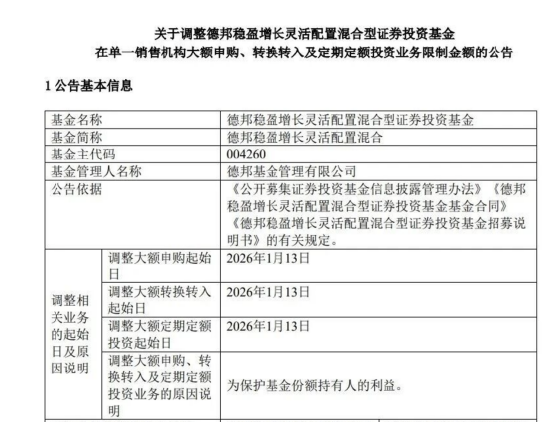
Xin Lang Cai Jing· 2026-01-14 05:54
Core Viewpoint - The heat of the GEO concept is spreading from A-share thematic stocks to the fund market, with significant attention on the Debon Stable Growth Fund due to rumors of massive capital inflows [2][9]. Fund Market Dynamics - The Debon Stable Growth Fund has been highlighted as AI application sector sentiment continues to rise, leading to a surge in investor interest [2][9]. - A limit purchase announcement was made by Debon Fund, effective January 13, 2026, adjusting the quota for large subscriptions to protect the interests of fund shareholders [3][10]. - This limit purchase reflects the reality of concentrated short-term capital inflows, driven by the high performance of certain products in the context of the GEO narrative [3][10]. Fund Performance and Management - The Debon Stable Growth Fund is managed by two fund managers, one of whom, Lei Tao, gained attention for a relatable response during a period of product decline, which has since become a talking point as the fund's performance recovers [4][11]. - Lei Tao's previous comments about doing household chores during downturns have shifted from self-deprecating humor to a point of interest as the fund's performance improves amid the AI application market's strength [6][13]. Investment Insights - As of January 14, Lei Tao's disclosed total investment amount is approximately 2.54 million yuan, with about 310,000 yuan invested in the Debon Stable Growth Fund [14][15]. - The highest investment is in the Debon Fuxin Flexible Allocation Mixed Fund, totaling around 860,000 yuan, while the Debon Stable Growth Fund represents a smaller portion of his overall portfolio [15]. - Recent performance metrics show a 6.35% return over the past week, 13.63% over the past month, and 65.79% over the past year, with significant returns from the Debon Semiconductor Industry Fund and Debon Xinxing Value Fund, achieving returns of 110% and 183% respectively [15].

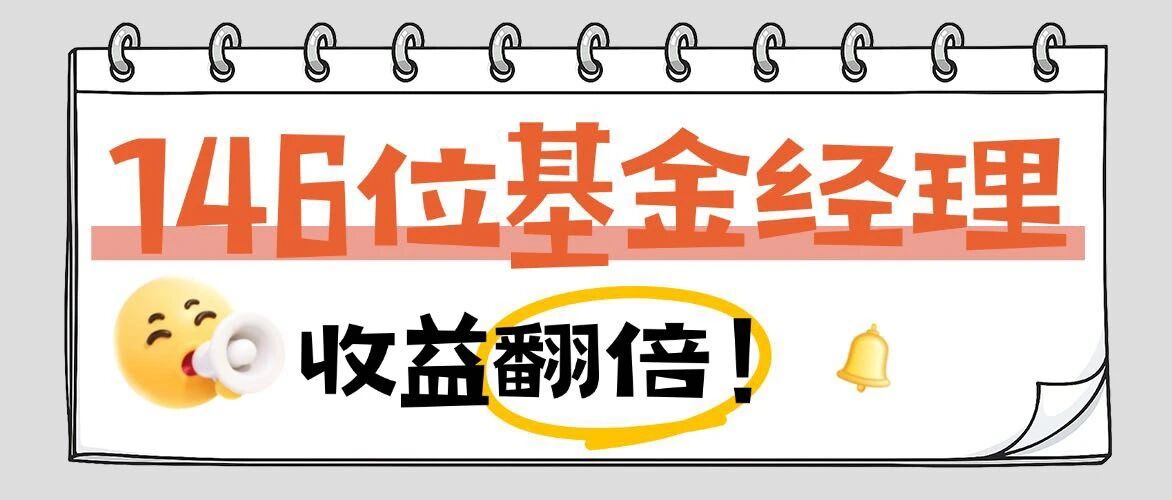
924一周年!146位基金经理收益翻倍!张璐、郑巍山等领衔!
Sou Hu Cai Jing· 2025-09-26 08:59
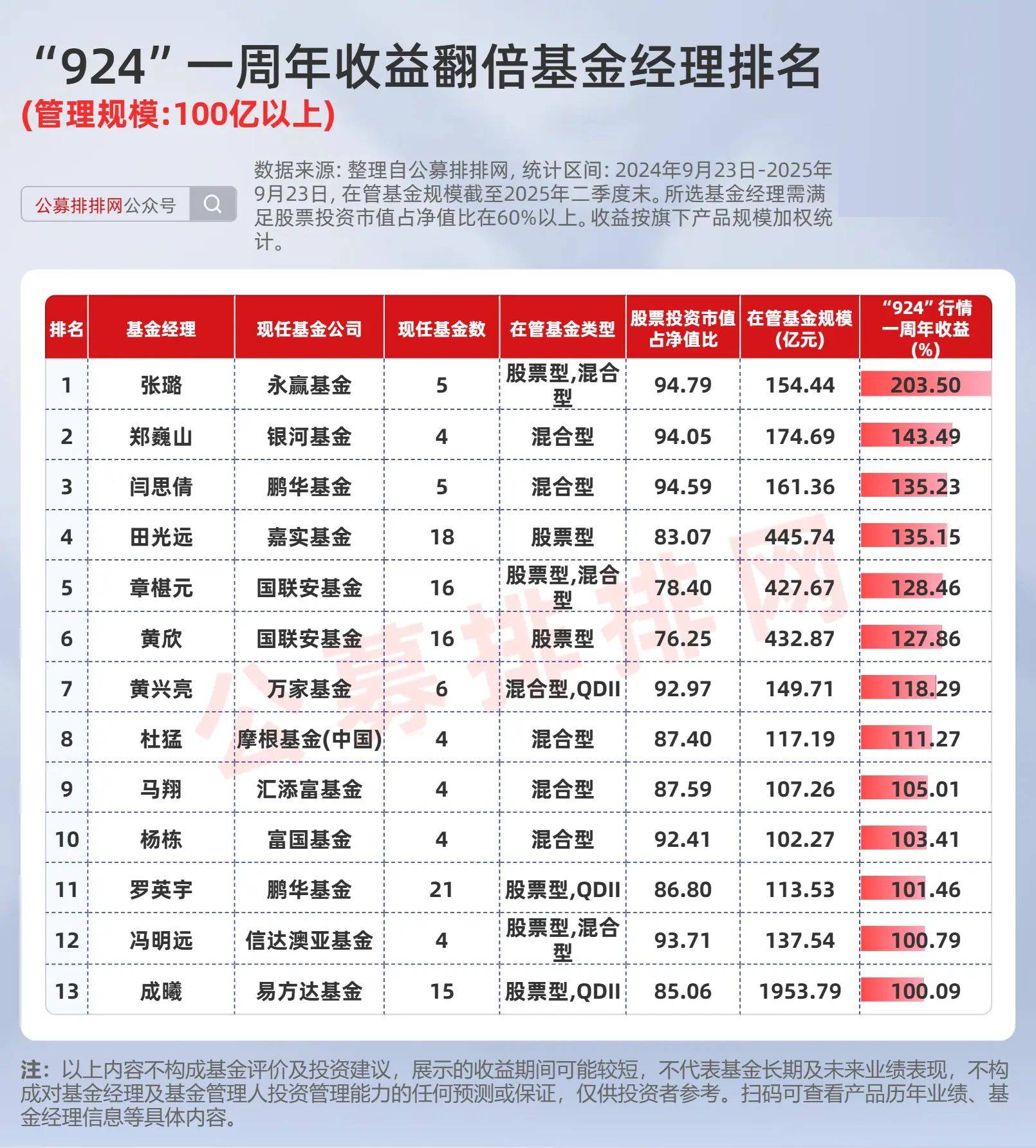
Core Insights - The equity market has shown signs of recovery since the "924" market rally, with an average increase of 80% across the A-shares, indicating a slow bull market trend [1] - During the one-year anniversary of the "924" rally, 1989 stock fund managers achieved an average return of 53.21%, with 146 managers doubling their returns [1] Group 1: Fund Managers with Over 100 Billion in Assets - Among the 184 fund managers managing over 100 billion, the average return during the "924" rally anniversary was 56.05%, with all achieving positive returns [1] - The top three fund managers in this category were Zhang Lu from Yongying Fund, Zheng Weishan from Galaxy Fund, and Yan Siqian from Penghua Fund [1][5] - Zhang Lu's funds achieved a remarkable return of 203.05%, with his flagship product, "Yongying Advanced Manufacturing Smart Selection Mixed A," returning 253.12% [5][6] Group 2: Fund Managers with 50-100 Billion in Assets - In the 50-100 billion category, 191 stock fund managers had an average return of 58.40%, with 23 managers doubling their returns [7] - The top three fund managers were Nong Bingli from Invesco Great Wall Fund, Sun Quan from Fortune Fund, and Xiao Ruijin from Bosera Fund [7][10] - Nong Bingli's funds achieved a return of 165.53%, with his representative product returning 151.02% [10] Group 3: Fund Managers with 20-50 Billion in Assets - Among 360 fund managers in this category, the average return was 55.22%, with 31 managers doubling their returns [11] - The top three were Lei Tao from Debang Fund, Wang Wenlong from Yongying Fund, and Wu Yang from E Fund [11][15] - Lei Tao's funds achieved a return of 172.03%, focusing on AI technology stocks [15] Group 4: Fund Managers with 10-20 Billion in Assets - In this segment, 309 fund managers had an average return of 54.09%, with 18 managers doubling their returns [16] - The top three were Ren Jie from Yongying Fund, Lu Yang from Debang Fund, and Han Hao from AVIC Fund [16][19] - Ren Jie achieved a return of 239.88%, with a focus on AI-related stocks [19] Group 5: Fund Managers with 5-10 Billion in Assets - The average return for 244 fund managers in this category was 52.55%, with 14 managers doubling their returns [20] - The top three were Zhou Jiansheng from Nord Fund, Dai Yi from Changsheng Fund, and Chen Peng from Anxin Fund [20][24] - Zhou Jiansheng's funds achieved a return of 179.19%, primarily investing in AI technology stocks [24] Group 6: Fund Managers with 0-5 Billion in Assets - Among 700 fund managers, the average return was 49.88%, with 47 managers doubling their returns [25] - The top three were Leng Wenpeng from CITIC Construction Investment Fund, Liu Xiaoming from Xinda Aoya Fund, and Li Ningning from Zhongjia Fund [25][29] - Leng Wenpeng's funds achieved a return of 261.14%, with his flagship product returning 263.38% [29]
“924”一周年!146位基金经理收益翻倍!永赢基金张璐、银河基金郑巍山等领衔!
私募排排网· 2025-09-26 03:35
Core Viewpoint - The article discusses the performance of public fund managers in the "924" market, highlighting significant returns achieved by various fund managers over the past year, with an average return of 80% across the A-share market and specific managers achieving over 200% returns [3][4]. Group 1: Performance of Fund Managers - Since the "924" market began, 1,989 stock investment fund managers achieved an average return of 53.21%, with 146 managers doubling their returns [3]. - Among managers with assets over 10 billion, Zhang Lu from Yongying Fund achieved the highest return of 203.50%, followed by Zheng Weishan from Galaxy Fund with 143.49% [4][5]. - The average return for managers with assets between 50-100 billion was 58.40%, with 23 managers doubling their returns [7]. Group 2: Notable Fund Managers and Their Strategies - Zhang Lu's fund, Yongying Advanced Manufacturing Select Mixed A, achieved a return of 253.12%, focusing on the robotics industry and benefiting from policy support [5][6]. - Zheng Weishan's portfolio primarily included semiconductor and AI chip companies, with a notable return of 157.12% for his flagship product [6][7]. - Fund manager Neng Bingli from Jingshun Changcheng Fund achieved a return of 165.53%, with a diversified portfolio including AI and new consumption sectors [9]. Group 3: Performance by Fund Size - For managers with assets between 20-50 billion, Lei Tao from Debang Fund led with a return of 172.03%, focusing on AI technology stocks [10][12]. - In the 10-20 billion category, Ren Jie from Yongying Fund achieved a remarkable return of 239.88%, with a focus on AI and technology stocks [15][16]. - Among managers with assets under 5 billion, Leng Wenpeng from CITIC JianTou Fund topped the list with a return of 261.14%, driven by strong performance in his selected stocks [19][21].
基金经理开实盘,收益率跑输普通网民?
Hu Xiu· 2025-08-18 00:01
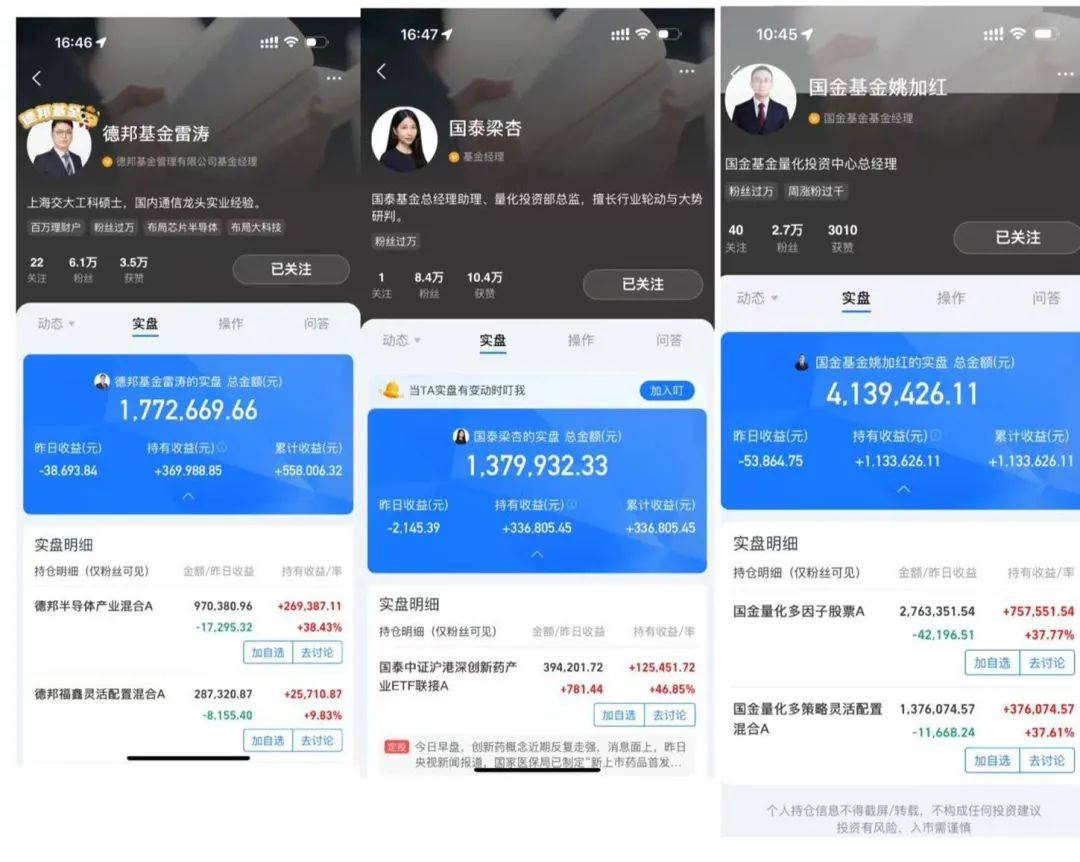
Core Viewpoint - The increasing popularity of A-shares has led many public fund managers to open real-time trading accounts on online platforms to showcase their performance [1][2]. Group 1: Fund Managers Opening Real Accounts - Numerous public fund managers, including those from Guojin Fund and Guotai Fund, have opened real accounts on platforms like Tiantian Fund and Ant Wealth [2][10]. - The total amount of these real accounts is generally high, with some exceeding 4 million yuan, such as Guojin Fund's Yao Jiahong, whose account reached 4.1394 million yuan [11]. Group 2: Performance and Investment Choices - Some fund managers have reported holding profits exceeding 1 million yuan, indicating positive returns [3][13]. - Fund managers predominantly invest in their own products or those from their fund companies, with no evidence of investing in products from other companies [8][9]. Group 3: Comparison with Retail Investors - Despite the reported profits, fund managers' returns often lag behind those of ordinary investors, with the top retail investors achieving monthly returns between 30.41% and 39.39% [16][17]. - Over the past year, no fund manager has made it to the top performance rankings, which raises questions about their short-term investment capabilities compared to retail investors [18][19]. Group 4: Implications and Industry Perspectives - The practice of fund managers opening real accounts may enhance trust and transparency with investors, especially for smaller firms or emerging managers [22][23]. - However, there are concerns that these accounts primarily serve as a marketing tool for their own products rather than providing genuine investment insights [12][21][26].
基金经理实盘收益“冷热不均”:有人投资300万赚100万,有人仍在亏损
Sou Hu Cai Jing· 2025-08-05 10:25
Core Insights - The trend of fund managers showcasing their real-time trading accounts on platforms like Ant Fund and Tian Tian Fund is gaining traction among investors, with over 20 fund managers publicly sharing their holdings and operations [2][3] - Fund manager Yao Jiahong from Guojin Fund leads with a real account amount of 4.064 million yuan, primarily investing in two quantitative funds with a total holding return of 1.058 million yuan [2][5] - Some fund managers are experiencing losses, such as Li Zhaoyu from Founder Fubon Fund, whose real account totals approximately 104,600 yuan with a cumulative loss of 1,062.77 yuan [2][8] Fund Manager Performance - As of August 5, five fund managers have real account sizes exceeding 1 million yuan, with Yao Jiahong at the forefront with 4.064 million yuan [3][5] - Yao Jiahong's holdings include approximately 2.72 million yuan in Guojin Quantitative Multi-Factor A with a return rate of 35.39% and about 1.35 million yuan in Guojin Quantitative Multi-Strategy A with a return rate of 34.84% [5] - Another fund manager, Ma Fang from Guojin Fund, has a total real account amount of 1.947 million yuan with a cumulative return of 592,000 yuan [5] Market Trends and Strategies - The A-share market has shown fluctuations, with the Shanghai Composite Index rebounding above 3,600 points, marking a new high for the year [9] - Fund managers like Cheng Xi from E Fund view recent market corrections as normal, suggesting investors should focus on long-term holdings rather than short-term volatility [10] - Investment opportunities in sectors such as technology growth, Chinese manufacturing, and new consumption are highlighted as areas of potential growth [11]