支持民营企业债券风险分担机制

Search documents
一揽子政策加码支持民间投资和居民消费——财政金融协同促内需
Jing Ji Ri Bao· 2026-01-29 22:12
Core Insights - The recent series of policies from the Ministry of Finance aims to promote domestic demand through financial collaboration, focusing on stimulating private investment and enhancing consumer spending [1][2] Group 1: Stimulating Private Investment - The new policies significantly enhance support for private investment, utilizing tools like loan interest subsidies and guarantee compensation to lower financing costs and barriers for private enterprises [2] - A new loan interest subsidy for small and micro enterprises will provide a 1.5% annual subsidy on loan principal for up to two years, with a maximum loan amount of 50 million yuan [2] - The newly established special guarantee plan for private investment aims to support loans for small and micro private enterprises with a total plan amount of 500 billion yuan over two years, covering various production and operational activities [2][3] Group 2: Enhancing Consumer Spending - The updated personal consumption loan interest subsidy policy significantly broadens its scope, allowing for a maximum subsidy of 3,000 yuan per transaction, thus encouraging larger consumer purchases [4][5] - The service industry loan interest subsidy policy has been optimized, increasing the maximum loan amount from 1 million yuan to 10 million yuan, with a 1% subsidy for one year [5] - The implementation period for both personal consumption and service industry loan interest subsidies has been extended to the end of 2026, aiming to create a favorable environment for consumption [5][6] Group 3: Policy Implementation and Effectiveness - The coordinated approach between fiscal and financial policies aims to release policy dividends more effectively, with a focus on simplifying processes and ensuring direct benefits to enterprises and consumers [6] - The government has made sufficient budget arrangements for the necessary fiscal expenditures related to these policies, encouraging local institutions to actively engage in business [6]
促内需一揽子政策:银行业的四个着力点
Guo Ji Jin Rong Bao· 2026-01-29 06:49
Core Viewpoint - The Chinese government has introduced a comprehensive set of financial policies aimed at reducing financing costs for residents and businesses, stimulating consumption, and enhancing effective investment to invigorate market activity [1] Group 1: Policy Implementation - Financial institutions are urged to accurately implement the collaborative fiscal and financial policies to lower financing costs for both enterprises and residents, enhancing their access to financing [1] - In promoting consumer spending, banks should optimize loan policies for service industry operators and personal consumption loans, effectively reducing credit costs and boosting consumer willingness [1] - Support for private investment should include the implementation of loan interest subsidies for small and micro enterprises, ensuring that fiscal investments translate into tangible benefits for businesses [1] Group 2: Credit Structure and Service Optimization - Financial institutions should adjust credit allocations to focus on key areas such as stimulating private investment and promoting consumer spending [2] - Increased lending to small and micro enterprises for long-term fixed asset loans is necessary to address previous financing gaps [2] - More credit resources should be directed towards emerging sectors like digital, green, and retail, while streamlining loan application and approval processes to enhance accessibility [2] Group 3: Collaboration and Coordination - Strengthening collaboration between fiscal departments, banks, guarantee institutions, and enterprises is essential to maximize the effectiveness of the financial policies [3] - Financial institutions should actively participate in the design and implementation of policies, particularly in providing effective risk-sharing and financing support for small and micro enterprises [2][3] Group 4: Innovation and Forward-Looking Strategies - Financial institutions are encouraged to maintain a balance between proactive planning and continuous innovation to enhance the overall synergy of the policies [3] - Developing financial products that align with equipment upgrades and consumption upgrades is crucial, alongside exploring partnerships with social capital to direct more resources to the real economy [3] - Continuous monitoring of policy implementation progress and adjusting service strategies is necessary to sustain the vitality of microeconomic entities and enhance internal economic momentum [3]
我国推出一揽子财政金融协同促内需政策
Zhong Guo Xin Wen Wang· 2026-01-21 07:14
Core Viewpoint - The Chinese Ministry of Finance and several departments have launched a comprehensive package of six fiscal and financial policies aimed at stimulating domestic demand, with a focus on supporting private investment and consumption [1][2]. Group 1: Policies Supporting Private Investment - Four policies are designed to support private investment, including a loan interest subsidy policy for small and micro enterprises, a special guarantee plan for private investment, a risk-sharing mechanism for private enterprise bonds, and an updated loan interest subsidy policy for equipment renewal [1][2]. - The new loan interest subsidy for small and micro enterprises and the optimized equipment renewal loan interest subsidy can provide a 1.5 percentage point interest subsidy on the total loan amount, significantly expanding the supported areas and loan purposes [1]. Group 2: Policies Promoting Consumption - Two policies aimed at promoting consumption include a loan interest subsidy policy for service industry operators and a personal consumption loan interest subsidy policy, which have been optimized to offer greater subsidy intensity, broader consumption areas, longer implementation periods, and wider institutional coverage [2].
一揽子政策出炉 财政金融协同发力促内需
Jin Rong Shi Bao· 2026-01-21 02:13
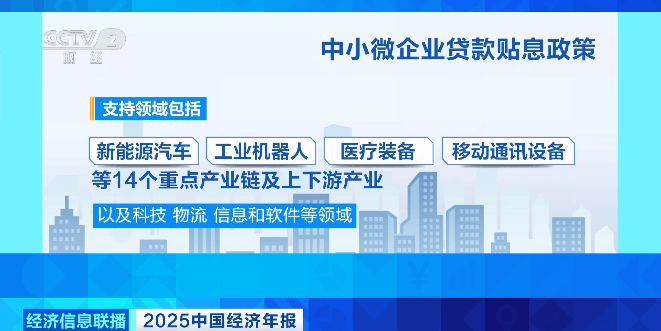
Core Viewpoint - The central government emphasizes the importance of expanding domestic demand as a stabilizing force for growth and a driving engine for high-quality development, with a focus on implementing a comprehensive set of fiscal and financial policies to boost consumption and investment [1][2]. Group 1: Fiscal and Financial Policies - The fiscal and financial policies aim to lower financing costs for residents and businesses, stimulate consumption, expand effective investment, and invigorate market vitality [1][2]. - The policies are summarized as having "one goal," "two focuses," "three principles," and "six policies," with a strong emphasis on linking these policies to bank credit activities to maximize their impact [1][2]. Group 2: Specific Policy Measures - Six key policies were introduced, with four aimed at supporting private investment and two focused on promoting consumption [2][3]. - The first policy is a loan interest subsidy for small and micro enterprises in sectors like new energy vehicles and medical equipment, providing a 1.5% subsidy for up to two years on loans capped at 50 million yuan [2]. - The second policy is a special guarantee plan for private enterprises, increasing the guarantee ratio from 20% to 40% for loans up to 20 million yuan [2]. - The third policy involves a risk-sharing mechanism for private enterprise bonds, with central government funds providing credit enhancement [2]. - The fourth policy optimizes equipment update loan subsidies, expanding the range of eligible sectors and increasing the subsidy to 1.5% for loans not exceeding two years [2]. Group 3: Consumer Support Policies - The fifth policy enhances loan interest subsidies for service industry operators, raising the loan cap from 1 million yuan to 10 million yuan, with a 1% subsidy for one year [3]. - The sixth policy optimizes personal consumption loan subsidies, allowing residents to receive a 1% subsidy on loans used for consumption, including credit card installment payments [3][7]. - The maximum subsidy for personal consumption has been increased from 500 yuan to 3,000 yuan, significantly enhancing purchasing power [7][8]. Group 4: Broader Impact and Future Outlook - The policies are designed to activate private investment and lower financing costs, addressing the challenges of high financing costs and difficulties in obtaining funds for private enterprises [5][6]. - The collaboration between fiscal and monetary policies is emphasized, aiming for a coordinated approach to stabilize growth and promote long-term high-quality development [4]. - The policies are expected to create a favorable environment for consumption, with an extended implementation period until the end of 2026 and a broader range of participating financial institutions [8].
财政部:一揽子支持政策降低企业融资成本和门槛
Sou Hu Cai Jing· 2026-01-20 14:55
Core Viewpoint - The recent fiscal and financial policies aim to stimulate private investment, with a focus on supporting small and micro enterprises through various financial incentives [1] Group 1: Policy Overview - The new policies include loan interest subsidies, special guarantees for private investment, risk-sharing mechanisms for private enterprise bonds, and optimized fiscal interest subsidies for equipment upgrades [3] - The interest subsidy for loans to small and micro private enterprises is set at 1.5% of the total loan amount, with a maximum loan limit of 50 million yuan and a subsidy period of up to 2 years [3] Group 2: Financial Impact on Enterprises - For example, a manufacturer of agricultural machinery seeking a loan of 50 million yuan can reduce interest expenses by 1.5 million yuan over two years due to the interest subsidy, enhancing the company's investment capacity [5] - The new "Special Guarantee Plan for Private Investment" aims to encourage banks to issue 500 billion yuan in loans to small and micro enterprises, addressing financing difficulties [7] Group 3: Loan Guarantee Details - Eligible small and micro private enterprises can receive support for medium to long-term loans needed for production expansion, renovation, and upgrades, with a maximum guarantee loan amount of 20 million yuan per enterprise [7] - The state can provide up to 8 million yuan in risk guarantees for a 20 million yuan loan, significantly increasing the likelihood of loan approval for enterprises with insufficient credit [9]

中国推出一揽子财政金融协同促内需政策
Sou Hu Cai Jing· 2026-01-20 13:41
Group 1 - The core viewpoint of the news is the introduction of a comprehensive set of six fiscal and financial policies aimed at stimulating domestic demand in China, with a focus on supporting private investment and consumption [1][2] Group 2 - Four policies are designed to support private investment, including interest subsidies for loans to small and micro enterprises, a special guarantee plan for private investment, a risk-sharing mechanism for private enterprise bonds, and interest subsidies for equipment upgrade loans [1] - The new interest subsidy for small and micro enterprise loans and the optimized interest subsidy for equipment upgrade loans can provide a subsidy of 1.5 percentage points on the total loan amount, significantly expanding the supported areas and loan purposes [1] - The policies aim to lower financing costs and reduce barriers for private enterprises, addressing the issues of high financing costs and difficulties in obtaining financing [1] Group 3 - Two policies are aimed at promoting consumption, which include interest subsidies for loans to service industry entities and personal consumption loans, with enhanced subsidy strength, broader consumption areas, longer implementation periods, and wider institutional coverage [2]
两部委同日重磅发声!政策靠前发力,多措并举扩内需
2 1 Shi Ji Jing Ji Bao Dao· 2026-01-20 13:30
Group 1: Economic Policy Initiatives - The Chinese government is focusing on policies to stimulate consumption, stabilize investment, and cultivate emerging industries as part of the 2026 economic strategy [1][2] - The National Development and Reform Commission (NDRC) is planning to implement significant high-tech industry projects and develop a strategy for expanding domestic demand from 2026 to 2030 [1][3] - A comprehensive package of policies was released by the Ministry of Finance, including optimizing personal consumption loan subsidies and implementing special guarantees for private investment [1][2][4] Group 2: Consumer and Investment Support - The Ministry of Finance aims to enhance consumer spending and private investment through various measures, including a 1% subsidy on personal consumption loans and expanding the scope of eligible financial institutions [4][5] - A total of 625 billion yuan has been allocated for the first phase of the "old for new" consumption support program, which has already been initiated in several provinces [3][4] - The government is also focusing on increasing the loan limits for businesses and expanding the categories of supported consumption areas to stimulate economic activity [5][8] Group 3: Focus on High-Tech Industries - The government is prioritizing investments in high-tech sectors, with the National Entrepreneurship Investment Fund set to attract over 1 trillion yuan in investments for projects in fields like quantum technology and biomedicine [10][11] - The share of high-tech manufacturing value added in industrial output has exceeded 17%, indicating a growing emphasis on innovation and technology [11][12] - Policies are being developed to support technological innovation and enhance the capabilities of small and medium-sized enterprises in high-tech sectors [12]
宏观纵览 | 财政部答一财:以更大力度激发民间投资
Sou Hu Cai Jing· 2026-01-20 11:44
Core Viewpoint - The State Council has initiated a comprehensive policy package aimed at promoting domestic demand through fiscal and financial collaboration, focusing on stimulating private investment and enhancing consumer spending [2][3]. Group 1: Policy Overview - The policy package includes six key measures: optimization of personal consumption loan interest subsidies, implementation of a special guarantee plan for private investment, and interest subsidies for loans to small and micro enterprises [2][3]. - The fiscal expenditures required for these policies have been adequately planned in the 2026 budget, allowing local and managing institutions to actively engage in business [2][3]. Group 2: Key Objectives and Principles - The primary goal is to "expand domestic demand," aligning with the central economic work conference's directives [3]. - The two main focuses are to "stimulate private investment" and "promote consumer spending," both critical components of domestic demand [3]. - The three guiding principles for execution are: 1. "Convenient and efficient" processes to simplify procedures and ensure direct benefits [3]. 2. "Precise and effective" targeting of key sectors and groups to lower financing costs and enhance consumer capacity [3]. 3. "Standardized and efficient" management to balance efficiency with regulatory compliance [3]. Group 3: Specific Policies - The six policies include four supporting private investment and two aimed at boosting consumption [3]. - The interest subsidy for loans to small and micro enterprises is set at 1.5% of the total loan amount, with a maximum loan limit of 50 million yuan and a subsidy period of up to two years [3][4]. - The special guarantee plan for private enterprises allows eligible small and micro enterprises to access loans up to 20 million yuan for various operational needs [4]. - The updated equipment loan interest subsidy policy expands the scope to include fixed asset loans related to equipment updates and technology innovation, with similar subsidy terms [4]. - The service industry loan interest subsidy policy increases the single loan limit from 1 million yuan to 10 million yuan, with a 1% subsidy for one year [5]. - The personal consumption loan interest subsidy policy now includes credit card installment payments, with a 1% subsidy for loans used for consumption [5].