
政府引导基金

Search documents
一周快讯丨200亿,澳门将设引导基金;100亿,长三角数智文化产业基金正式成立;510亿,央企战新产业发展基金招GP
FOFWEEKLY· 2026-03-01 07:20
Group 1 - The article highlights the establishment of various funds across regions such as Jiangsu, Anhui, and Sichuan, focusing on sectors like artificial intelligence, new materials, high-end manufacturing, and health care [2][3] - The Macau government announced the creation of a government-guided fund with an expected scale of 20 billion Macau dollars, with a government investment of 11 billion [5] - The Jiangsu New Energy (Guoxin) Industry Special Fund has been launched with a total scale of 5 billion yuan, targeting investment in wind energy, hydrogen energy, and new energy storage [21] Group 2 - The Central State-Owned Enterprises Strategic Emerging Industry Development Fund is seeking GP for its sub-funds, emphasizing investment in strategic emerging industries and future industries [6] - Leshan Science and Technology Innovation Group plans to establish a 10 billion yuan mother fund to support advanced manufacturing and new energy sectors [7] - The Nantong Industrial Chain Development Fund has a total scale of 5 billion yuan, focusing on key industrial clusters and strategic emerging industries [11] Group 3 - The Long Triangle Digital Cultural Industry Fund has been established with a total scale of 10 billion yuan, focusing on AI and digital cultural technology [19] - The Tianjin Binhai New Energy Storage Equity Investment Fund has been established with a capital of 2 billion yuan, focusing on private equity investment and asset management [25] - The Zhejiang University Qizhen Future Fund has been established with a scale of 1.5 billion yuan, targeting strategic emerging industries such as integrated circuits and high-end intelligent manufacturing [33]


最高允许100%亏损,这个省优化国资创投考核机制
母基金研究中心· 2025-12-22 09:22
Core Viewpoint - The article discusses the recent policy initiatives by the Sichuan Provincial Government aimed at increasing financial support for technological innovation, particularly through a more lenient loss tolerance mechanism for investment funds [2][3]. Group 1: Policy Initiatives - Sichuan's new plan allows for a maximum investment loss tolerance of 60% for government-guided and state-owned funds, which can be increased to 80% for funds investing in seed-stage companies or future industries, and up to 100% for individual projects [2]. - The policy encourages equity investment institutions to increase their investments in technology-driven enterprises and projects that focus on results transformation [2][3]. Group 2: Loss Tolerance Mechanism - The article highlights a growing trend among local state-owned assets to adopt a 100% loss tolerance for individual projects, indicating a significant shift in investment risk acceptance [3]. - This trend is seen as a positive signal for the venture capital landscape, suggesting that local state-owned assets are becoming more open to the idea of total loss in investments [3]. Group 3: Government and State-Owned Fund Management - Recent policies emphasize the need for optimizing the management and accountability mechanisms of government investment funds, including the establishment of a fault tolerance mechanism [4][5]. - The government aims to create a supportive environment for innovation by allowing for a more flexible evaluation system that does not solely rely on the performance of individual projects or annual profits [5]. Group 4: Long-term Investment Strategies - Sichuan's initiatives reflect a commitment to "patient capital," which is characterized by long-term support and a high tolerance for risk and failure, particularly in the context of technological innovation [6][7]. - The province aims to establish a significant number of private equity and venture capital management institutions by 2030, with a target fund management scale of 4 trillion yuan [8]. Group 5: Fund Duration and Investment Conditions - The article notes that many newly established funds have extended durations of 15 to 20 years, with a significant portion of new funds allowing for a longer investment horizon [9]. - Sichuan's policies also propose that the duration for sub-funds can be extended up to 15 years, demonstrating a commitment to long-term capital [10]. Group 6: Investment Return Requirements - There is a noticeable trend towards lowering the return requirements for government investment funds, with average return multiples decreasing significantly over the past six years [11][13]. - The article mentions that many local governments are increasingly flexible regarding return requirements, allowing for lower ratios and broader definitions of what constitutes a return [12]. Group 7: Future Expectations - The article anticipates that more regions will adopt similar policies to enhance the incentive and fault tolerance mechanisms for government and state-owned funds, promoting the development of long-term, patient capital [13].

中国政府引导基金行业发展形势及前景战略研究报告2026-2032年
Sou Hu Cai Jing· 2025-12-11 21:53
Group 1 - The report analyzes the current status and future prospects of China's government guidance fund industry from 2026 to 2032 [1] - It provides a comprehensive overview of the government guidance fund's concept, classification, objectives, and operational principles [3][4] - The report includes an analysis of the policy environment surrounding government guidance funds at both national and local levels [3][4] Group 2 - The report details the establishment and scale of government guidance funds, including the number of funds and their management scale [3][4] - It examines the various operational models of government guidance funds, including financing guarantee models and co-investment strategies [4][5] - The report highlights the regional distribution of government guidance funds, analyzing their quantity and scale across different provinces [5][6] Group 3 - The report investigates the investment structure of government guidance funds, focusing on sectors such as TMT, healthcare, artificial intelligence, and IoT [6][7] - It discusses the trends in investment fields based on policy direction and market conditions [7] - The report includes case studies of successful government guidance funds both domestically and internationally, providing insights into best practices [8][9] Group 4 - The report outlines the development trends and strategic recommendations for the future of government guidance funds in China [10][11] - It emphasizes the need for regulatory improvements, market-oriented operations, and a clear performance evaluation system [10][11] - The report predicts the cumulative scale of government guidance funds from 2025 to 2031, indicating significant growth potential [12][13]

今朝更好看|2025年度有限合伙人、国资、精品投行三大榜单揭晓
3 6 Ke· 2025-11-27 12:24
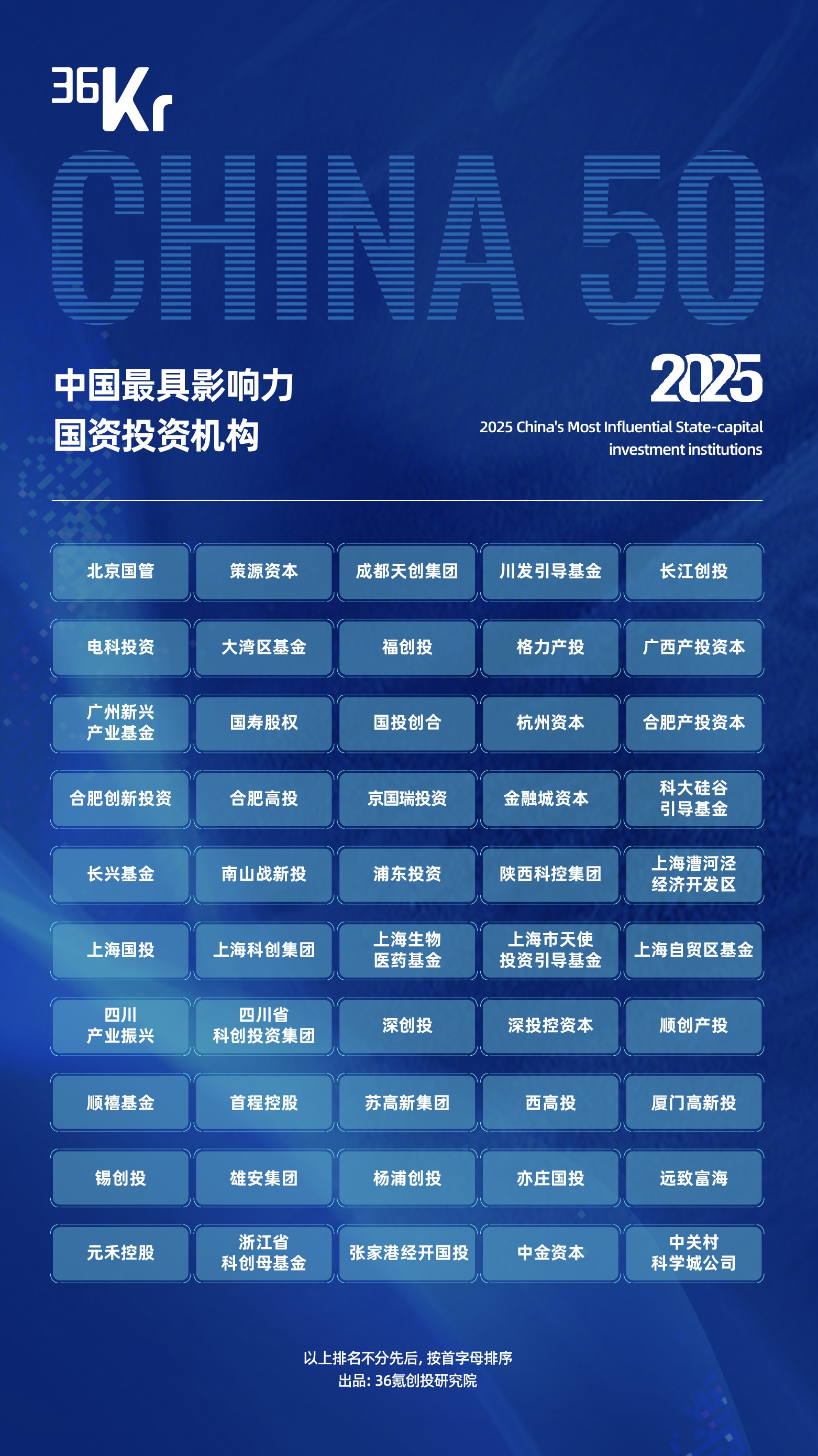
Core Insights - The Chinese primary market has undergone significant changes and challenges over the past few years, particularly in the last year, with a structural adjustment in funding sources [1] - State-owned institutions and local government guidance funds have shown stability and strategic focus, supporting key technology sectors aligned with national strategies [1] - There has been an increase in merger and acquisition activities, with private equity firms actively seeking quality assets to enhance their financial management capabilities [1] Funding Structure - The funding landscape has shifted, with state-owned institutions and local government funds taking on a dual mission of industrial upgrading and regional collaboration [1] - Diverse capital sources, including mother funds and insurance capital, are adjusting their strategies to participate in industrial transformation and promote innovation [1] Mergers and Acquisitions - There is a notable rise in M&A activities, with private equity firms like CPE Yuanfeng acquiring significant stakes in companies such as Burger King China and forming strategic partnerships with Starbucks [1] - The trend indicates a growing interest in quality assets and a focus on enhancing management through financial capital [1] Market Participants - The report highlights the establishment of influential state-owned investment institutions and lists the most notable limited partners, government guidance funds, and S funds [2] - Boutique investment banks are facing challenges and need to deepen their understanding of global trends and specific technology sectors to provide comprehensive services [2] Awards and Recognition - The report introduces awards for the most influential and growth-oriented boutique investment banks in the Chinese equity investment market, with specific categories for M&A and corporate financing [2] - The awards also recognize leaders in various technology sectors, including advanced manufacturing, artificial intelligence, and new energy [2]
地方国资开始“搭伙”设基金,利益协调与机制保障是关键
Zheng Quan Shi Bao· 2025-11-21 00:44
Core Insights - The article discusses the shift from localized government guidance funds to cross-regional collaborations among state-owned assets, aiming to enhance fund efficiency and project implementation across different regions [1][5]. Group 1: New Fund Establishment Models - Recent examples include the establishment of the Hubei Jiangcheng Huafa Industrial Investment Fund, with a total scale of 10 billion yuan, focusing on high-tech sectors such as integrated circuits and smart terminals [2]. - The collaboration between Anhui and Henan provinces aims to create a cooperative development plan, encouraging market-oriented industrial fund establishment to facilitate the transfer of industries from the eastern regions [2]. - Guangdong's cooperation with multiple provinces has resulted in the signing of seven provincial collaborative development mother funds, exceeding 17 billion yuan in total scale [2]. Group 2: Driving Forces Behind Collaboration - Three core driving forces for this new model include policy changes, similar industrial structures among neighboring regions, and the need for resource sharing [4][5]. - The "No. 1 Document" from the State Council emphasizes stricter controls on local government investment funds, prompting regions to seek collaborative funding solutions [5]. - The need to avoid homogeneous competition in industrial attraction has become critical, especially after the implementation of the "Fair Competition Review Regulations" [5]. Group 3: Benefits of Cross-Regional Fund Collaboration - Cross-regional fund collaborations can enhance industrial synergy, allowing projects to benefit from the strengths of multiple regions, thus improving overall competitiveness [6]. - This approach helps mitigate issues of repeated construction and competition by considering regional compatibility in project investments [7]. - The collaboration allows access to a broader pool of quality general partners (GPs), which is essential for attracting high-quality projects [7]. Group 4: Challenges and Coordination Mechanisms - The complexity of interest coordination and the need for a stable cooperation mechanism are significant challenges in cross-regional fund establishment [9]. - The lack of national-level coordination can complicate profit distribution among provinces, making it harder to implement collaborative funds [9]. - Differences in regional policies and standards increase the costs of collaboration, necessitating the establishment of unified standards for return investments and incentives [10].
地方国资开始“搭伙”设基金!利益协调与机制保障是关键
证券时报· 2025-11-21 00:00
Core Viewpoint - The article discusses the shift from localized government guidance funds to cross-regional collaborations among local state-owned assets, highlighting the need for resource sharing and cooperation to enhance fund efficiency and project implementation [2][5]. Group 1: Background and Current Trends - Traditionally, local government guidance funds have a strong localization bias, requiring funds to be registered and projects to be implemented locally, leading to issues like repeated investments and intensified competition among similar industries [1][6]. - Recently, there has been a surge in cases of local government guidance funds collaborating across provinces, indicating a move towards cooperative models that can better serve regional needs and contribute to a unified national market [2][3]. Group 2: Case Studies - A notable example is the establishment of the Hubei Jiangcheng Huafa Industrial Investment Fund, with a total scale of 10 billion yuan, focusing on hard technology sectors such as integrated circuits and optical communications [3]. - Additionally, the collaboration between Anhui and Henan provinces aims to enhance cooperation in industrial development and attract investments through market-oriented fund establishment [3]. - Guangdong's collaboration with multiple provinces has resulted in the signing of seven provincial collaborative development mother funds, exceeding 17 billion yuan in total scale [3]. Group 3: Driving Forces Behind the New Model - Three core driving forces for this new model include: 1. Policy changes that restrict local governments from independently establishing investment funds, prompting a need for collaboration [6][8]. 2. The necessity to avoid homogeneous competition among geographically adjacent regions, especially after the implementation of the Fair Competition Review Regulations [6][7]. 3. The opportunity to access a broader pool of quality general partners (GPs) by collaborating across regions, enhancing the attractiveness of local markets [8]. Group 4: Challenges and Coordination Mechanisms - Despite the potential benefits, cross-regional collaborations face significant challenges, particularly in coordinating interests and ensuring effective profit-sharing mechanisms [10][11]. - The lack of unified standards and policies across regions increases the complexity of collaboration, necessitating the establishment of stable cooperation mechanisms and efficient coordination among local governments [11]. - Suggestions for overcoming these challenges include forming integrated mother fund alliances and establishing standardized return investment criteria based on industry contributions [11].

告别美国模式幻想:是时候提出“中国式股权创投基金”理论了
Sou Hu Cai Jing· 2025-10-18 01:28
Core Insights - The current private equity market in China is predominantly driven by state-owned limited partners (LPs), which account for 84% of the market, reflecting the government's role in economic development [1][2][5] - The government-led model has become deeply ingrained in local leadership, with officials prioritizing industrial development as a key responsibility [2][5] - The role of government venture capital has been recognized as essential in supporting startups affected by the US-China trade war, indicating a unique "Chinese model" of private equity and venture capital [3][5] Group 1: Market Dynamics - The dominance of state-owned LPs is a manifestation of China's economic development model, which relies heavily on local government initiatives [2][5] - The shift from traditional fiscal support to government-guided funds represents a significant optimization in funding models for industrial development [5][6] - The private equity market in China is characterized by a focus on policy-driven investments rather than purely market-driven decisions [5][6] Group 2: Investment Strategies - The current investment model in China resembles a "quick turnover" approach, similar to real estate, where high valuations are pursued for rapid exits [7][8] - There is a need for a transformation in the investment approach, advocating for reasonable valuations and mechanisms like "earn-out" to align interests between investors and entrepreneurs [8] - The establishment of a dedicated bad asset management company could help address the challenges of exit difficulties in the private equity market [8][9] Group 3: Future Directions - The proposal to create a stock exchange in Macau aims to provide an alternative listing venue for companies that do not meet Hong Kong's stringent requirements, enhancing market accessibility [9][10] - Emphasizing the importance of international capital markets, the need for regulatory flexibility in overseas listings is highlighted to support the growth of private equity [10] - A new framework for observing the private equity and venture capital industry in China is necessary to address the real issues and find effective solutions [10]
上海又迎来一个千亿母子基金群
母基金研究中心· 2025-10-13 09:10
Group 1 - The core viewpoint of the article highlights the establishment of a significant investment fund matrix in Minhang District, Shanghai, aiming to create a "100 billion fund, 1 trillion scale" ecosystem through strategic partnerships and social capital involvement [2][3] - The four major fund categories include strategic investment funds, new quality navigation funds, future industry funds, and industrial investment funds, designed to support the entire lifecycle of enterprise growth [2] - The Minhang District's financial policies focus on future investments, technology empowerment, inclusive finance, and regional services, encouraging equity investment institutions to invest in local tech enterprises [2] Group 2 - The establishment of the "100 billion fund, 1 trillion scale" fund cluster is seen as a vital boost for the mother fund industry, which has experienced a significant decline in new fund setups and scales in 2025 [3] - In recent developments, Shanghai has been active in the mother fund and venture capital sectors, with the establishment of the Jing'an Capital Investment Operation Co., which has a registered capital of 12 billion yuan [4] - The Shanghai government has initiated measures to optimize the equity investment environment, supporting the creation of equity investment clusters across various districts [4][5] Group 3 - The Shanghai Future Industry Fund has successfully expanded its scale from 10 billion to 15 billion yuan, actively participating in investments across cutting-edge fields such as brain science and synthetic biology [7] - The Shanghai government has implemented a series of supportive policies for the equity investment industry, including the establishment of district-level guiding funds of no less than 10 billion yuan [5][6] - The Shanghai municipal government has also launched significant initiatives to enhance the development of venture capital and private equity, with a focus on mergers and acquisitions [11][12] Group 4 - The article emphasizes Shanghai's leading position in the mother fund industry, with over 40 mother funds and a total managed scale ranking among the top five in the country [12][13] - Recent policies have been introduced to support the establishment of large-scale S funds, promoting a capital relay mechanism for the cultivation of the sci-tech industry [15] - The Shanghai government is committed to creating a favorable environment for private equity funds, enhancing the attractiveness of the region for investment institutions [14][15]

上海又一个超级LP来了
FOFWEEKLY· 2025-10-10 10:08
Core Viewpoint - The establishment of Shanghai Jing'an Capital Investment Operation Co., Ltd. aims to create a significant investment matrix through a model of "government-guided funds + direct investment + market-oriented" operations, focusing on strategic emerging industries and future industries [2][3]. Group 1: Company Establishment and Objectives - Shanghai Jing'an Capital has a registered capital of 12 billion yuan and will integrate state-owned capital fund operations to enhance investment in key sectors such as artificial intelligence, big data, cultural creativity, and life health [3][4]. - The company will focus on early-stage investments and the cultivation of new industries, aiming to create a full lifecycle industrial ecosystem and enhance the value of state-owned listed companies through strategic holdings and market value management [3][4]. Group 2: Strategic Partnerships and Collaborations - Jing'an Capital has signed cooperation agreements with eight fund companies, including Daohe High-tech Fund and Blockchain Fund, to strengthen its investment capabilities [4]. - The partnership with Shanghai Guotou Company aims to deepen cooperation and create a fund matrix that supports technology enterprises throughout their lifecycle [5]. Group 3: Policy Support and Industry Development - Shanghai's government has issued policies to promote the innovation and development of the intelligent computing cloud industry, targeting a scale of 200 billion yuan by 2027 [6]. - The city is actively supporting the software and information service industry with financial incentives, including rewards for companies reaching specific revenue milestones [6]. Group 4: Capital Flow and Market Dynamics - The capital layout in Shanghai's AI sector is becoming more sophisticated, with a comprehensive capital matrix established to support innovation from seed funding to corporate venture capital [8]. - The establishment of Jing'an Capital further enhances the national capital investment system in Shanghai, promoting a more systematic approach to state-owned capital investment [9].

青岛发布基金发展行动方案 推动经济高质量发展
Zhong Guo Jing Ji Wang· 2025-09-26 05:53
Core Viewpoint - The Qingdao government has launched an action plan to enhance venture capital and private equity investment, aiming for high-quality economic development from 2025 to 2027 [1][2] Group 1: Action Plan Details - The action plan includes "three focuses": integrating government-guided funds, leveraging state-owned enterprises, and deepening the transformation of fiscal funds into investments [1] - It also outlines "five empowering actions": enabling investment attraction, industry cultivation, resource support, quality improvement, and resource aggregation [1] - Specific targets set for 2027 include a government-guided fund investment scale of 150 billion yuan, state-owned enterprise fund scale exceeding 100 billion yuan, and venture capital investment in Qingdao projects surpassing 100 billion yuan [1] Group 2: Industry Impact - The action plan reflects Qingdao's strong emphasis on the development of venture capital and private equity, aiming to create a favorable ecosystem for fund development [2] - It seeks to address industry challenges such as fundraising difficulties and exit issues by establishing a comprehensive policy support system covering the entire investment lifecycle [2] - The plan is expected to inject financial momentum into Qingdao's economic high-quality development by aligning funds with the real economy [2]