教育课程

Search documents
港股收评:市场传闻扰动!科技股巨震,黄金股强势反弹
Ge Long Hui· 2026-02-03 08:53
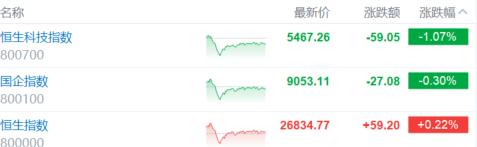
Market Overview - Technology stocks experienced a significant decline, impacting major indices, with the Hang Seng Index closing up 0.22% after a drop of 1.3% during the day [1] - The Hang Seng Tech Index fell by 1.07%, having previously dropped by 3.4% [1][2] Sector Performance - Large technology stocks mostly turned negative, while gold stocks led a rebound in the metals sector [2] - Heavy machinery stocks continued to rise, and airline stocks showed strength [2] - Mobile gaming stocks faced the largest declines, with AI application concept stocks, lithium battery stocks, and certain financial and automotive stocks also underperforming [2][4] Specific Stock Movements - Major tech stocks like Tencent Holdings and Baidu Group saw declines of 2.92% and 3.61% respectively, with Tencent's market cap at 5.3 trillion [5] - Mobile gaming stocks such as Duolingo and Tencent faced significant drops, with Duolingo down over 6% [5][6] - Gold and precious metals stocks rebounded, with companies like WanGuo Gold Group rising over 13% [6][7] Investment Insights - The education sector showed positive momentum, with companies like Yinxing Education and New Oriental seeing gains of over 8% and 6% respectively, driven by policy improvements and the integration of AI in education [7][8] - Steel stocks also performed well, with Asia Pacific Resources rising over 10% [9] Capital Flows - Net inflows from southbound funds amounted to 9.52 billion HKD, indicating strong interest in Hong Kong stocks [10] Future Outlook - Analysts suggest that the current global dollar cycle is peaking, with a favorable revaluation window for Chinese equity assets, recommending a focus on manufacturing core assets and sectors benefiting from currency appreciation [11]


莫让盗版灰产阻碍教育创新
Jing Ji Ri Bao· 2025-12-20 22:04
Group 1 - The report indicates that 79% of copyright infringement issues in the education sector are related to audio and video courses, with vocational education and higher education institutions being the most affected [1] - A complete industrial chain has formed around online gray production, involving resource theft, recording, and sales on various platforms, making infringement more concealed and difficult to prove [1] - The prevalence of low-cost pirated courses is squeezing the development of legitimate educational content, which could hinder the healthy development of the educational content ecosystem and ultimately obstruct educational innovation [1] Group 2 - Strengthening regulatory enforcement and increasing the cost of violations is essential, with punitive damages becoming a norm rather than an exception in judicial practice [2] - There is a need for cross-regional law enforcement collaboration to effectively combat illegal activities in the gray market, addressing the challenges posed by its virtual and cross-border nature [2] - Promoting public awareness that supporting legitimate resources is crucial for the future of quality education, while companies should explore legitimate resource channels and consider tiered pricing for some resources [2]
Perdoceo Education (PRDO) - 2025 Q3 - Earnings Call Transcript
2025-11-04 23:02
Financial Data and Key Metrics Changes - The company reported net income of $39.9 million, or $0.60 per diluted share, with adjusted earnings per diluted share at $0.65 compared to $0.59 in the prior year [6][12] - Revenue for the third quarter was $211.9 million, representing a 24.8% increase from $169.8 million in the prior year [12] - Adjusted operating income grew by 27.4% to $61 million compared to $47.8 million during the prior year [12] Business Line Data and Key Metrics Changes - Total student enrollments grew 15.1% year-over-year, driven by a 6.7% increase at CTU and the acquisition of St. Augustine [7][12] - CTU's revenue was $117.1 million, a 4.3% increase from the prior year, while operating income increased 6.7% to $47.8 million [15] - AIU system's revenue remained flat at $56.7 million, but operating income increased due to lower operating expenses [15][16] - St. Augustine recorded third quarter revenue of $38 million, with adjusted operating income expected to grow in 2026 [16] Market Data and Key Metrics Changes - The corporate student programs at CTU and AIU continue to see increasing enrollments, which remain a priority for the company [9] - New student enrollments at St. Augustine increased, particularly in nursing and speech-language pathology programs [14] Company Strategy and Development Direction - The company is focused on enhancing academic outcomes and student experiences through investments in technology and support processes [10][24] - There is a commitment to returning capital to shareholders, with $94.1 million returned through share repurchases and dividends in the first three quarters of 2025 [10][21] - The company plans to continue expanding corporate student program teams to support further growth and engagement [24] Management's Comments on Operating Environment and Future Outlook - Management expressed optimism for 2026, expecting continued growth in student retention and engagement [11][22] - The company anticipates revenue and total student enrollments to increase in the fourth quarter and for the full year 2025 [15][23] - Adjusted operating income outlook for the full year 2025 is updated to a range between $234 million and $236 million [21][22] Other Important Information - The effective tax rate for the year-to-date period was 26.2%, with expectations for the full year to be between 26% and 26.5% [17] - The company ended the third quarter with $668.6 million in cash and equivalents, an increase of approximately $77.1 million from the year-end position [18] Q&A Session Summary - No specific questions or answers were documented in the provided content, thus this section is not applicable.

在硅谷,我见过教育如何被算法改写
Hu Xiu· 2025-10-16 13:38
Core Insights - Education is evolving into a product that can be iterated upon, with a focus on quantification and efficiency in teaching methods [1][2][3] Group 1: Education as a Product - In Silicon Valley, education is treated like a product, with structured processes for course design, testing, and feedback [5][7] - Courses are developed in a systematic manner, akin to product launches, where every aspect is measurable and optimized [8][9] - The role of educators is shifting, with students being viewed as participants in a project rather than traditional learners [9][10] Group 2: The Collapse of Standard Answers - The traditional notion of education is challenged, as students are encouraged to think critically rather than seek singular correct answers [16][20] - The experience of learning is framed as a complex cultural issue rather than a straightforward personal choice [17][25] - The educational system often imposes a singular path, which can stifle creativity and critical thinking [21][22] Group 3: High Barriers in Education - The education sector is facing significant challenges, as seen during the upheaval in 2021 that affected many educational consulting firms [26][28] - The importance of emotional safety in education is highlighted, emphasizing that true learning occurs in a supportive environment [35][36] - The perception of educators as infallible can hinder their ability to connect with students and foster a safe learning space [37][39] Group 4: The Centrality of Human Presence - The significance of human interaction in education is underscored, with technology serving as a tool rather than a replacement for personal engagement [40][50] - The role of educators is to create environments where students feel seen and understood, which is essential for effective learning [39][67] - The future of education relies on educators who are willing to recognize and nurture the human aspects of learning [68]

全场景维权实操手册:从消费、教育到房产,小白也能上手
Xin Lang Cai Jing· 2025-10-13 08:25
Core Viewpoint - The article emphasizes the importance of effective consumer rights protection through proper channel selection, evidence preservation, and logical progression in various common dispute scenarios, enabling ordinary individuals to resolve issues efficiently. Group 1: Consumer Disputes - Consumer disputes are prevalent and include scenarios like online shopping, food delivery, and offline purchases, with a focus on quickly engaging merchants and utilizing official channels for resolution [2][3]. - For online shopping issues such as "goods not as described" or "false advertising," initiating a complaint through the Black Cat Complaint platform is recommended, with a high resolution rate for simple disputes [3]. - In offline shopping, retaining proof such as receipts and product labels is crucial, and consumers can directly contact the 12315 hotline for assistance [4]. Group 2: Education Disputes - Education-related disputes often involve issues like "prepaid fees and refunds" and "false advertising of course effectiveness," requiring evidence collection and regulatory checks [5]. - If an educational institution closes or refuses refunds, consumers should first document evidence through Black Cat Complaints and then contact the 12391 education supervision hotline for further action [6]. - For poor course quality, initial negotiation with the institution is advised, followed by a complaint if necessary, with evidence of discrepancies in course quality being critical [7]. Group 3: Key Questions in Rights Protection - Consumers should never agree to withdraw complaints in exchange for refunds, as this can lead to complications in the resolution process [8]. - For cross-regional disputes, it is essential to select the appropriate channels based on the merchant's location to ensure effective intervention [10]. - If a complaint has been pending for over ten days, consumers should check the status and follow up with relevant authorities to expedite the process [10]. Group 4: Evidence Preservation and Progress Tracking - Evidence should be categorized into three core types: proving relationships, proving issues, and proving communication, which aids in the complaint process [12][14]. - Consumers should actively track the progress of their complaints through various platforms, ensuring they are aware of the status and any necessary follow-ups [13][15]. Group 5: Common Pitfalls in Rights Protection - Consumers are encouraged to pursue even small claims, as this can lead to broader improvements in merchant practices and provide valuable experience for future disputes [16]. - Effective communication during disputes should focus on clear expression of facts, demands, and supporting evidence rather than emotional arguments [17]. - The essence of effective rights protection lies in rational and orderly approaches, utilizing the right channels, preserving evidence, and following a structured process [18].
Universal Technical's Q2 Earnings Beat Estimates, FY25 View Up
ZACKS· 2025-05-08 14:55
Core Insights - Universal Technical Institute, Inc. (UTI) reported strong second-quarter fiscal 2025 results, with stock gaining 11.4% in after-hours trading due to earnings and revenues surpassing estimates and showing year-over-year growth [1][2] Financial Performance - Adjusted earnings per share (EPS) reached 21 cents, exceeding the consensus estimate of 12 cents by 75% and increasing from 14 cents in the prior year [4] - Quarterly revenues amounted to $207.4 million, surpassing the consensus mark of $197 million by 3.8% and reflecting a 12.6% increase from the previous year [4] - New student starts totaled 6,650, up 21.4% from 5,480 students a year ago, while average full-time active students increased 10.3% to 24,604 [5] Segment Performance - UTI segment revenues rose 8.8% to $134.2 million, supported by a 26.4% increase in new student starts [6] - Concorde segment revenues reached $73.2 million, up 20.3% year over year, with new student starts increasing by 19.6% [7] Operational Highlights - Adjusted EBITDA was $28.9 million, up 27.8% from $22.6 million a year ago, with adjusted EBITDA margins growing 160 basis points to 13.9% [5] - The company is advancing its North Star strategy, announcing nine new programs for 2025 and plans to open three campuses in 2026 [3] Guidance and Future Outlook - UTI raised its fiscal 2025 guidance, expecting new student starts in the range of 29,000-30,000, up from the previous estimate of 28,500-29,500 [10] - Anticipated revenues are now projected to be between $825-$835 million, an increase from the prior estimate of $810-$820 million [10] - Estimated net income is expected to be in the range of $56-$60 million, up from the previous estimate of $54-$58 million [11]