
新兴市场主权债

Search documents
国泰海通|固收:核心-卫星框架下的EM主权债投资——可落地的2026海外债策略债券年报
国泰海通证券研究· 2025-12-19 11:51
Core Viewpoint - The overseas bond market in 2026 is expected to exhibit a pattern of "interest rate decline and credit differentiation within a moderate easing cycle," with emerging market sovereign debt presenting a significant allocation window [1] Group 1: Economic Environment - Global central banks are entering a differentiated easing cycle, with developed economies experiencing a slowdown in growth, while emerging markets maintain a medium to high growth rate of 5-7% driven by supply chain restructuring and manufacturing spillover [1] - Overall inflation in emerging markets has decreased from 5.2% to 4.0%-4.3%, falling faster than in developed economies, creating space for monetary policy easing [1] - The US dollar index, after a 15-year strong cycle, is expected to enter a phase of moderate decline in 2026, leading to a significant alleviation of global liquidity pressure and a trend of funds flowing back into emerging market assets [1] Group 2: Investment Opportunities in Emerging Market Sovereign Debt - Emerging market sovereign debt benefits from three key allocation advantages: 1. The debt environment has improved significantly, with no new sovereign defaults since the end of 2023, a continuous decline in corporate default rates, and government leverage ratios significantly lower than those of developed economies, leading to a relatively lighter debt sustainability pressure and upgrades in credit ratings for multiple countries [2] 2. There is a notable yield advantage, with the 10-year government bond yields of major emerging economies rising over 360 basis points, placing them at high levels since the global financial crisis, offering significantly higher nominal and real yields compared to US and European bonds, highlighting strong carry value [2] 3. Geopolitical restructuring and industrial chain spillover are creating structural growth momentum, with countries like ASEAN, India, and Mexico leveraging labor, location, and policy advantages to attract "capacity transfer" from outside China, resulting in a positive cycle of export expansion, accelerated FDI inflows, and alleviated fiscal pressures, thereby improving sovereign credit [2] Group 3: Investment Strategy - A "core-satellite" allocation framework is recommended, where core positions consist of investment-grade or near-investment-grade hard currency sovereign debt, complemented by medium to long-term structures to benefit from the decline in US Treasury rates and the compression of sovereign credit spreads, providing stable income sources [3] - Satellite positions should include high-yield sovereign debt (BB, single B ratings) and local currency bonds, which can achieve stronger total returns under improved risk appetite, a declining dollar, or stabilizing fundamentals in emerging markets, with a steeper convergence of spreads [3] - Duration allocation can be adjusted based on the Federal Reserve's interest rate cut path and market volatility, with a focus on countries in Latin America and Asia-Pacific that have stable fundamentals and are at the early stages of a rate-cutting cycle [3] - Policy-wise, the expansion of southbound trading to include brokerages, funds, insurance, and wealth management institutions, along with a shift in RMB internationalization from "cautious advancement" to "promotion," provides institutional convenience for domestic investors' global allocation [3]


可落地的2026海外债策略:核心-卫星框架下的EM主权债投资
国泰海通· 2025-12-19 06:53
Group 1 - The report indicates that the overseas bond market in 2026 will exhibit a pattern of "interest rate decline and credit differentiation within a moderately easing cycle," presenting a significant allocation window for emerging market sovereign bonds [3] - Emerging markets are expected to maintain a medium to high growth rate of 5-7%, driven by supply chain restructuring and manufacturing spillover, contrasting with the slowing growth momentum in developed economies [3][24] - The overall inflation in emerging markets is projected to decline from 5.2% to a range of 4.0% to 4.3%, creating space for monetary policy easing [3] Group 2 - Emerging market sovereign bonds offer three key allocation benefits: improved debt environment, significant yield advantage, and structural growth momentum from geopolitical reshaping and industrial chain spillover [4] - The debt environment has improved significantly, with no new sovereign defaults since the end of 2023, and many countries receiving credit rating upgrades [4] - Emerging market sovereign bonds have seen a cumulative rise of over 360 basis points in 10-year government bond yields, providing significantly higher nominal and real yields compared to US and European bonds [4] Group 3 - The report recommends a "core-satellite" allocation framework, with core positions in investment-grade or near-investment-grade hard currency sovereign bonds, complemented by medium to long-term structures [5] - Satellite positions should include high-yield sovereign bonds and local currency bonds, which can achieve stronger total returns under favorable conditions [5] - Duration allocation can be adjusted based on the Federal Reserve's interest rate path and market volatility, focusing on countries in Latin America and Asia-Pacific with stable fundamentals [5] Group 4 - In 2025, emerging market bonds outperformed developed markets, with Latin America and Asia leading the gains, driven by high yield attractiveness, improved growth expectations, and a weaker dollar [11] - The report highlights that sovereign credit rating adjustments in 2025 created structural opportunities, with frequent rating changes reflecting the evolving macroeconomic landscape [19] - The report emphasizes that the overall credit environment for emerging markets has improved, with a significant reduction in risk premiums and a favorable external financial environment [44] Group 5 - The report outlines that the global economic growth trend is characterized by "weakened resilience but structural differentiation," with emerging markets becoming the main contributors to global growth [24] - Developed economies are expected to experience a slowdown in growth rates, while emerging markets like India, Vietnam, and Indonesia maintain robust growth [24] - The inflation trend is expected to stabilize globally, with emerging markets showing a faster decline in inflation rates compared to developed economies [27] Group 6 - The report anticipates a downward shift in global interest rates, with the U.S. experiencing a gradual decline in nominal rates, while European bonds are expected to see a clearer downward trend [36] - Emerging market local currency bonds are projected to benefit from both declining interest rates and stable exchange rates, potentially outperforming developed market bonds [36] - The report notes that the credit environment in emerging markets is improving, with a significant reduction in sovereign default risks and a favorable outlook for credit ratings [44] Group 7 - The report discusses the potential for increased demand for emerging market sovereign bonds due to a weakening dollar, which historically correlates with improved relative performance of emerging market assets [50] - The geopolitical reshaping and industrial chain spillover are expected to benefit countries like ASEAN, India, and Mexico, enhancing their manufacturing and export capabilities [52] - The report highlights that the structural improvements in emerging markets' macroeconomic fundamentals are likely to continue, providing a favorable environment for sovereign credit improvement [52] Group 8 - The report indicates that the Southbound Bond Connect has seen significant institutional expansion, allowing for greater participation from non-bank financial institutions [66] - The rapid growth of the Southbound Bond Connect market is evidenced by a substantial increase in the number of bonds and total custody scale [68] - The report suggests that the participation of long-term institutional investors will enhance the demand for offshore RMB bonds and support the internationalization of the RMB [73]

美联储或9月降息,全球大类资产迎流动性红利?
Sou Hu Cai Jing· 2025-09-10 08:39
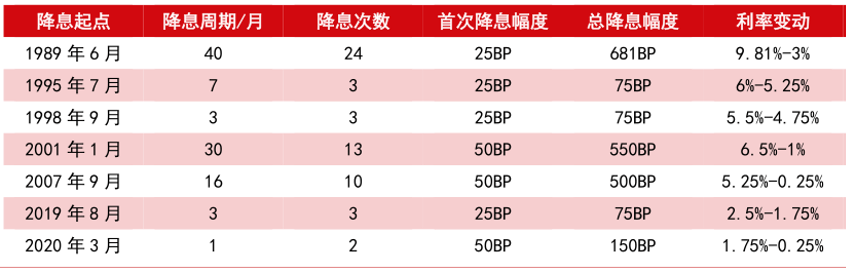
Core Viewpoint - The article discusses the potential for a shift in global asset classes due to the Federal Reserve's dovish stance and rising expectations for a rate cut in September, following a significant decline in U.S. employment data [1][5]. Historical Review: Federal Reserve Rate Cut Cycles - The article categorizes past Federal Reserve rate cut cycles into three scenarios: 1. **Preventive Rate Cuts** (1995-1996, 2019): Small and gradual cuts aimed at softening potential economic slowdowns [2]. 2. **Recessionary Rate Cuts** (2001-2004, 2007-2008): Large and rapid cuts in response to economic recessions or financial crises [3]. 3. **Crisis Response Rate Cuts** (1987, 1998): Quick measures taken to stabilize market sentiment during specific risk events [4]. Asset Performance During Rate Cut Cycles - **Equities**: Rate cuts typically boost risk appetite, leading to stock market gains. For instance, after the 2019 rate cut, the S&P 500 index rose nearly 10% over the following year [5][6]. - **Bonds**: The bond market often reacts first to rate cuts, with U.S. Treasury yields generally declining. Historically, 10-year Treasury yields have dropped by an average of 80-100 basis points during rate cut cycles [7]. - **Gold**: Gold tends to perform well during rate cut cycles due to lower holding costs and increased demand for safe-haven assets. Since 1990, gold has shown an 83% success rate in the 10 trading days following rate cuts [8][9]. Market Outlook and Strategy - The article suggests that if the Federal Reserve cuts rates, it may lead to a narrowing of the China-U.S. interest rate differential, potentially easing depreciation pressure on the RMB and allowing for more accommodative domestic monetary policy [7]. - It emphasizes the importance of maintaining diversified and flexible asset allocations to navigate market uncertainties, regardless of the rate cut outcome [10][11].
美银:看好欧洲高收益债、中国股市及黄金,建议减持美国科技股
Ge Long Hui A P P· 2025-09-04 02:02
Core Viewpoint - The report from Bank of America highlights significant divergence in asset performance this year, with gold leading precious metals, a resurgence in the Chinese stock market, and U.S. equities at high levels but nearing bubble warning signs [1] Investment Strategy - Bank of America recommends a "three increases and two decreases" risk-averse investment strategy, suggesting investors increase holdings in European high-yield bonds and emerging market sovereign debt, which are expected to benefit from a shift towards looser monetary policy [1] - The report expresses optimism about the Chinese stock market, citing attractive valuations and a gradual inflow of capital [1] - Gold is identified as a key asset for hedging against geopolitical risks and potential depreciation of the U.S. dollar [1] Asset Recommendations - The report advises reducing exposure to U.S. technology stocks, particularly the "big tech" companies, due to their high valuations and associated risks [1] - Additionally, the outlook for the oil market is negative, with the report indicating that the supply-demand imbalance is unlikely to improve in the short term [1]