旅游出行

Search documents
CPI专题报告:服务消费CPI能否重启上行?
Zhong Guo Yin He Zheng Quan· 2026-02-13 00:45
Investment Rating - The report maintains a positive investment rating for the service CPI sector [2] Core Insights - The service consumption CPI is expected to restart its upward trend, driven by stronger performance compared to overall consumption [7] - The demand for service consumption is resilient, particularly in sectors like tourism and entertainment, which are currently in a phase where prices are more likely to rise than fall [15] - The report highlights the importance of government policies aimed at boosting consumption, including various initiatives to enhance service quality and expand domestic demand [12] Summary by Sections 1. Overview of Service CPI - Service consumption CPI is performing better than overall consumption CPI, indicating a potential for price increases in the service sector [7] 2. Price Increases in Service Sectors - Hotel prices are expected to show elasticity due to supply-demand convergence and anti-monopoly measures [7] - The restaurant sector's ability to pass on costs to consumers is under observation, with Western fast food and tea drinks showing relative advantages [7] 3. Investment Recommendations - The report suggests focusing on sectors with strong demand resilience and potential for price increases, particularly in tourism and hospitality [7] 4. Policy Support - Various government policies are outlined, including actions to stimulate consumption and improve service quality, which are expected to support the service sector's growth [12]
2026十大研判
2026-01-05 15:42
Summary of Key Points from the Conference Call Industry and Company Overview - The discussion centers around the Chinese economy and stock market, particularly focusing on the year 2026 as a pivotal point for China's return to prosperity, drawing parallels with historical trends in the United States and Japan during their industrialization phases [2][5][6]. Core Insights and Arguments 1. **Economic Recovery and Growth**: 2026 is anticipated to mark the beginning of China's return to prosperity, driven by a per capita GDP exceeding $10,000, which signifies a mature industrial phase. This is expected to enhance manufacturing export capabilities and improve domestic consumption [2][5][6]. 2. **Impact of U.S. Federal Reserve Policies**: The Federal Reserve's potential interest rate cuts and quantitative easing (QE) are expected to increase global liquidity, facilitating the return of cross-border capital to China, which will support the appreciation of the Renminbi and aid in the recovery of the balance sheets of the real economy [2][4][7]. 3. **Commodity Supercycle**: A supercycle for commodities began in April 2025, driven by abundant global liquidity. The focus should initially be on PPI manufacturing sectors, followed by CPI consumer sectors as monetary policies are implemented [2][8][14]. 4. **Technology Sector Outlook**: The technology sector remains a strong investment theme, with a focus on humanoid robots, AI applications, and new consumption trends. A dynamic scoring model is suggested for adjusting investment strategies in this sector [2][9][17][18]. 5. **Industry Configuration Recommendations**: Suggested sectors for investment include: - **Non-ferrous Metals**: Gold, silver, and copper, benefiting from global liquidity [2][10][19]. - **New and Consumer Sectors**: Food and beverage, tourism, and travel, which are expected to see growth due to improved consumer sentiment [2][10][19]. - **High-end Manufacturing**: Including power equipment, chemicals, home appliances, and pharmaceuticals, which are projected to have strong growth potential [2][10][19]. Additional Important Insights 1. **Renminbi Exchange Rate Trends**: The Renminbi is expected to enter a medium to long-term appreciation cycle, supported by an increase in the current account surplus due to rising export levels. This trend is anticipated to be reinforced by the return of previously exited capital [2][12]. 2. **Manufacturing Sector Resilience**: China's manufacturing sector is expected to be re-evaluated positively, benefiting from improved cash flows and competitive advantages in exports, particularly during the Renminbi appreciation phase [2][13]. 3. **Cyclical Industry Dynamics**: The cyclical industries are expected to experience a transition from a bear to a bull market, driven by improved cash flows and consumer sentiment as national wealth returns [2][16]. 4. **Market Performance Context**: Despite a global bull market since 2020, the A-share market faced challenges from 2022 to 2024 due to capital outflows caused by U.S. interest rate hikes. However, the outlook for 2026 is optimistic, with expectations of new highs in market indices [2][10][11]. This comprehensive analysis highlights the anticipated economic recovery in China, the implications of U.S. monetary policy, and the strategic sectors for investment as the market evolves towards 2026.
2026年元旦旅游出行数据点评:元旦开门红,出游迎增长
Dongguan Securities· 2026-01-05 09:45
Investment Rating - The industry investment rating is "Overweight" (maintained) [1] Core Insights - The 2026 New Year's Day holiday saw 142 million domestic trips in China, with total spending reaching 84.789 billion yuan, marking a 5.2% increase in trips and a 6.3% increase in spending compared to the same period in 2024 [2][5] - The "Please take 3 days off" strategy has become popular, allowing for an extended 8-day holiday, which has significantly boosted travel demand [2] - Young consumers, particularly those born after 2000, are driving a trend towards experiential and self-rewarding travel during the New Year, with notable increases in bookings for concerts and themed events [3] Summary by Sections Travel Demand and Spending - During the 2026 New Year's holiday, domestic travel reached 142 million trips, with total expenditure of 84.789 billion yuan, reflecting a 5.2% and 6.3% increase from 2024 respectively [2] - The average price for domestic economy class tickets reached 684.6 yuan, a 9.8% increase from the previous year [2] Consumer Trends - The report highlights a significant participation of younger generations in travel, with 39% of travelers being from the post-2000 generation and 33% from the post-1990 generation [3] - Concerts and events have become key attractions, with cities like Harbin and Zhuji seeing substantial increases in travel bookings due to major events [3] International Travel - There has been a notable increase in outbound travel bookings, with overall interest rising by over 30% compared to previous years [4] - South Korea remains the top international destination, while travel to Japan has seen a significant decline of 40.5% [4] Investment Recommendations - The report suggests focusing on popular travel destinations such as Changbai Mountain, Emei Mountain, and Tianmu Lake, as well as companies providing unique regional experiences like Songcheng Performance [5] - Companies benefiting from the recovery of inbound and outbound travel, such as China Duty Free Group, are also highlighted as potential investment opportunities [5]
国家统计局:2024年全国旅游及相关产业增加值占GDP比重为4.35%
智通财经网· 2025-12-30 07:14
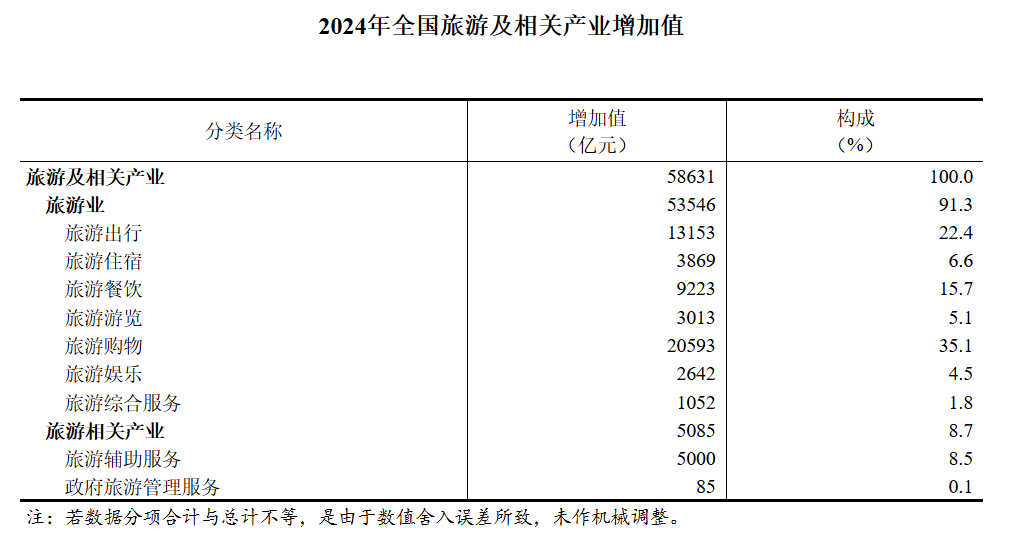
Core Insights - The total value added of the national tourism and related industries in 2024 is 58,631 billion yuan, accounting for 4.35% of the GDP, an increase of 0.11 percentage points from the previous year [1][3] Industry Composition - The value added by the tourism industry is 53,546 billion yuan, representing 91.3% of the total value added in tourism and related industries, which is an increase of 0.3 percentage points from the previous year [1][3] - The value added by tourism-related industries is 5,085 billion yuan, accounting for 8.7% of the total, which is a decrease of 0.3 percentage points from the previous year [1][3] Detailed Breakdown of Tourism Industry - The breakdown of the tourism industry includes: - Tourism travel: 13,153 billion yuan (22.4%) - Tourism accommodation: 3,869 billion yuan (6.6%) - Tourism dining: 9,223 billion yuan (15.7%) - Tourism sightseeing: 3,013 billion yuan (5.1%) - Tourism shopping: 20,593 billion yuan (35.1%) - Tourism entertainment: 2,642 billion yuan (4.5%) - Tourism comprehensive services: 1,052 billion yuan (1.8%) [3] Related Services - The value added by tourism auxiliary services is 5,000 billion yuan (8.5%) - The value added by government tourism management services is 85 billion yuan (0.1%) [3]

2024年全国旅游及相关产业增加值占GDP比重为4.35% - 国家统计局
Guo Jia Tong Ji Ju· 2025-12-30 01:37
Core Insights - The total value added of the national tourism and related industries in 2024 is projected to be 58,631 billion yuan, accounting for 4.35% of the GDP, an increase of 0.11 percentage points from the previous year [1] - The value added from the tourism sector is estimated at 53,546 billion yuan, representing 91.3% of the total value added in tourism and related industries, which is an increase of 0.3 percentage points year-on-year [1] - The value added from tourism-related industries is expected to be 5,085 billion yuan, making up 8.7% of the total, which is a decrease of 0.3 percentage points compared to the previous year [1] Industry Composition - The tourism sector's value added is broken down as follows: - Tourism travel: 13,153 billion yuan (22.4%) - Tourism accommodation: 3,869 billion yuan (6.6%) - Tourism dining: 9,223 billion yuan (15.7%) - Tourism sightseeing: 3,013 billion yuan (5.1%) - Tourism shopping: 20,593 billion yuan (35.1%) - Tourism entertainment: 2,642 billion yuan (4.5%) - Tourism comprehensive services: 1,052 billion yuan (1.8%) [3] - The tourism-related industries include: - Tourism auxiliary services: 5,000 billion yuan - Government tourism management services: 85 million yuan [3][4] Statistical Classification - The classification of value added in tourism and related industries is based on the "National Statistical Classification of Tourism and Related Industries (2018)" issued by the National Bureau of Statistics, which is derived from the "National Economic Industry Classification" [8] - The first-level classification includes nine categories: tourism travel, tourism accommodation, tourism dining, tourism sightseeing, tourism shopping, tourism entertainment, tourism comprehensive services, tourism auxiliary services, and government tourism management services [8]
扩大服务消费!商务部等9部门发文
Sou Hu Cai Jing· 2025-09-17 02:16
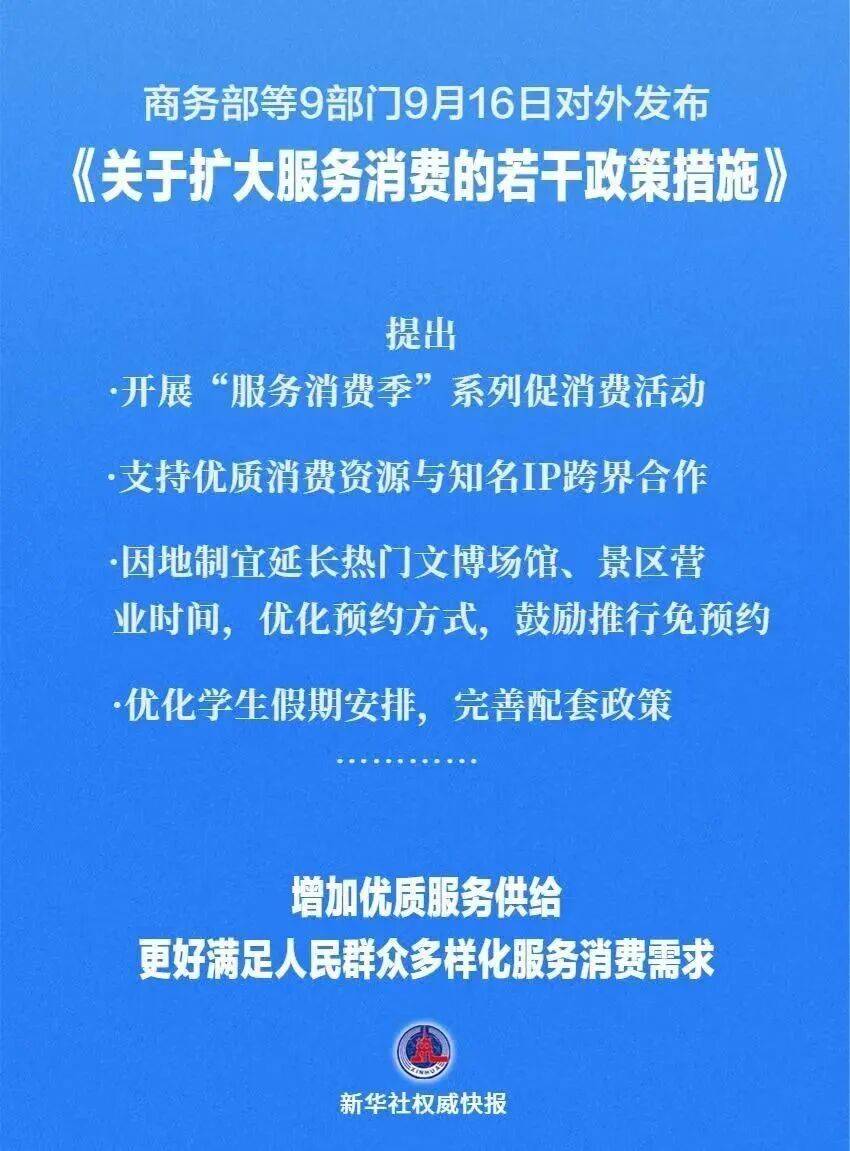
Core Viewpoint - The Ministry of Commerce and nine other departments released policies on September 16 to expand service consumption through 19 measures across five areas [3] Group 1: Service Consumption Enhancement - Implementation of a quality improvement action for service consumption, continuing to deepen the "Buy in China" brand, and launching a series of promotional activities for "Service Consumption Season" [4] - Development of pilot cities for new business formats, models, and scenarios in consumption [4] - Promotion of the "first release economy" and support for innovative and diverse service consumption scenarios, including collaborations between quality consumption resources and well-known IPs [4] Group 2: Opening Up the Service Sector - Expansion of high-level openness in the service industry, with orderly opening in internet, culture, telecommunications, medical, and educational sectors [4] - Inclusion of more service consumption areas in the "Encouraged Foreign Investment Industry Catalog" to provide differentiated service supply [4] Group 3: Optimizing Consumer Experience - Extension of operating hours for popular cultural and tourist venues, optimization of reservation methods, and encouragement of no-reservation policies [4] - Support for the introduction of high-quality foreign sports events and local mass sports events, aiming to create well-known boutique events and professional leagues [4] Group 4: Educational Policy Adjustments - Optimization of student holiday arrangements while maintaining the total number of holiday days and teaching hours, encouraging local adaptations based on climate and production schedules [5] - Exploration of setting up spring and autumn breaks in primary and secondary schools, with a corresponding reduction in winter and summer vacation durations to increase service consumption time for tourism [5]